
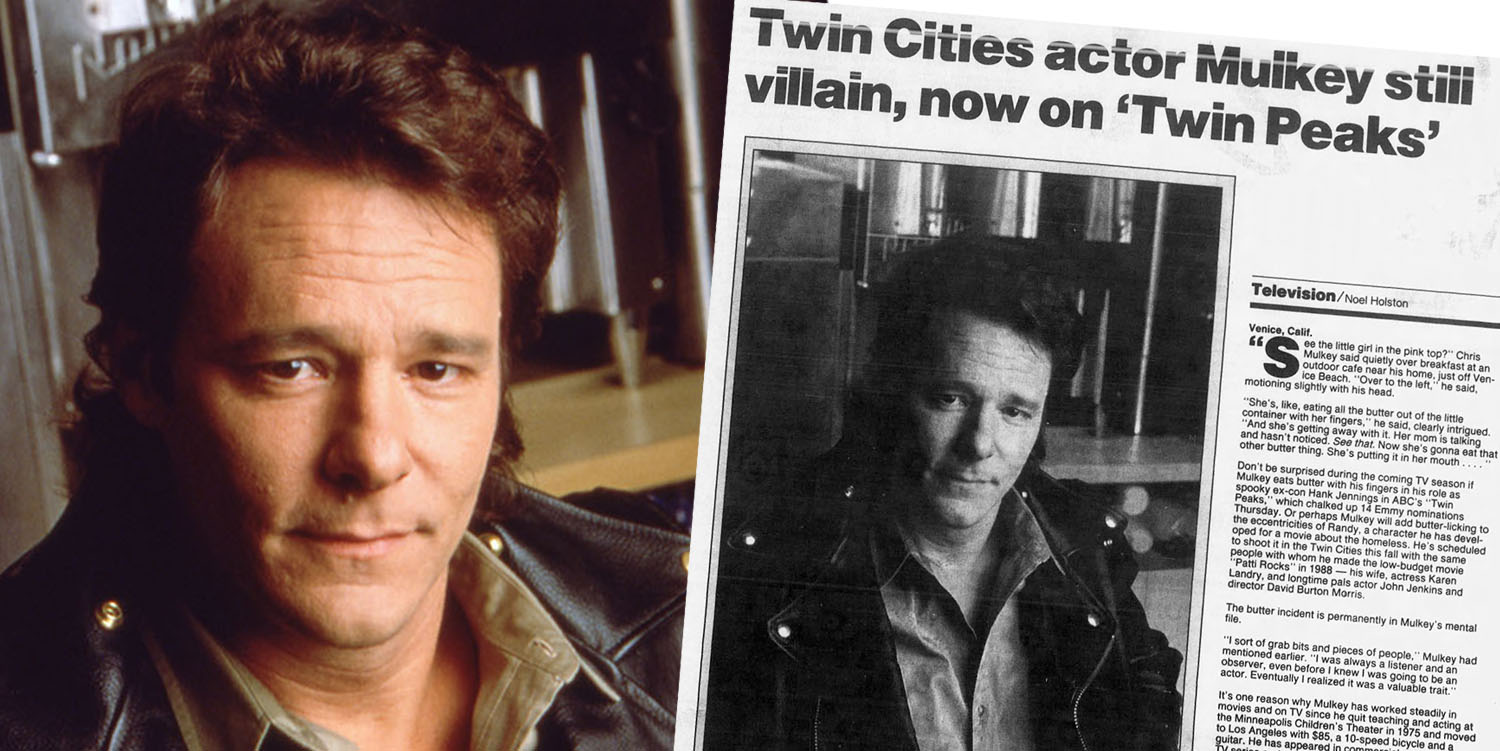
My favorite things to find while researching Mark Frost and David Lynch’s Twin Peaks are early interviews from cast and crew members, especially from the 1990s. The stories shared are more fresh and contain interesting nuggets and details. This time, I found Noel Holston’s spotlight on former Twin Cities resident Chris Mulkey who played Hank Jennings during the show’s first two seasons. His article was published in The Star Tribune on August 5, 1990 just as ABC Television began a summer rebroadcast of Frost and Lynch’s groundbreaking series.
WHO IS NOEL HOLSTON?

Mississippi native Noel Holston was the Minneapolis Star Tribune’s television and radio critic from 1986 through 2001. He’s written more than 4 million words about pop culture, TV and music for a number of publications including The Orlando Sentinel, New York Newsday. Holston’s profiles and features have appeared in more than 100 papers including the Los Angeles Times, the Chicago Tribune, The Washington Postand New York Daily News
In 2006, he became the public relations director and principal writer for Peabody Awards program at the University of Georgia. Retired now, he lives in Athens, Ga., with his wife, singer-actress Marty Winkler.
Noel has published two memoirs, “Life After Deaf,” which recounts his sudden and full hearing loss in 2010, and “As I Die Laughing,” a collection of stories and sketches that illuminates his “free range” childhood in the 1950s and ’60s. His features and commentary appear regularly on Substack as The Grassy Noel.
TWIN CITIES ACTOR CHRIS MULKEY PROFILE FROM AUGUST 5, 1990
Then Minneapolis Star Tribune report Noel Holston spoke with Chris Mulkey in Venice, California during summer 1990. Chris still lives in Venice today where he occasionally plays music at local venues. You can follow his music at ChrisMulkeyMusic.com.
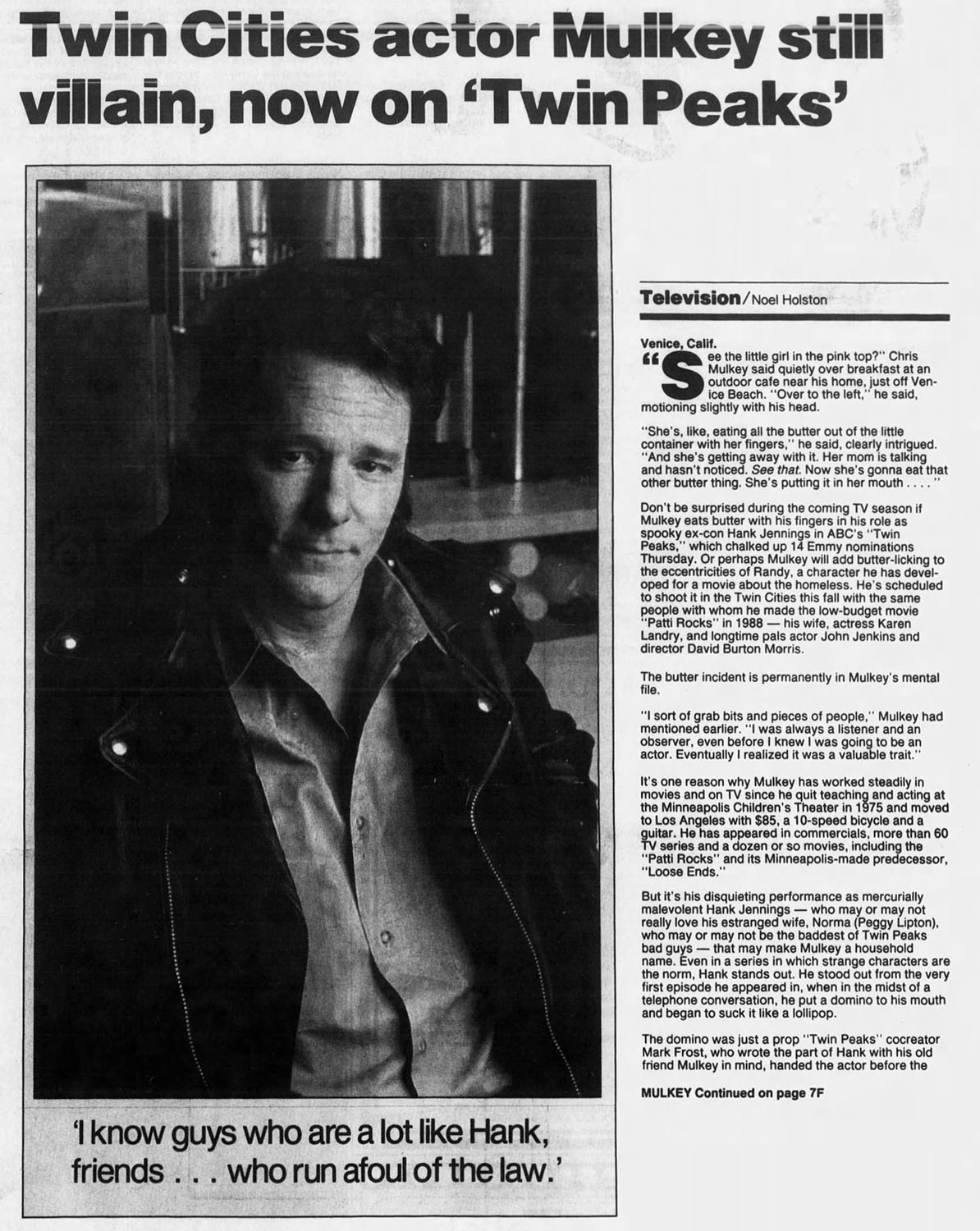
Twin Cities actor Mulkey still villain, now on “Twin Peaks’
See the little girl in the pink top?” Chris Mulkey said quietly over breaktast at an outdoor cafe near his home, just off Venice Beach. “Over to the left.’
he said, motioning slightly with his head.
“She’s, like, eating all the butter out of the little container with her fingers,” he said, clearly intrigued.
“And she’s getting away with it. Her mom is talking and hasn’t noticed. See that. Now she’s gonna eat that other butter thing. She’s putting it in her mouth…
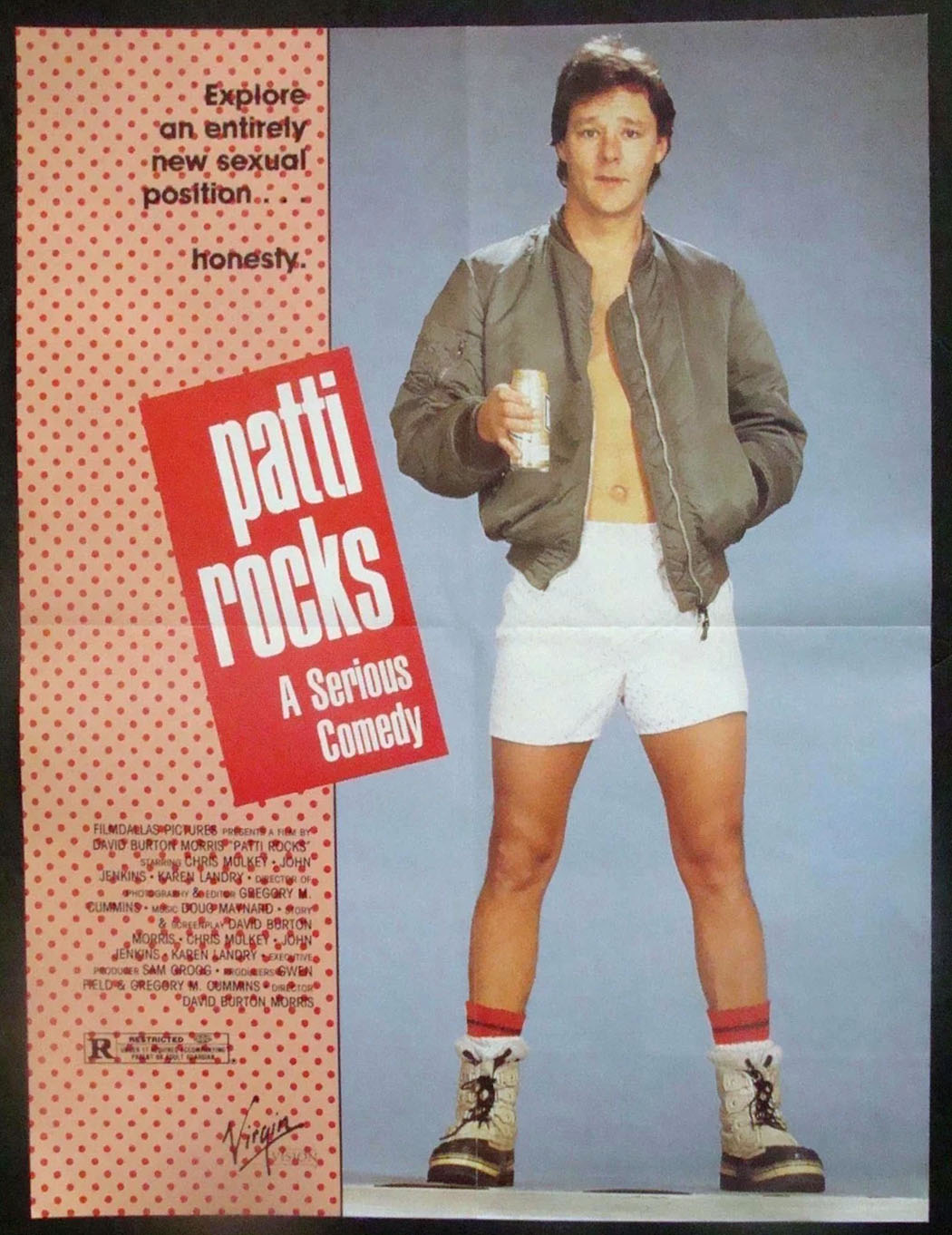
Don’t be surprised during the coming TV season if Mulkey eats butter with his fingers in his role as spooky ex-con Hank Jennings in ABC’s “Twin Peaks,” which chalked up 14 Emmy nominations Thursday. Or perhaps Mulkey will add butter-licking to the eccentricities of Randy, a character he has developed for a movie about the homeless. He’s scheduled to shoot it in the Twin Cities this fall with the same people with whom he made the low-budget movie ‘Patti Rocks” in 1988 – his wife, actress Karen Landry, and longtime pals actor John Jenkins and director David Burton Morris.
The butter incident is permanently in Mulkey’s mental file.
“I sort of grab bits and pieces of people,” Mulkey had mentioned earlier. “I was always a listener and an observer, even before i knew I was going to be an actor. Eventually I realized it was a valuable trait.”
It’s one reason why Mulkey has worked steadily in movies and on TV since he quit teaching and acting at the Minneapolis Children’s Theater in 1975 and moved to Los Angeles with $85, a 10-speed bicycle and a guitar. He has appeared in commercials, more than 60 TV series and a dozen or so movies, including the “Patti Rocks” and its Minneapolis-made predecessor, “Loose Ends.”

But it’s his disquieting performance as mercurially malevolent Hank Jennings – who may or may not really love his estranged wife, Norma (Peggy Lipton). who may or may not be the baddest of Twin Peaks bad guys – that may make Mulkey a household name. Even in a series in which strange characters are the norm, Hank stands out. He stood out from the very first episode he appeared in, when in the midst of a telephone conversation, he put a domino to his mouth and began to suck it like a lollipop. The domino was just a prop “Twin Peaks” co-creator Mark Frost, who wrote the part of Hank with his old friend Mulkey in mind, handed the actor before the scene. Mulkey was improvising with the domino, but Hank’s other mannerisms are based on observation.
“I know guys who are a lot like Hank, friends of mine who run afoul of the law:’ Mulkey said. In particular, he said, a guy named Ed whom he met when he worked with a San Quentin theater group. He calls Ed the “aggressively sincere” type.
“I really think Hank is a sincere guy,” he said. “When he says he really loves or feels this, I think he means it. Looking at the scripts, my gosh, it’s like 180 degrees every scene. But I never play it with anything except heartfelt reality. I act it like it’s for keeps.”
Mulkey is 42 and, in the series, he looks 42. In person, in shorts and a T-shirt and black high-top sneakers, he seems years younger, mischievously boyish. all loose limbs and basketball player’s bounce, even though on this day he’s limp-ing from an ankle turned in a pickup game. “It’s a choice,” he said of his Twin Peaks character, noting that he normally has “a lot of body go-ing all the time. That’s the younger me. I play a lower range (as Hank). I give you less body, more stillness.”
Mulkey’s youth sounds like that of an Army brat, although his father, in fact, operated a string of hardware stores. Born near La Crosse, Wis., he lived in Washington state, Iowa and Georgia before his family settled in St. Paul when he was in the seventh grade. He attended Cretin High School, where he was on the wrestling team (“Probably the only reason I stayed in school,” he said).
Mulkey tells tales of summer jobs laying track for the railroad in North Dakota and Montana, and of hopping a freight train in Dinkytown and riding out to Seattle stowed away in a carload of new pickup trucks. He even considered becoming a switchman by trade, but eventually decided to stick with acting.
By his account, he was “a little bit of a rebellious kid. I was probably not the guy you’d want to have at your house for a party, ’cause I’d probably bring about 20 friends, and we’d all have on the same color jackets.
“We had this ‘fraternity’ when I was in high school,” he said with a laugh.
“We were in the same gang actually,” said director Morris. “We went to rival military schools. I was at SPA when he was at Cretin, and we met, oh, sometime in our sophomore year and we got into the same street gang in St. Paul and ran around together.”
Street gang? “In those days, it was a little bit different,” Morris qualified. “There was some fighting and stuff going on, but we weren’t protecting turf and running coke and shooting each other with guns.
“We have a lot of friends that just didn’t make it, you know what I mean?” Morris said. “They’re dead or in jail or just, you know, flakes. I think because he and I knew what we wanted to do, and a lot of our peers didn’t, we sort of avoided a lot of the pitfalls of that whole period we grew up in in the late ’60s.”

After high school, Morris went to UCLA film school and Mulkey studied theater at the University of Minnesota, where his teachers included Warren Frost, who is Mark Frost’s father and is now a “Twin Peaks” regular. In 1970, after a short, unsatisfying stint in the theater program at Boston University, Mulkey returned to the Twin Cities, where he auditioned for a part in a play that Peter Michael Goetz, later of the Guthrie Theatre, was producing at Children’s Theater. During that time, fellow actor John Jenkins asked Mulkey to substitute-teach an acting class for him. Mulkey wound up on the staff as a teacher and actor, appearing in such plays as “The School for Scandal,” in which he played Snake, “Madeline and the Gypsys,” “The Cookie Jar” and “The Suitcase,” a play by Children’s Theater director John Clark Donahue that was subsequently filmed.
“Chris was heavily involved in producing that film,” recalled Children’s Theater actor Gerry Drake, who worked with Mulkey. “He had tremendous ambition, I always felt. He got the cameraman. He got the director. He got the editor, who was David Morris. And then they went off to make movies together.
“I think the interesting thing about film for Chris is that it can get inside,” Drake said. “You know how the camera can go into you? There’s something about that. In a way, it’s somehow a gentler art, as opposed to presenting something on the stage. It’s more of a sense of being something.”
Of his decision to leave the Children’s Theater in 1975, Mulkey said he came to feel he wasn’t being properly used. He laughed. “I guess I got tired of wearing the wolf suit.”
The wolf suit? “Yeah, I was the wolf for like three or four years straight — the wolf in ‘Peter and the Wolf.’ “
In Los Angeles, Mulkey shed the wolf suit but not the image. For most of his career, he has been cast as a villain although, aside from the fact that he’s big (6-foot-2, 190 pounds), he’s not sure why. “Just like there are more roles out here for women than for men,” he theorized, “there are more roles for bad guys and menacing types than for heroes. I mean, look how many bad guys Schwarzenegger goes through in a movie. They need volume.”
The big difference now, he joked, is that instead of being the young bad guy, taking orders, he’s the older bad guy, giving orders to young punks (like slimy truck driver Leo in “Twin Peaks”). He also sees what he’s getting to do in the series as a sign of progress. “I’m finally getting to act with women,” he said, referring to his scenes with Lipton and Joan Chen.
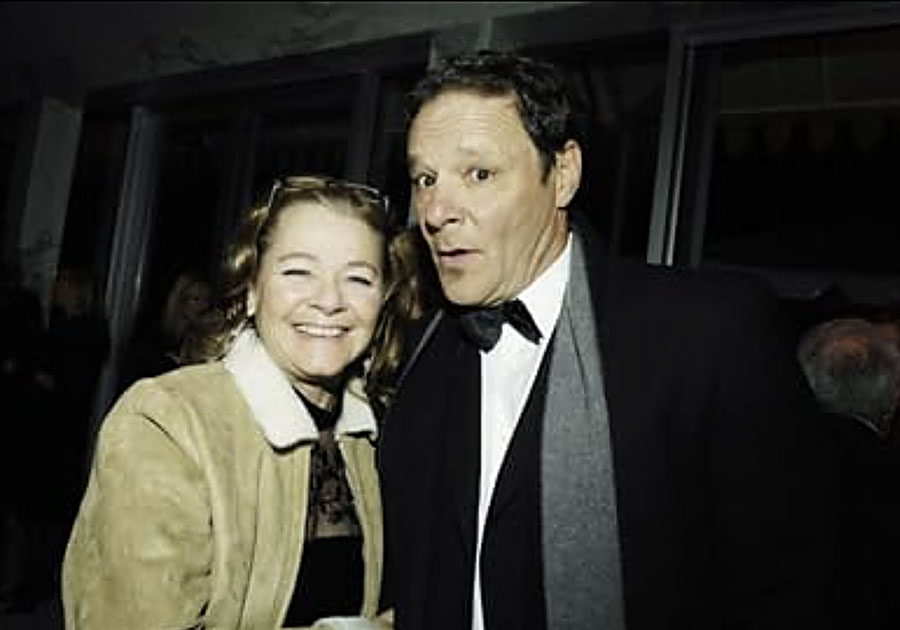
Although Mulkey talks about hang-ing out with the guys — Tim Busfield of “thirtysomething” is one of his closest pals – and plays guitar in a “hobby” rock band, he seems to have left the fast lane behind. He talks even more enthusiastically about going to the soccer games of his two daughters with Landry, Amelia, 8 1/2, and Elizabeth, 6. Their skateboards and toys spill off the front porch and into the front lawn of the tile-roofed, Mediterranean-style house in Venice he and Karen recently remodeled. To anyone but a visiting Minnesotan, the wooden loon by the doorbell would probably look strangely out of place.
He met Landry at a party at David Morris’ house in Los Angeles in 1980 and, though he “flipped” for her, lost track of her when she went to Denver to do a play. Five months later, he learned from a friend that Landry, fed up with Hollywood, had decided to return for a while to the Guthrie, where she’d worked three seasons in the mid-’70s after graduating from the University of Minnesota, and then try her luck in New York. “I drove with her to Minneapolis, and on the way we fell in love,” he said. “It was the most wonderful thing in the world.”
After she did “A Streetcar Named Desire” at the Guthrie, they returned to Los Angeles and got married the next year.
Mulkey and Landry will be back in the Twin Cities in October, when “Twin Peaks” is on hiatus, to make another low-budget film, “Randy, the Urban Aboriginal,” in collaboration with Morris and Jenkins, now an acting teacher at DePaul University in Chicago. “We’re gonna get some letters on this one, I’ll tell ya,” said Mulkey, noting that the movie, a satirical, mock documentary, is a contemporary twist on “A Modest Proposal,” in which Jonathan Swift suggested that the Irish poor could alleviate poverty and hunger by raising children for food.
The movie, Mulkey said, will strike a darkly comic blow at society’s tendency to treat the homeless as if they aren’t human. Randy, a character he developed by following homeless people around, “is one of those in-your-face guys on the street, more of a vagabond than the homeless. He’s one of those guys who comes right up to you and says, ‘Can you spell ‘donation?’ ” In the script, another collaboration by the “Patti Rocks” gang, a German documentarian (Jenkins) and an American social scientist (Landry) make Randy their subject, then find they can’t make him go away.
Although making movies over which he has control is Mulkey’s main goal, he said he’s having a ball doing “Twin Peaks,” which is “different from any series I’ve ever worked on. It’s more like doing a feature film.”
He said he watched the first season shows religiously, even though he’s not much of a TV watcher, sports and news aside, and doesn’t much like watching himself on screen. “It makes me yell at the screen: ‘Oh my God, what?’ I mean, I know the scripts. I know what’s coming up, but it flips me out. The angles and the way it looks, it just flips me out.”
Frost was understandably hesitant about saying much about what’s going to happen to Mulkey’s character on “Twin Peaks” this fall, but he said Hank is “definitely in the ascendancy” in his importance to the ever-twisting story line. Mulkey, who has seen the first several scripts, concurred. “I know what goes on up to script four now, and I have such interesting stuff to do. I was reading and I just started laughing. Its really good stuff, the way (FBI agent) Cooper and all these guys develop.”
He stopped himself from getting too carried away. “I keep wanting to talk about the stuff we’re gonna do, but . . . .”
He flashed one of his mischievous grins, and headed down to Venice Beach, where there are more eccentrics than Twin Peaks and the people-watching opportunities are peerless.
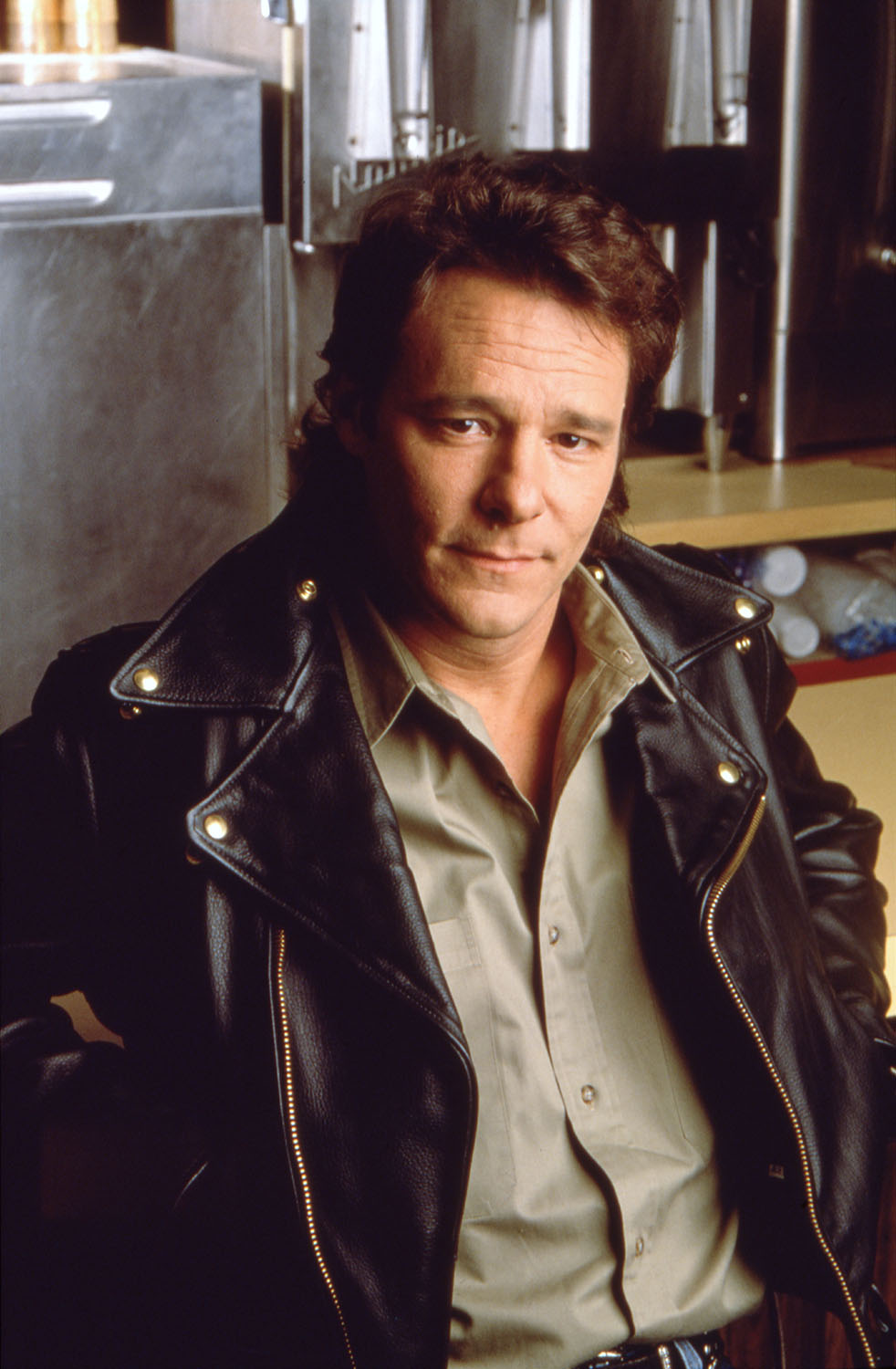
The photo of Mulkey as Hank Jennings was taken by long-time ABC Television Network photographer Craig Sjodin. Jennings is seen sitting on the Double R Diner set.

This publicity image comes from a photo slide produced in 1990. It’s labeled, “Chris Mulkey / “Twin Peaks,” and has the copyright – 1990 Craig Sjodin / Capital Cities / ABC. Sjodin worked for ABC and later The Walt Disney Company for 39 as a still photographer. He passed on September 15, 2023 as a result of injuries sustained from a bicycling accident.
Author

Discover more from TWIN PEAKS BLOG
Subscribe to get the latest posts sent to your email.