
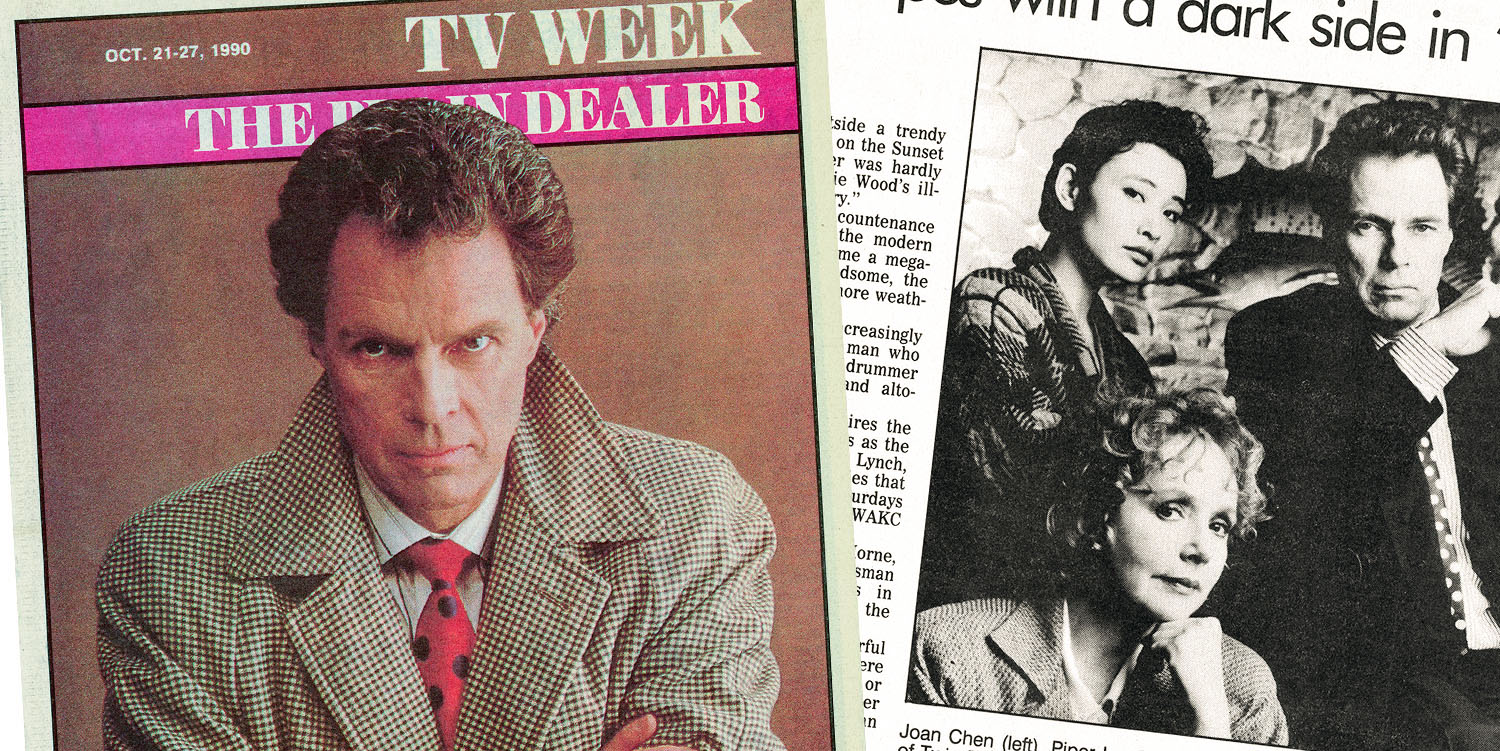
I am continuously amazed that some people had the forethought to save newspaper clippings from when Twin Peaks first aired on the ABC Television Network in 1990. I recently acquired a rather pristine copy of “TV Week” from October 21-27, 1990 included in Cleveland’s The Plain Dealer. The cover featured a stunning photo of Richard Beymer as Benjamin Horne while the accompanying syndicated story by Stephanie DuBois offered insight about Beymer’s career.
RICHARD BEYMER IN THE PLAIN DEALER’S TV WEEK, OCT. 21-27, 1990 | COVER
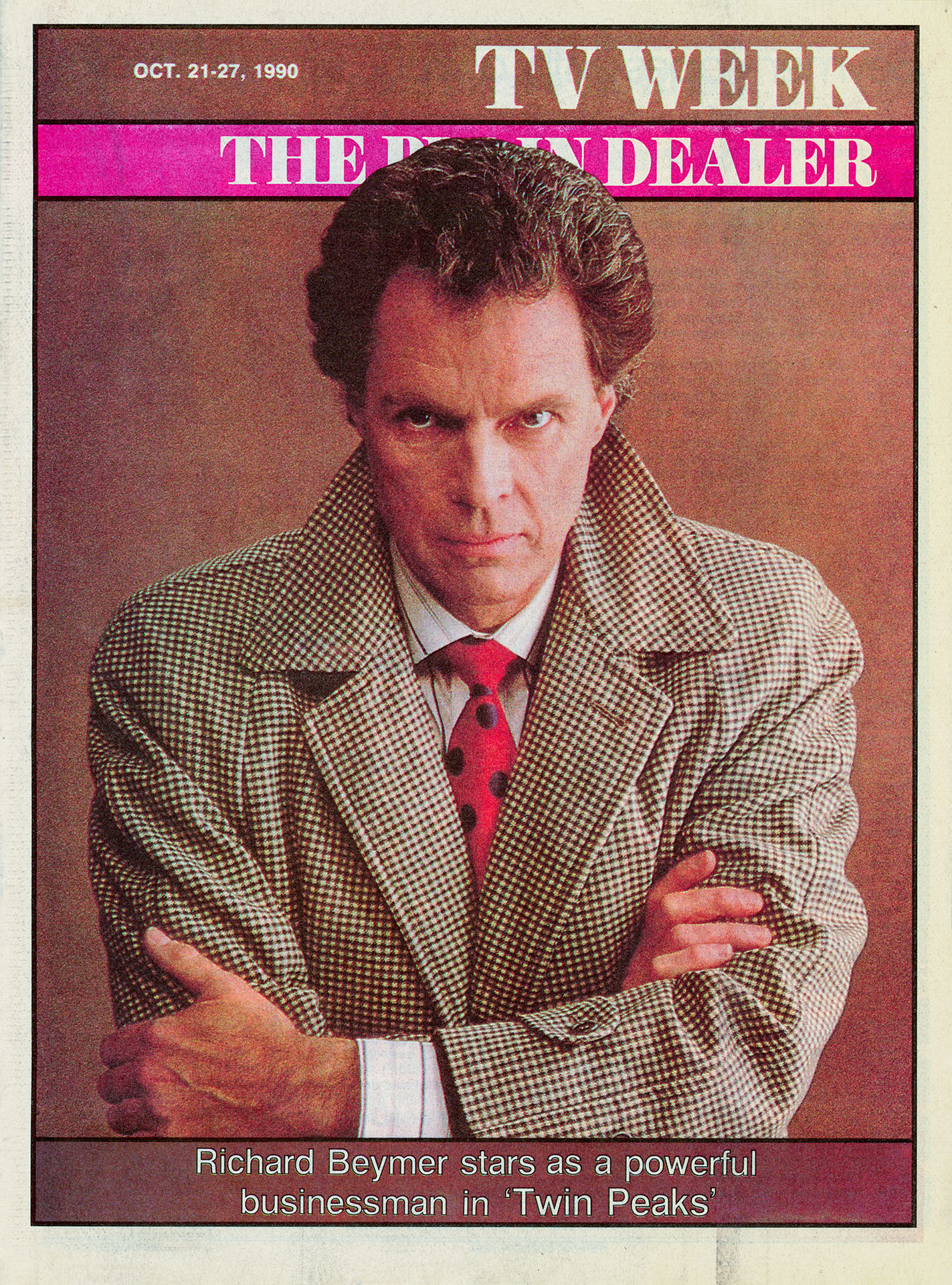
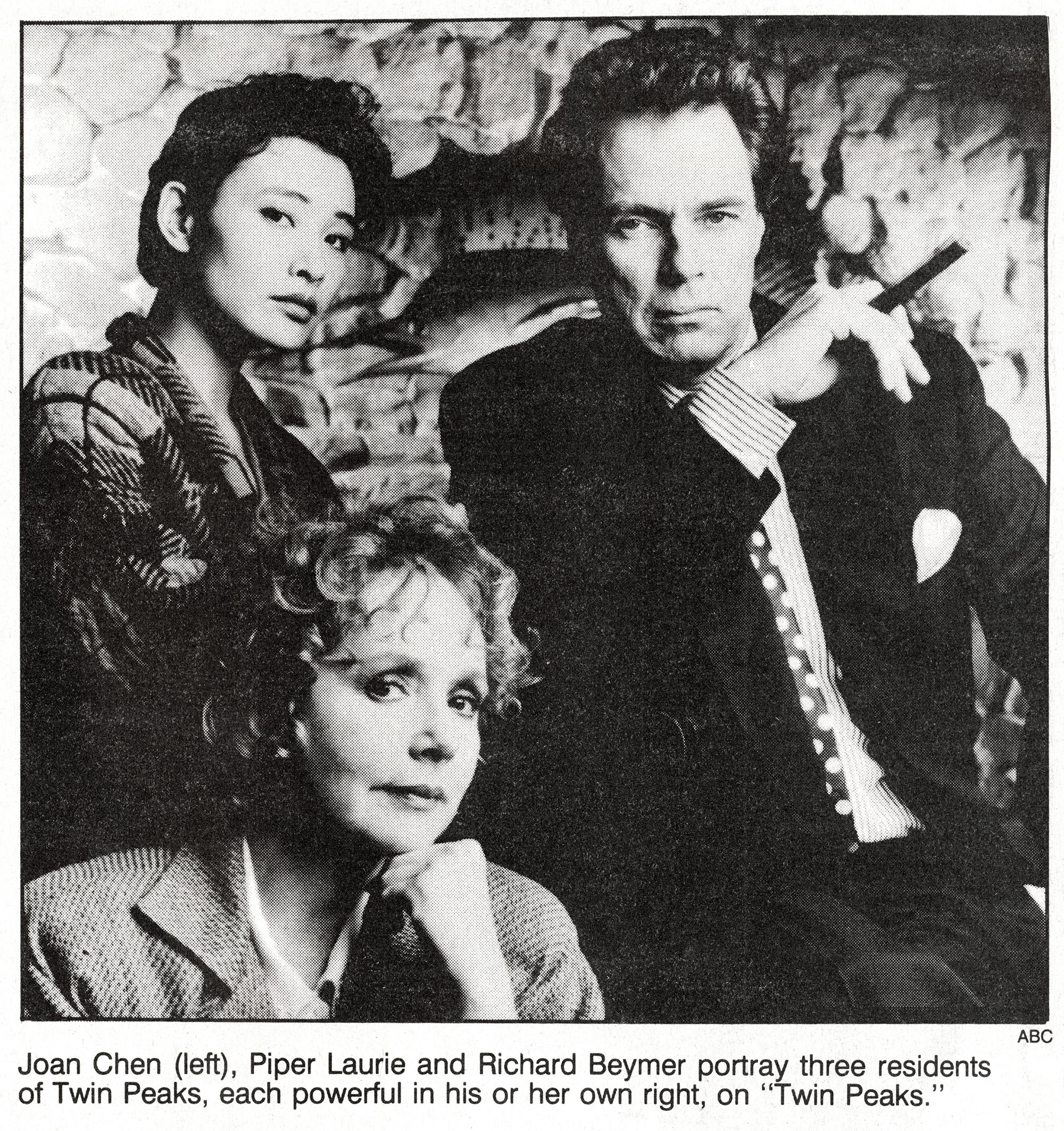
“TV Week” for October 21-27, 1990 from The Plain Dealer in Cleveland, Ohio features a publicity photo of Richard Beymer as Benjamin Horne. The caption reads: “Richard Beymer stars as a powerful businessman in ‘Twin Peaks.'”
The publication was basically a viewing guide for both local and cable channels. This particular issue was published in advance of episode 2.005 (#12) which aired on Saturday, October 27, 1990.

I wrote about this particular publicity image in November 2025. It’s awesome seeing it on the cover of this publication as these kinds of images were designed for this purpose.
The more pressing question is why did “TV Week” include Beymer on the cover? Assuming it took a few weeks to create the publication, The Plain Dealer may have opted for Beymer’s image based on the fervor for the show’s return on September 30.
RICHARD BEYMER IN THE PLAIN DEALER’S TV WEEK, OCT. 21-27, 1990 | COVER STORY
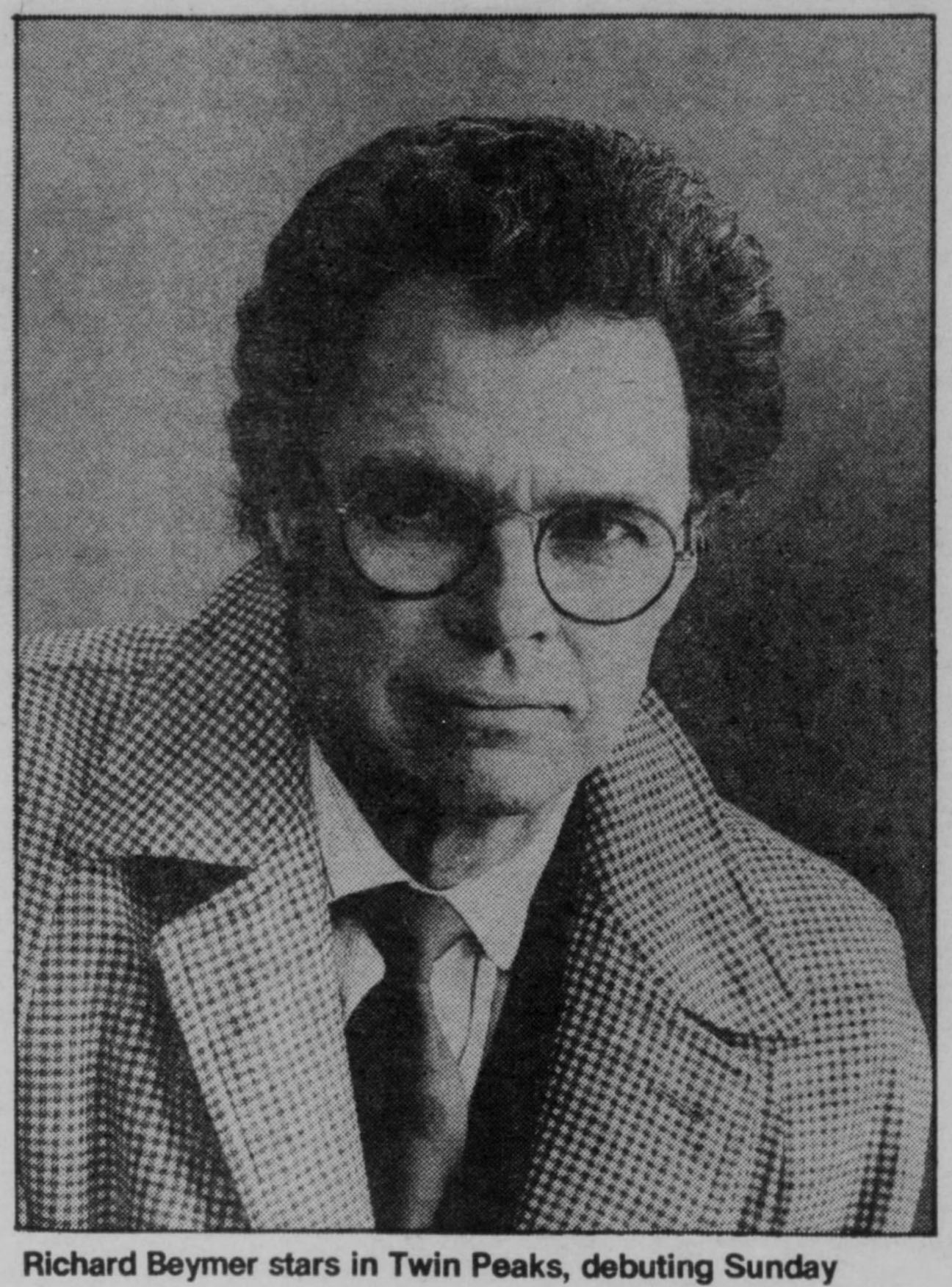
On the backside of the cover image, “TV Week” ran a Tribune Media Services syndicated story by Stephanie DuBois about Richard Beymer. It was titled, “Beymer copes with a dark side in ‘Peaks.’ More interesting is that DuBois’ story was first published on April 1, 1990 before Twin Peaks debuted on ABC on April 8, 1990. In a time before the internet and social media, these kinds of syndicated stories could have a long shelf life.
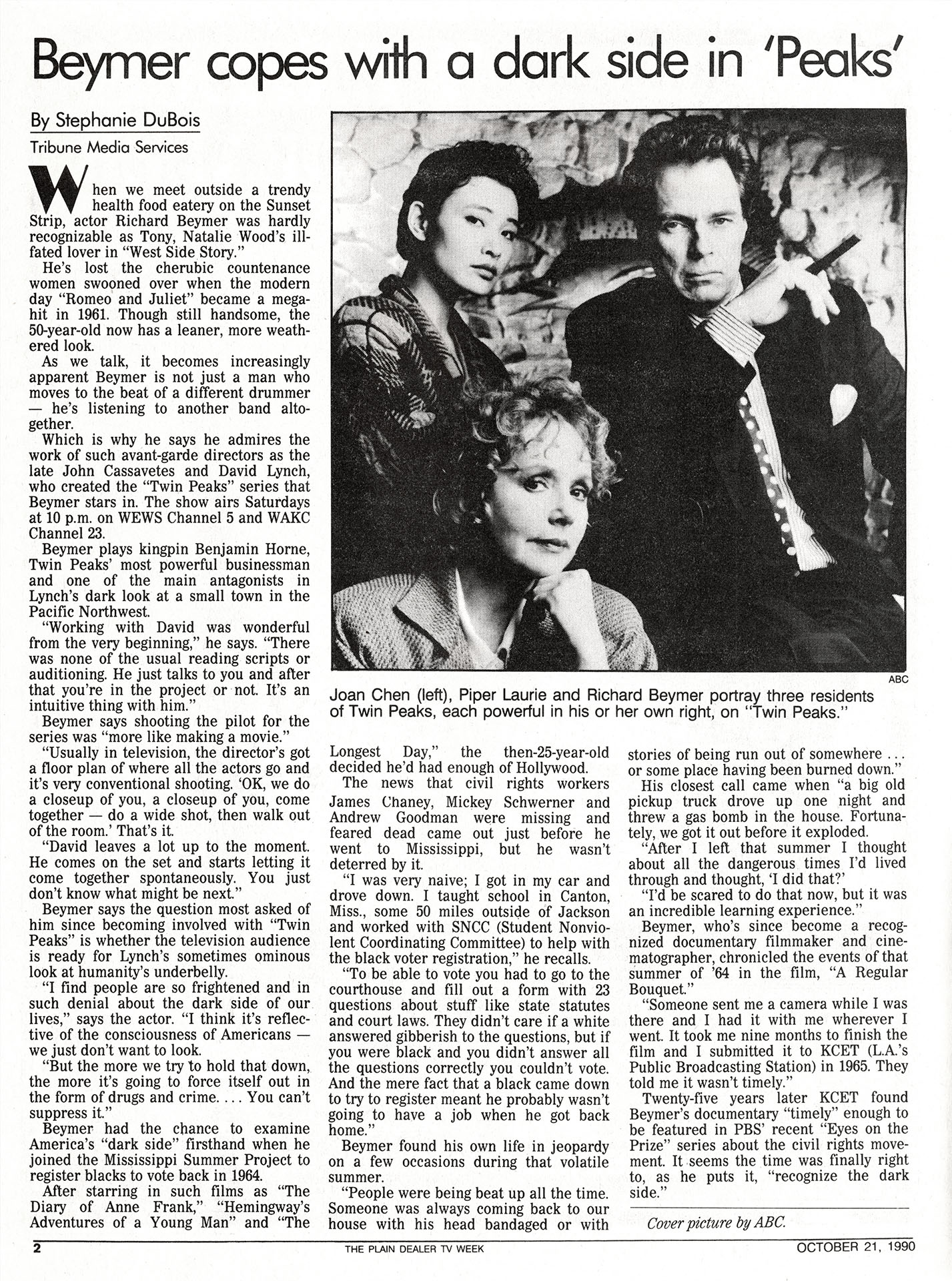
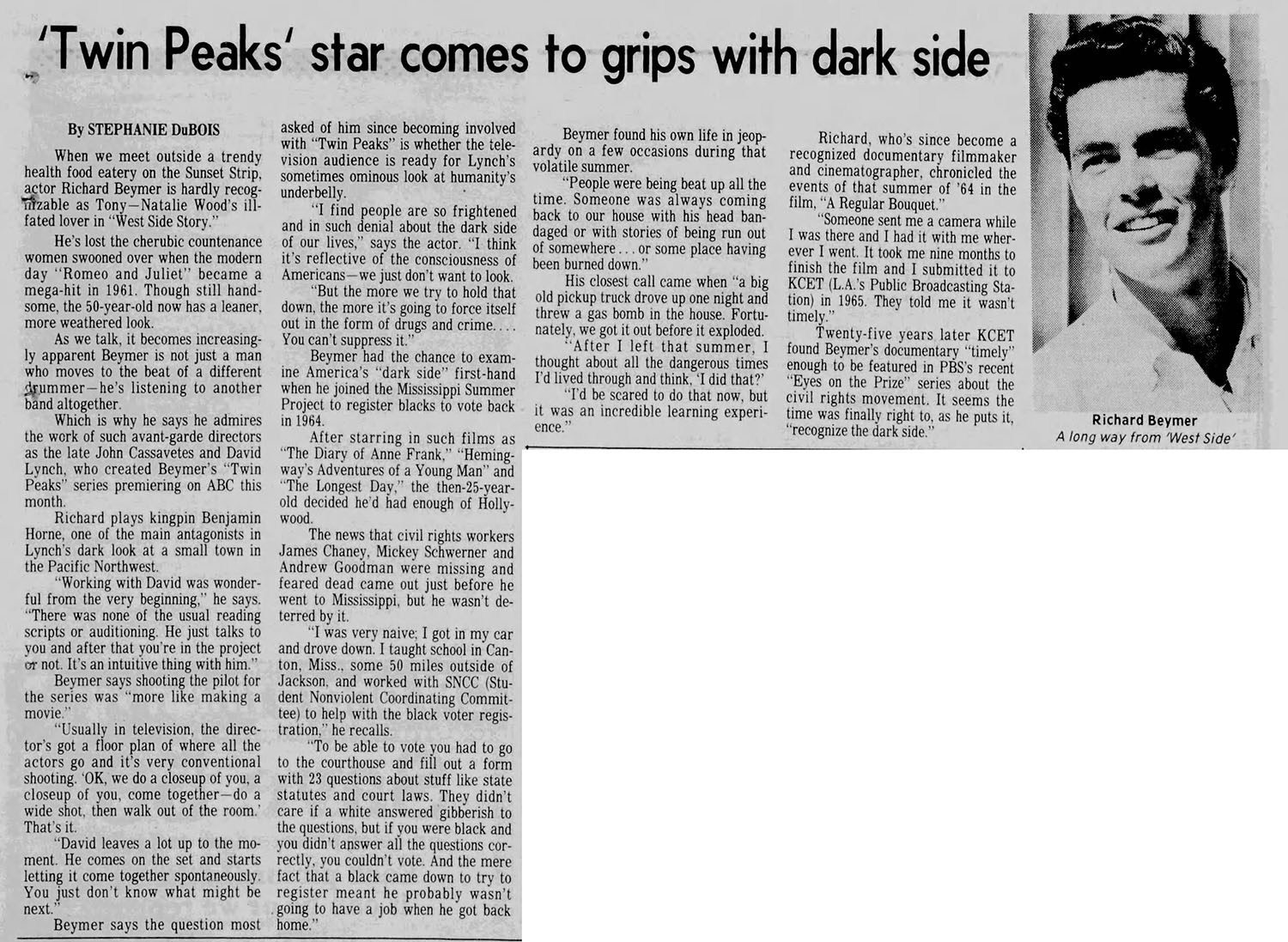
Below is a transcript of this story along with how it first appeared in publications from April 1990.
Beymer copes with a dark side in ‘Peaks’
By Stephanie DuBois Tribune Media Services
When we meet outside a trendy health food eatery on the Sunset Strip, actor Richard Beymer was hardly recognizable as Tony, Natalie Wood’s ill-fated lover in “West Side Story.”
He’s lost the cherubic countenance women swooned over when the modern day “Romeo and Juliet” became a mega-hit in 1961. Though still handsome, the 50-year-old now has a leaner, more weathered look.
As we talk, it becomes increasingly apparent Beymer is not just a man who moves to the beat of a different drummer – he’s listening to another band altogether.
Which is why he says he admires the work of such avant-garde directors as the late John Cassavetes and David Lynch, who created the “Twin Peaks” series that Beymer stars in. The show airs Saturdays at 10 p.m. on WEWS Channel 5 and WAKC Channel 23.
Beymer plays kingpin Benjamin Horne, Twin Peaks’ most powerful businessman and one of the main antagonists in Lynch’s dark look at a small town in the Pacific Northwest.
“Working with David was wonderful from the very beginning,” he says. “There was none of the usual reading scripts or auditioning. He just talks to you and after that you’re in the project or not. It’s an intuitive thing with him.”
Beymer says shooting the pilot for the series was “more like making a movie.”
“Usually in television, the director’s got a floor plan of where all the actors go and it’s very conventional shooting. ‘OK, we do a closeup of you, a closeup of you, come together — do a wide shot, then walk out of the room.’ That’s it
“David leaves a lot up to the moment. He comes on the set and starts letting it come together spontaneously. You just don’t know what might be next.”
Beymer says the question most asked of him since becoming involved with “Twin Peaks” is whether the television audience is ready for Lynch’s sometimes ominous look at humanity’s underbelly.
“I find people are so frightened and in such denial about the dark side of our lives,” says the actor. “I think it’s reflective of the consciousness of Americans – we just don’t want to look. “But the more we try to hold that down, the more it’s going to force itself out in the form of drugs and crime. … You can’t suppress it.”
Beymer had the chance to examine America’s “dark side” firsthand when he joined the Mississippi Summer Project to register blacks to vote back in 1964. After starring in such films as “The Diary of Anne Frank,” “Hemingway’s Adventures of a Young Man” and “The Longest Day,” the then-25-year-old decided he’d had enough of Hollywood.
The news that civil rights workers James Chaney, Mickey Schwerner and Andrew Goodman were missing and feared dead came out just before he went to Mississippi, but he wasn’t deterred by it.
“I was very naive; I got in my car and drove down. I taught school in Canton, Miss., some 50 miles outside of Jackson and worked with SNCC (Student Nonvio-lent Coordinating Committee) to help with the black voter registration,” he recalls.
“To be able to vote you had to go to the courthouse and fill out a form with 23 questions about stuff like state statutes and court laws. They didn’t care if a white answered gibberish to the questions, but if you were black and you didn’t answer all the questions correctly you couldn’t vote. And the mere fact that a black came down to try to register meant he probably wasn’t going to have a job when he got back home.”
Beymer found his own life in jeopardy on a few occasions during that volatile summer.
“People were being beat up all the time. Someone was always coming back to our house with his head bandaged or with stories of being run out of somewhere … or some place having been burned down.”
His closest call came when “a big old pickup truck drove up one night and threw a gas bomb in the house. Fortunately, we got it out before it exploded.
“After I left that summer I thought about all the dangerous times I’d lived through and thought, ‘I did that?’
“I’d be scared to do that now, but it was an incredible learning experience.”
Beymer, who’s since become a recognized documentary filmmaker and cinematographer, chronicled the events of that summer of ’64 in the film, “A Regular Bouquet.”
“Someone sent me a camera while I was there and I had it with me wherever I went. It took me nine months to finish the film and I submitted it to KCET (L.A.’s Public Broadcasting Station) in 1965. They told me it wasn’t timely.”
Twenty-five years later KCET found Beymer’s documentary “timely” enough to be featured in PBS’ recent “Eyes on the Prize” series about the civil rights move-ment. It seems the time was finally right to, as he puts it, “recognize the dark side.”
Author

Discover more from TWIN PEAKS BLOG
Subscribe to get the latest posts sent to your email.