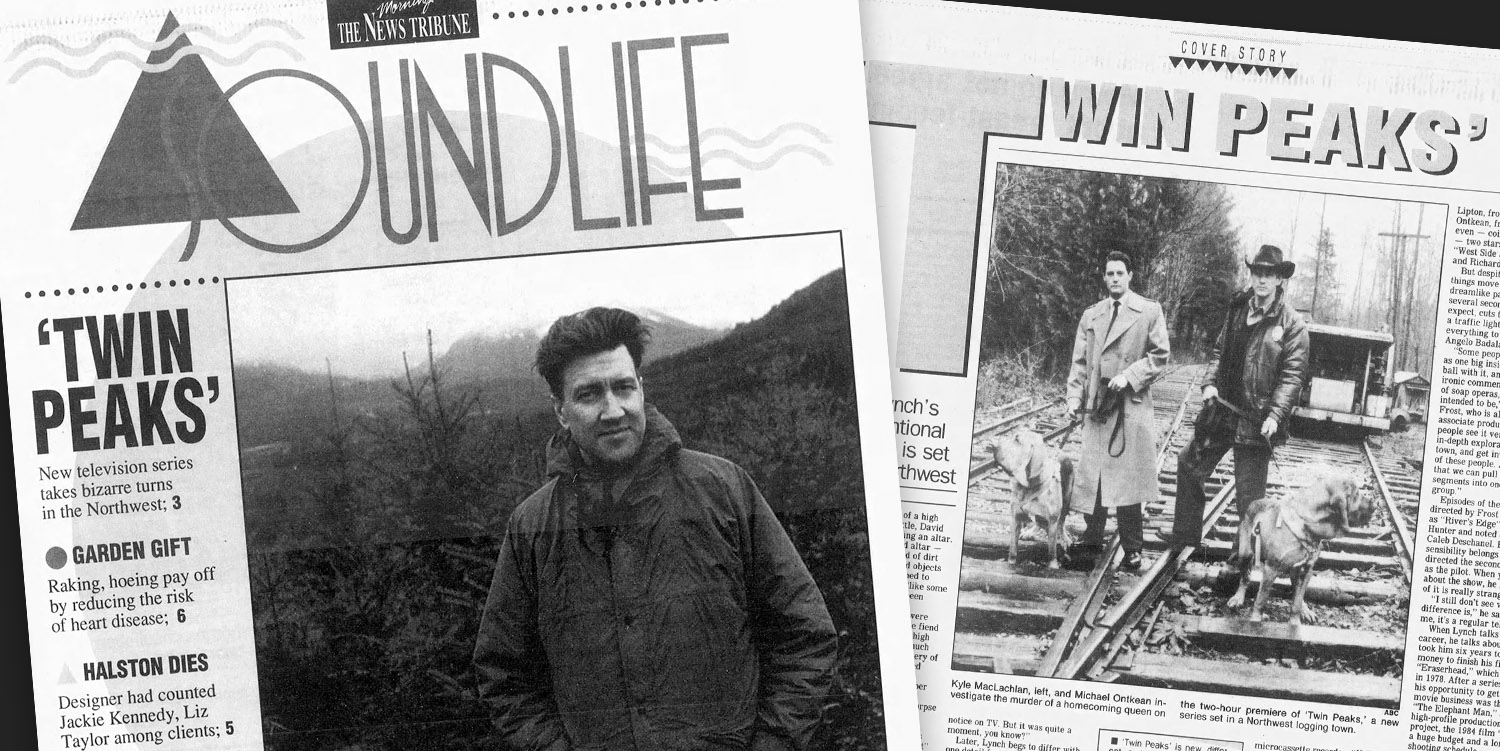
With only days away from the premiere of Twin Peaks on the ABC Television Network on April 8, “Soundlife” in The Morning News Tribune ran a cover story about David Lynch and Mark Frost’s new show on March 28, 1990. Two additional articles by Tribune’s TV-radio columnist Andee Beck accompanied Steve Bond’s story that was distributed by Los Angeles Times Syndicate. I can finally dispel the rumor that the ear placed on the mound of dirt was the same one (“Mr. Ear”) from Lynch’s Blue Velvet.
THE MORNING NEWS TRIBUNE ON MARCH 28, 1990
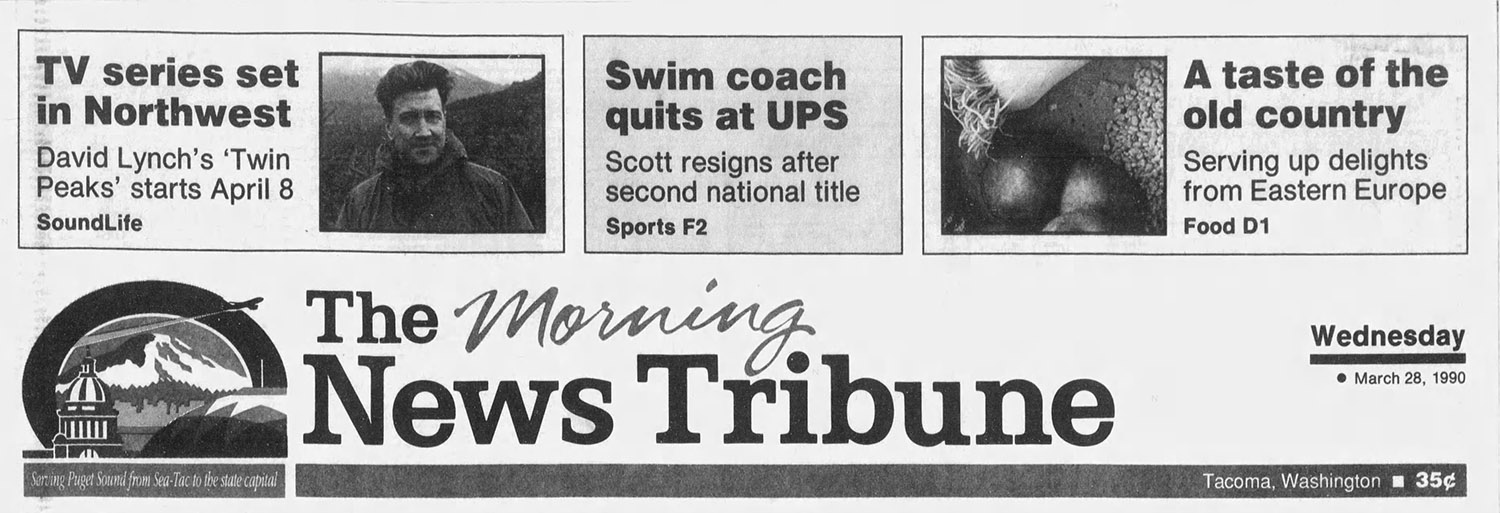
Tacoma, Washington’s The News Tribune newspaper can trace its roots to 1883 when two local papers called The Ledger and The Weekly Tacoma News became daily papers. Through a series of sales and merges in the years that followed, Frank S. Baker eventually acquire the more modern paper in 1918. The Baker family would own the paper for 73 years before McClatchy Newspapers agreed purchase the Tribune Publishing Company’s newspaper assets in October 1985. The estimated $112 million transaction was completed on August 1, 1986.
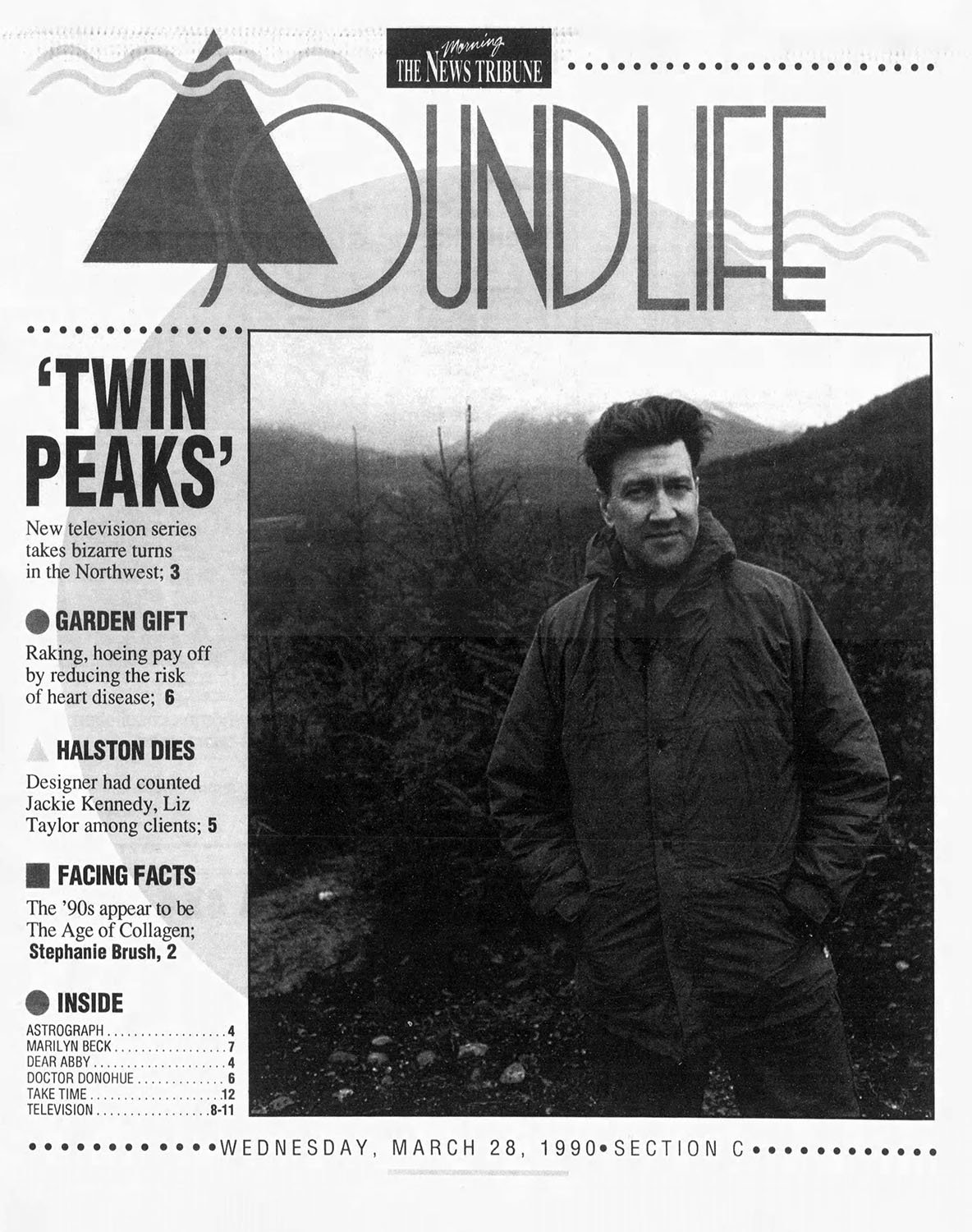
“Soundlife” was a Wednesday supplement to the morning edition of The News Tribune that began Section C. The cover includes a black and white photo of David Lynch next to a snippet about the Twin Peaks cover story – “‘Twin Peaks’ / New television series takex bizarre turns in the Northwest; 3”
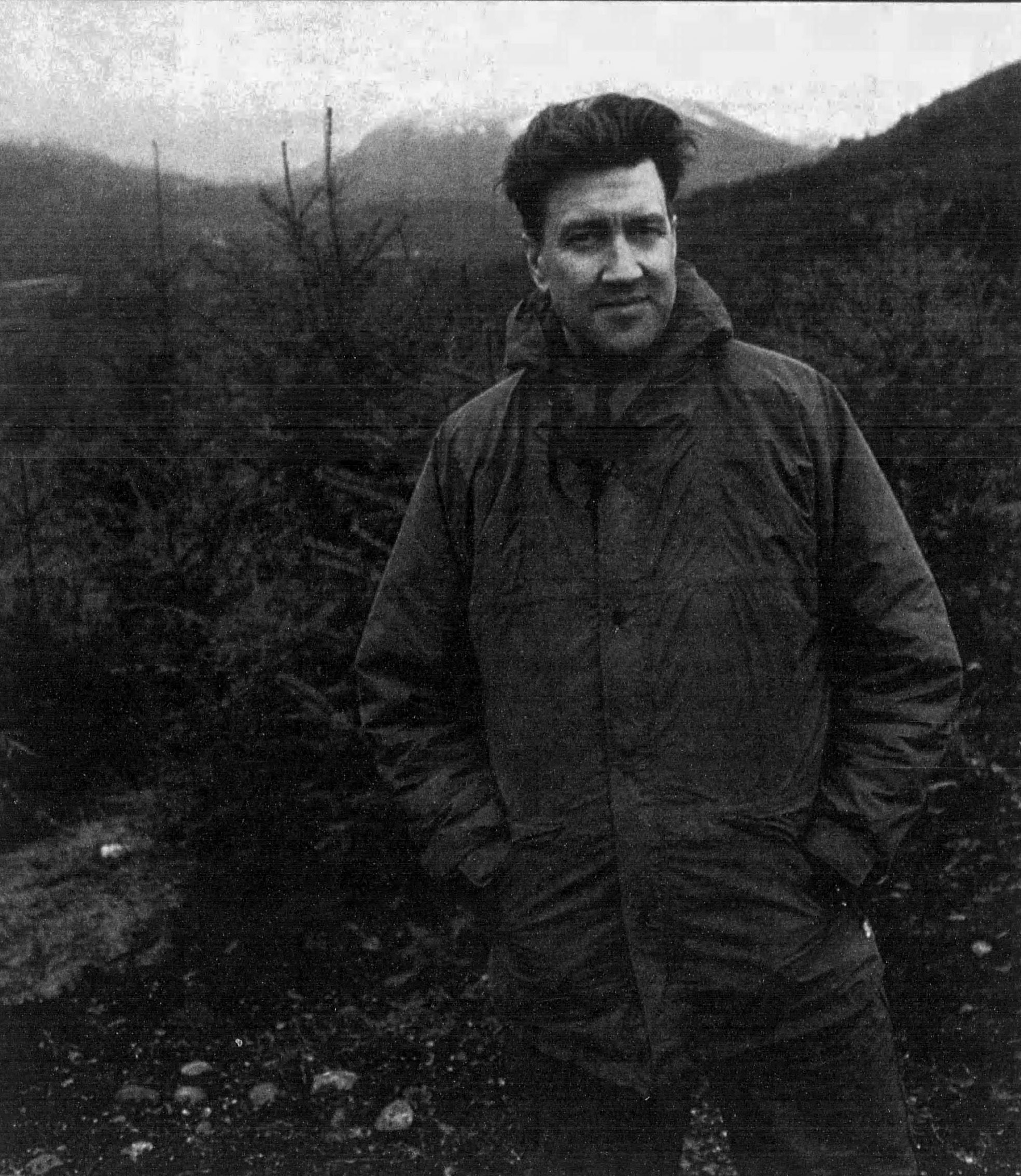
Lynch is standing in a winter coat at a location known today as Snoqualmie Point Park in Snoqualmie, Washington. This is the same spot where James Hurley is seen brooding in the pilot and where Donna Hayward and Laura Palmer held their picnic … in February … in Winter.
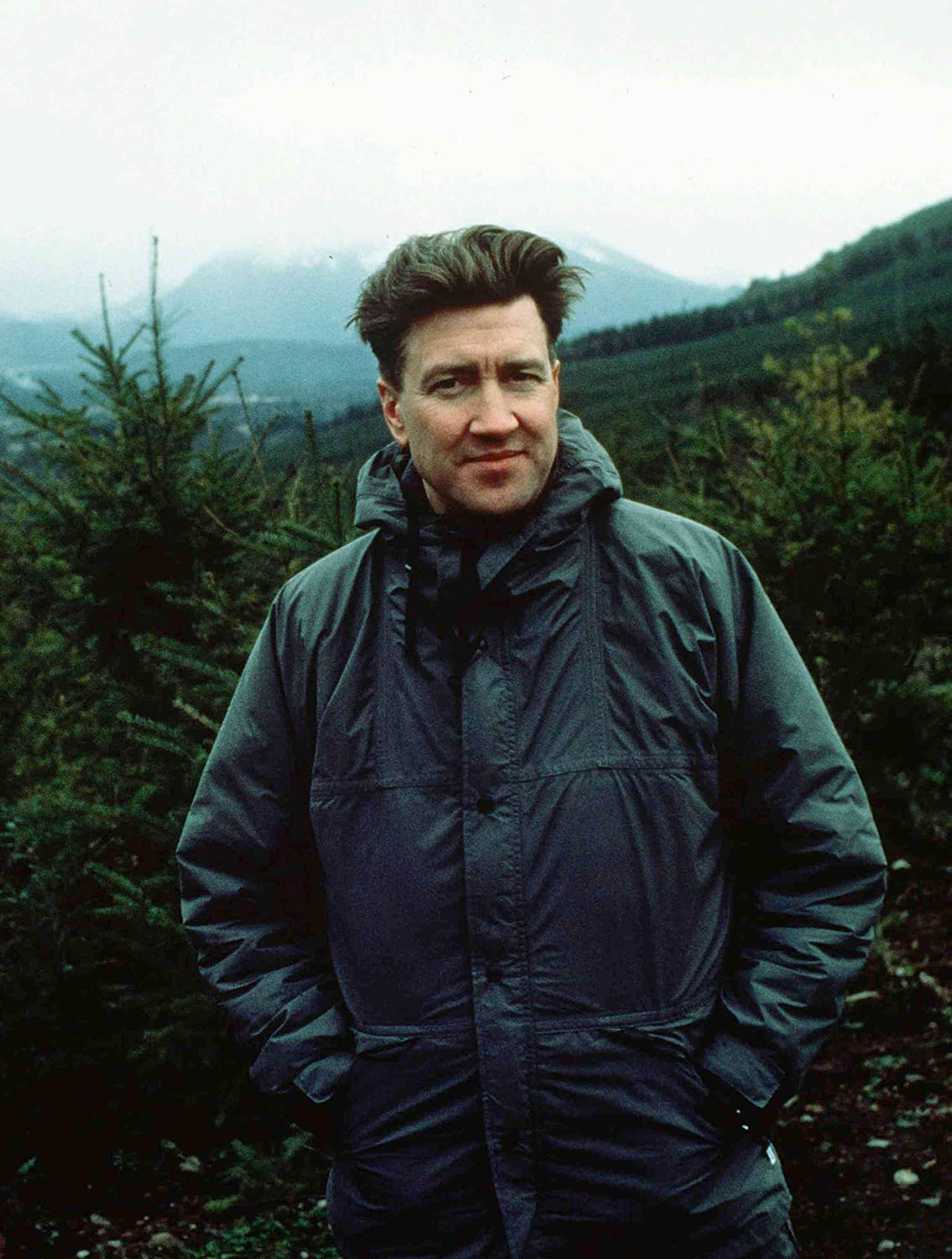
The Mauve Zone has a slightly cropped, full-color image of Lynch. The newspaper’s image is the full version of this shot.

Lynch is most likely standing around where James Hurley is sitting with the mountain on the far right in the background. Mount Si is seen to the left of this image. The “Mountain Overlook” scene was shot around March 3, 1989 which means Lynch’s photo was probably taken that same day.
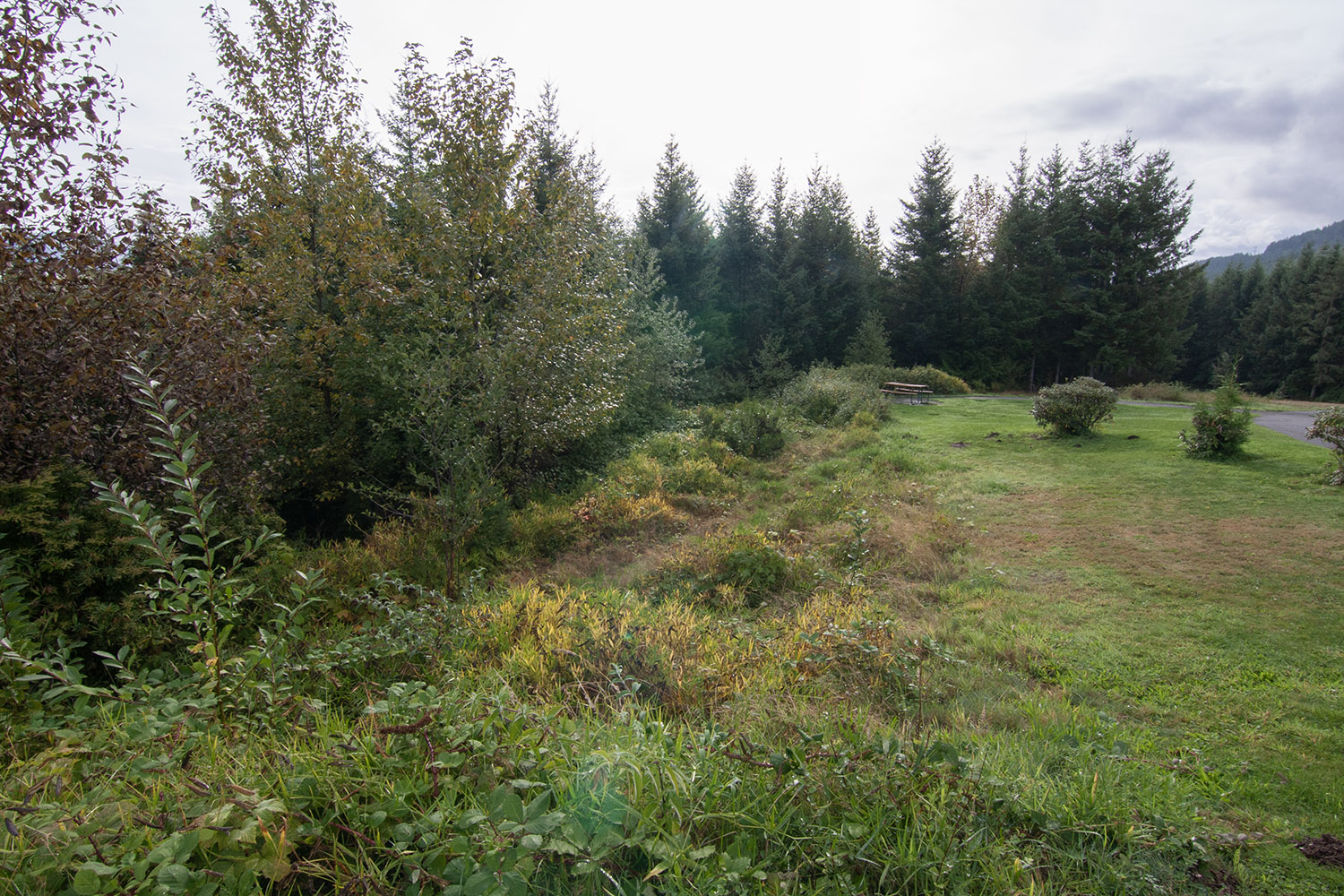
The park, which was once home to a winery, looks different today. The trees are much taller now and the gravel and dirt area where James sat is now filled in with grass and shrubbery.
“SOUNDLIFE” IN THE MORNING NEWS TRIBUNE ON MARCH 28, 1990 | PAGE 21
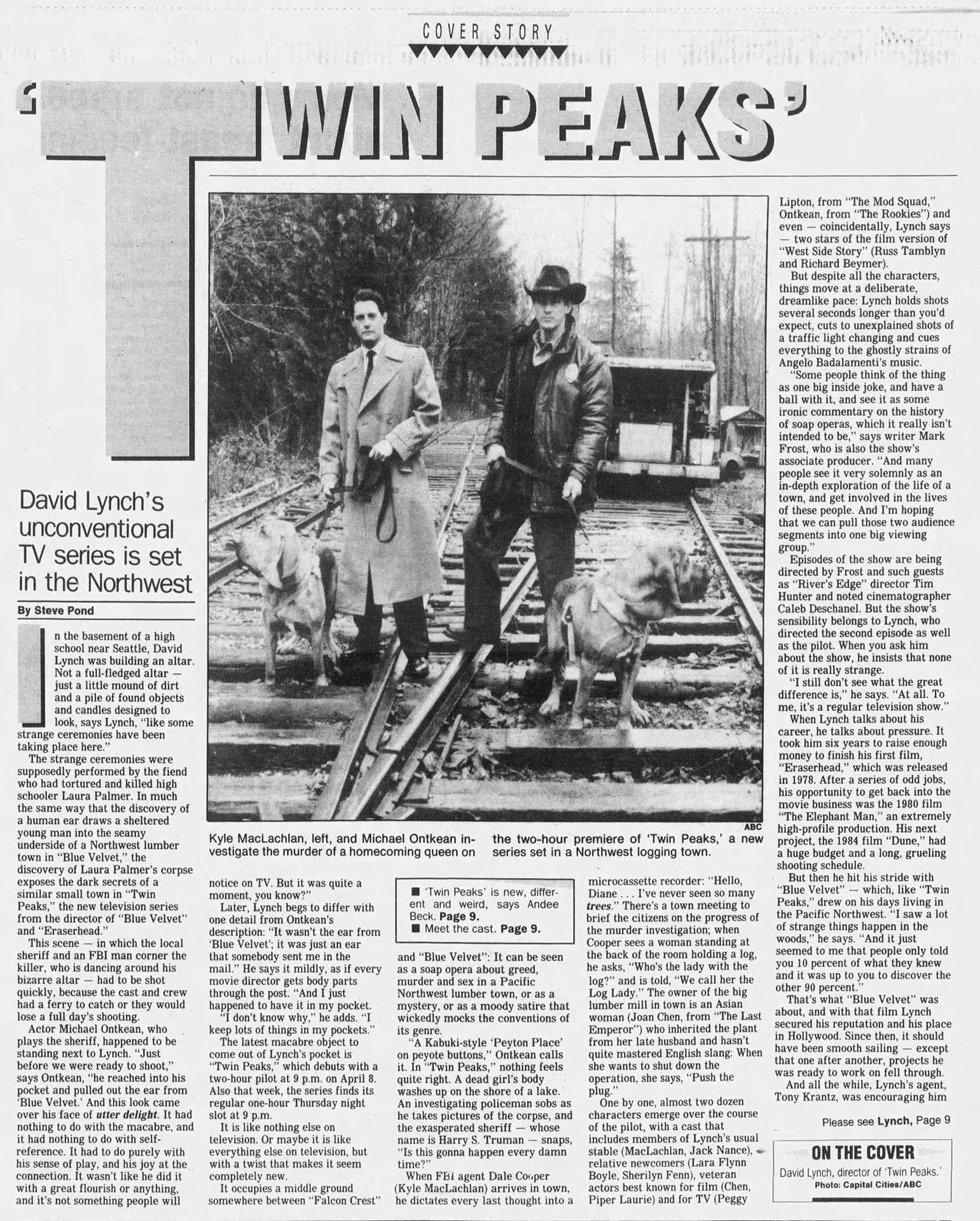
The cover story was written by Steve Pond who would later write the cover story about Twin Peaks for the May 28, 1990 issue of “US Weekly.”
According to his bio on The Wrap, Pond spent decades “writing about film, television, music and the entertainment industry for the Los Angeles Times, Washington Post, Rolling Stone, Premiere, New York Times, Playboy and many other publications.” He published the L.A. Times bestseller “The Big Show,” a behind-the-scenes look at the Academy Awards based on 15 years of unprecedented access to that show. Today, he serves as The Wrap’s Executive Editor and has been writing about awards coverage on the site since 2009.
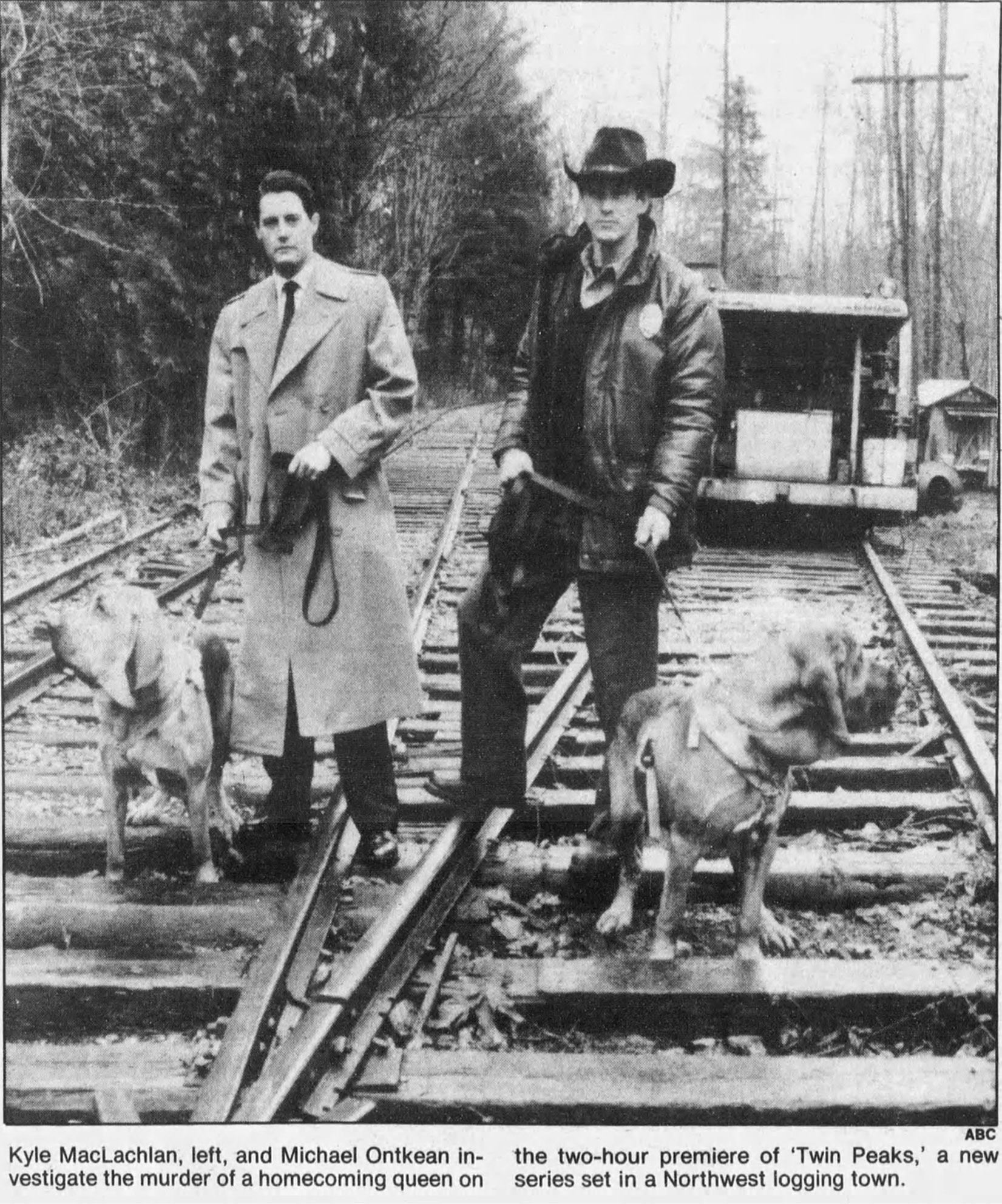
The image used on this page features Kyle MacLachlan (left) as Special Agent Dale Cooper and Michael Ontkean (right) as Sheriff Harry S. Truman. This is an outtake or publicity photo of a scene not found in the broadcast episode. The dogs are briefly seen in the final edit but we never see this duo with the dogs. They are at the now demolished train graveyard once located along Snoqualmie Parkway in Snoqualmie.
The caption reads: “Kyle MacLachlan, left, and Michael Ontkean investigate the murder of a homecoming queen on the two-hour premiere of ‘Twin Peaks,’ a new series set in a Northwest logging town.”

This is the location where they investigate the abandoned train car, which was the location of Laura Palmer’s murder. Below is a transcript of the article along with some commentary from me.
David Lynch’s unconventional TV series is set in the Northwest
By Steve Pond
In the basement of a high school near Seattle, David Lynch was building an altar.
Not a full-fledged altar – just a little mound of dirt and a pile of found objects and candles designed to look, says Lynch, “like some strange ceremonies have been taking place here.”
The strange ceremonies were supposedly performed by the fiend who had tortured and killed high schooler Laura Palmer. In much the same way that the discovery of a human ear draws a sheltered young man into the seamy underside of a Northwest lumber town in “Blue Velvet,” the discovery of Laura Palmer’s corpse exposes the dark secrets of a similar small town in “Twin Peaks,” the new television series from the director of “Blue Velvet” and “Eraserhead.”
This scene – in which the local sheriff and an FBI man corner the killer, who is dancing around his bizarre altar – had to be shot quickly, because the cast and crew had a ferry to catch or they would lose a full day’s shooting.
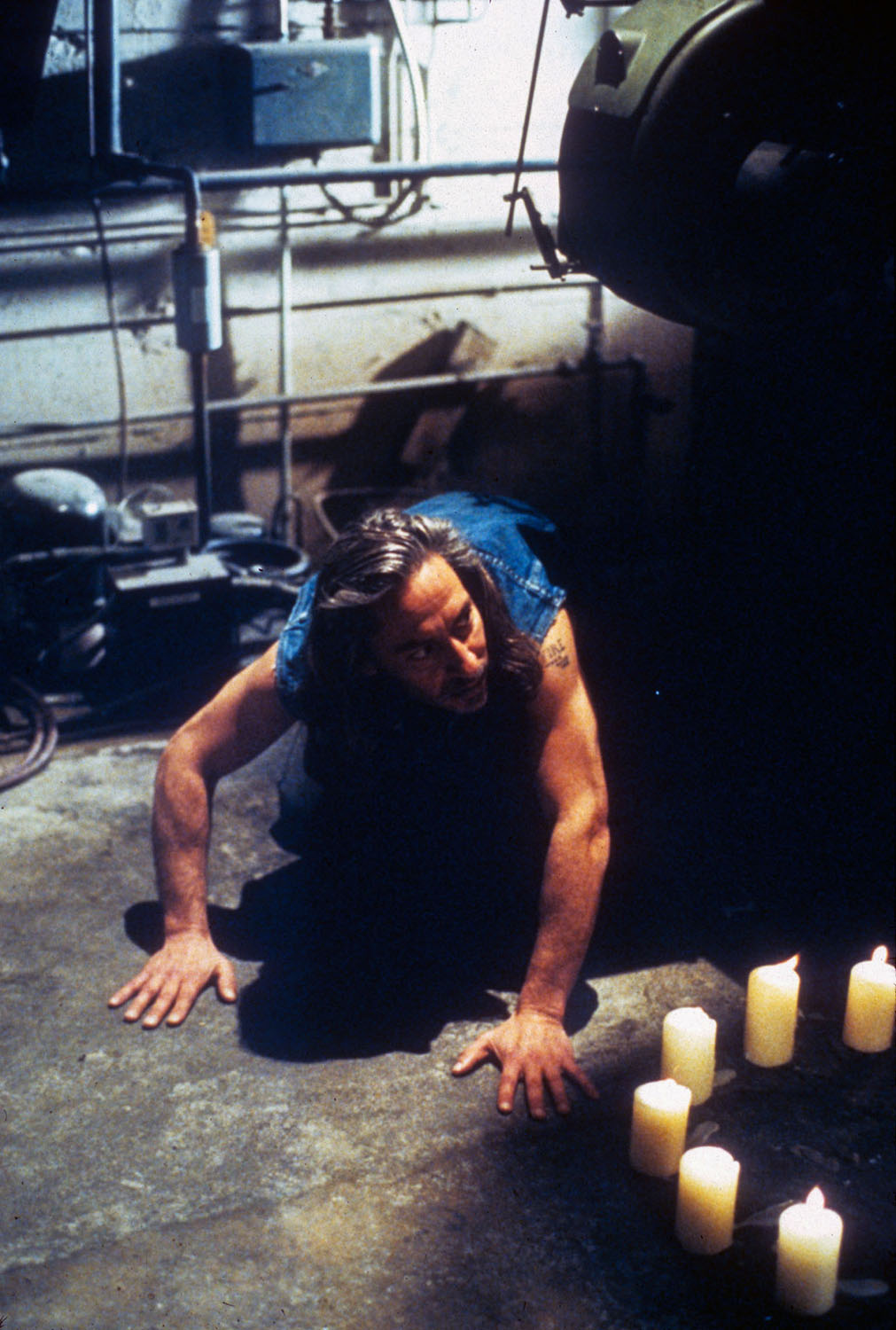
The scene with described was shot around March 16, 1989 in Carnation, Washington. The location was a now demolished school that was close to where the Twin Peaks Town Hall scenes were filmed. The crew was wrapping up production in Snoqualmie Valley before traveling to Kiana Lodge in Poulsbo, Washington for the final days of location filming.
Actor Michael Ontkean, who plays the sheriff, happened to be standing next to Lynch. “Just before we were ready to shoot,” says Ontkean, “he reached into his pocket and pulled out the ear from ‘Blue Velvet.’ And this look came over his face of utter delight. It had nothing to do with the macabre, and it had nothing to do with self-reference. It had to do purely with his sense of play, and his joy at the connection. It wasn’t like he did it with a great flourish or anything, and it’s not something people will notice on TV. But it was quite a moment, you know?”
Later, Lynch begs to differ with one detail from Ontkean’s description: “It wasn’t the ear from ‘Blue Velvet;’ it was just an ear that somebody sent me in the mail.” He says it mildly, as if every movie director gets body parts through the post. “And I just happened to have it in my pocket.
‘I don’t know why.” he adds. “I keep lots of things in my pockets.”
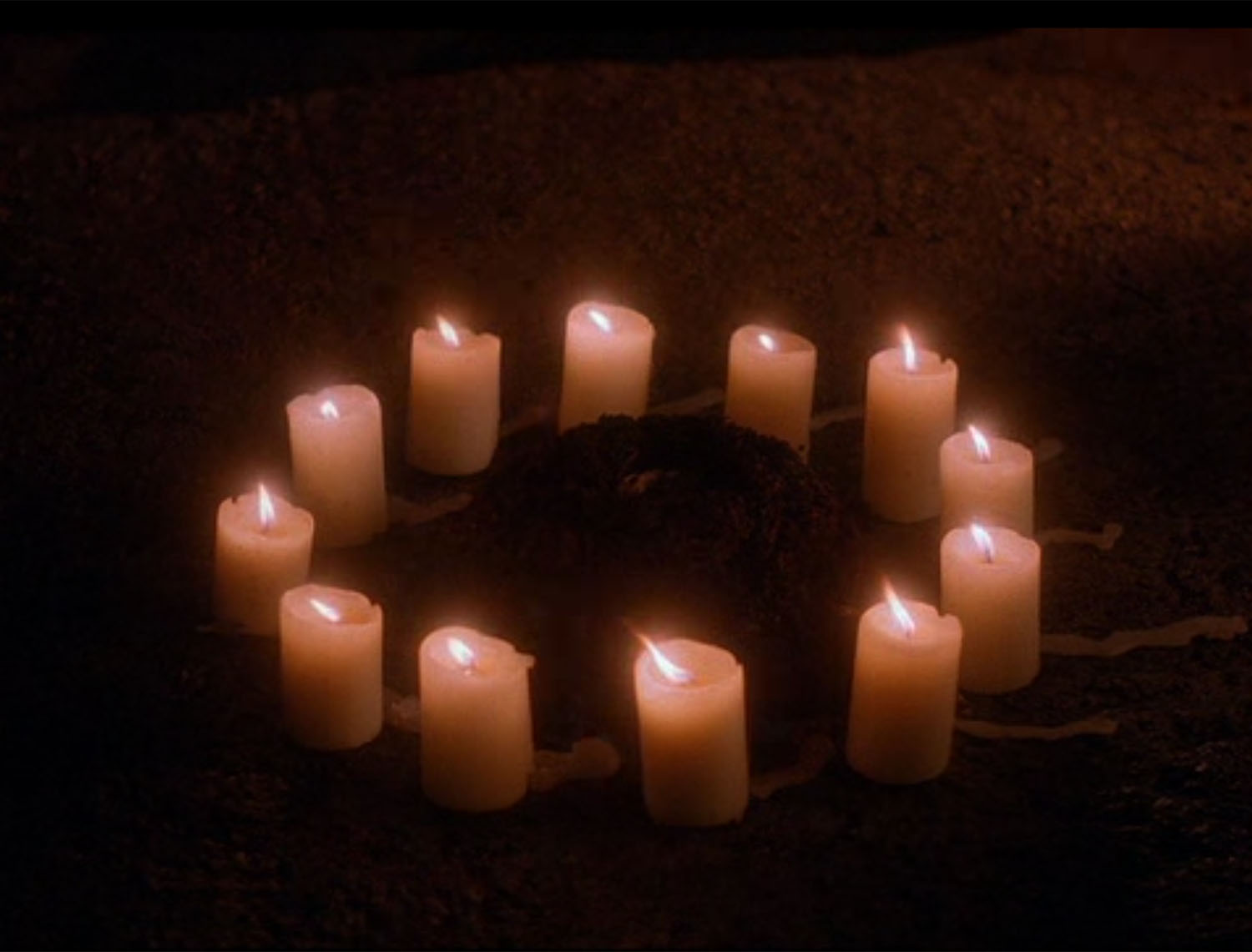
I had always wondered if the ear which is faintly seen in the center of dirt mound was the actual ear created by Prop Master Jeff Goodwin (which fellow Twin Peaks Blog author Vinnie Guidera profiled). David Lynch confirms it was an ear (alright) but not the human ear prop seen in his 1986 feature film.

The latest macabre object to come out of Lynch’s pocket is “Twin Peaks,” which debuts with a two-hour pilot at 9 p.m. on April 8.
Also that week, the series finds its regular one-hour Thursday night slot at 9 p.m. It is like nothing else on television. Or maybe it is like everything else on television, but with a twist that makes it seem completely new.
It occupies a middle ground somewhere between “Falcon Crest” and “Blue Velvet”: It can be seen as a soap opera about greed, murder and sex in a Pacific Northwest lumber town, or as a mystery, or as a moody satire that wickedly mocks the conventions of
“A Kabuki-style Peyton Place’ on pevote buttons.” Ontkean calls it. In “Twin Peaks.” nothing feels quite right. A dead girl’s body washes up on the shore of a lake.
An investigating policeman sobs as he takes pictures of the corpse, and the exasperated sheriff – whose name is Harry S. Truman – snaps, “Is this gonna happen every damn time?”

When FBI agent Dale Cooper (Kyle MacLachlan) arrives in town, he dictates every last thought into a microcassette recorder: “Hello, Diane … I’ve never seen so many trees.” There’s a town meeting to brief the citizens on the progress of the murder investigation; when Cooper sees a woman standing at the back of the room holding a log, he asks, “Who’s the lady with the log?” and is told, “We call her the Log Lady.” The owner of the big lumber mill in town is an Asian woman (Joan Chen, from “The Last Emperor”) who inherited the plant from her late husband and hasn’t quite mastered English slang: When she wants to shut down the operation, she says, “Push the plug.”
One by one, almost two dozen characters emerge over the course of the pilot, with a cast that includes members of Lynch’s usual stable (MacLachlan, Jack Nance), sir relative newcomers (Lara Flynn Boyle, Sherilyn Fenn), veteran actors best known for film (Chen, Piper Laurie) and for TV (Peggy Lipton, from “The Mod Squad,” Ontkean, from “The Rookies”) and even – coincidentally, Lynch says – two stars of the film version of “West Side Story” (Russ Tamblyn and Richard Beymer).
But despite all the characters, things move at a deliberate, dreamlike pace: Lynch holds shots several seconds longer than you’d expect, cuts to unexplained shots of a traffic light changing and cues everything to the ghostly strains of Angelo Badalamenti’s music.

“Some people think of the thing as one big inside joke, and have a ball with it, and see it as some ironic commentary on the history of soap operas, which it really isn’t intended to be,” says writer Mark Frost, who is also the show’s associate producer. “And many people see it very solemnly as an in-depth exploration of the life of a town, and get involved in the lives of these people. And I’m hoping that we can pull those two audience segments into one big viewing group.
Episodes of the show are being directed by Frost and such guests as “River’s Edge” director Tim Hunter and noted cinematographer Caleb Deschanel. But the show’s sensibility belongs to Lynch, who directed the second episode as well as the pilot. When you ask him about the show, he insists that none of it is really strange.
“I still don’t see what the great difference is,” he says. “At all. To me, it’s a regular television show.”
When Lynch talks about his career, he talks about pressure. It took him six years to raise enough money to finish his first film,
“Eraserhead.” which was released in 1978. After a series of odd jobs, his opportunity to get back into the movie business was the 1980 film “The Elephant Man,” an extremely high-profile production. His next project, the 1984 film “Dune,” had a huge budget and a long, grueling shooting schedule.
But then he hit his stride with “Blue Velvet” – which, like “Twin Peaks,” drew on his days living in the Pacific Northwest. “I saw a lot of strange things happen in the woods,” he says. “And it just seemed to me that people only told you 10 percent of what they knew and it was up to you to discover the other 90 percent.
That’s what “Blue Velvet” was about, and with that film Lynch secured his reputation and his place in Hollywood. Since then, it should have been smooth sailing – except that one after another, projects he was ready to work on fell through.
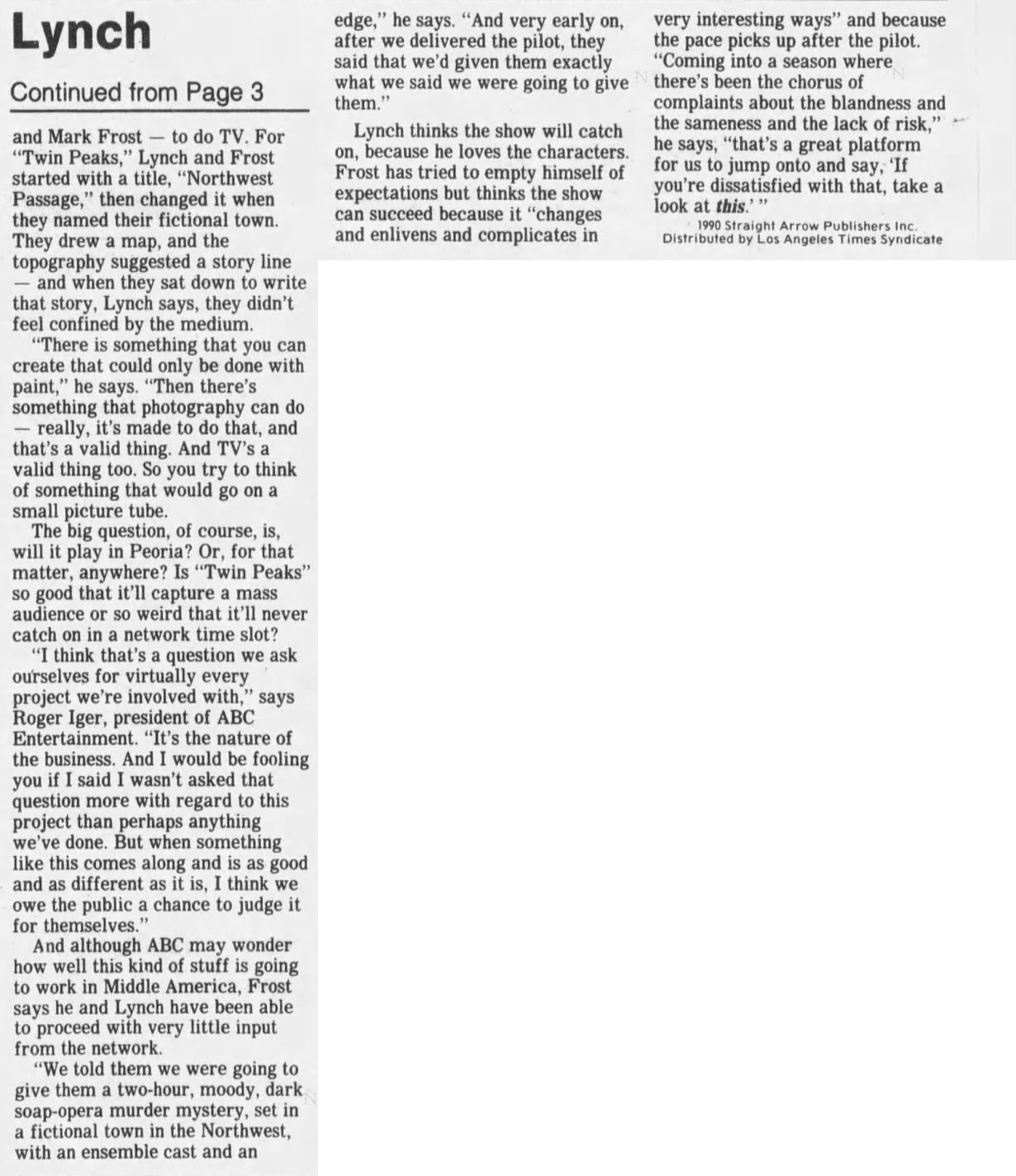
And all the while, Lynch’s agent, Tony Krantz, was encouraging him and Mark Frost – to do TV. For “Twin Peaks,” Lynch and Frost started with a title, “Northwest Passage,” then changed it when they named their fictional town.
You can read how Lynch and Frost pitched the series to ABC Television in this deep dive article on Twin Peaks Blog.
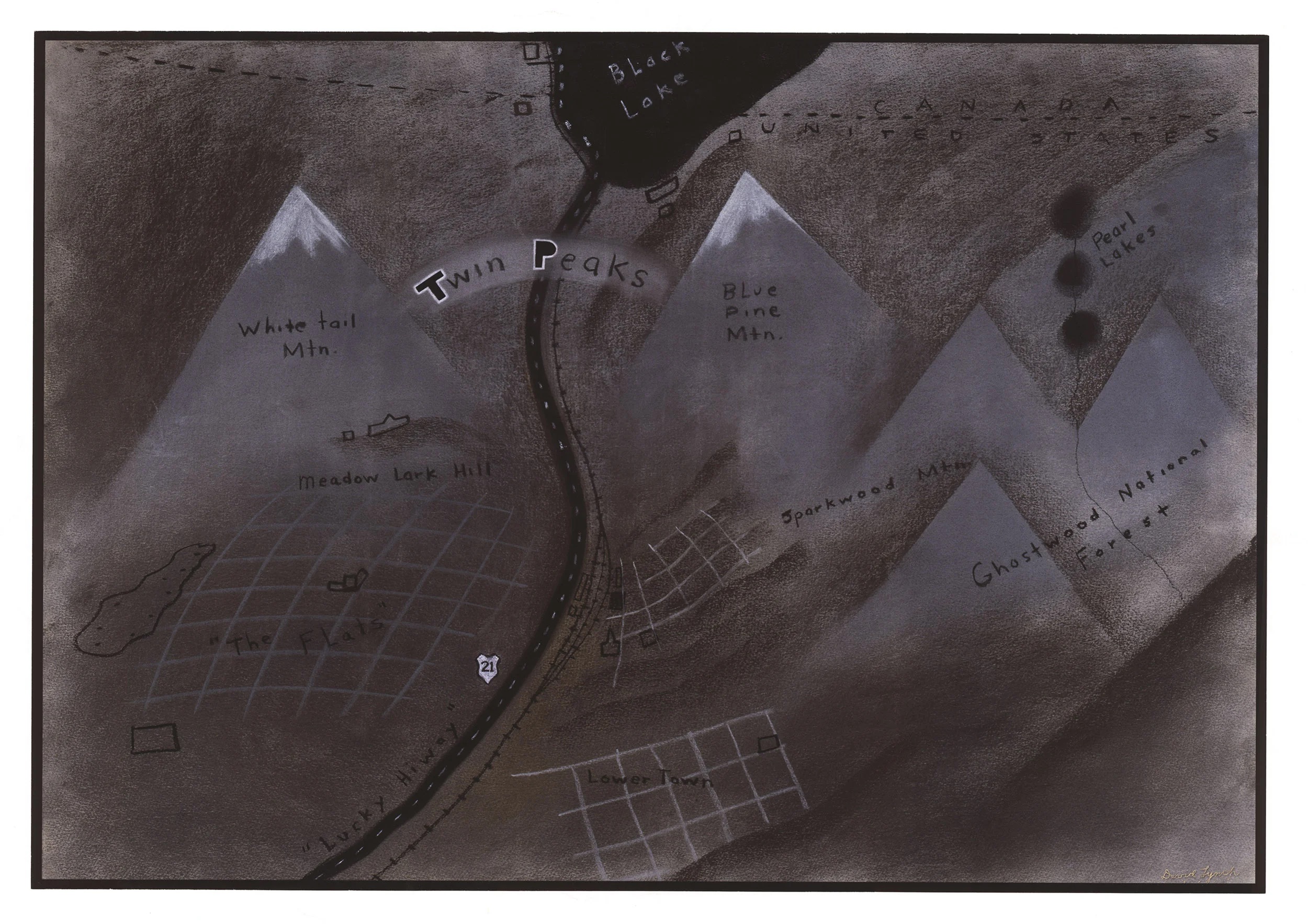
They drew a map, and the topography suggested a story line – and when they sat down to write that story, Lynch says, they didn’t feel confined by the medium.
*There is something that you can create that could only be done with paint,” he says. “Then there’s something that photography can do – really, it’s made to do that, and that’s a valid thing. And TV’s a valid thing too. So you try to think of something that would go on a small picture tube.
The big question, of course, is, will it play in Peoria? Or, for that matter, anywhere? Is “Twin Peaks” so good that it’ll capture a mass audience or so weird that it’ll never catch on in a network time slot?
“I think that’s a question we ask ourselves for virtually every project we’re involved with,” says Roger [sic] Iger, president of ABC Entertainment. “It’s the nature of the business. And I would be fooling you if I said I wasn’t asked that question more with regard to this project than perhaps anything we’ve done. But when something like this comes along and is as good and as different as it is, I think we owe the public a chance to judge it for themselves.”
And although ABC may wonder how well this kind of stuff is going to work in Middle America, Frost says he and Lynch have been able to proceed with very little input from the network.
“We told them we were going to give them a two-hour, moody, dark soap-opera murder mystery, set in a fictional town in the Northwest, with an ensemble cast and an edge,” he says. “And very early on, after we delivered the pilot, they said that we’d given them exactly what we said we were going to give them.”
Lynch thinks the show will catch on, because he loves the characters.
Frost has tried to empty himself of expectations but thinks the show can succeed because it “changes and enlivens and complicates in very interesting ways” and because the pace picks up after the pilot.
“Coming into a season where there’s been the chorus of complaints about the blandness and the sameness and the lack of risk,” he says, “that’s a great platform for us to jump onto and say, ‘If you’re dissatisfied with that, take a look at this?'”
“SOUNDLIFE” IN THE MORNING NEWS TRIBUNE ON MARCH 28, 1990 | PAGE 27
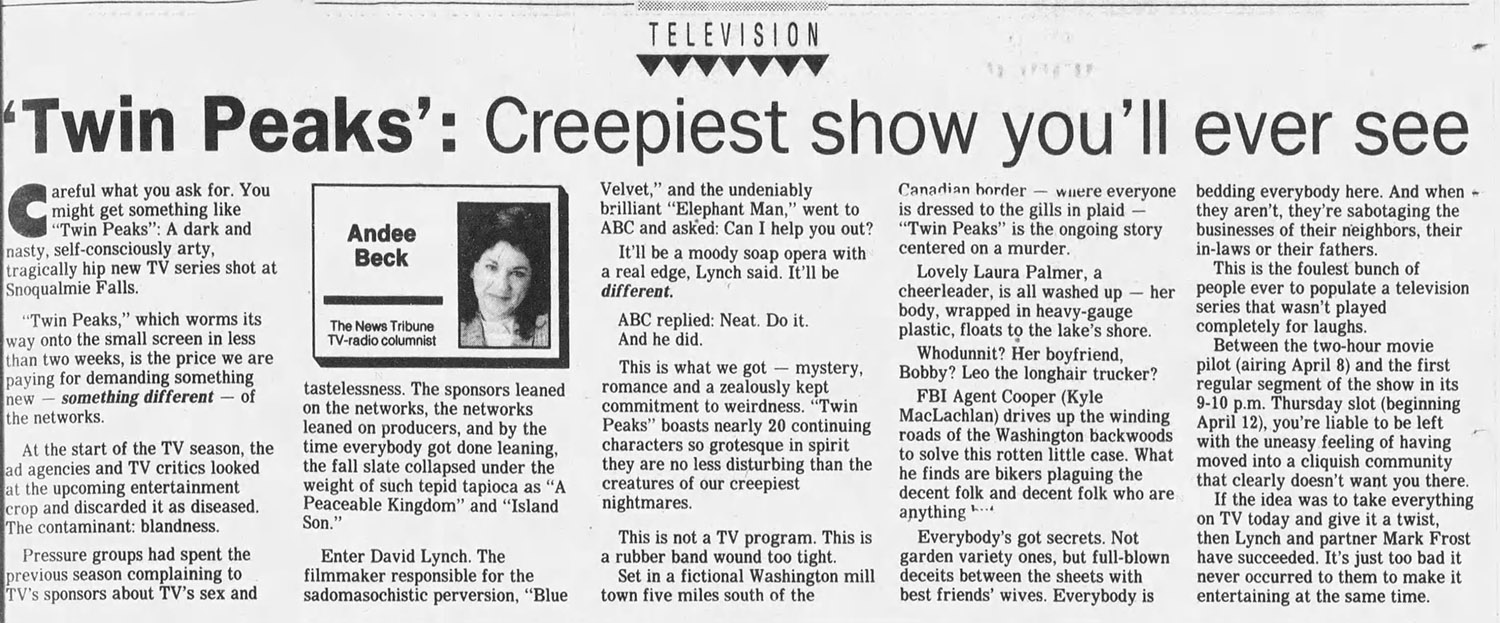
Later in the supplement, News Tribune television and radio columnist Andee Beck wrote two stories about Lynch and Frost’s new show. She offers a more simplified take on how Lynch and Frost
Twin Peaks’: Creepiest show you’ll ever see
Careful what you ask for. You might get something like “Twin Peaks”: A dark and nasty, self-consciously arty, tragically hip new TV series shot at Snoqualmie Falls.
“Twin Peaks,” which worms its way onto the small screen in less than two weeks, is the price we are paying for demanding something new — something different — of the networks.
At the start of the TV season, the ad agencies and TV critics looked at the upcoming entertainment crop and discarded it as diseased. The contaminant: blandness.
Pressure groups had spent the previous season complaining to TV’s sponsors about TV’s sex and tastelessness. The sponsors leaned on the networks, the networks leaned on producers, and by the time everybody got done leaning, the fall slate collapsed under the weight of such tepid tapioca as “A Peaceable Kingdom” and “Island Son.”
Enter David Lynch. The filmmaker responsible for the sadomasochistic perversion, “Blue Velvet,” and the undeniably brilliant “Elephant Man,” went to ABC and asked: Can I help you out?
It’ll be a moody soap opera with a real edge, Lynch said. It’ll be different.
ABC replied: Neat. Do it. And he did.
This is what we got — mystery, romance and a zealously kept commitment to weirdness. “Twin Peaks” boasts nearly 20 continuing characters so grotesque in spirit they are no less disturbing than the creatures of our creepiest nightmares.
This is not a TV program. This is a rubber band wound too tight. Set in a fictional Washington mill town five miles south of the Canadian border — where everyone is dressed to the gills in plaid —”Twin Peaks” is the ongoing story centered on a murder.
Lovely Laura Palmer, a cheerleader, is all washed up — her body, wrapped in heavy-gauge plastic, floats to the lake’s shore.
Whodunnit? Her boyfriend, Bobby? Leo the longhair trucker?
FBI Agent Cooper (Kyle MacLachlan) drives up the winding roads of the Washington backwoods to solve this rotten little case. What he finds are bikers plaguing the decent folk and decent folk who are anything
Everybody’s got secrets. Not garden variety ones, but full-blown deceits between the sheets with best friends’ wives. Everybody is bedding everybody here. And when – they aren’t, they’re sabotaging the businesses of their neighbors, their in-laws or their fathers.
This is the foulest bunch of people ever to populate a television series that wasn’t played completely for laughs.
Between the two-hour movie pilot (airing April 8) and the first regular segment of the show in its 9-10 p.m. Thursday slot (beginning April 12), you’re liable to be left with the uneasy feeling of having moved into a cliquish community that clearly doesn’t want you there.
If the idea was to take everything on TV today and give it a twist, then Lynch and partner Mark Frost have succeeded. It’s just too bad it never occurred to them to make it entertaining at the same time.
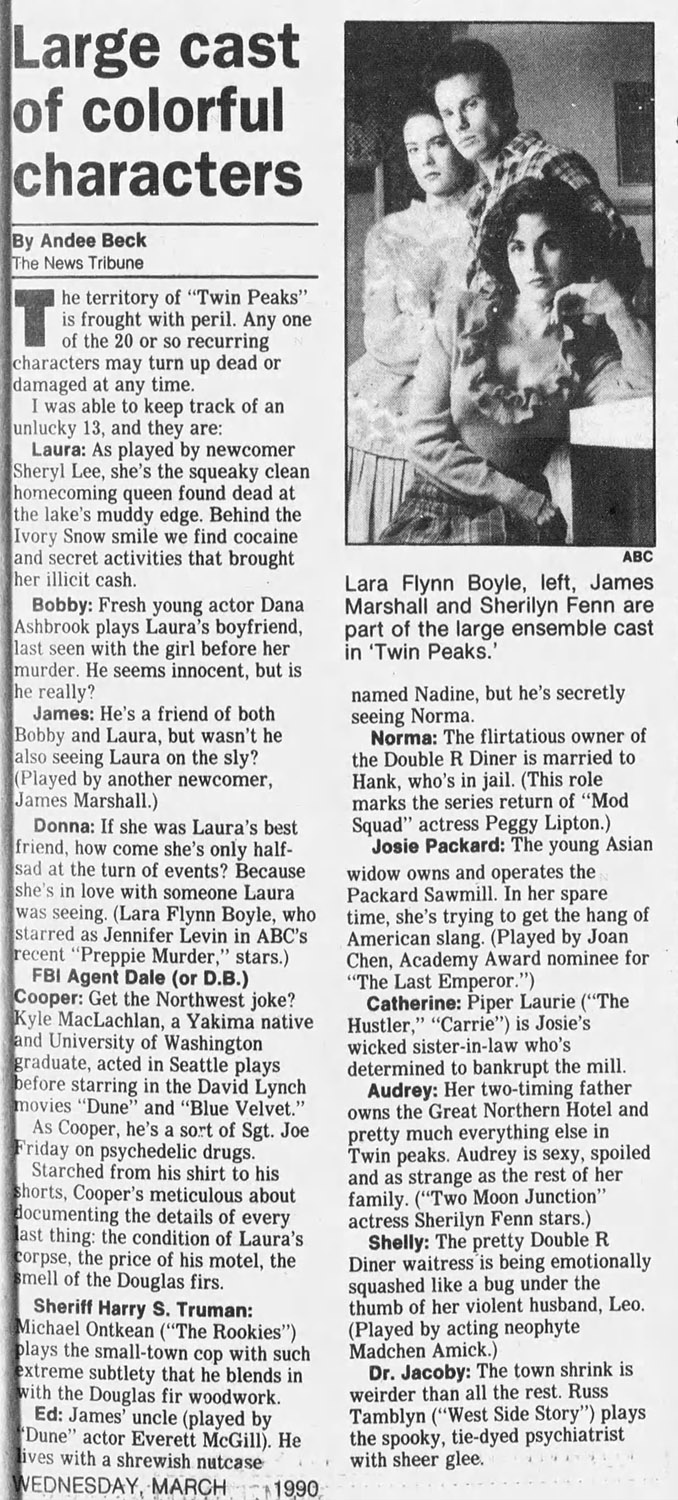
Beck penned a second article detailing 13 characters found in the “creepiest show you’ll ever see.”
Large cast of colorful characters
The territory of “Twin Peaks” is frought with peril. Any one of the 20 or so recurring characters may turn up dead or damaged at any time.
I was able to keep track of an unlucky 13, and they are:
Laura [Palmer]: As played by newcomer Sheryl Lee, she’s the squeaky clean homecoming queen found dead at the lake’s muddy edge. Behind the Ivory Snow smile we find cocaine and secret activities that brought her illicit cash.
Bobby [Briggs]: Fresh young actor Dana Ashbrook plays Laura’s boyfriend, last seen with the girl before her murder. He seems innocent, but is he really?
James [Hurley]: He’s a friend of both Bobby and Laura, but wasn’t he also seeing Laura on the sly? (Played by another newcomer, James Marshall.)
Donna [Hayward]: If she was Laura’s best friend, how come she’s only half-sad at the turn of events? Because she’s in love with someone Laura was seeing. (Lara Flynn Boyle, who starred as Jennifer Levin in ABC’s ecent “Preppie Murder,” stars.)
FBI Agent Dale (or D.B.) Cooper: Get the Northwest joke? Kyle MacLachlan, a Yakima native and University of Washington graduate, acted in Seattle plays before starring in the David Lynch movies “Dune” and “Blue Velvet.” As Cooper, he’s a sort of Sgt. Joe Friday on psychedelic drugs. Starched from his shirt to his shorts, Cooper’s meticulous about documenting the details of every last thing: the condition of Laura’s corpse, the price of his motel, the smell of the Douglas firs.
Sheriff Harry S. Truman: Michael Ontkean (“The Rookies”) lays the small-town cop with such extreme subtlety that he blends in with the Douglas fir woodwork.
Ed [Hurley]: James’ uncle (played by “Dune” actor Everett McGill). He lives with a shrewish nutcase named Nadine, but he’s secretly seeing Norma.
Norma [Jennings]: The flirtatious owner of the Double R Diner is married to Hank, who’s in jail. (This role marks the series return of “Mod Squad” actress Peggy Lipton.)
Josie Packard: The young Asian widow owns and operates the Packard Sawmill. In her spare time, she’s trying to get the hang of American slang. (Played by Joan Chen, Academy Award nominee for “The Last Emperor.”)
Catherine [Martell]: Piper Laurie (“The Hustler,” “Carrie”) is Josie’s wicked sister-in-law who’s determined to bankrupt the mill.
Audrey [Horne]: Her two-timing father owns the Great Northern Hotel and pretty much everything else in Twin Peaks. Audrey is sexy, spoiled and as strange as the rest of her family. (“Two Moon Junction” actress Sherilyn Fenn stars.)
Shelly [Johnson]: The pretty Double R Diner waitress is being emotionally squashed like a bug under the thumb of her violent husband, Leo. (Played by acting neophyte Madchen Amick.)
Dr. Jacoby: The town shrink is weirder than all the rest. Russ Tamblyn (“West Side Story”) plays the spooky, tie-dyed psychiatrist with sheer glee.
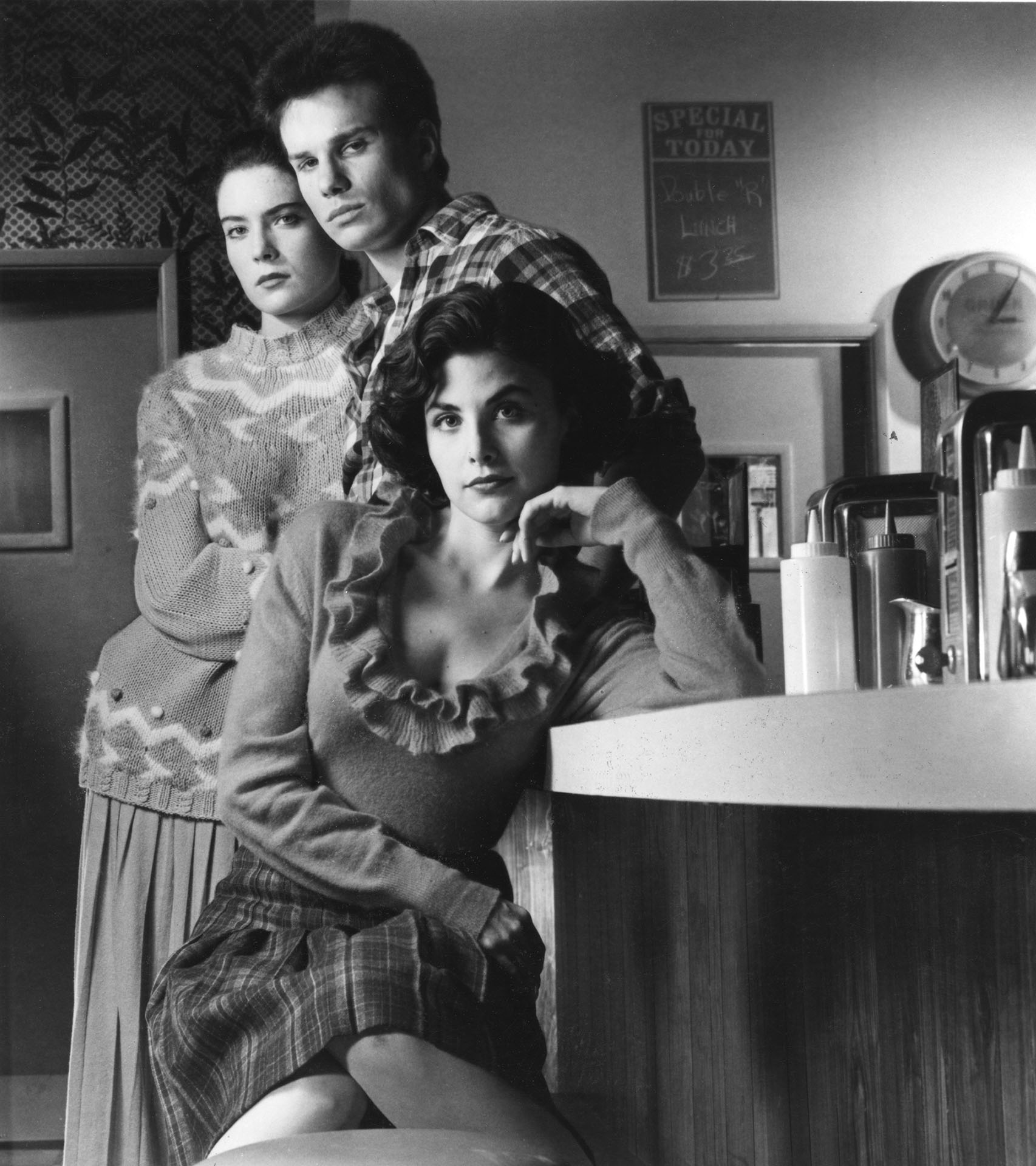
Here is the uncropped photo of Donna Hayward, James Hurley and Audrey Horne on the Double R Diner set. Interestingly the trio never interacts with each other during the show.
Author
Discover more from TWIN PEAKS BLOG
Subscribe to get the latest posts sent to your email.