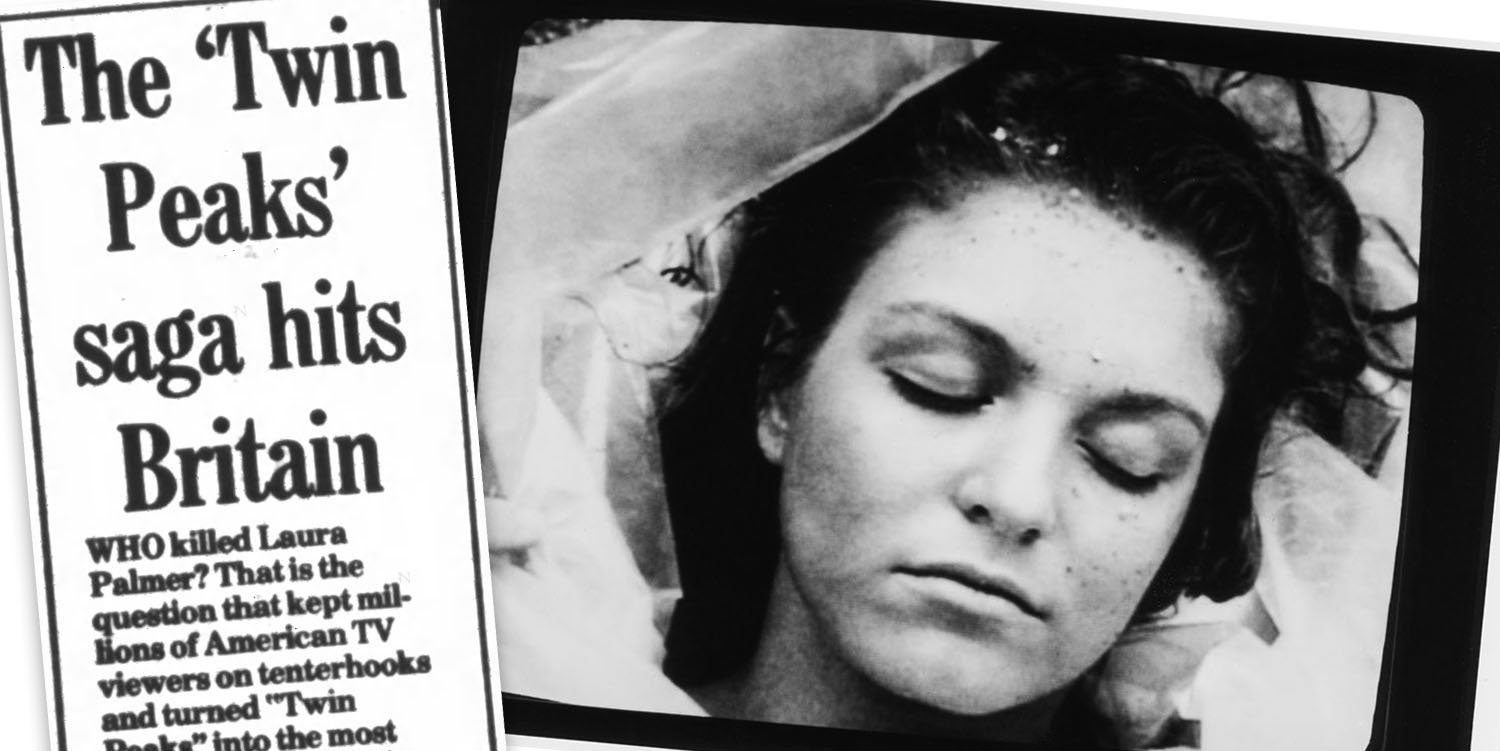
Twin Peaks arrived on UK television screens on Tuesday 23rd October 1990 at 21:00 hours. The UK’s oldest listings magazine, Radio Times (1) devoted its front cover for the week to a portrait of Sherilyn Fenn under the heading “Bad Little Rich Girl”, and inside the publication’s chief film critic Barry Norman introduced the series. Note that it was the film critic, rather than one of the people who covered TV drama, who got the job. That’s unsurprising, really. Norman was, if not a David Lynch fan, then certainly an admirer; one who had given Blue Velvet an acclamatory review, interviewed Lynch at Cannes in May for his BBC TV show Film 90 (2) and would place Wild at Heart in his end of the year top ten only a few weeks later.(3)

After that first screening of the pilot, Twin Peaks ran almost without interruption from the pilot to the Season Two finale and on a weekly schedule, with only a brief break for Christmas. This was pretty much in-keeping with the standard UK approach of the time, where what Americans might call “in-season” breaks were basically unknown, except for around public holidays.
In addition, “going to repeats” in the middle of a run of new programming was, and essentially still is, unknown. To the extent that if you explain it to a non-TV nerd UK viewer even now, they look at you like they’re Sheriff Truman and you’re Leland Palmer bouncing around a holding cell.
WHAT IS BARB?
I’m glad you asked. BARB is the British Audience Research Bureau, a quasi-government agency set up in the early 1980s to bring the ratings for all UK television viewing under one roof, and to make them subject to the same methodology. This replaced two separate systems, one of BBC internal figures, and another for the UK’s then single commercial network, ITV. Because these two systems worked in very different ways. The former was for measuring audience size, and the latter for measuring households. This was because the BBC system was genuinely looking to see how many people had seen a programme, whereas the ITV one was about selling advertising. Which are not the same thing.
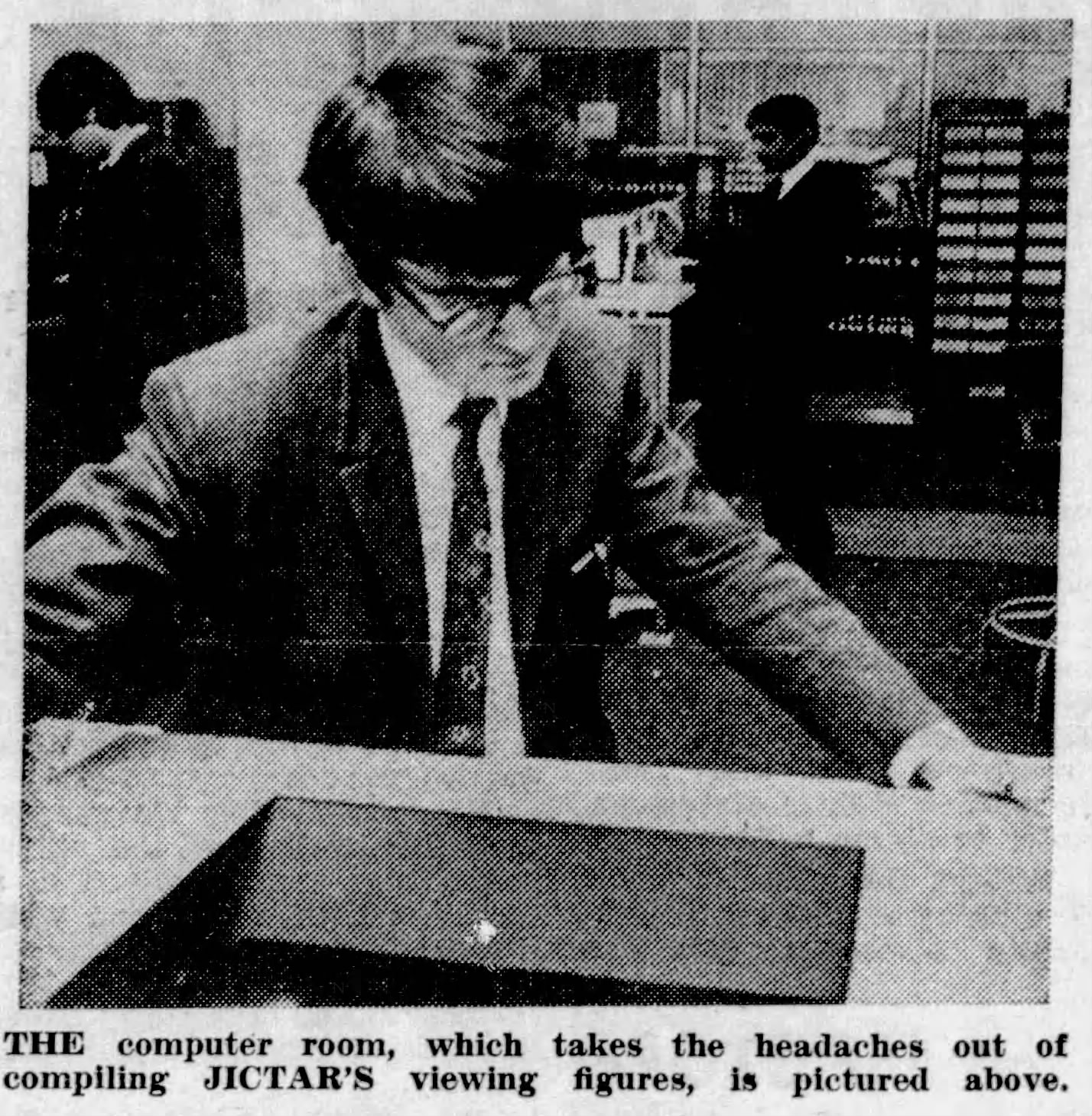
BARB was more like the BBC’s system than JICTAR (which is what ITV’s was called). Initially it was paper based, with a demographically representative sample of the population filling in paper ledgers of what was being watched in a household, by whom and when; it later became more advanced. BARB would, with your permission of course, fit a box to the TV sound output of, again, a demographically representative sample of the population. By automatically comparing the sound waves of what was being sent to the TV’s speakers at any given time to what it knew was on TV, a BARB box would know exactly what you were watching without you telling it. All you had to do was hit the pre-programmed button for the member(s) of the household who were watching, plus any guests. For whom you required to enter basic demographic information with a few more button mashes.
BARB still exists, as do its boxes, and while the methodology they use has changed a few times, that’s because every time the landscape of television has moved, BARB has kept up with it. Just after Twin Peaks finished its UK run, BARB started being able to measure when people were watching VHS recordings of things transmitted recently, and adding this viewing to the programme’s overall recorded viewership. Even by the time Twin Peaks was on, it was capable of conflating two showings of a programme in a single week into one figure. It now measures streaming programmes, even those you watch on your phone, laptop or tablet if you’re on the “BARB panel”, and this is called the “four screens figure,” as such we have loads of good data as to TV viewership in the UK, and for as recently as last week.
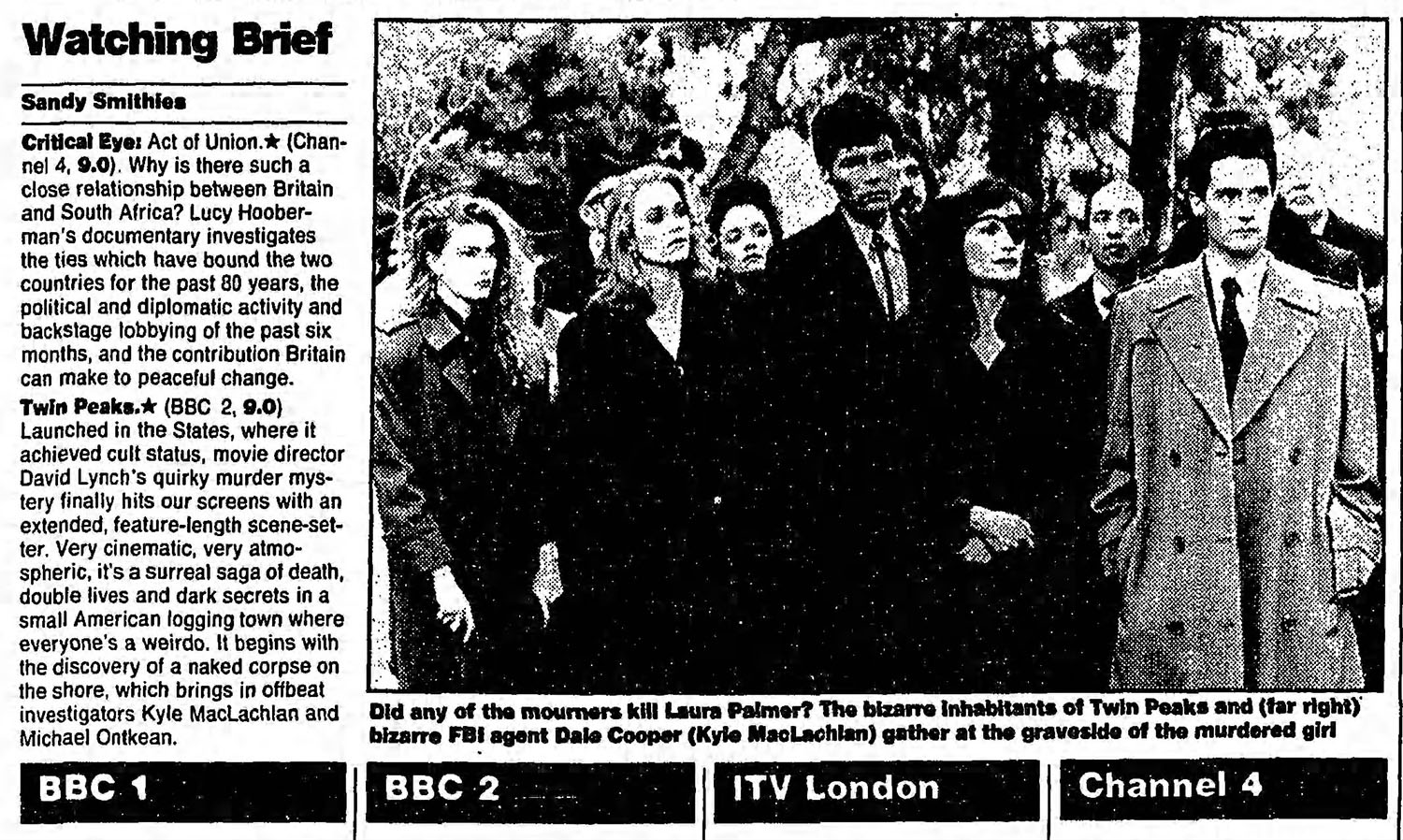
Back in 1990 BARB really only had four channels to report. (4) BBCs One and Two, and ITV had been joined in 1982 by Channel 4. Another commercials-funded station, like ITV, Channel 4 was (and is) also publicly owned, rather than business as such. It is also like BBC Two, in part intended as a “niche” channel, intended to cater to minority interests. Both see it as part of their remit to transmit e.g. artfilms or documentaries on obscure subjects, and did so to an even greater extent in 1990. Channel 4 also developed extensive interests in independent film production, putting money into e.g. Lynch’s The Straight Story (1999) and David Cronenberg’s Crash (1996). It was BBC Two, though, that showed Twin Peaks, and after a surprisingly long build up, and I don’t just mean since the series’ first US airing on 8th April 1990.
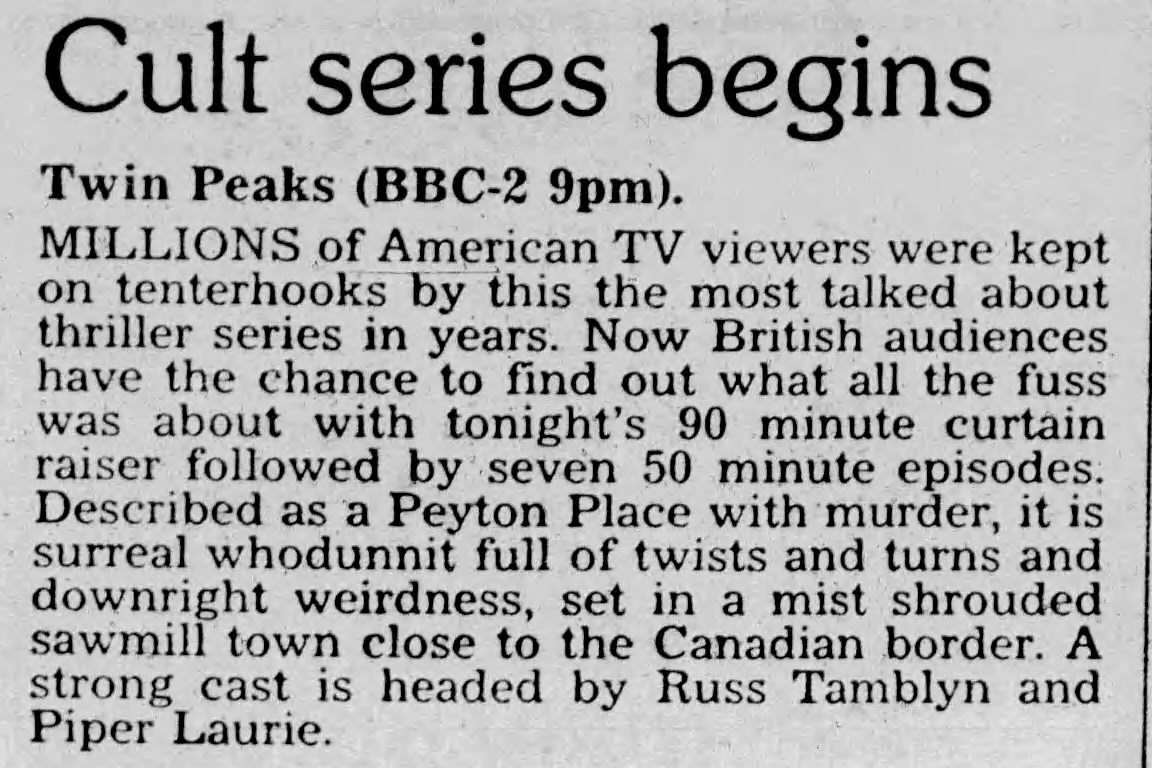
TWIN PEAKS AIRS IN THE UNITED KINGDOM ON OCTOBER 23, 1990

The rental VHS of the International Pilot had been available in UK video shops since 8 December 1989 (yes, before the US airing) and I think every artsy fifteen year old in the land had seen it. Although I hadn’t, as I was only twelve. Said build up continued in the week leading up to the transmission, too.
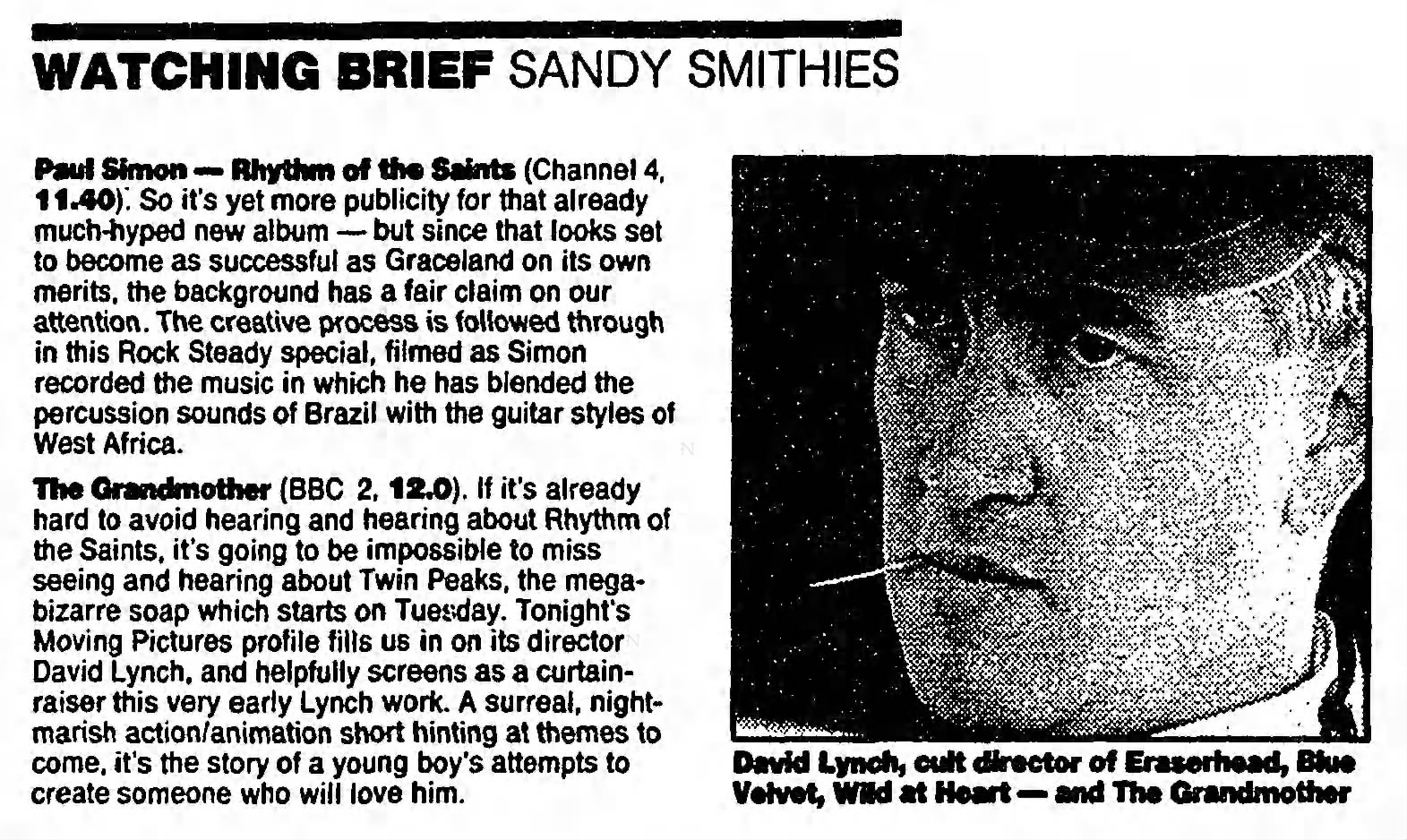
On Saturday 20th October 1990, another BBC film show, Moving Pictures, one which concentrated on art films rather than the latest releases (5) as Film 90 did, profiled Lynch to introduce the series, and concluded that week’s episode with a screening, in full, of his The Grandmother short from 1969. Surely the first time it was shown on national television in any country? And possibly the last too. Then, on Monday afternoon, a ten minute slot before the news was found for an episode of Behind The Screen, yet another film-adjacent series, to make sure the afternoon crowd was aware of what was coming.
The nature of BBC Two and Channel 4 as “minority interest” channels meant that they did not get the highest ratings for any of their programming, and that was fine, because they were not expected to. In the mid 1990s The X-Files did so well on BBC Two that it was moved to BBC One, where the size of its audience was considered to be more appropriate, and likely to grow further. But even a mid-size UK TV audience of the 1980s or 1990s can seem remarkably high, proportionately speaking, by American standards. Or rather by routine American standards. We’ve never had any single programme watched by as many people as the highest ever Superbowl ratings. But then the UK doesn’t have as many people in it as watch the Superbowl some years.
But for a country of, in 1990, 57.3m people, for the prime time soap opera Coronation Street to be routinely getting 19m viewers was remarkable. That’s a whole third of the population watching the same programme at the same time twice a week. Not a third of the people watching TV, you understand, a third of the nation.
I mention all this, broad audience history, relative sizes of population, historical trends and so on, to set the scene and give non-UK readers, whom I assume will be the majority, enough context to make sense of the numbers below.
The list they’re in includes original production codes (i.e., 1.001 = first season, episode #1; 2.001 = second season, episode #1) – along with the episode number starting with 1.001 = #1. I did not include those pesky episode titles which were “added” later after the original ABC Television broadcast.
The two numbers for each episode represent the Tuesday and late Saturday night / early Sunday morning showings within the same week. The figure combining both of these is considered the “true” figure for UK ratings statistical purposes.
Now, I’m sure that’s all as clear as a cup of coffee that’s a black as midnight on a moonless night. So let’s see what we can see.
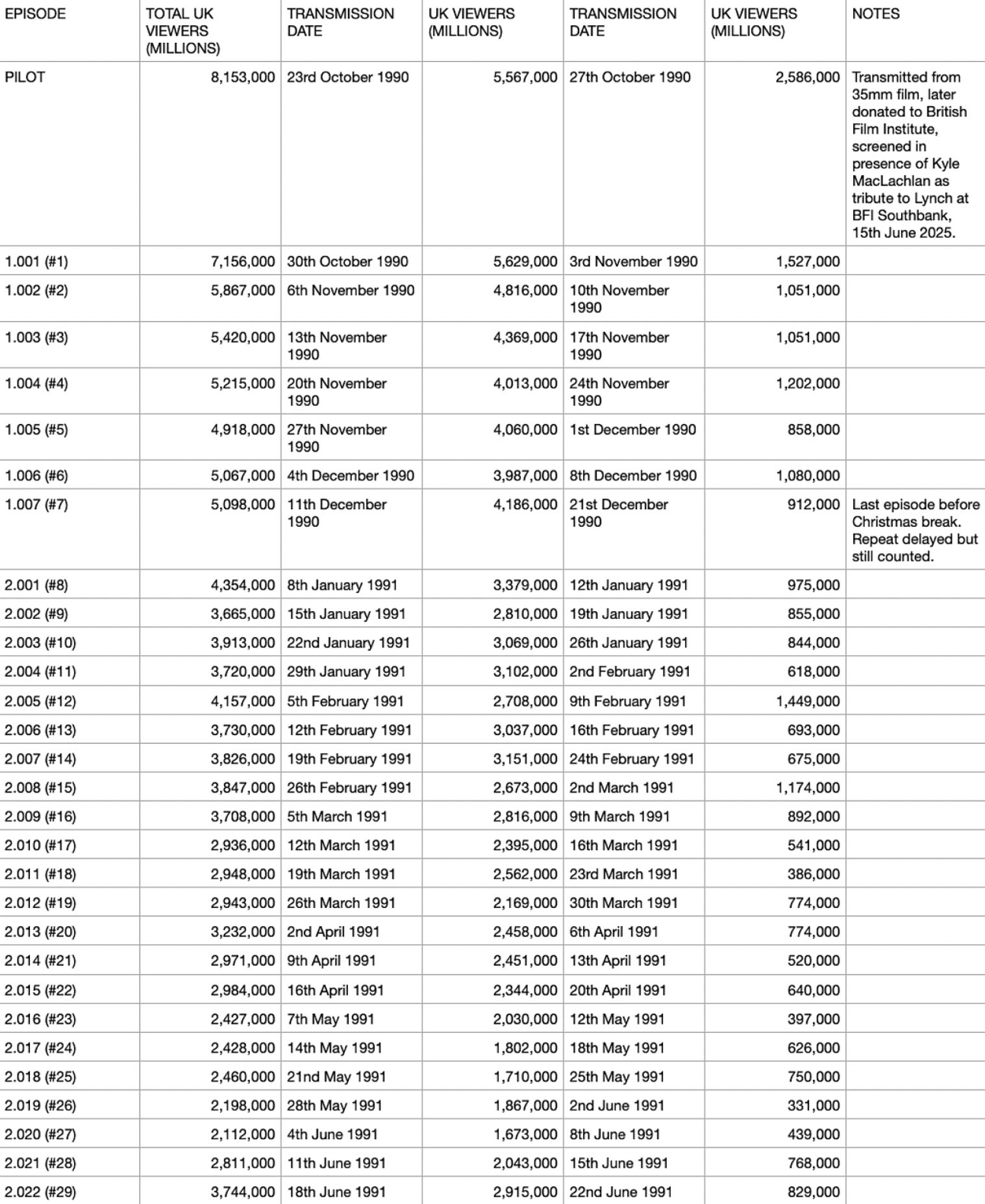
Those figures are of course much smaller than the US numbers. But as we’ve said, the UK has a much smaller population. In 1990/1991 the US was a country of approximately 253,000,000 people, against the UK’s 57.3m. So those figures for the pilot, of 34.6m and 8.15m represent very similar sized slices of their respective populations. 13.6% (US) and 14.2% (UK).
In both countries that was the most watched episode of the series, and in both countries the least watched episode was 2.20, which drew 7.4m (US) and 2.1m (UK) viewers respectively. They represent 2.9% and 3.6% of their respective populations. In both cases the UK is marginally higher.

But what I think is a more interesting takeaway is that the two “markets” rose and fell together, with roughly the same share of the population on both sides of the Atlantic being there at the start and the end. We don’t think of Twin Peaks as being as big in the UK as it was in the US, and in many ways it wasn’t. Not least that that c14% of the population was enough to make the show the fifth most watched thing on US TV the week it launched, whereas an almost identically sized slice of the population landed Twin Peaks in the Top 50 of all UK programming for that month, not the Top 5.
It was, however, #1 for BBC Two, and one of the highest rated programmes in the history of the “minority interest channel,” which was even then nearly thirty years old. This is very much everything then BBC Two Controller Alan Yentob could possibly have wanted for it. Whether that makes it a bigger or smaller hit is really a matter of perspective.

Now, of course, the UK audience couldn’t influence whether Twin Peaks was made or not. Whatever we did wasn’t going to have any impact or whether ABC renewed the series. Or indeed whether CIBY2000 was prepared to fund any more films after Fire Walk With Me which debuted on UK TV, and in the TV series old slot, in 1995. Fire Walk With Me’s UK ratings and indeed its cinema takings are a bit more complicated than the above.
The ratings for the 2017 series of Twin Peaks, which was simulcast with its US broadcast and so shown in the early hours of the morning, are even more so. I need to look into these in a bit more detail, so hopefully I’ll see you all back here for a discussion of them early in 2027?
Aces.
NOTES
- It’s called that because, like the BBC itself, it predates the creation of television.
- It might help American viewers to think of Norman as something like our Ebert equivalent, although his onscreen persona was very different. He presented The Film Programme (which changed its name every season to Film [The Year]) for nearly thirty years, albeit without any kind of onscreen partner, and was the UK’s most recognisable film critic for essentially all of that time. He was a great critic and a lovely man.
- Towards the end of the 1990s I was myself a film critic and had some nice conversations with Norman. He remained a fan of Wild at Heart a decade later, you’ll be pleased to know.
- Plus a handful of satellite channels seen by statistically insignificant numbers of people who were never the less recorded.
- The Lynch profile edition also featured an interview with radical director Derek Jarman. That’s the tone of the show.
Author
Discover more from TWIN PEAKS BLOG
Subscribe to get the latest posts sent to your email.