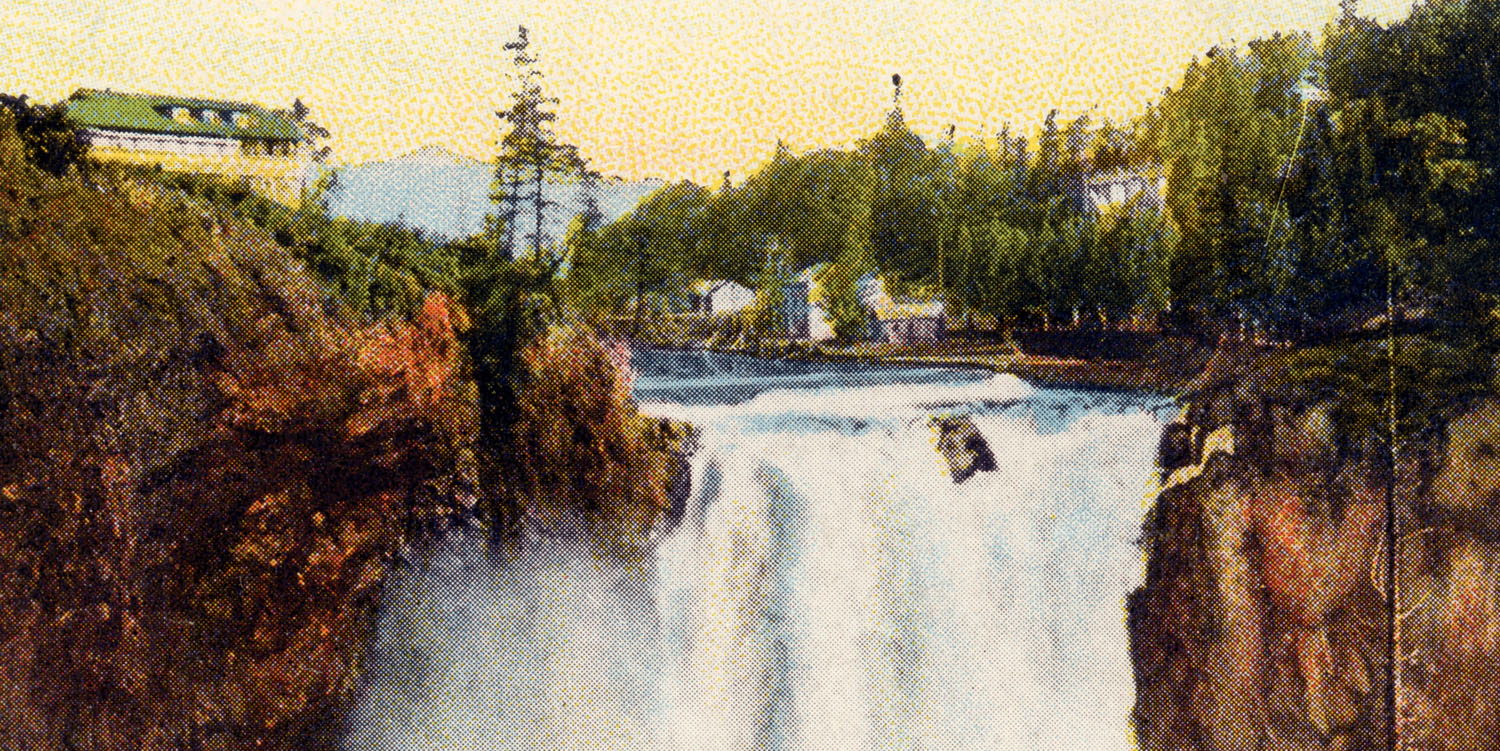
Snoqualmie Falls and Snoqualmie Falls Lodge, known today as Salish Lodge & Spa, have served as inspiration for countless postcards for decades. This postcard produced by the C.P. Johnston Co. of Seattle Washington uses a colorized photo taken by John Juleen from J.A. Juleen Studio in Everett. I was surprised to a see a lengthy inscription on the back that completely skips over the importance of the falls to the Snoqualmie Tribe.
SNOQUALMIE FALLS AND LODGE POSTCARD BY C.P. JOHNSTON CO. – 3228 | FRONT
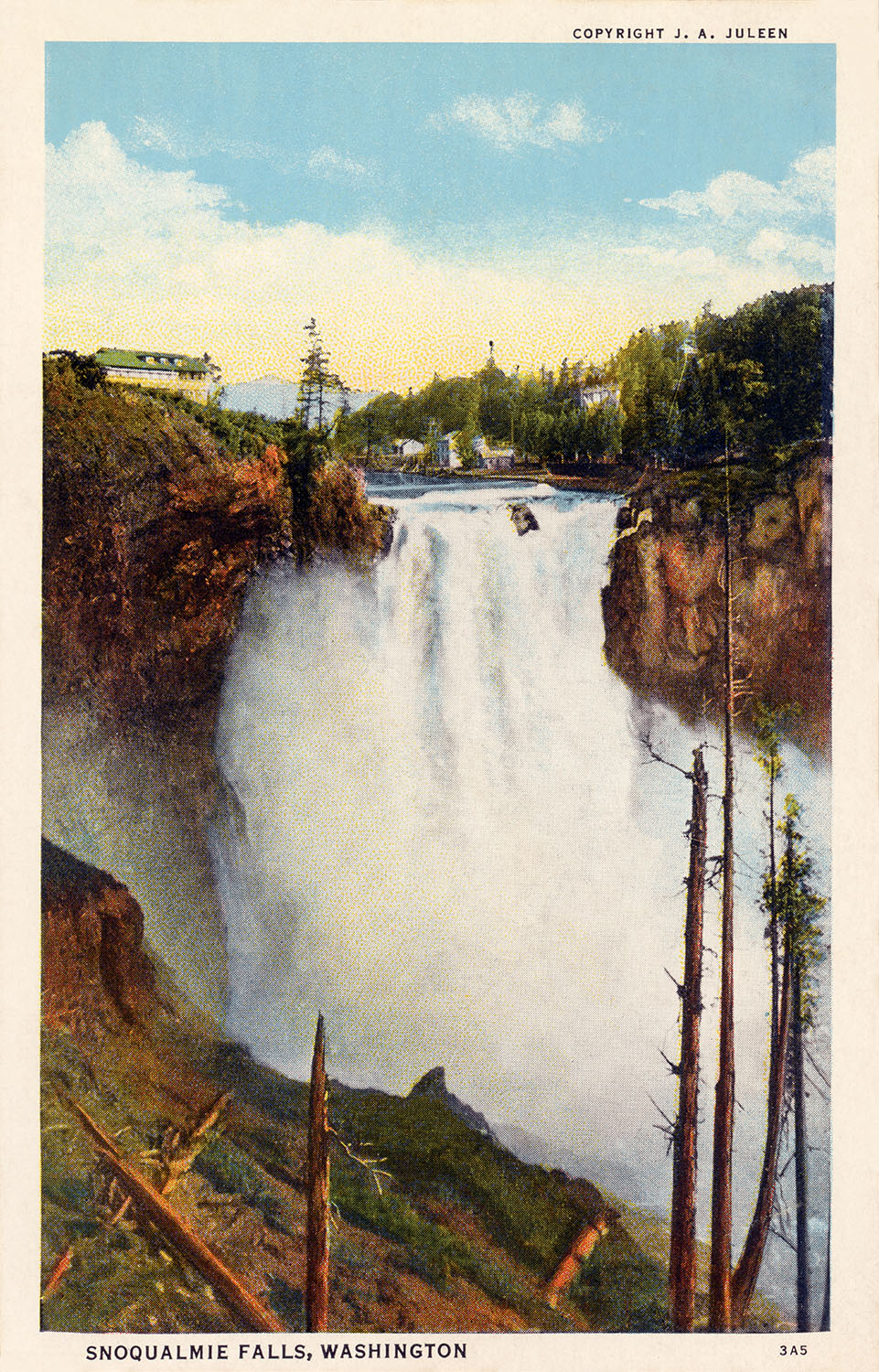
This Snoqualmie Falls postcard shows the 268-foot waterfall at full flow. Perched above the falls, you’ll see the former Snoqualmie Falls Lodge which opened in 1916 as a roadside inn and restaurant.
The front of the card contains the words “Snoqualmie Falls, Washington” and an unidentified code 3A5. The copyright is J.A. Juleen, who was John Albert Juleen, a Washington state photographer based in Everett.
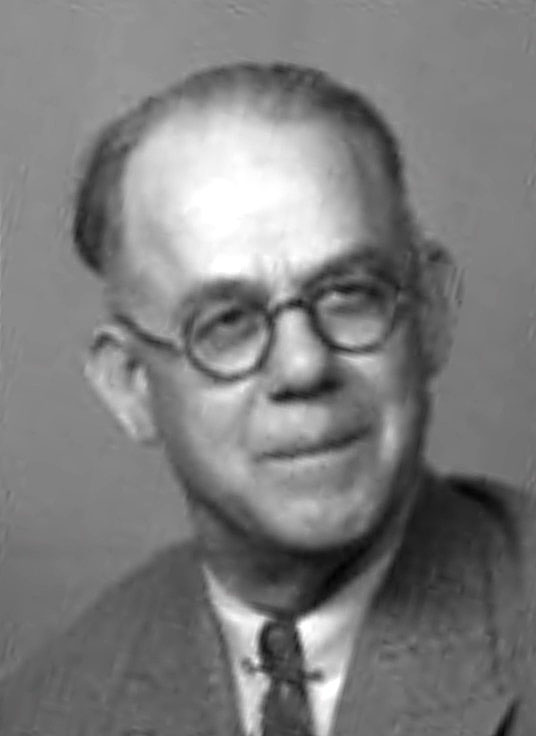
Juleen operated the J.A. Juleen Studio in Everett from about 1908 to his death in July 1935. After John’s passing, his wife Lena Dalquist Juleen ran the business until her passing in 1955. They produced thousands of photographs of businesses, residents, street views and more in Everett and Snohomish County.
John was born in Whitehall, Michigan, January 19, 1874 and began his career as an electrical engineer. In 1907, he moved to Seattle, Washington to follow that line of work. A year later in April 1908, Juleen was sent to Everett to open a local office for the Seattle Electric Company. Photography was John’s hobby but he turned it into a successful business, first operating out of the Colby Building, located on the southwest corner of Hewitt and Colby in Everett.
According to the Everett Public Library, his photo studio moved around town to the “Eclipse Building at 2810 Colby in 1912; 1709 Hewitt Avenue, circa 1921; and 2930 Rockefeller in 1923. For a time, Lee Juleen operated the studio in Everett’s Bon Marche building.”
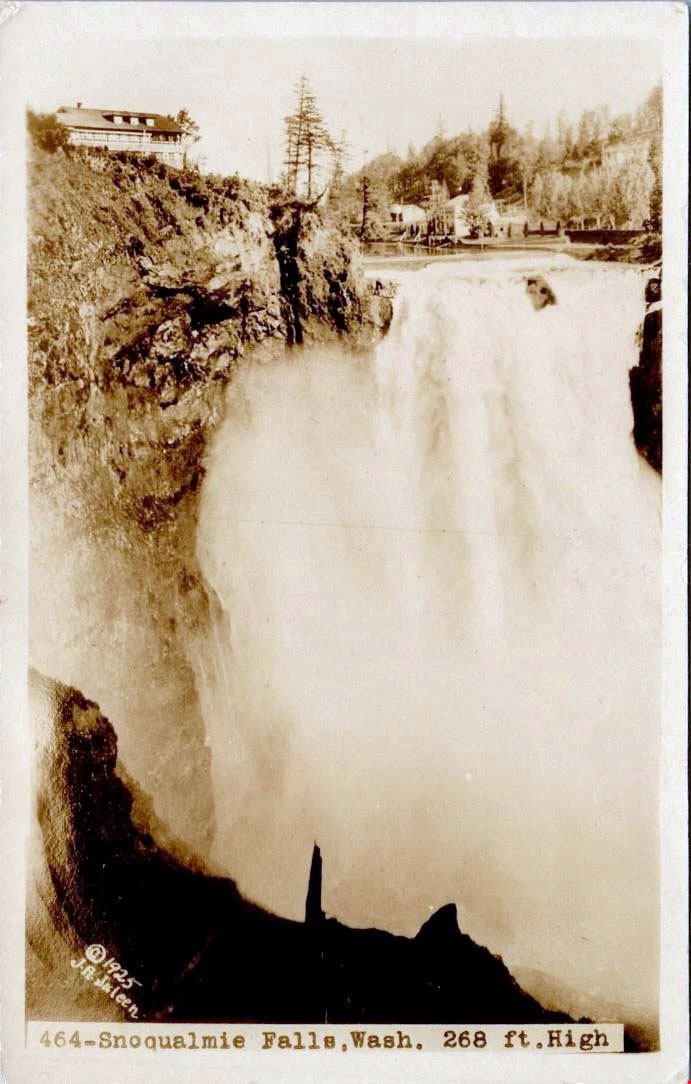
In 1925, Juleen captured this photograph of Snoqualmie Falls which I believe was referenced by C.P. Johnston Co. to make the postcard. I didn’t find much information about C.P. Johnston other than numerous postcards of Seattle published between the early 1900s through the 1970s. One page said the company was a “defunct postcard manufacturer.” The company seemed pretty prolific as there were many image of buildings, landscapes and events including the Space Needle from the 1962 World’s Fair in Seattle.
SNOQUALMIE FALLS AND LODGE POSTCARD BY C.P. JOHNSTON CO. – 3228 | BACK
The back of the card contains the manufacturing details. The card was colored by C. T. American Art based in Chicago, Illinois. Founded in Chicago in 1898, the Curt Teich Company would become the most dominant printer of postcards in the United States.
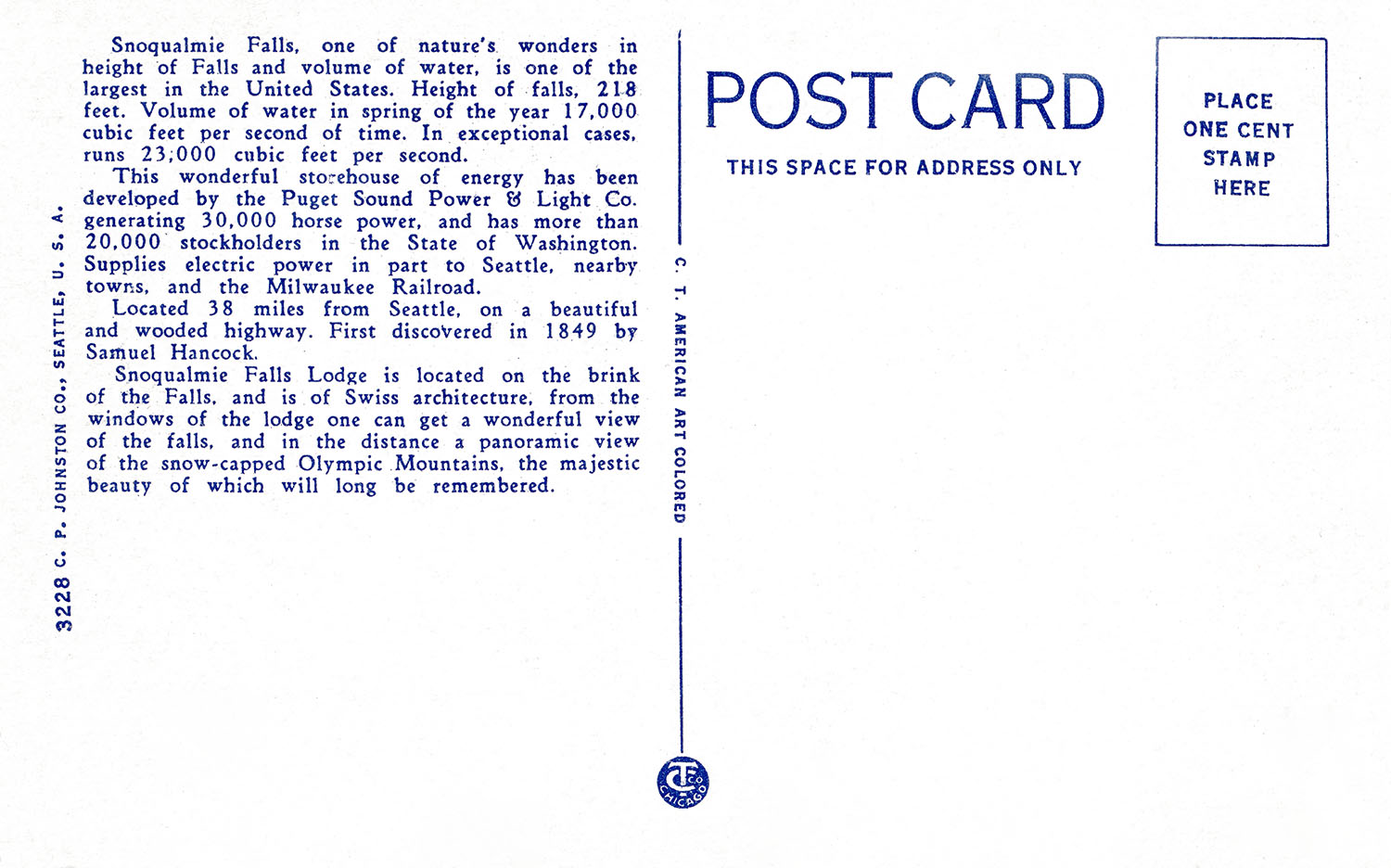
The inscription, however, is the thing that surprised me the most. It takes up most of the space where someone who purchased the card would typically write a message to friends, family or loved ones. This four paragraph note reads:
Snoqualmie Falls, one of nature’s wonders in height of Falls and volume of water, is one off the largest in the United States. Height of falls, 218 feet. Volume of water in spring of the year 17,000 cubic feet per second of time. In exceptional cases, runs 23, 000 cubic feet per second.
This wonderful storehouse of energy has been developed by the Puget Sound Power & Light Co. generating 30,000 horse power, and has more than 20,000 stockholders in the State of Washington. Supplies electric power in part to Seattle, nearby towns, and the Milwaukee Railroad.
Located 38 miles from Seattle, on beautiful and wooded highway. First discovered in 1849 by Samuel Hancock.
Snoqualmie Falls Lodge is located on the brink of the Falls, and is of Swiss architecture, from the windows of the lodge one can get a wonderful view of the falls, and in the distance a panoramic view of the snow-capped Olympic Mountains, the majestic beauty of which will long be remembered.
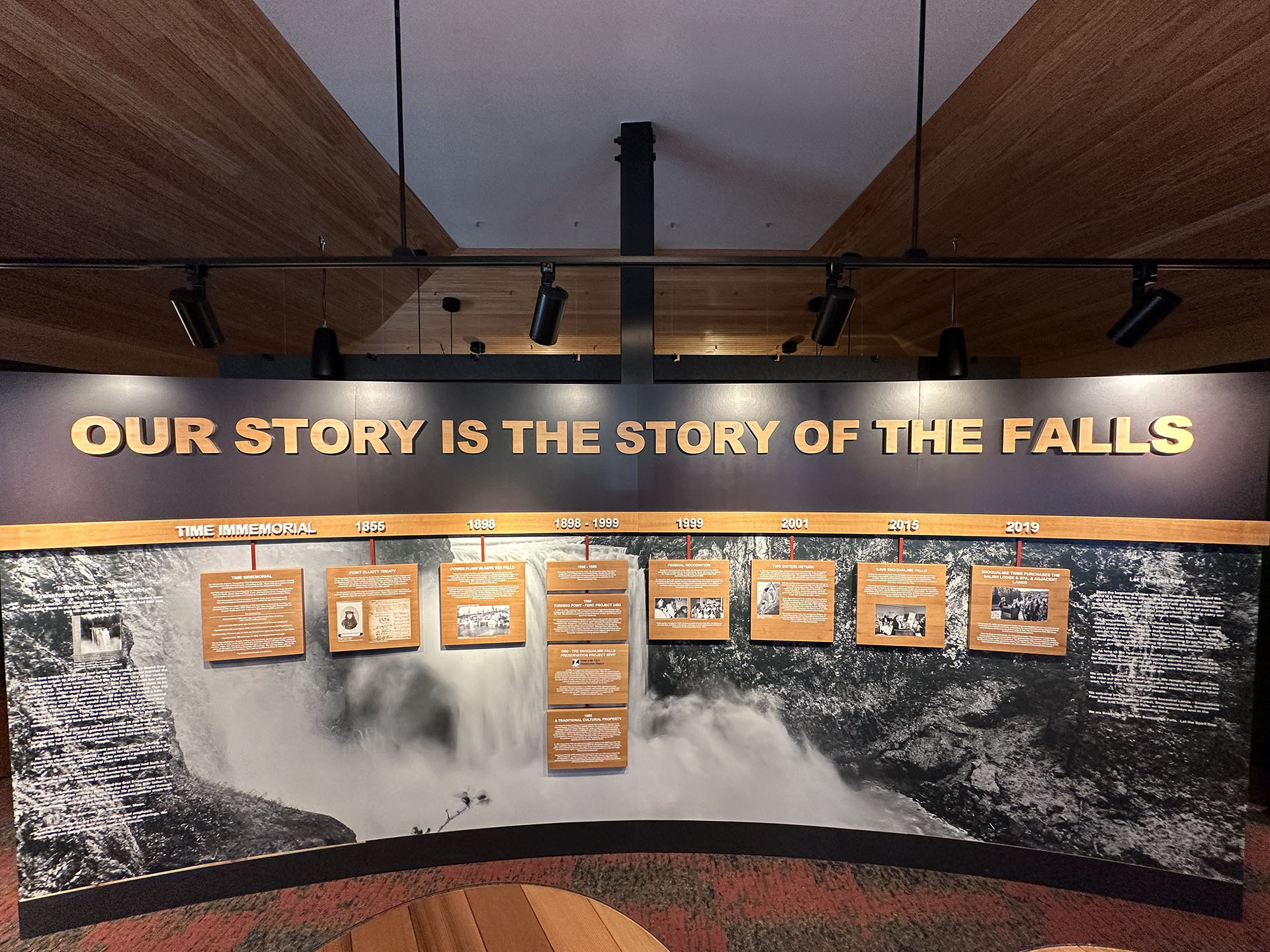
Clearly, the inscription was written at a different time in society, before the Snoqualmie Tribe was respected and represented.
It’s true that Samuel Hancock was an early white explorer who provided the first written documentation about the falls. According to the East Side Heritage Center, Hancock was searching for coal with Native American guides in the region. He learned about Snoqualmie Fall and asked to be shown this natural wonder. He wrote the following in 1851:
“We went right alongside the cataract* in our canoe and beheld a most imposing spectacle, though the roar was almost deafening. The river has a perpendicular fall of about 170 feet, with a surface at the present stage of the water not more than 30 feet broad. The banks upon either side of the basin, where the cataract deposits itself, are perhaps 200 feet high, and so steep that it is impossible to climb them.”
*A cataract waterfall is created when a large amount of water moving very quickly drops off a cliff to form the falls. It is determined based on the size and power of the waterfall.
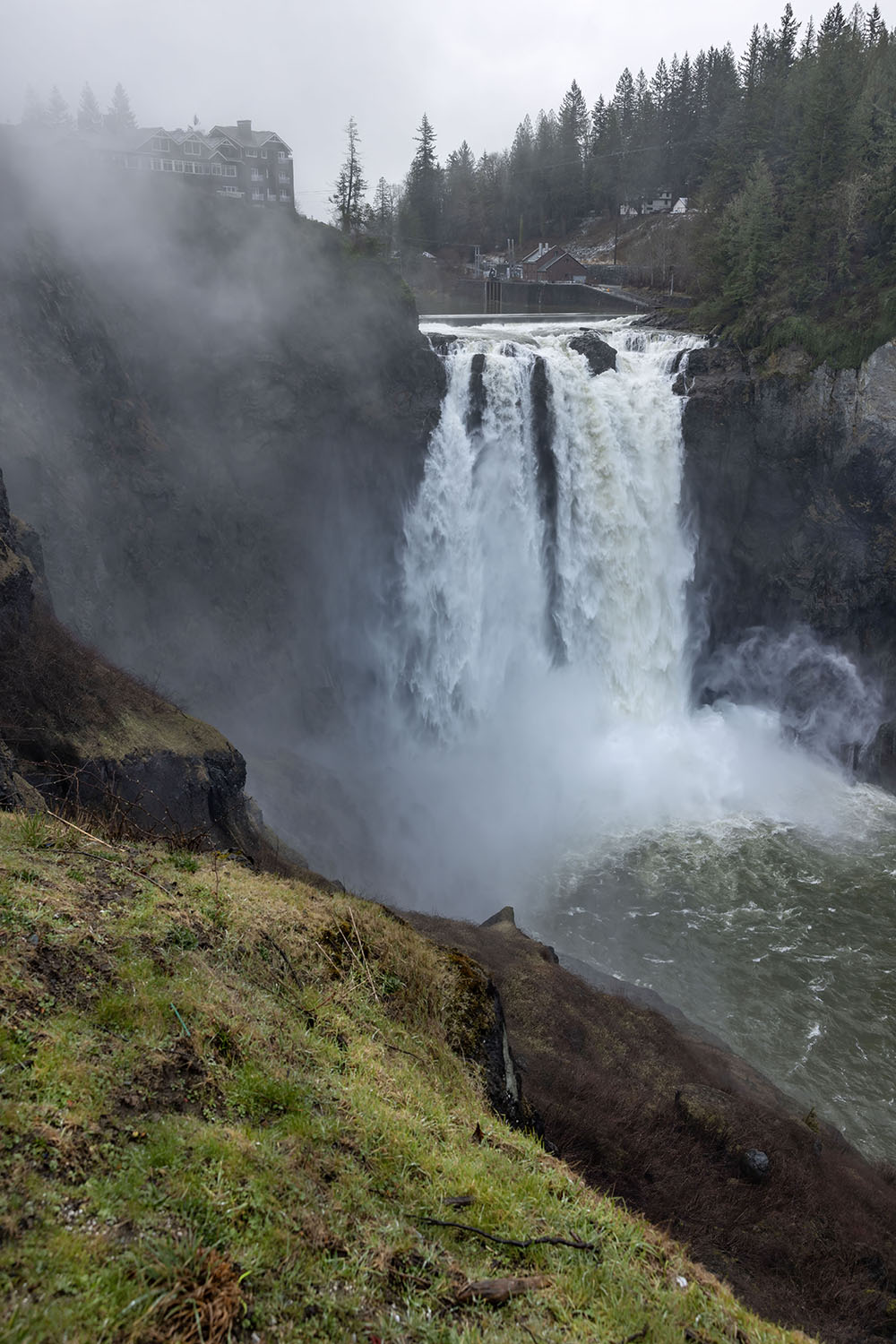
Yet the falls were considered a sacred place to the Snoqualmie Tribe long before Hancock’s visit. The tribe says Moon the Transformer created the falls and the first Snoqualmie Man and Woman were made at this sacred spot.
I invite you to stop by the Snoqualmie Falls Gift Shop next time you are in Snoqualmie where you can learn more about the importance of the land to the tribe. Learn more about what you can do to protect, respect and restore it on the Snoqualmie Tribe Ancestral Land Movement website.
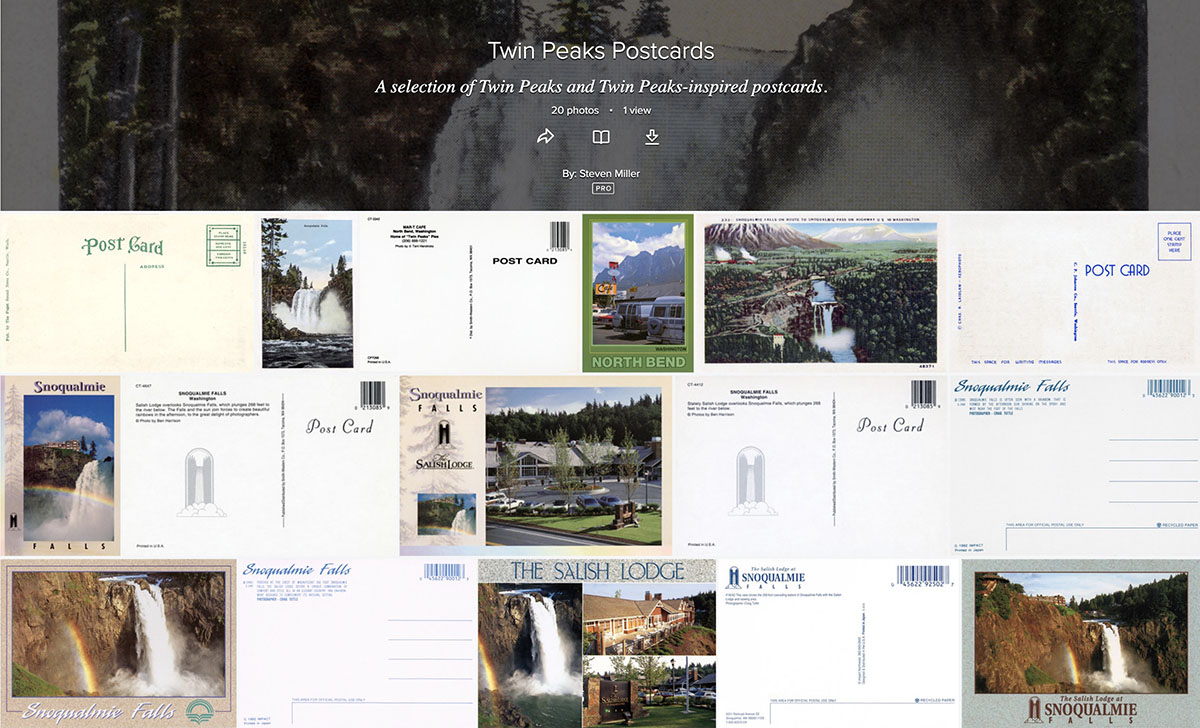
Download a high-resolution version of this postcard on my Flickr account: https://www.flickr.com/photos/aloha75/albums/72177720331531617
Author

Discover more from TWIN PEAKS BLOG
Subscribe to get the latest posts sent to your email.