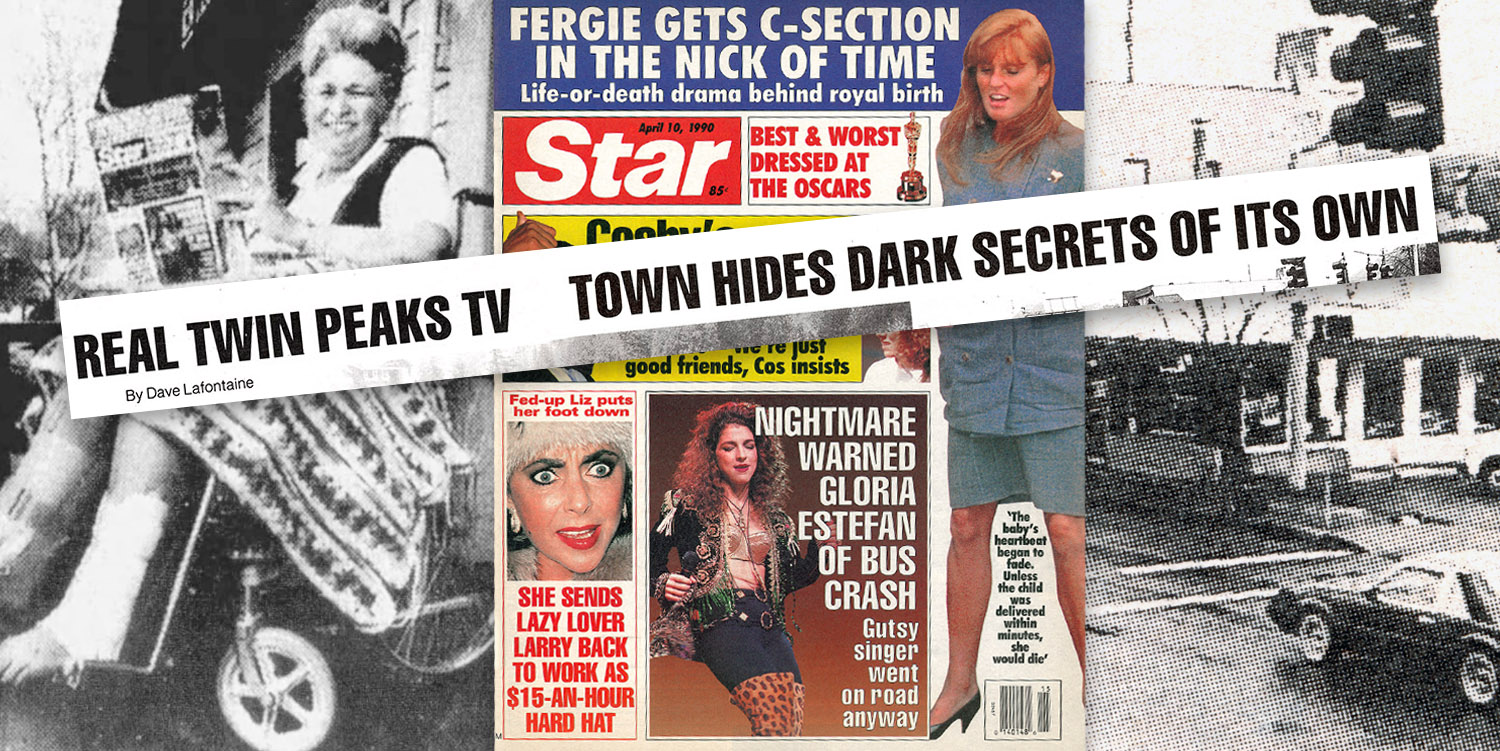
When Mark Frost and David Lynch’s Twin Peaks first aired on April 8, 1990, newspapers and magazines had wall-to-wall coverage of the show that was unlike anything ever seen on network television. Two days after the pilot was shown, the American celebrity tabloid magazine, Star, published a two-page spread about the real Twin Peaks of North Bend and Snoqualmie where Frost and Lynch filmed their groundbreaking series. The report by Dave Lafontaine with photos by Eddie Sanderson is something of legend for an archivist like me. I’m happy to present the original Star article along with The Seattle Times‘ Louis T. Corsaletti’s syndicated story that offered a rebuttal to Lafontaine’s slightly sensationalized report.
WHAT IS THE AMERICAN CELEBRITY TABLOID MAGAZINE, STAR?
Founded in 1974 by Rupert Murdoch, Star is an American celebrity supermarket tabloid magazine that features sensationalized stories paired with unflattering photos that are designed to grab shoppers’ attention. The paper was original headquartered in New York City as a competitor to the National Enquirer tabloid. In the late 1980s, the magazine relocated its offices to Tarrytown, New York.
On March 29, 1990, Murdoch sold the magazine to G.P. Group, Inc., then publisher of the National Enquirer and Weekly World News, for $400 million. At the time, Star had a weekly circulation of 3.6 million while the Enquirer’s circulation was 4 million. Today, the paper is owned by American Media, Inc. and is found online at Starmagazine.com.
STAR ON APRIL 10, 1990 | COVER
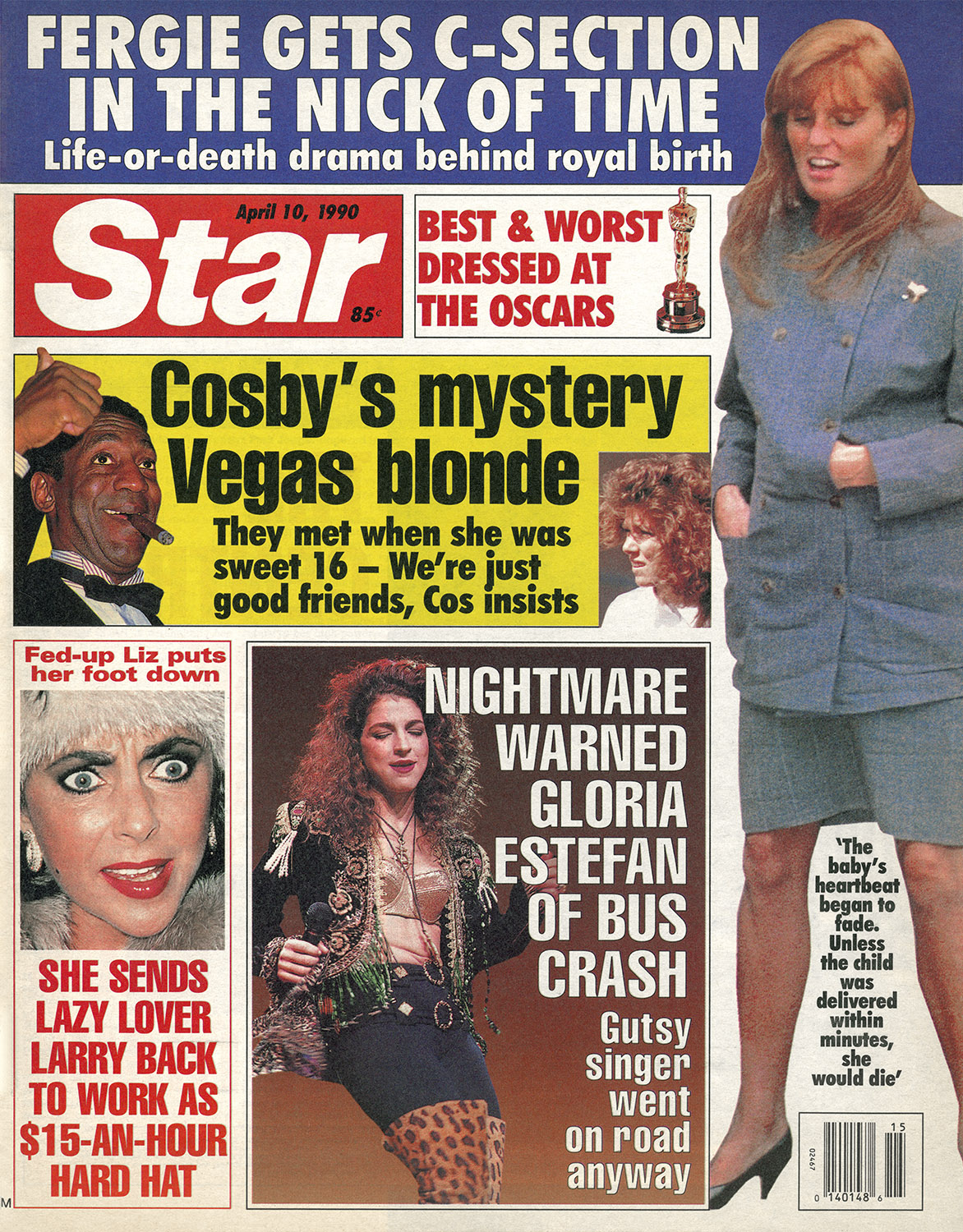
This is how the cover of Star looked when it was published on Tuesday April 10, 1990. You can see some of those attention-grabbing headlines about the Royal family, Liz Taylor, Gloria Estefan and more. There was, however, no mention of the real Twin Peaks article on the cover.
The story was written by Dave LaFontaine with with photos taken by Eddie Sanderson
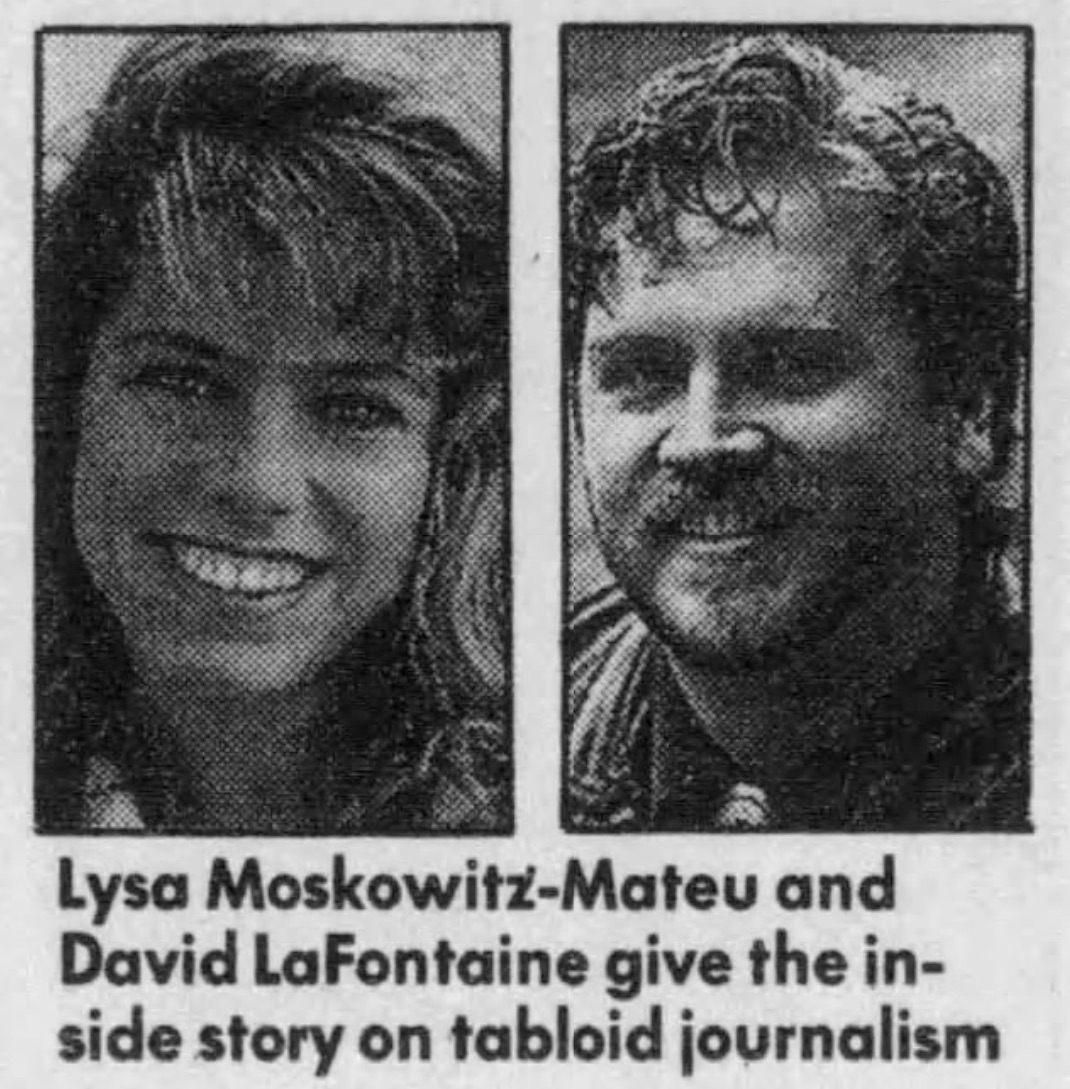
According to the back cover of “Poison Pen: the True Confessions of Two Tabloid Reporters” co-authored with his then wife Lysa Moskowitz-Mateu, LaFontaine began his journalism career at age fourteen and has been writing for newspapers and magazines ever since.
A graduate of the University of Wisconsin-Eau Claire, he was awarded a Pulliam Fellowship to work at the Arizona Republic. He served as managing editor of the Caracas Daily Journal (now the Latin American Herald-Tribune), the largest English-language newspaper in South America, until joining the staff of Star.
His wife Lysa was a graduate of the University of Southern California and was a staff reporter for Star magazine until 1993. In 1996 the couple owned a karate school in Los Angeles called L.A. Mateu Karate Dojo.
Today, Dave is a lead UX designer, researcher, and trainer who “has written or coauthored five books, including Social Media Design For Dummies and Mobile Web Design For Dummies, and produced more than 40 hours of online training videos for KelbyOne and Pluralsight.” As an adjunct professor at the Annenberg School for Journalism at the University of Southern California, he taught Digital Immersion, Online Multimedia, and Digital Publishing.

Eddie Sanderson was born and educated in England. He spent more than 40 years as a feature photographer traveling the world. Eddie’s photos were syndicated in over 20 countries, printed on more than 1,000 magazine covers worldwide. He did over 2,500 assignments worldwide for print, movie and television productions. His wide range of work includes fine art, celebrity home shoots, music icons, fashion, corporate jets, nature, royalty and presidents.
Sanderson published two books, with the second titled “Every Picture tells a Story.” This collection of photographs and anecdotes of iconic music figures and celebrities he photographed for five decades. His website is no longer active and I can’t find any updated information about him.
STAR ON APRIL 10, 1990 | PAGES 30-31
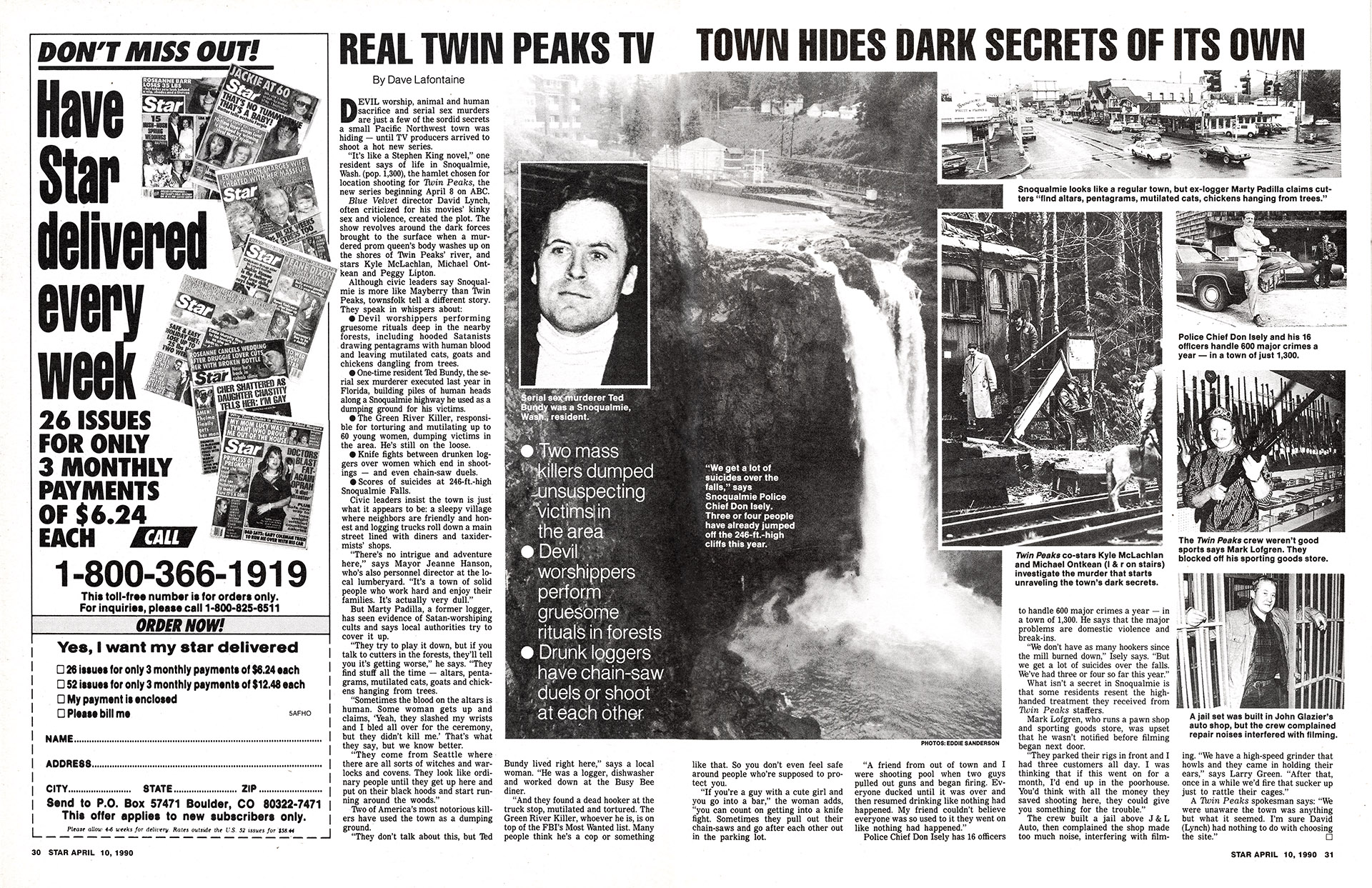
Dave LaFontaine’s story about the real Twin Peaks was found on pages 30-31 with the headline, “Real Twin Peaks TV Town Hides Dark Secrets of Its Own.” I’ve transcribed the long, out-of-print article below.
Real Twin Peaks TV Town Hides Dark Secrets of Its Own
Devil worship, animal and human sacrifice and serial sex murders are just a few of the sordid secrets a small Pacific Northwest town was hiding – until TV producers arrived to shoot a hot new series.
“It’s like a Stephen King novel,” one resident says of life in Snoqualmie, Wash. (pop. 1,300), the hamlet chosen for location shooting for Twin Peaks, the new series beginning April 8 on ABC.
Blue Velvet director David Lynch, often criticized for his movies’ kinky sex and violence, created the plot. The show revolves around the dark forces brought to the surface when a murdered prom queen’s body washes up on the shores of Twin Peaks’ river, and stars Kyle McLachlan, Michael Ontkean and Peggy Lipton.
Although civic leaders say Snoqualmie is more like Mayberry than Twin Peaks, townsfolk tell a different story. They speak in whispers about:
- Devil worshippers performing gruesome rituals deep in the nearby forests, including hooded Satanists drawing pentagrams with human blood and leaving mutilated cats, goats and chickens dangling from trees.
- One-time resident Ted Bundy, the serial sex murderer executed last year in Florida, building piles of human heads along a Snoqualmie highway he used as a dumping ground for his victims.
- The Green River Killer, responsible for torturing and mutilating up to 60 young women, dumping victims in the area. He’s still on the loose
- Knife fights between drunken loggers over women which end in shootings – and even chainsaw duels.
- Scores of suicides at 246-ft.-high Snoqualmie Falls. (ed. note – Snoqualmie Falls is 268-feet)
Civic leaders insist the town is just what it appears to be: a sleepy village where neighbors are friendly and honest and logging trucks roll down a main street lined with diners and taxidermists shops.
“There’s no intrigue and adventure here,” says Mayor Jeanne Hanson, who’s also personnel director at the local lumberyard. “It’s a town of solid people who work hard and enjoy their families. It’s actually very dull.”
But Marty Padilla, a former logger, has seen evidence of Satan-worshiping cults and says local authorities try to cover it up.
“They try to play it down, but if you talk to cutters in the forests, they’ll tell vou it’s getting worse” he savs. “They find stuff all the time – altars, penta-grams, mutilated cats, goats and chickens hanging from trees.
“Sometimes the blood on the altars is human. Some woman gets up and claims, ‘Yeah, they slashed my wrists and I bled all over for the ceremony. but they didn’t kill me!’ That’s what they say, but we know better.
“They come from Seattle where there are all sorts of witches and warlocks and covens. They look like ordinary people until they get up here and put on their black hoods and start running around the woods.”
Two of America’s most notorious killers have used the town as a dumping ground.
“They don’t talk about this, but Ted Bundy lived right here,” says a local woman.
“He was a logger, dishwasher and worked down at the Busy Bee diner.
“And they found a dead hooker at the truck stop, mutilated and tortured. The Green River Killer, whoever he is, is on top of the FBI’s Most Wanted list. Many people think he’s a cop or something like that. So you don’t even feel safe around people who’re supposed to protect you. (ed. note – Police wouldn’t arrest Gary Ridgway until Nov. 30, 2001 when he was working at a Kenworth truck factory).
“If you’re a guy with a cute girl and you go into a bar ” the woman adds, “you can count on getting into a knife fight. Sometimes they pull out their chainsaws and go after each other out in the parking lot.
“A friend from out of town and I were shooting pool when two guys pulled out guns and began firing. Everyone ducked until it was over and then resumed drinking like nothing had happened. My friend couldn’t believe everyone was so used to it they went on like nothing had happened.”
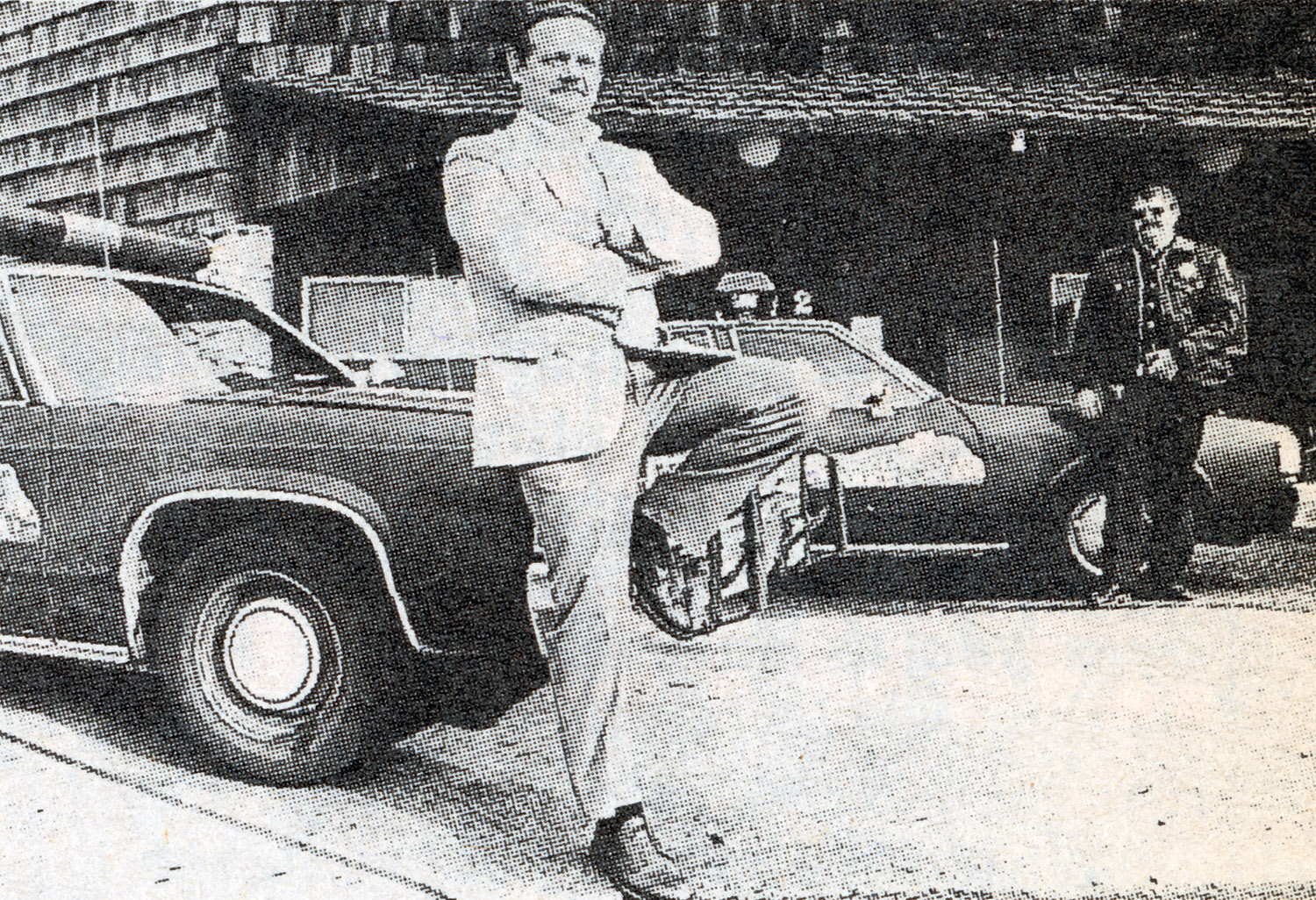
Police Chief Don Isely has 16 officers to handle 600 major crimes a year – in a town of 1,300. He says that the major problems are domestic violence and break-ins.
“We don’t have as many hookers since the mill burned down,” Isely says. (ed. note – The plywood plant at the Weyerhaeuser Sawmill in Snoqualmie did burn down on February 5, 1989. That burned mill footage was used in Twin Peaks for the burned Packard Sawmill)
“But we get a lot of suicides over the falls. We’ve had three or four so far this year.”
What isn’t a secret in Snoqualmie is that some residents resent the high-handed treatment they received from Twin Peaks staffers.
Mark Lofgren, who runs a pawn shop and sporting goods store, was upset that he wasn’t notified before filming began next door.
“They parked their rigs in front and I had three customers all day. I was thinking that if this went on for a month, I’d end up in the poorhouse. You’d think with all the money they saved shooting here, they could give you something for the trouble.”
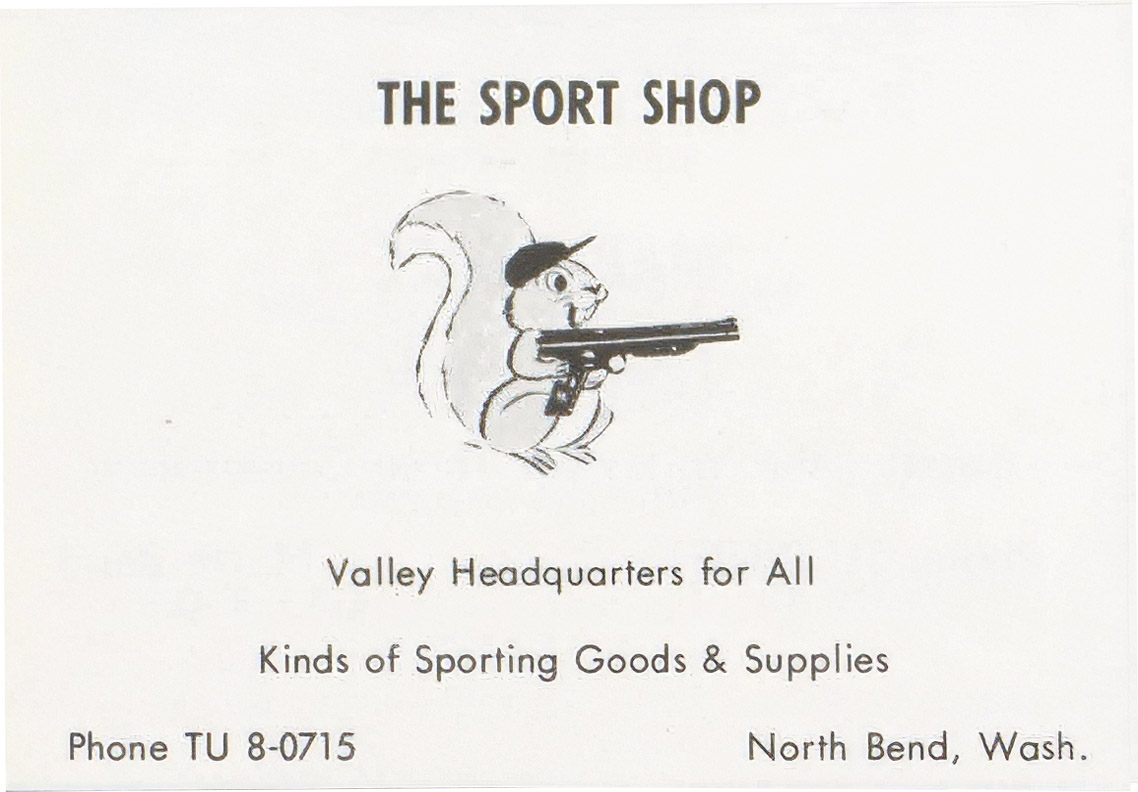
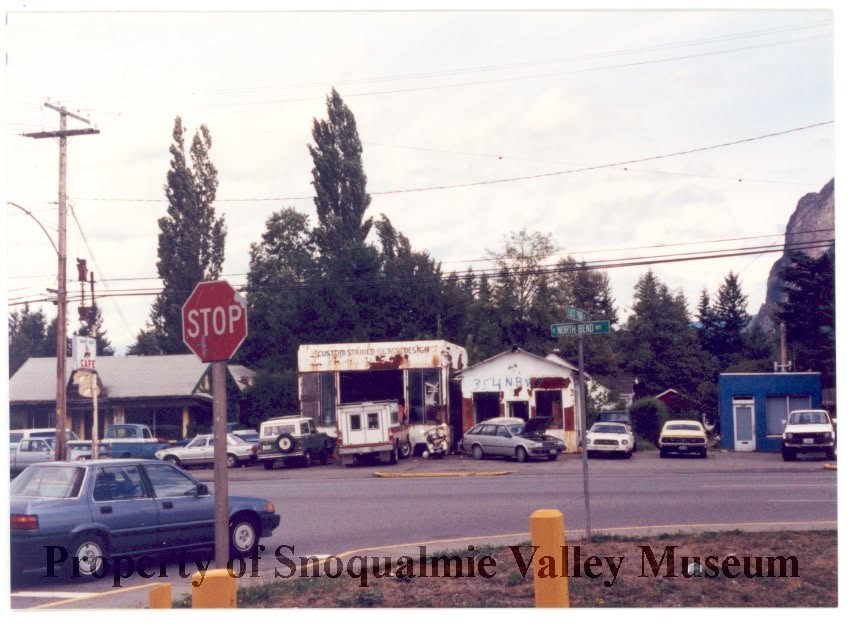
Most likely the sporting good store mentioned was the former The Sport Shop which was located at 129 West North Bend Way. This shop was next to the former Mar-T Cafe where the crew spent three days filming in February 1989. Today it’s home to Lucia’s European Tailoring and Alternations (seen briefly in the background of Part 11 from Twin Peaks: The Return) and the Twin Peaks Pub.
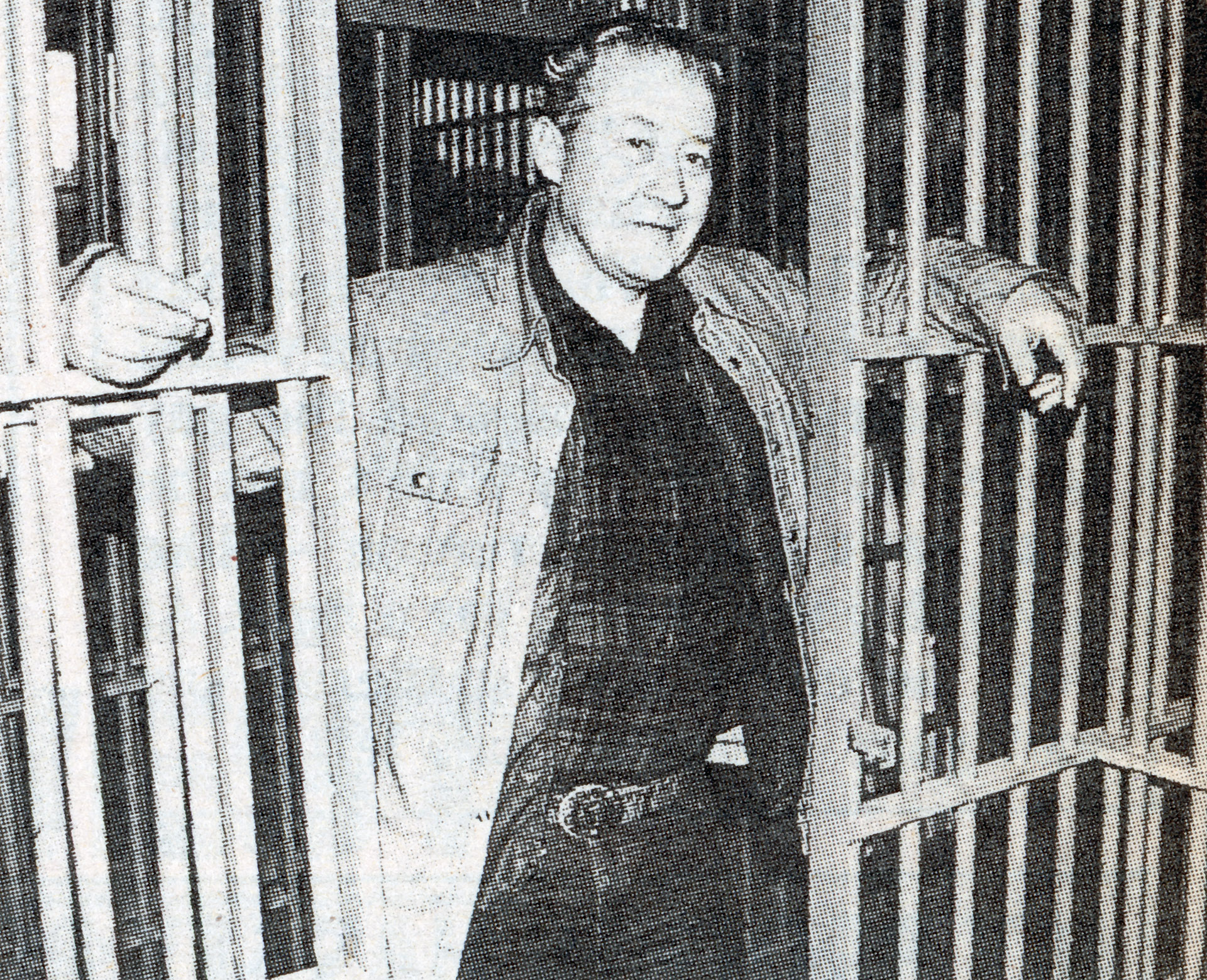
The crew built a jail above J& L Auto, then complained the shop made too much noise, interfering with filming “We have a high-speed grinder that howls and they came in holding their ears,” says Larry Green. “After that, once in a while we’d fire that sucker up just to rattle their cages.”
A Twin Peaks spokesman says: “We were unaware the town was anything but what it seemed. I’m sure David (Lynch) had nothing to do with choosing the site.”
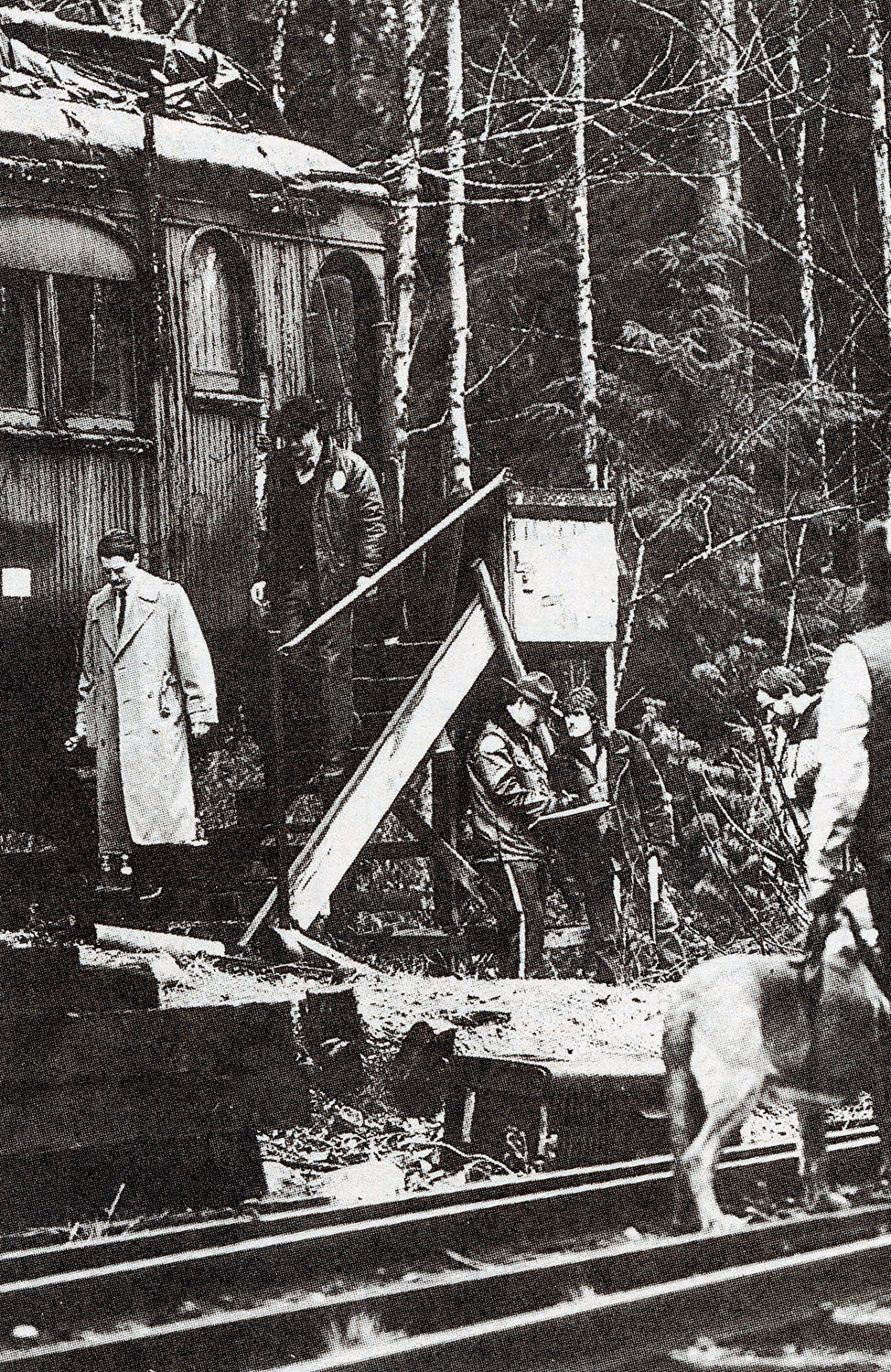
There is a fantastic shot of Special Agent Dale Cooper and Sheriff Harry S. Truman leaving the train car at the former train graveyard once located off Snoqualmie Parkway in Snoqualmie.
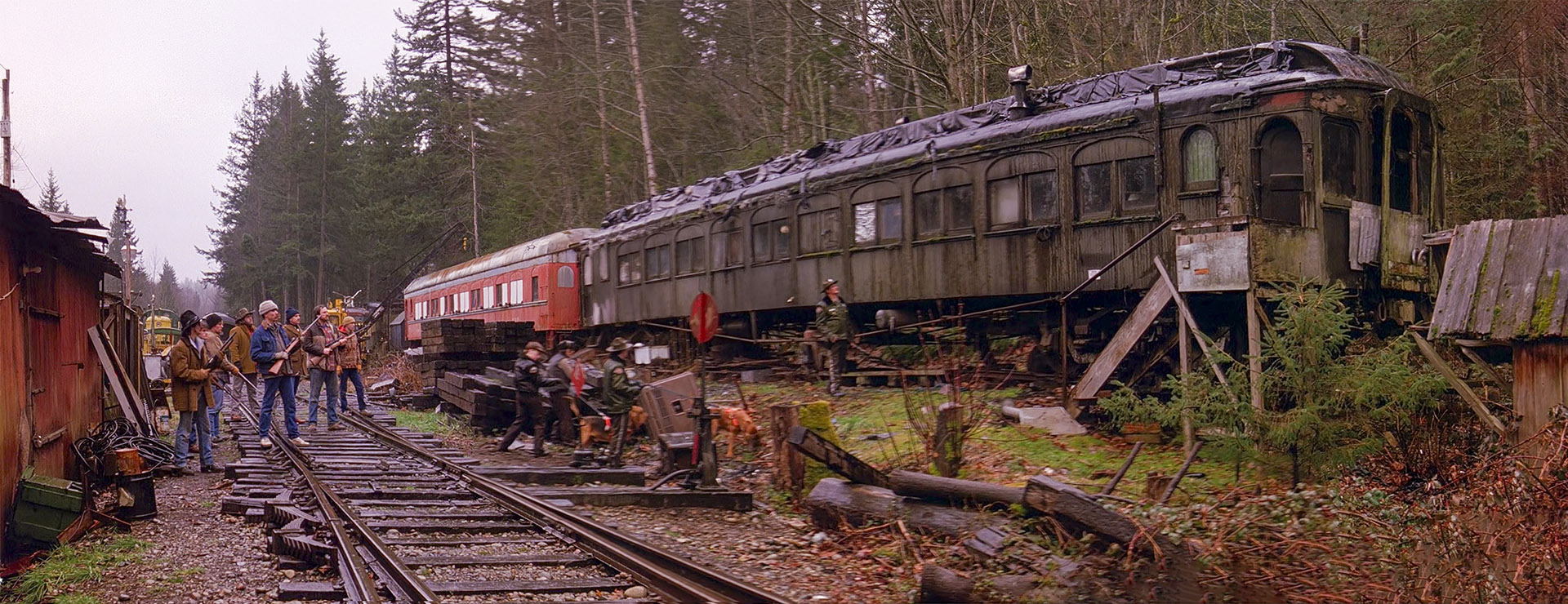
We never see Cooper and Truman entering or leaving the train car. We do get a panning establishing shot which I have combined in Photoshop and filled in the missing sections using content-aware and generative fills. Unfortunately, this train graveyard is long gone so all we have are images from the Twin Peaks pilot.
THE SEATTLE TIMES ARTICLE BY LOUIS CORSALETTI ON APRIL 11, 1990
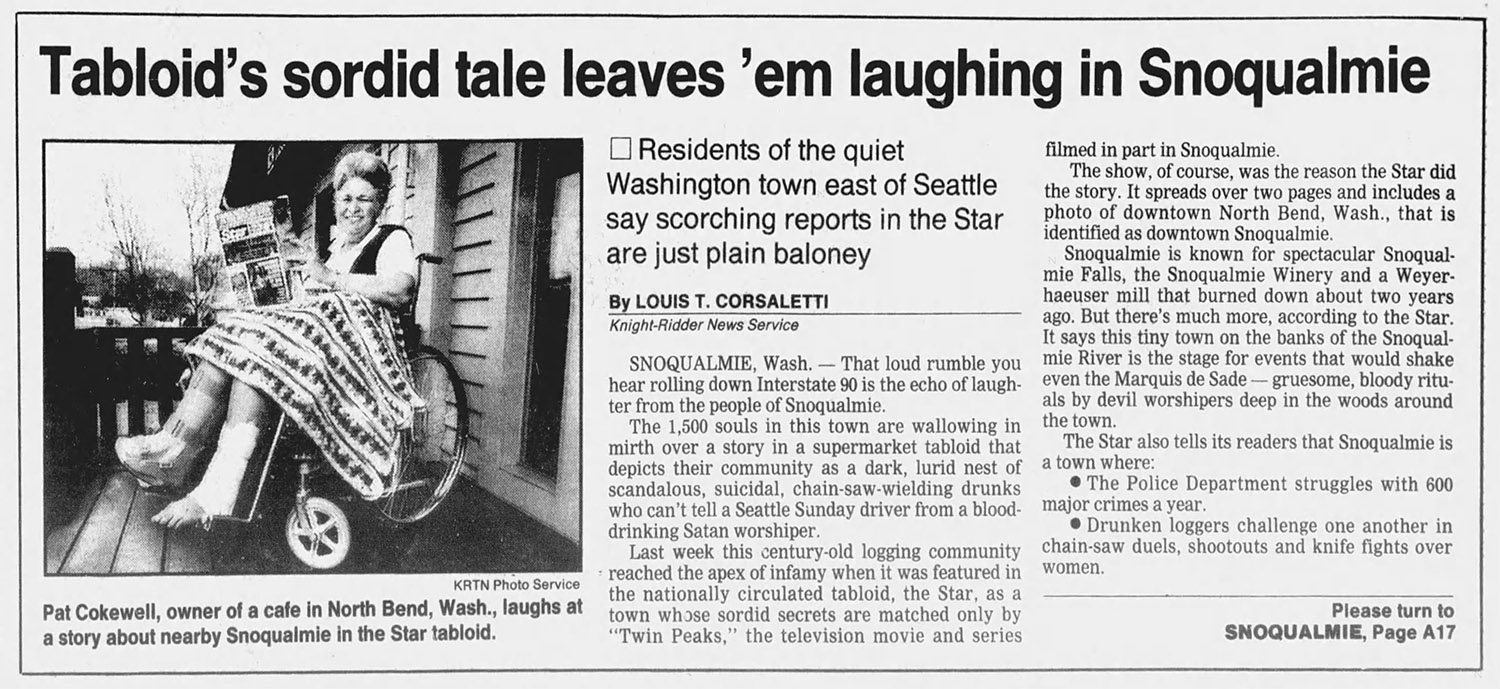
On April 10, 1990, Louis Corsaletti from The Seattle Times published as syndicated story via Knight-Ridder News Service that contain reactions to the story. Most likely LaFontaine’s article appeared in Star prior to April 10 but I’m unsure when the company released their publications. Corsaletti’s story was picked up by several papers including The Oregonian, which ran the story on April 11.
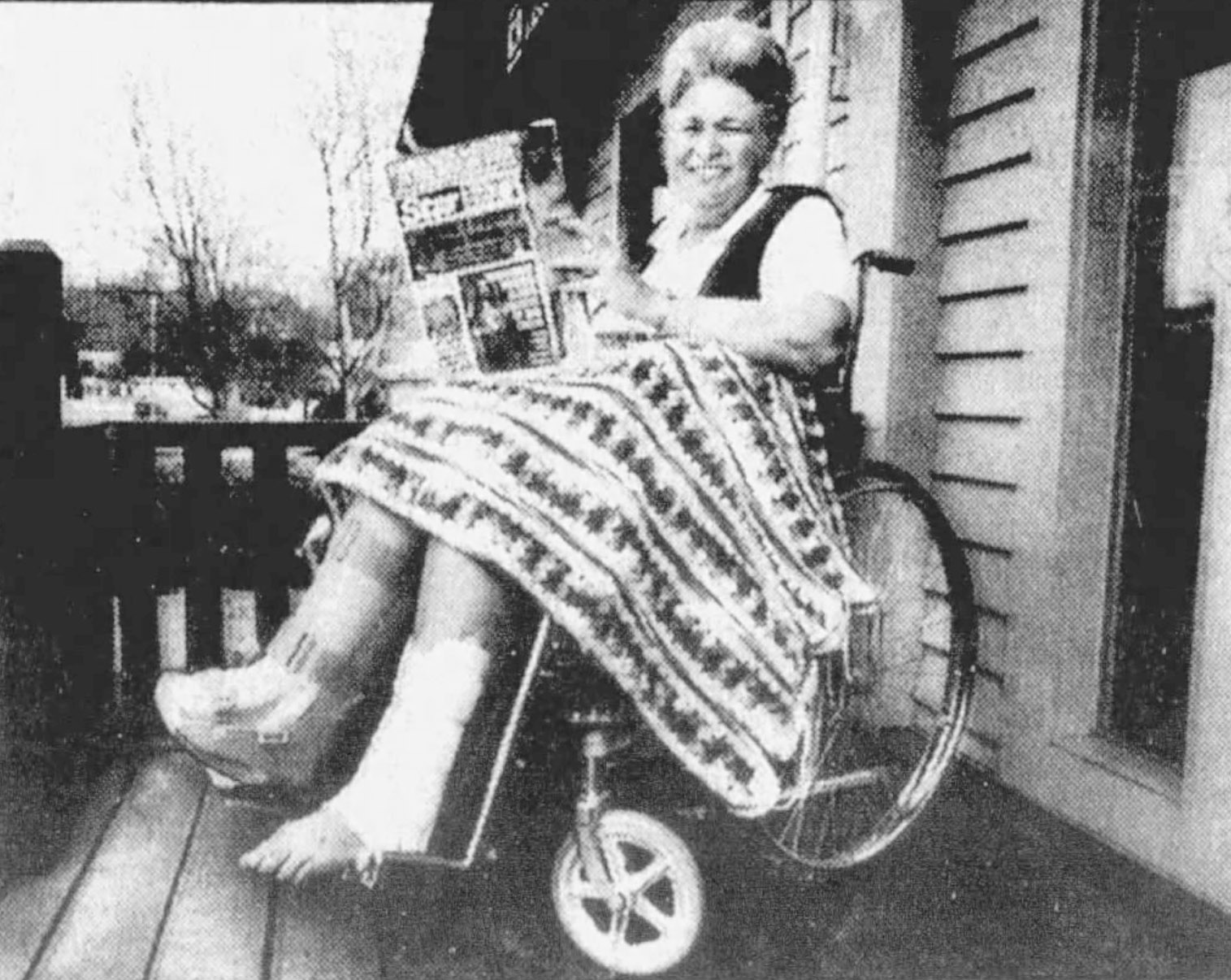
I love this photo of the late Pat Cokewell, former owner of the Mar-T Cafe (now Twede’s Cafe), holding a copy of Star. It was this photo that helped me confirm I found the correct magazine on Ebay.
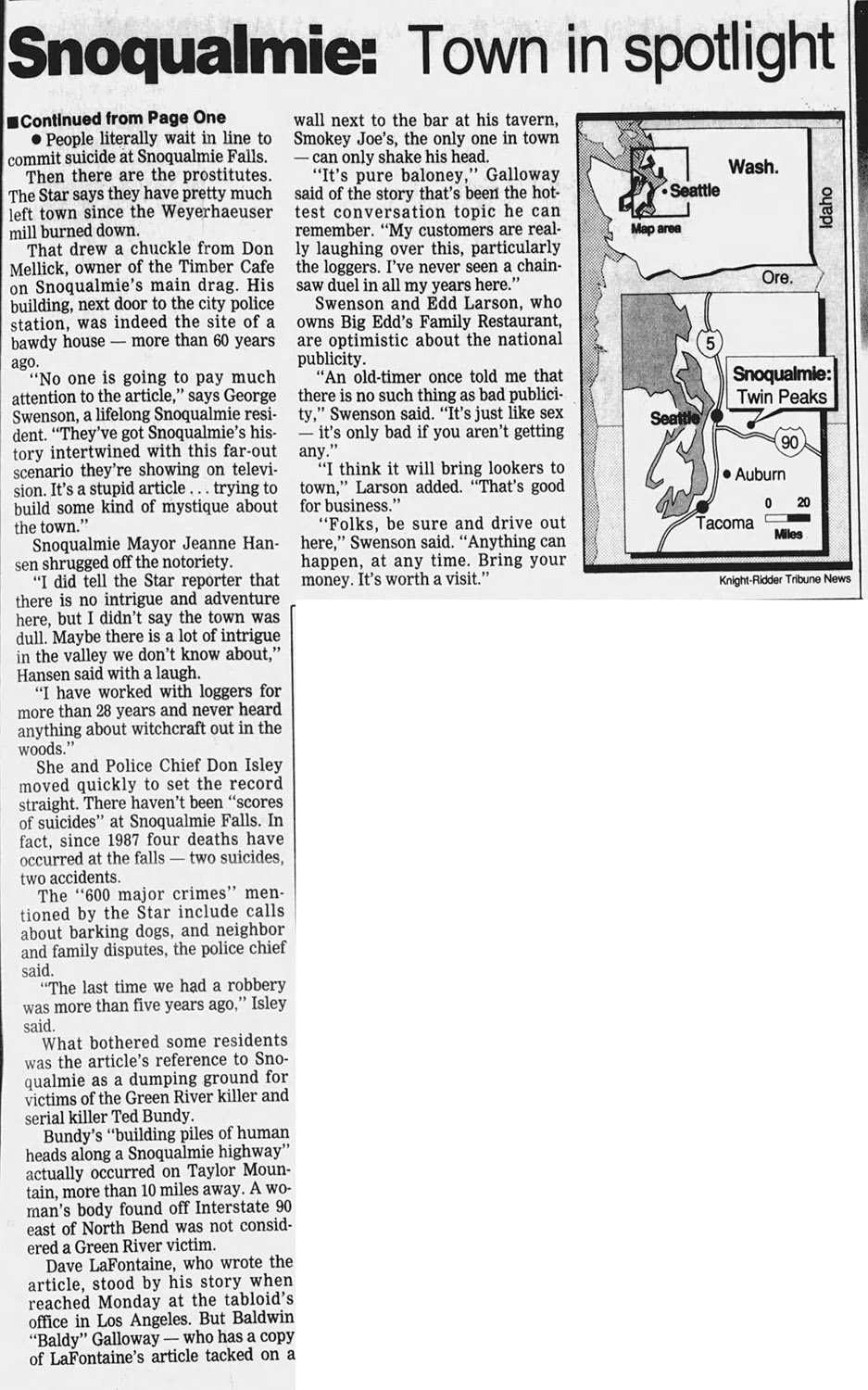
Tabloid’s sordid tale leaves ’em laughing in Snoqualmie
That loud rumble you hear rolling down Interstate 90 is the echo of laughter from the people of Snoqualmie.
The 1,500 souls in this town are wallowing in mirth over a story in a supermarket tabloid that depicts their community as a dark, lurid nest of scandalous, suicidal, chain-saw-wielding drunks who can’t tell a Seattle Sunday driver from a blood-drinking Satan worshiper.
Last week this century-old logging community reached the apex of infamy when it was featured in the nationally circulated tabloid, the Star, as a town wh use sordid secrets are matched only by “Twin Peaks,” the television movie and series filmed in part in Snoqualmie.
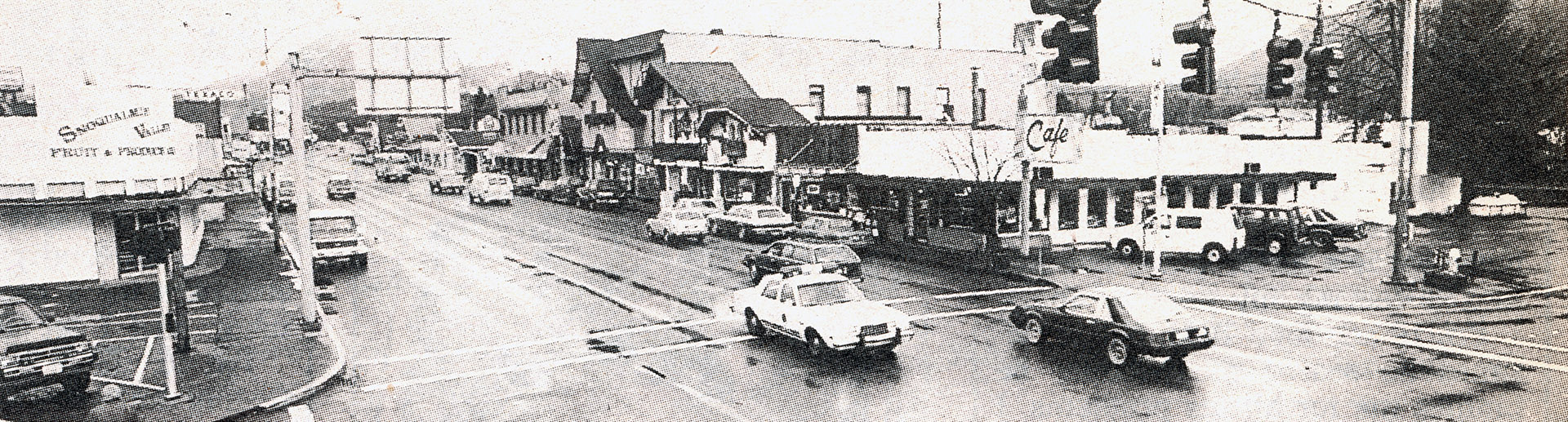
The show, of course, was the reason the Star did the story. It spreads over two pages and includes a photo of downtown North Bend, Wash., that is identified as downtown Snoqualmie.
Snoqualmie is known for spectacular Snoqualmie Falls, the Snoqualmie Winery and a Weyerhaeuser mill that burned down about two years ago. But there’s much more, according to the Star. It says this tiny town on the banks of the Snoqualmie River is the stage for events that would shake even the Marquis de Sade — gruesome, bloody rituals by devil worshipers deep in the woods around the town.
The Star also tells its readers that Snoqualmie is a town where:
- The Police Department struggles with 600 major crimes a year.
- Drunken loggers challenge one another in chain-saw duels, shootouts and knife fights over women.
- People literally wait in line to commit suicide at Snoqualmie
Then there are the prostitutes. The Star says they have pretty much left town since the Weyerhaeuser mill burned down.
That drew a chuckle from Don Mellick, owner of the Timber Cafe on Snoqualmie’s main drag. His building, next door to the city police station, was indeed the site of a bawdy house – more than 60 years ago.
“No one is going to pay much attention to the article,” says George Swenson, a lifelong Snoqualmie resident. “They’ve got Snoqualmie’s his-tory intertwined with this far-out scenario they’re showing on television. It’s a stupid article … trying to build some kind of mystique about the town.”

Snoqualmie Mayor Jeanne Hansen shrugged off the notoriety.
“I did tell the Star reporter that there is no intrigue and adventure here, but I didn’t say the town was dull. Maybe there is a lot of intrigue in the valley we don’t know about,” Hansen said with a laugh.
“I have worked with loggers for more than 28 years and never heard anything about witchcraft out in the woods.”
She and Police Chief Don Isley moved quickly to set the record straight. There haven’t been “scores of suicides” at Snoqualmie Falls. In fact, since 1987 four deaths have occurred at the falls — two suicides, two accidents.
The “600 major crimes” mentioned by the Star include calls about barking dogs, and neighbor and family disputes, the police chief said.
“The last time we had a robbery was more than five years ago.” Isley said.
What bothered some residents was the article’s reference to Snoqualmie as a dumping ground for victims of the Green River killer and serial killer Ted Bundy.
Bundy’s “building piles of human heads along a Snoqualmie highway” actually occurred on Taylor Mountain, more than 10 miles away. A woman’s body found off Interstate 90 east of North Bend was not considered a Green River victim.
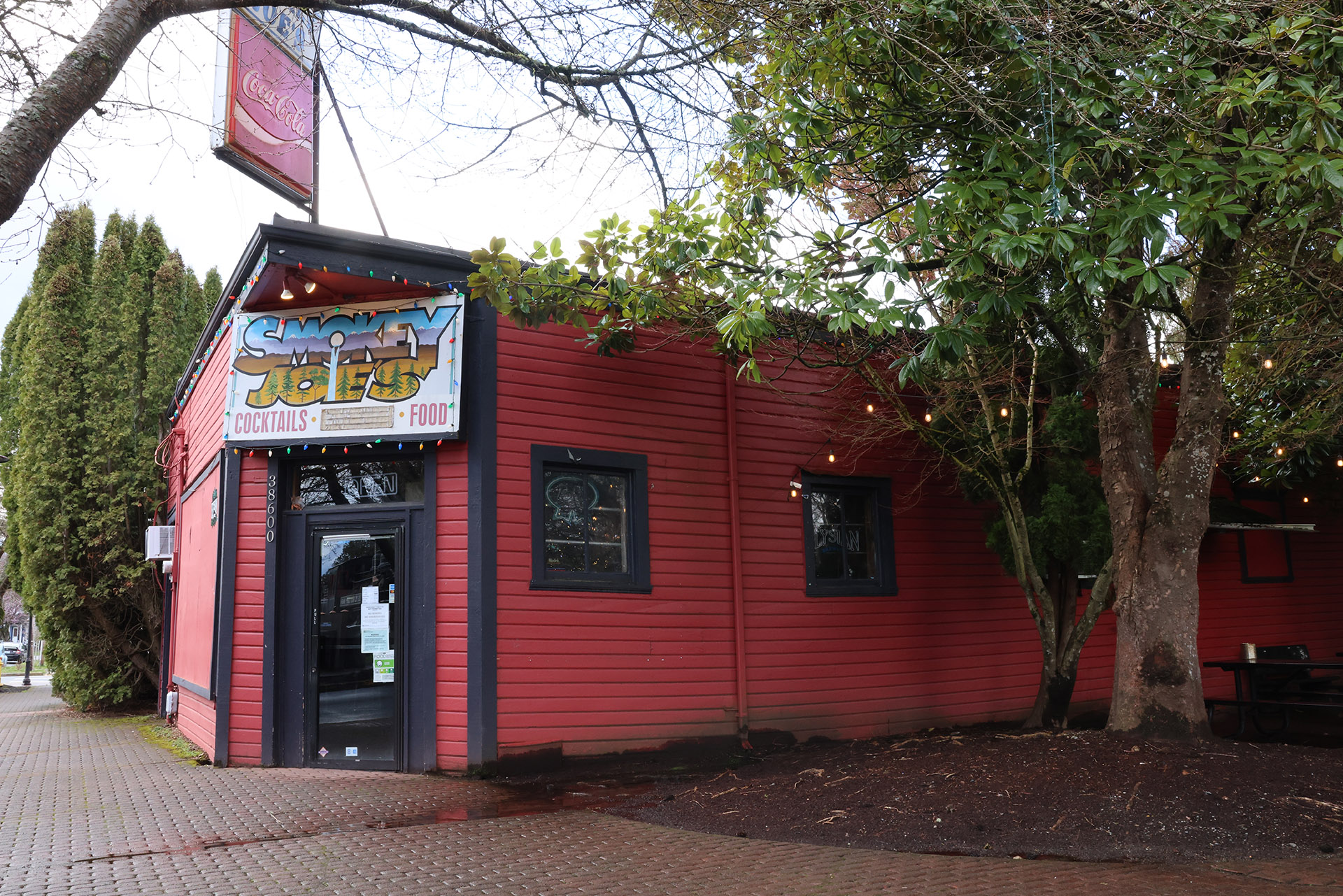
Dave LaFontaine, who wrote the article, stood by his story when reached Monday at the tabloid’s office in Los Angeles. But Baldwin “Baldy” Galloway — who has a copy of LaFontaine’s article tacked on a wall next to the bar at his tavern, Smokey Joe’s, the only one in town – can only shake his head.
“It’s pure baloney,” Galloway said of the story that’s been the hottest conversation topic he can remember.
“My customers are really laughing over this, particularly the loggers. I’ve never seen a chainsaw duel in all my years here.”
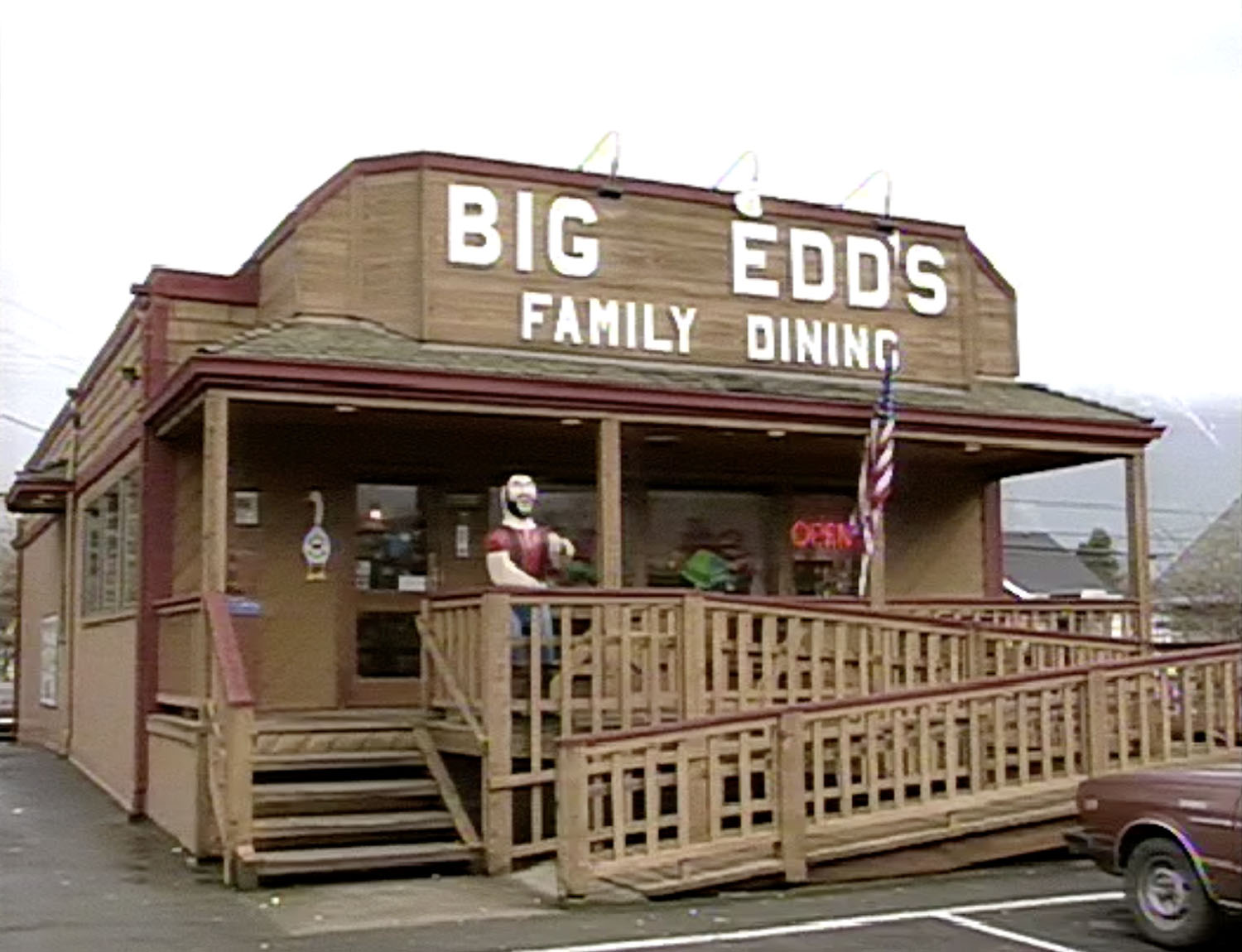
Swenson and Edd Larson, who owns Big Edd’s Family Restaurant, are optimistic about the national publicity.
“An old-timer once told me that there is no such thing as bad publicity,” Swenson said. “It’s just like sex – it’s only bad if you aren’t getting any.”
“I think it will bring lookers to town,” Larson added. “That’s good for business.”
“Folks, be sure and drive out here,” Swenson said. “Anything can happen, at any time. Bring your money. It’s worth a visit.”
Despite the sensational claims in the Star article, I’m happy to have this story now a part of the Twin Peaks archive. In the months that followed, Snoqualmie Valley would continue seeing tourists flock to the area in search of the Real Twin Peaks. LaFontaine’s story was one of the first to highlight the area and it hasn’t stopped people from visiting decades after it was published.
Download high-resolution images from this article on my Flickr account: https://www.flickr.com/photos/aloha75/albums/72177720334640570
Author
Discover more from TWIN PEAKS BLOG
Subscribe to get the latest posts sent to your email.
As always, you provide a public service in a very elegant and entertaining way. Thanks.
Thank you for the kind note! The “Star” article was the stuff of legend in the “Twin Peaks” fan community. I couldn’t believe I found a copy which was reasonably priced.