
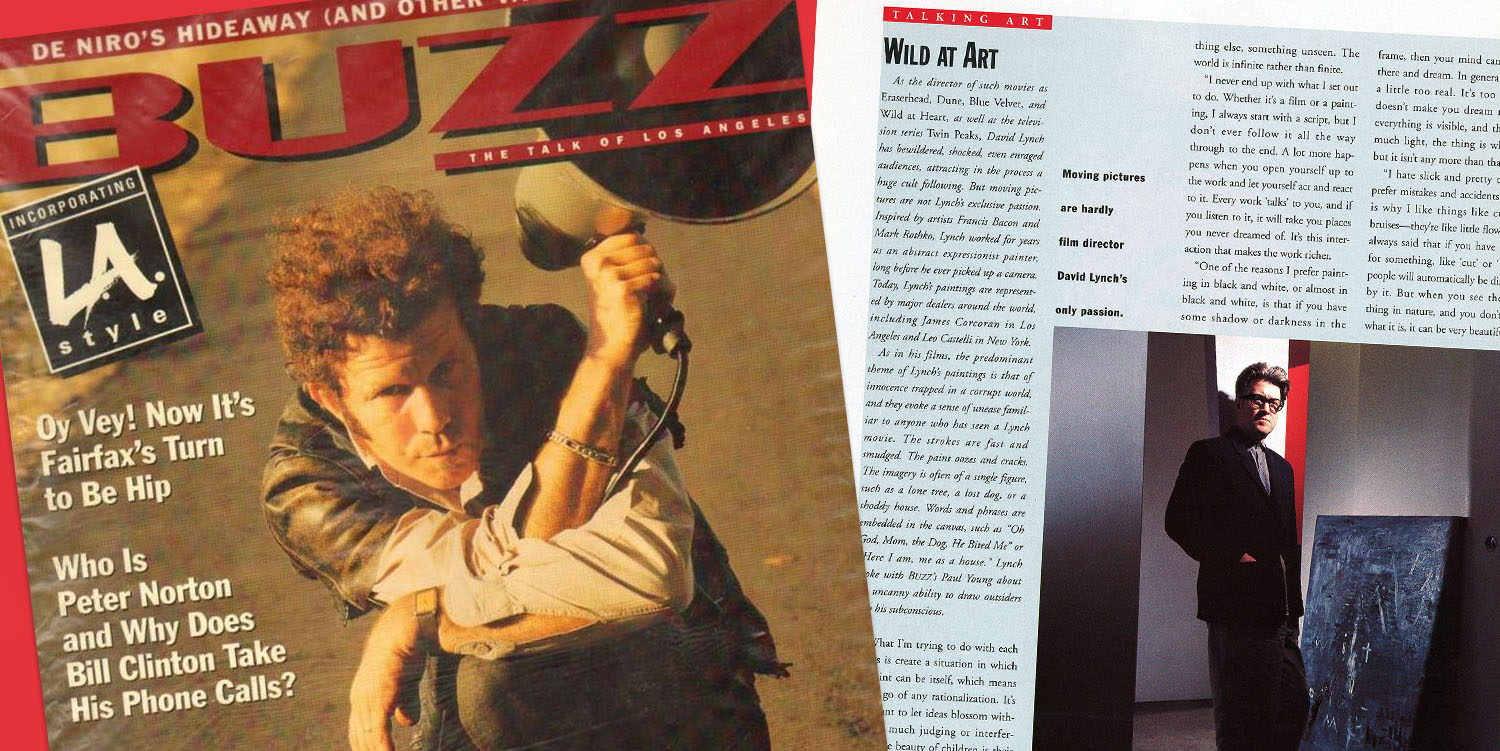
As I continue archiving all sorts of details related to David Lynch’s works, I came across an interview with the late artist from “Buzz Magazine.” Launched in fall 1990, this glossy magazine was once considered the “best journal yet on the local scene” in Los Angeles, California. This interview is one of several I scanned from A.M. Starr’s clipping collection (she runs the wonderfully insightful 1400 River Road blog). The short article by the magazine’s arts editor Paul Young for the May 1993 issue which features David discussing his art.
WHAT IS BUZZ MAGAZINE?
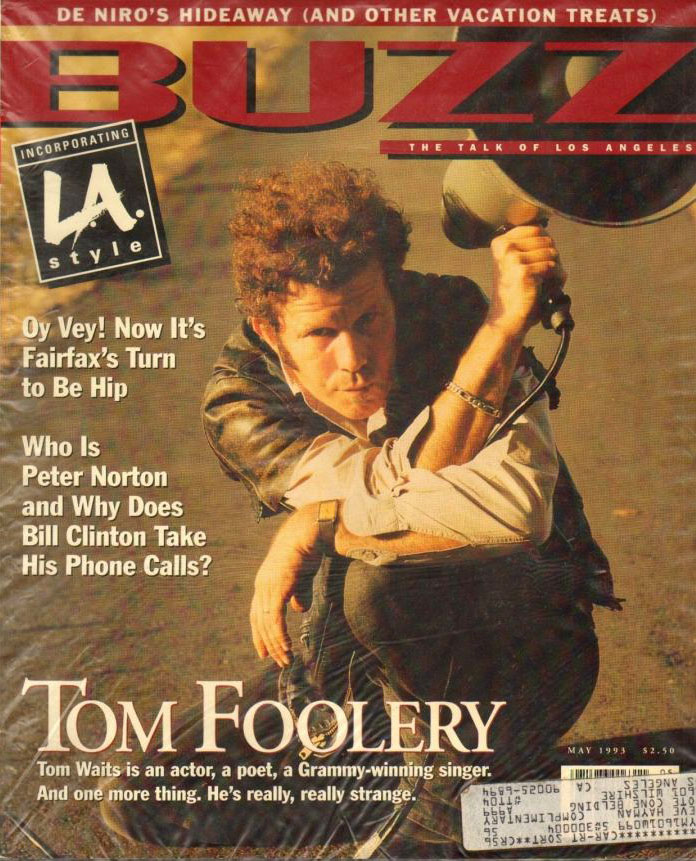
Founded by New York entrepreneurs Eden Collinsworth, Susan Gates and Allan Mayer, the original “Buzz Magazine” was launched from an estate on Mulholland Drive in Los Angeles in October / November 1990. It folded after three issues after one of the original investors, Lawrence Ellison, pulled funding. The magazine returned in 1991 and continued publication until April 1998 when it filed for Chapter 11 bankruptcy.
Paul Young worked as the magazine’s arts editor from January 1990 to January 1998, writing celebrity cover and lifestyle stories.
BUZZ MAGAZINE | MAY 1993 | TALKING ART | “WILD AT ART”
The David Lynch interview appeared on page 30 under Young’s “Talking Art” column. It was titled, “Wild At Art,” a play on Lynch’s award-winning 1990 film, Wild at Heart. It was subtitled: “Moving pictures are hardly film director David Lynch’s only passion.” A transcript of this article has been available online for decades on Mike Lee’s Lynchnet.com.
This article appeared about a month before reruns of Twin Peaks aired on Bravo TV. All 32 episodes from the first and second season, along with new introductions from The Log Lady (Catherine Coulson), were shown in their “TV Too Good for TV” programming block starting June 11 that year.
Lynch’s brief insights echo a familiar story at how he approached creating his works, preferring “mistakes” and “accidents.”
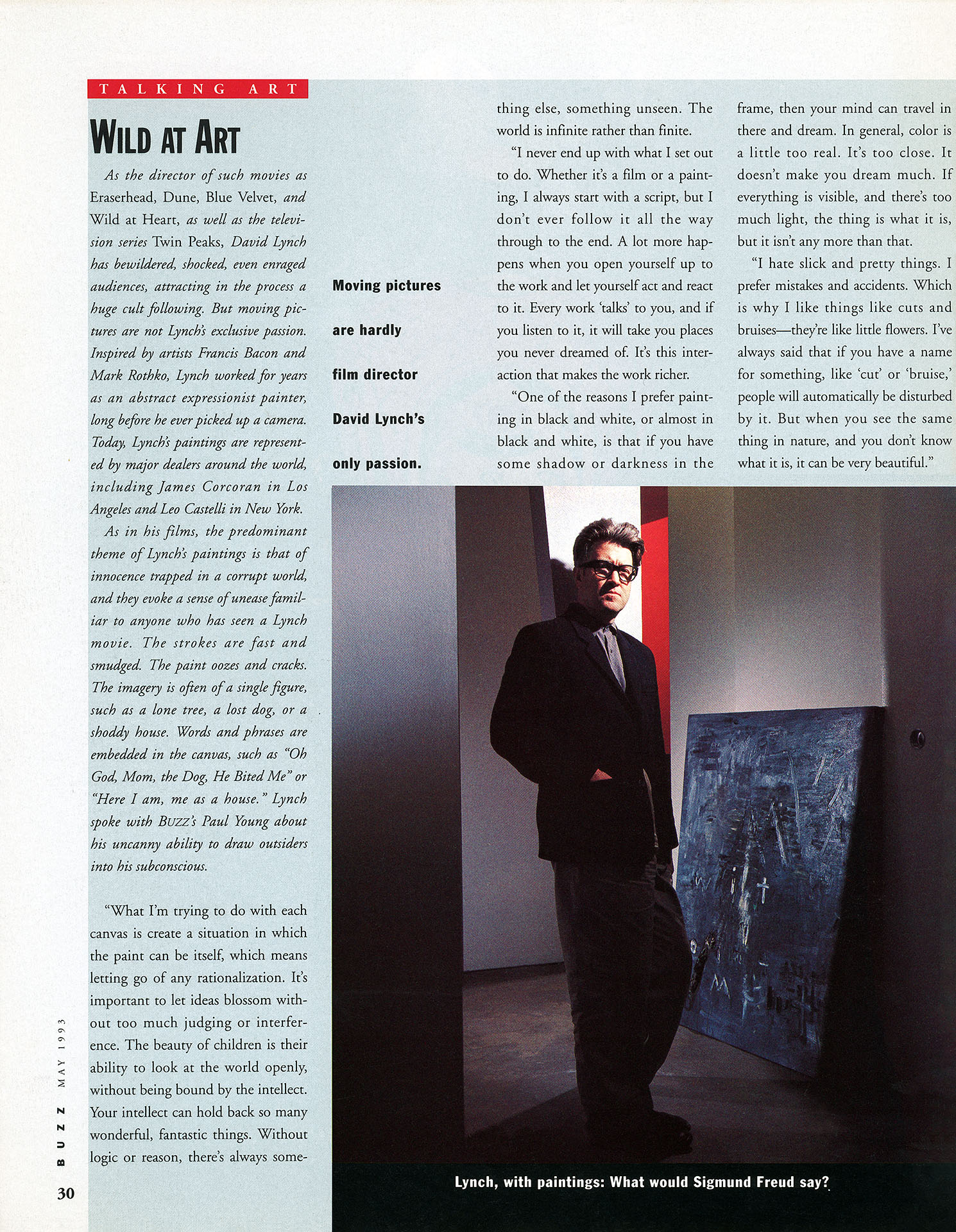
As the director of such movies as Eraserhead, Dune, Blue Velvet, and Wild at Heart, as well as the television series Twin Peaks, David Lynch has bewildered, shocked, even enraged audiences, attracting in the process a huge cult following. But moving pictures are not Lynch’s exclusive passion. Inspired by artists Francis Bacon and Mark Rothko, Lynch worked for years as an abstract expressionist painter, long before he ever picked up a camera. Today, Lynch’s paintings are represented by major dealers around the world, including James Corcoran in Los Angeles and Leo Castelli in New York.
As in his films, the predominant theme of Lynch’s paintings is that of innocence trapped in a corrupt world, and they evoke a sense of unease familiar to anyone who has seen a Lynch movie. The strokes are fast and smudged. The paint oozes and cracks. The imagery is often of a single figure, such as a lone tree, a lost dog, or a shoddy house. Words and phrases are embedded in the canvas, such as “Oh God, Mom, the Dog, He Bited Me or “Here I am, me as a house.” Lynch spoke with Buzz’s Paul Young about his uncanny ability to draw outsiders into his subconscious.
“What I’m trying to do with each canvas is create a situation in which the paint can be itself, which means letting go of any rationalization. It’s important to let ideas blossom with out too much judging or interference. The beauty of children is their ability to look at the world openly, without being bound by the intellect. Your intellect can hold back so many wonderful, fantastic things. Without logic or reason, there’s always something else, something unseen. The world is infinite rather than finite.
“I never end up with what I set out to do. Whether it’s a film or a painting, I always start with a script, but I don’t ever follow it all the way through to the end. A lot more happens when you open yourself up to the work and let yourself act and react to it. Every work talks’ to you, and if you listen to it, it will take you places you never dreamed of. It’s this interaction that makes the work richer.
“One of the reasons I prefer painting in black and white, or almost in black and white, is that if you have some shadow or darkness in the frame, then your mind can travel in there and dream. In general, color is a little too real. It’s too close. It doesn’t make you dream much. If everything is visible, and there’s too much light, the thing is what it is, but it isn’t any more than that.
“I hate slick and pretty things. I prefer mistakes and accidents. Which is why I like things like cuts and bruises – they’re like little flowers. I’ve always said that if you have a name for something, like ‘cut’ or ‘bruise, people will automatically be disturbed by it. But when you see the same thing in nature, and you don’t know what it is, it can be very beautiful.”

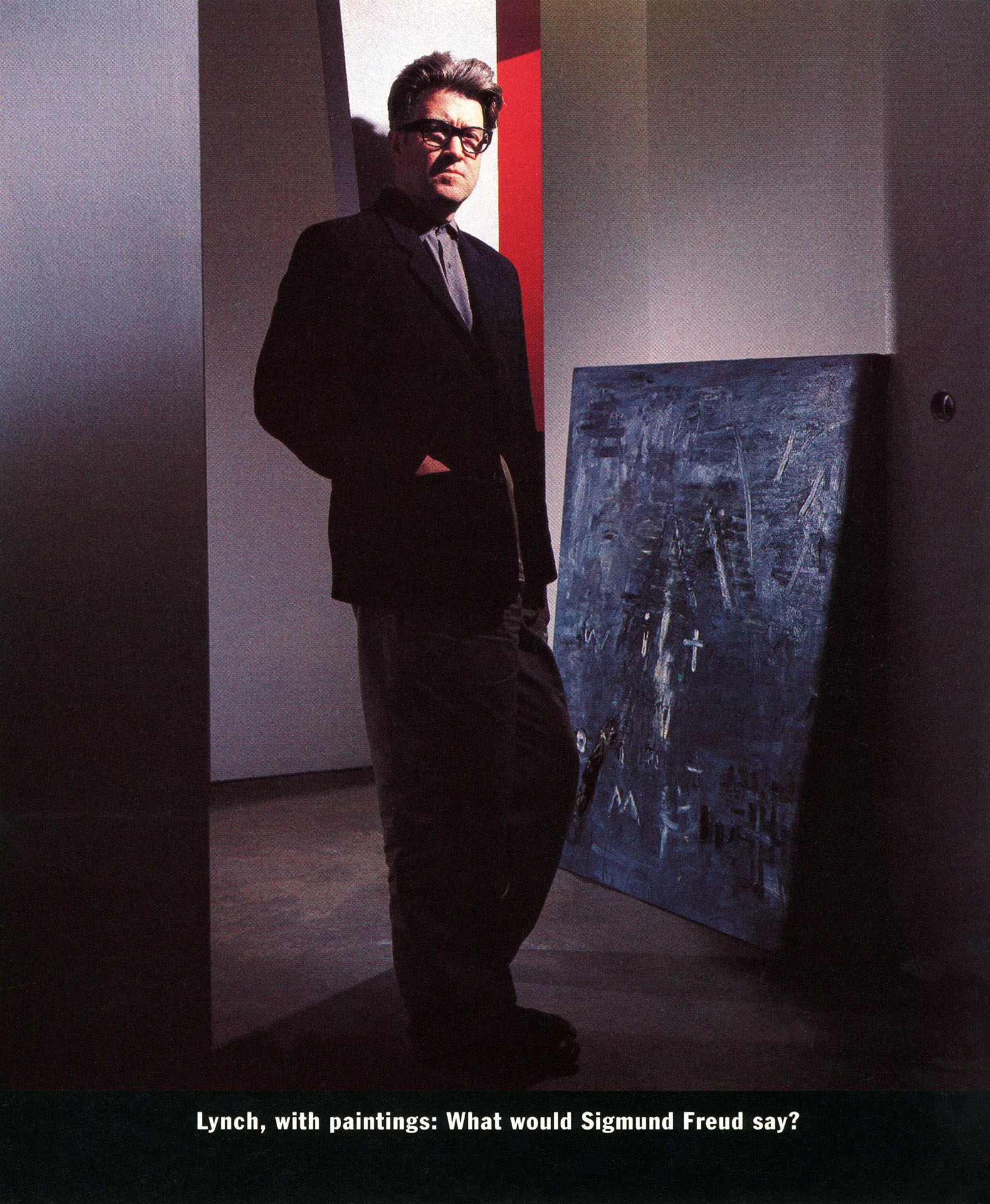
The photo of David is one of two taken by American photographer Mark Hanauer. He is know for his iconic portraits of the culture’s foremost figures. According to his bio, Mark served as Chief photographer for A&M Records from 1977-1979.
He then went on to document the counter-culture and music scene in the decades following. His images of Andy Warhol, The Clash, Charles Bukowski, Leonard Cohen, Joni Mitchell, Stevie Wonder, and Muhammad Ali – among many others – appeared in Rolling Stone, Esquire, New York Magazine, and the Los Angeles Times.
Mark currently resides in Santa Monica and still takes photos today. Follow him on Instagram and see more his iconic works on his website – Mark Hanauer Photography.
Thank you A.M. Star for providing this clipping to scan.
Author
Discover more from TWIN PEAKS BLOG
Subscribe to get the latest posts sent to your email.