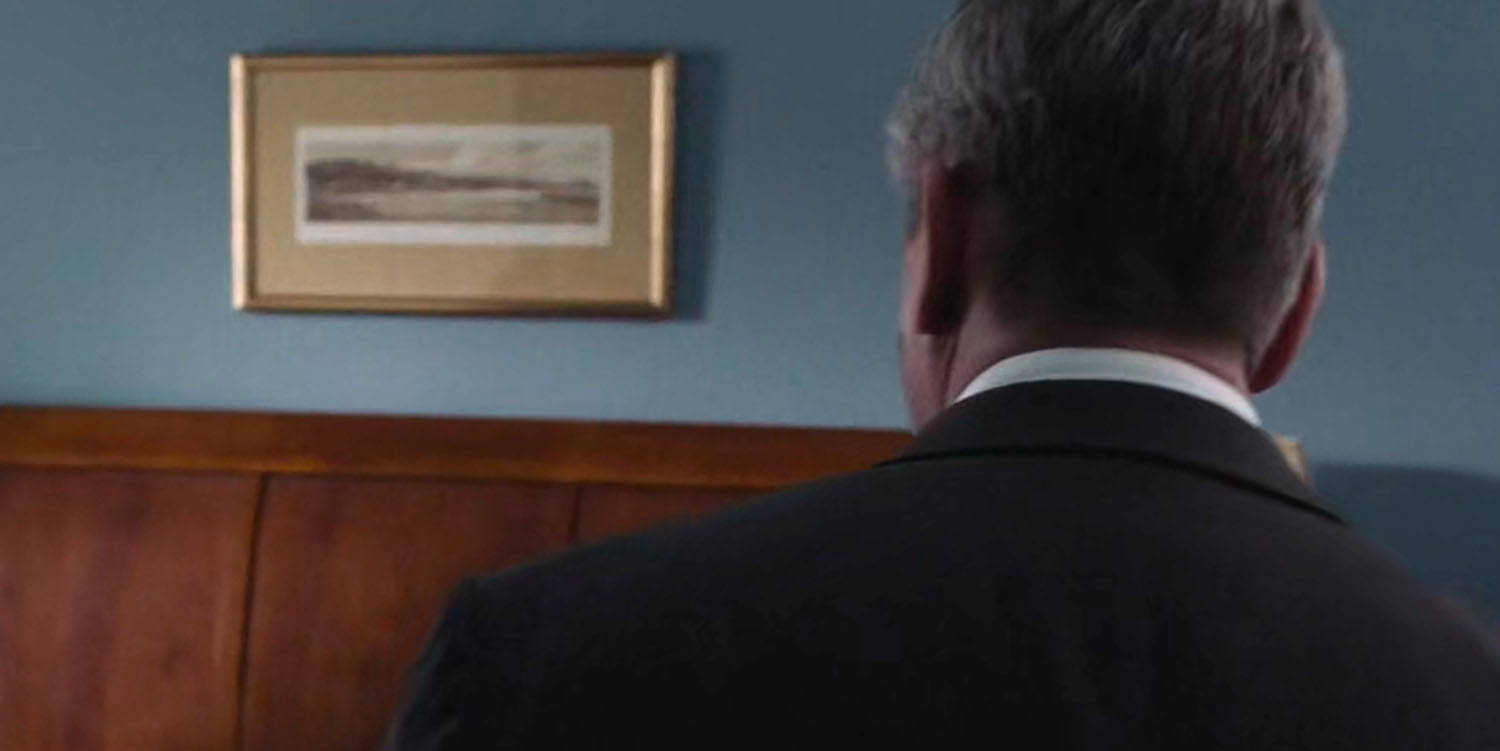
My favorite game to play is finding the artwork used to decorate the sets of Twin Peaks. This time, I located the framed art seen hanging above Ruth Davenport’s bed in Part 1 of Twin Peaks: The Return. It’s a public domain piece that created in 1802 by an English watercolorist and etcher.
ARTWORK ABOVE RUTH DAVENPORT’S BED
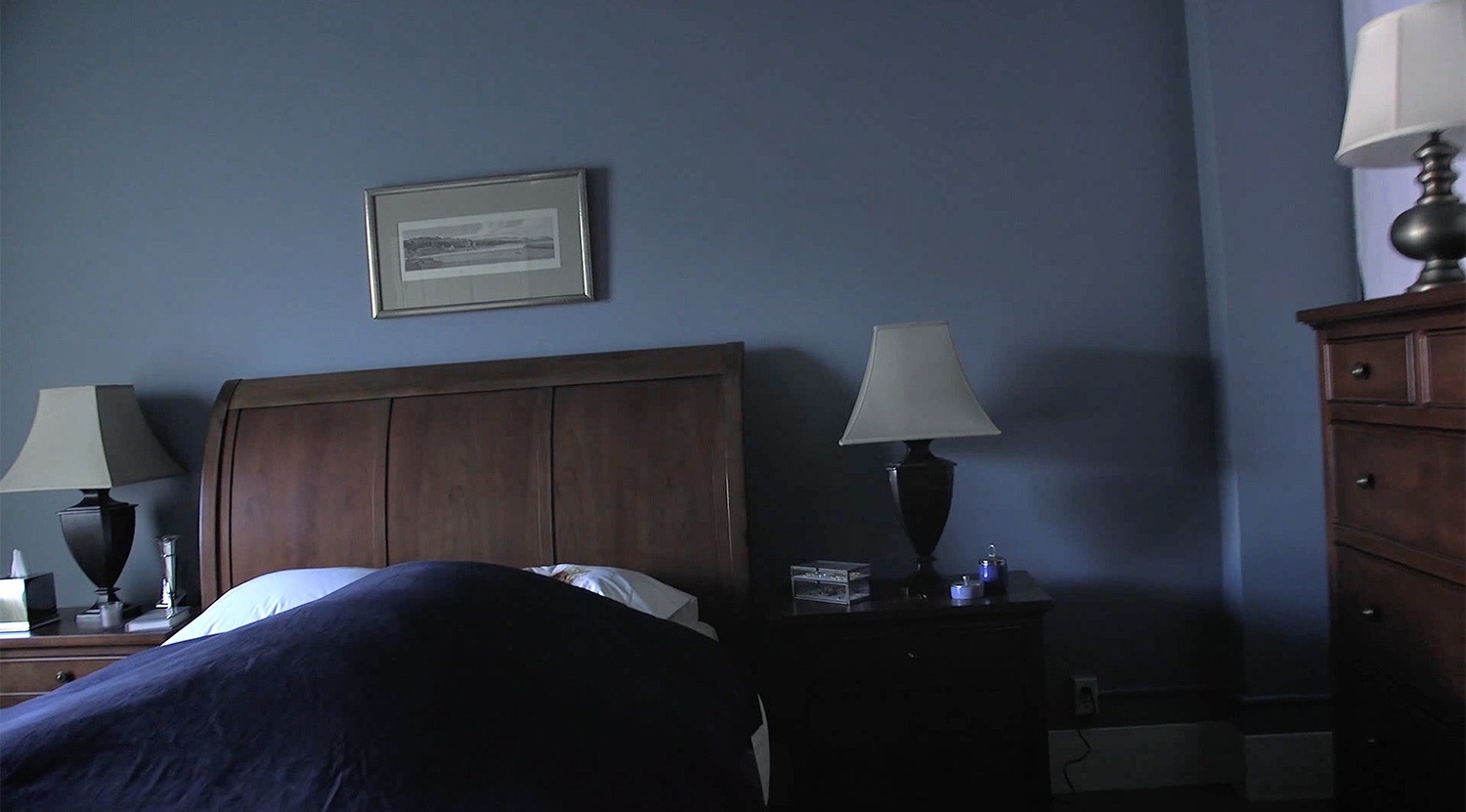
In part 1 of Twin Peaks: The Return, the Buckhorn Police Department make a grisly discovery in Ruth Davenport’s apartment – a dead body in the master bedroom. Hanging just above the bed is a long rectangular framed and matted photo. Using a cropped image and a reverse image search, it was fairly easy to identify the artwork.

I found the print by Thomas Girtin titled, “View of St. Cloud and Mt. Calvary taken from Pont de Seve, 1802” in a catalog for the Yale Center for British Art. This Public Domain image contained the following inscription:
Drawn and Etch’d by T. Girtin | View of St. Cloud & Mount Calvery | Taken from Pont Seve| Print”; lower right: “Aquatinted by F. C. Lewis | Vue de St. Cloud & du Mont Calvaire | Prise de Pont de Seve”; lower center “London: Pub’d Dec’r 16, 1802 by Thos. & Jn’o. Girtin No. 330 Oxford Street.
The fact this image is in the public domain could be the reason it was selected for use in Ruth’s apartment. This means the production wouldn’t have to pay for usage rights to show the artwork.
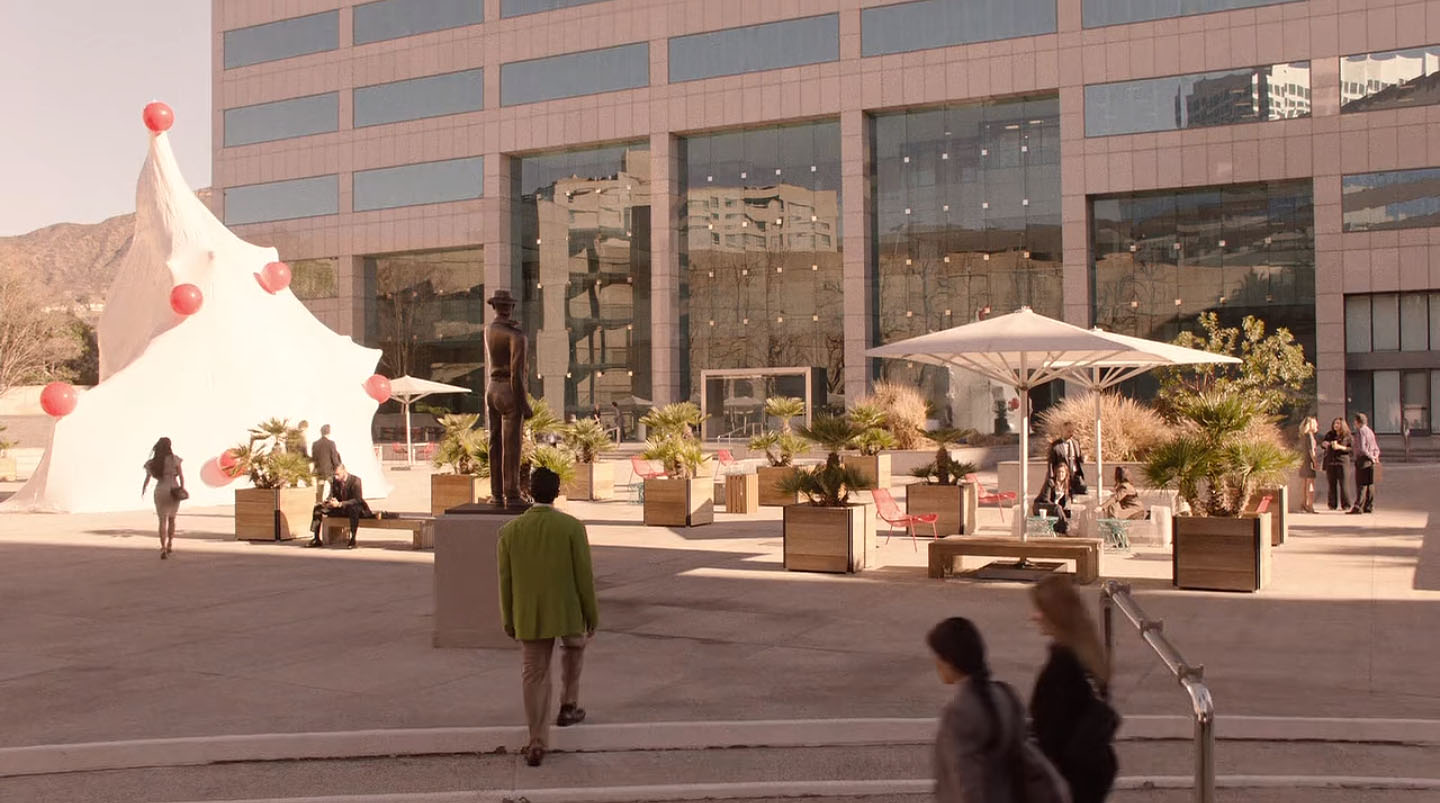
If the production couldn’t secure the rights to artwork, they became creative. This is best seen outside the Lucky 7 Insurance office in Twin Peaks: The Return. A giant sculpture is covered by a white tarp with red balloons.
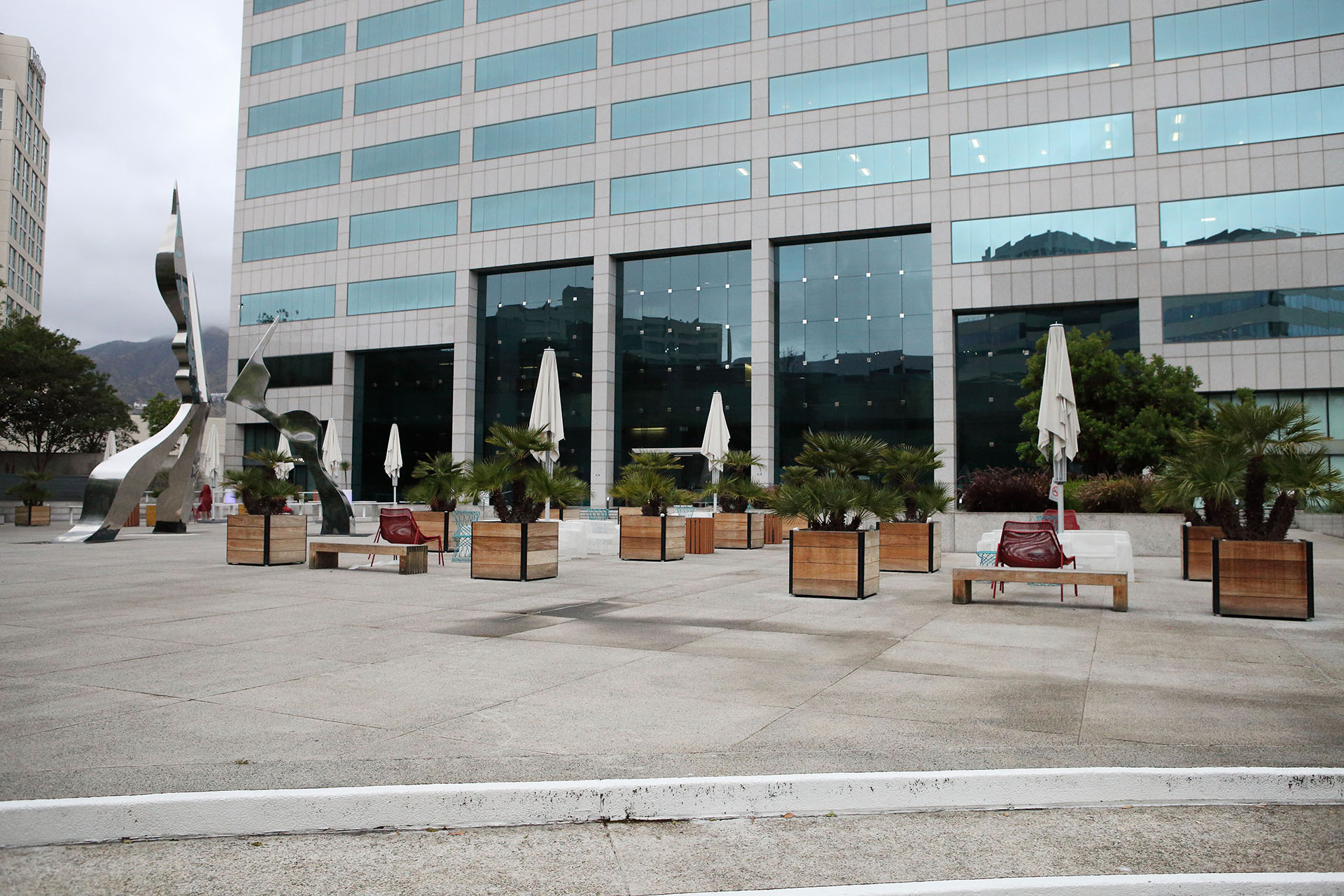
The stainless steel sculpture by James Thomas Russell is titled “Triumph.” It measures approximately 19-foot by 25-foot by 30-foot and was commissioned by Allstate Insurance in 1997. I’m assuming the production couldn’t get the rights to show the sculpture in the show (as it would not be in public domain), so it was covered.
WHO IS THOMAS GIRTIN?

Thomas Girtin (February 18, 1775 – November 9, 1802) was an English watercolorist and etcher who played a key role in establishing watercolor as a reputable art form. Born in Southwark, London to a wealthy brushmaker of Huguenot descent, Girtin’s father died while he was a child. His mother remarried a pattern-draughtsman named Mr. Vaughan. Girtin studied drawing as a boy and later apprenticed to the topographical watercolorist Edward Dayes.
In his teens, Girtin became friends with J. M. W. Turner and the boys were employed to color prints with watercolors. Girtin’s architectural and topographical sketches and drawings “established his reputation, his use of watercolour for landscapes being such as to give him the credit of having created Romantic watercolor painting.”
In late 1801 to early 1802, he spent five and a half months in Paris, France where he painted watercolors. He made a series the pencil sketches that he engraved on his return to London, and which were posthumously published as Twenty Views in Paris and its Environs. In November 1802, he died in his painting room and was buried at St Paul’s, Covent Garden in London.
APPEARANCES IN TWIN PEAKS: THE RETURN

The framed artwork appears briefly only in Part 1 of Twin Peaks: The Return. It shows up when the two Buckhorn Police officers slowly walk down the hallway toward Ruth Davenport’s bedroom.

When Detective Dave Macklay (Brent Briscoe) enters Ruth’s bedroom, you can see the artwork hanging above the bed.

The last appearance of the artwork is seen when Detective Macklay assists Constance Talbot with removing the bed sheets to reveal a dead body.
Happy now to add this framed artwork to the endless list of identified props and set decorations from Twin Peaks.
Author
Discover more from TWIN PEAKS BLOG
Subscribe to get the latest posts sent to your email.