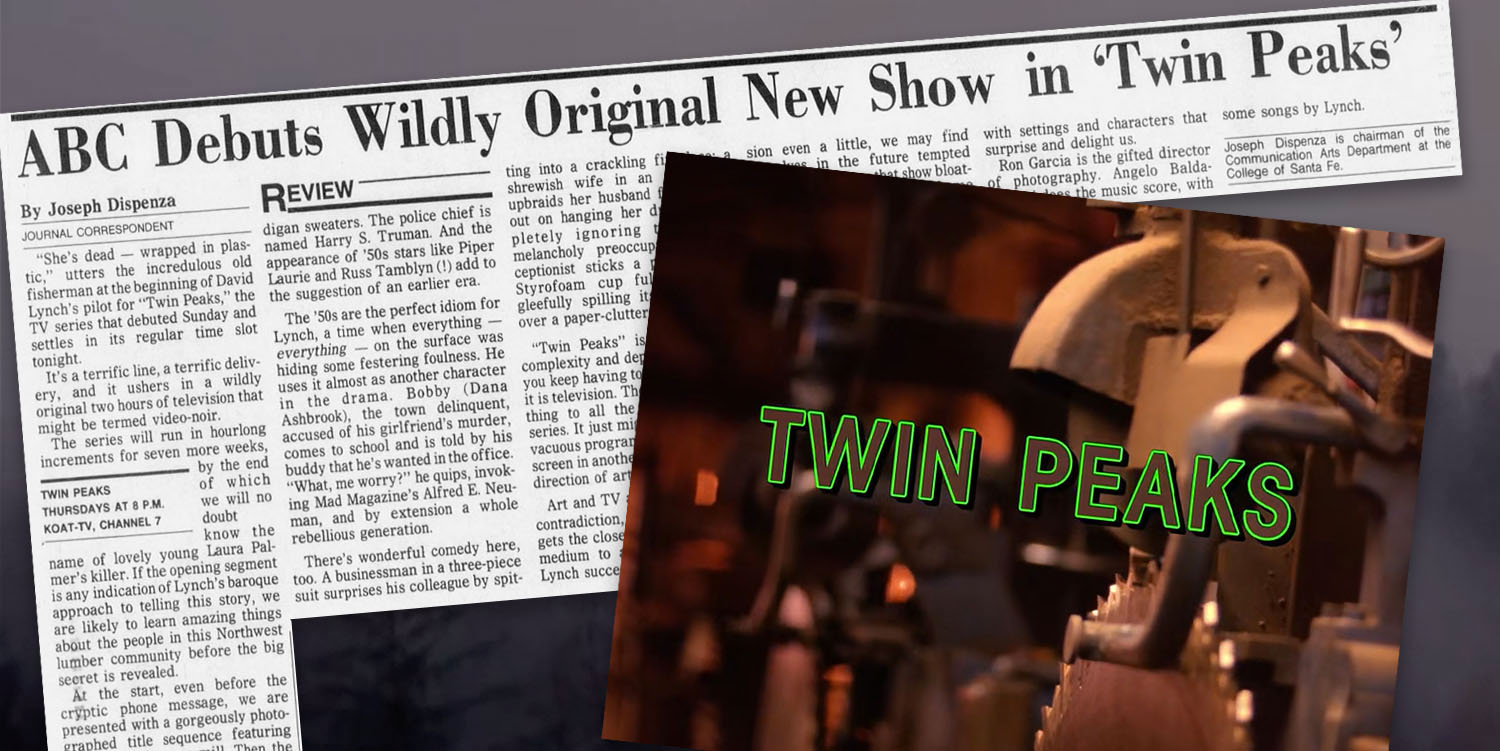
Mark Frost and David Lynch’s Twin Peaks captured the attention of millions of viewers when it first aired on April 8, 1990. People had never seen anything like it on television which inspired some like Joseph Dispenza, former Albuquerque Journal correspondent and once chairman of the Communication Arts Department at the College of Santa Fe, to put pen to paper to express praise. This was Dispenza’s only review of the show which was published on Thursday, April 12, 1990, the night episode 1.001 aired on ABC Television.
WHO IS JOSEPH DISPENZA?

Joseph Dispenza was born in Ashtabula, Ohio, in September 1942. He moved to Santa Fe, New Mexico in January 1977 where he until about 2000. A writer and film historian, Joseph started the film program at the College of Santa Fe and raised money to build the sound stages that became Garson Studios in 1990. By 2015, the studio had housed production of more than 40 television shows, including Longmire, feature films such as City Slickers, The Missing and Cowboys and Aliens.
During his lifetime, he wrote 16 books and many articles for several publications, including Albuquerque Journal and The Santa Fe New Mexican. Books included a biography of artist Will Shuster (co-authored with Louise Turner) and The Chemotherapy Diet, a guide to eating healthy under chemotherapy.
He also penned autobiographical Older Man, Younger Man, based on his relationship with Mike Herbert whom he met in the late 1990s and later married in California when same sex marriage was legalized.
Sadly, Joseph died of “multiple organ failures” on July 13, 2015 in San Antonio, Texas at the age of 72.
ABC DEBUTS WILDLY ORIGINAL NEW SHOW IN ‘TWIN PEAKS’ REVIEW BY JOSEPH DISPENZA ON APRIL 12, 1990
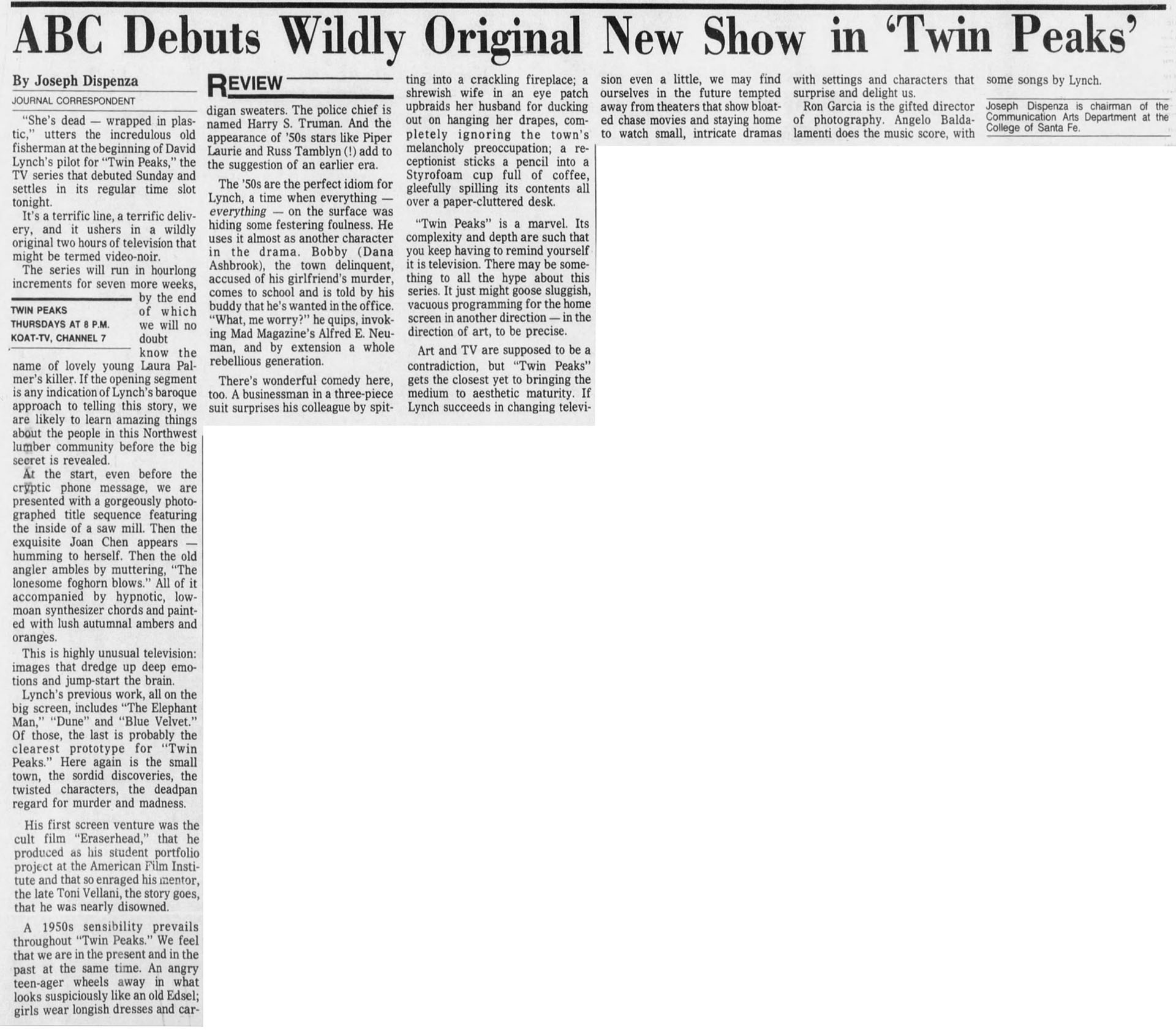
Below is a transcription of Dispenza’s positive review of Lynch and Frost’s groundbreaking television pilot. It was published on April 12, 1990 in the Albuquerque Journal. I did not find another review from Joseph about any of Lynch’s works. Clearly, Twin Peaks made an impression of him!
ABC Debuts Wildly Original New Show in ‘Twin Peaks’
“She’s dead — wrapped in plastic,” utters the incredulous old fisherman at the beginning of David Lynch’s pilot for “Twin Peaks,” the TV series that debuted Sunday and settles in its regular time slot tonight.
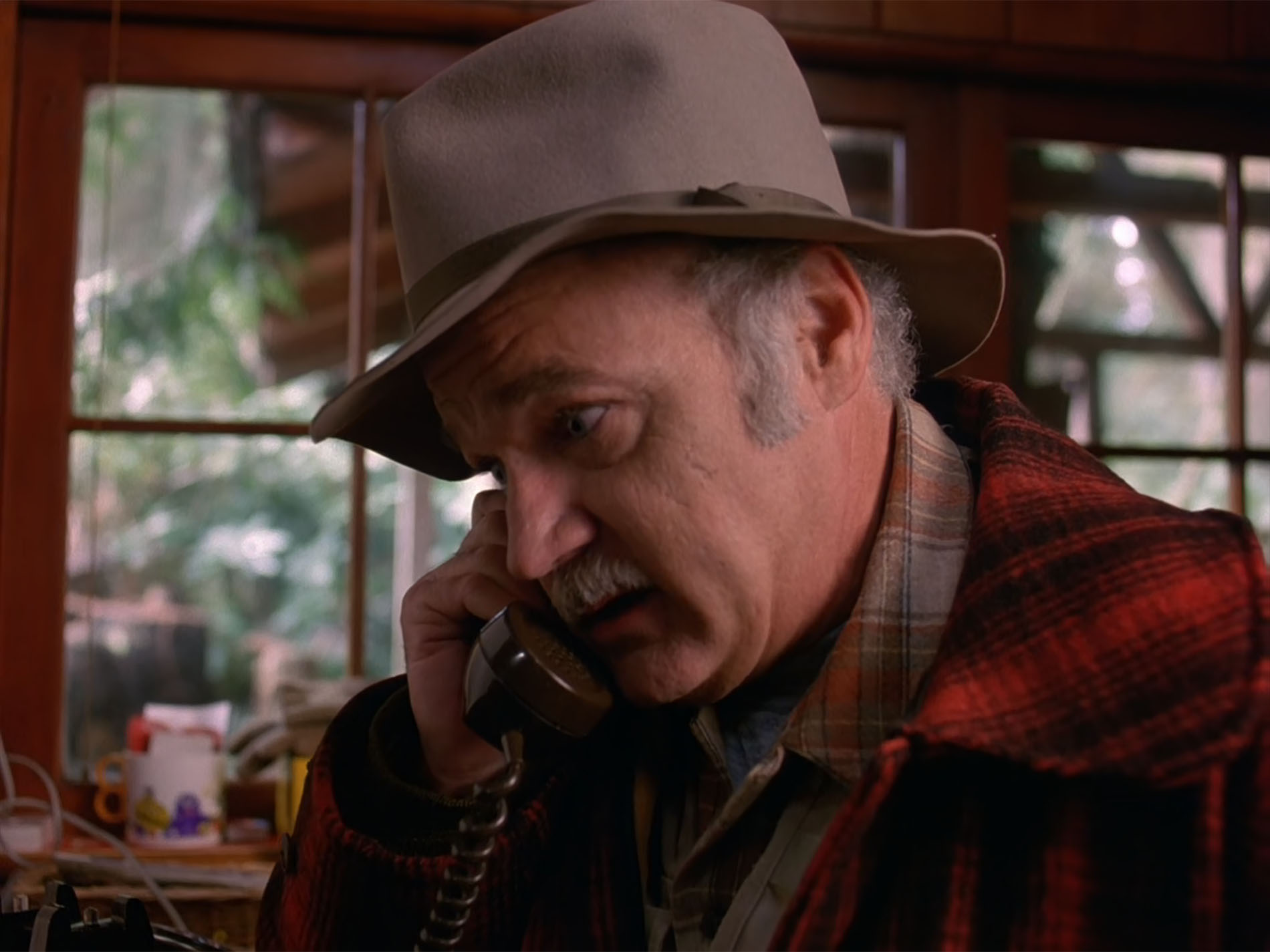
It’s a terrific line, a terrific delivery, and it ushers in a wildly original two hours of television that might be termed video-noir.
The series will run in hourlong increments for seven more weeks, by the end of which we will no doubt know the name of lovely young Laura Palmer’s killer. If the opening segment is any indication of Lynch’s baroque approach to telling this story, we are likely to learn amazing things about the people in this Northwest lumber community before the big secret is revealed.

At the start, even before the cryptic phone message, we are presented with a gorgeously photographed title sequence featuring the inside of a saw mill. Then the exquisite Joan Chen appears – humming to herself. Then the old angler ambles by muttering, The lonesome foghorn blows.” All of it accompanied by hypnotic, low-moan synthesizer chords and painted with lush autumnal ambers and oranges.
This is highly unusual television: images that dredge up deep emotions and jump-start the brain.
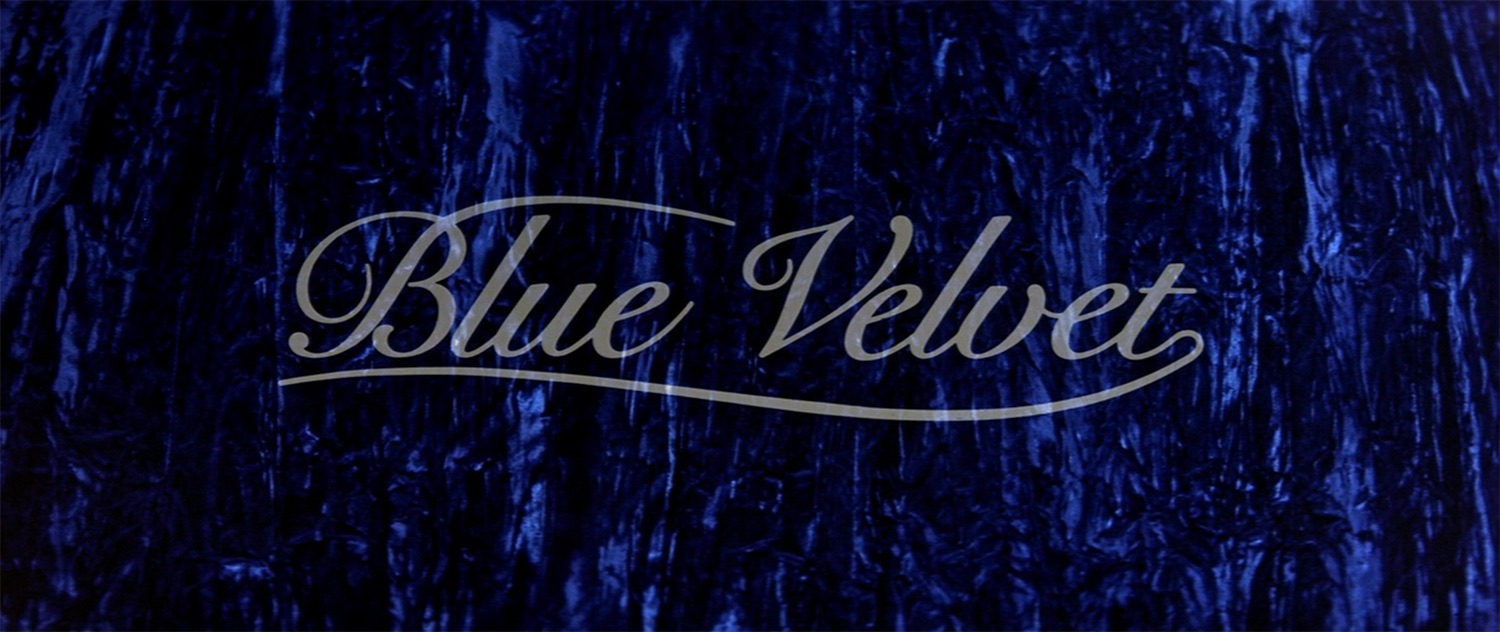
Lynch’s previous work, all on the big screen, includes “The Elephant Man,” “Dune” and “Blue Velvet.” Of those, the last is probably the clearest prototype for “Twin Peaks.” Here again is the small town, the sordid discoveries, the twisted characters, the deadpan regard for murder and madness.
His first screen venture was the cult film “Eraserhead,” that he produced as his student portfolio project at the American Film Institute and that so enraged his mentor, the late Toni Vellani, the story goes, that he was nearly disowned [ed. note – Tony was the head of the institute who gave money to Lynch to make Gardenback which eventually morphed into Eraserhead].
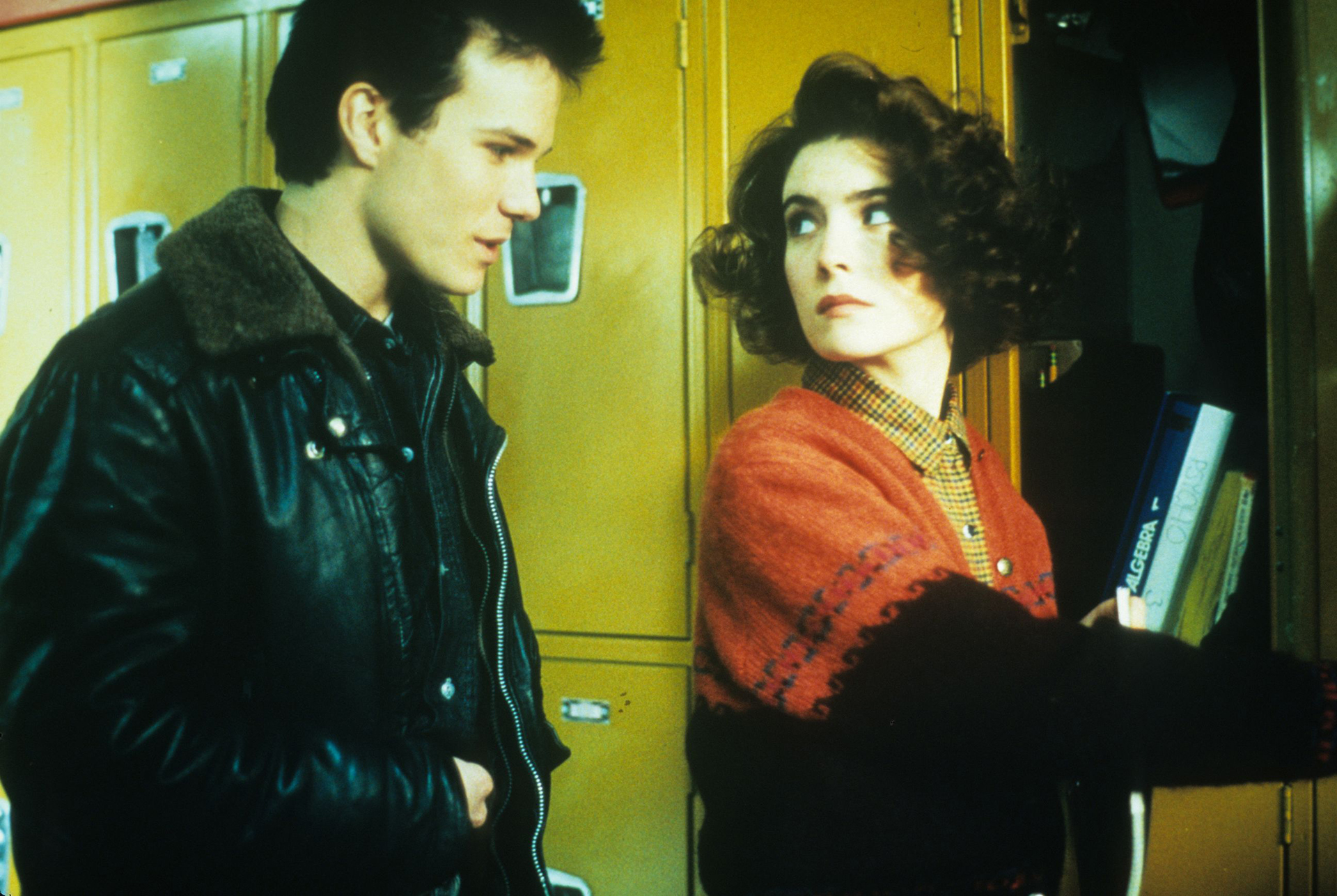
A 1950s sensibility prevails throughout “Twin Peaks.” We feel that we are in the present and in the past at the same time. An angry teenager wheels away in what looks suspiciously like an old Edsel; girls wear longish dresses and cardigan sweaters. The police chief is named Harry S. Truman. And the appearance of ’50s stars like Piper Laurie and Russ Tamblyn (!) add to the suggestion of an earlier era.
The ’50s are the perfect idiom for Lynch, a time when everything – everything – on the surface was hiding some festering foulness. He uses it almost as another character in the drama. Bobby (Dana Ashbrook), the town delinquent, accused of his girlfriend’s murder, comes to school and is told by his buddy that he’s wanted in the office. “What, me worry?” he quips, invoking Mad Magazine’s Alfred E. Neuman, and by extension a whole rebellious generation.
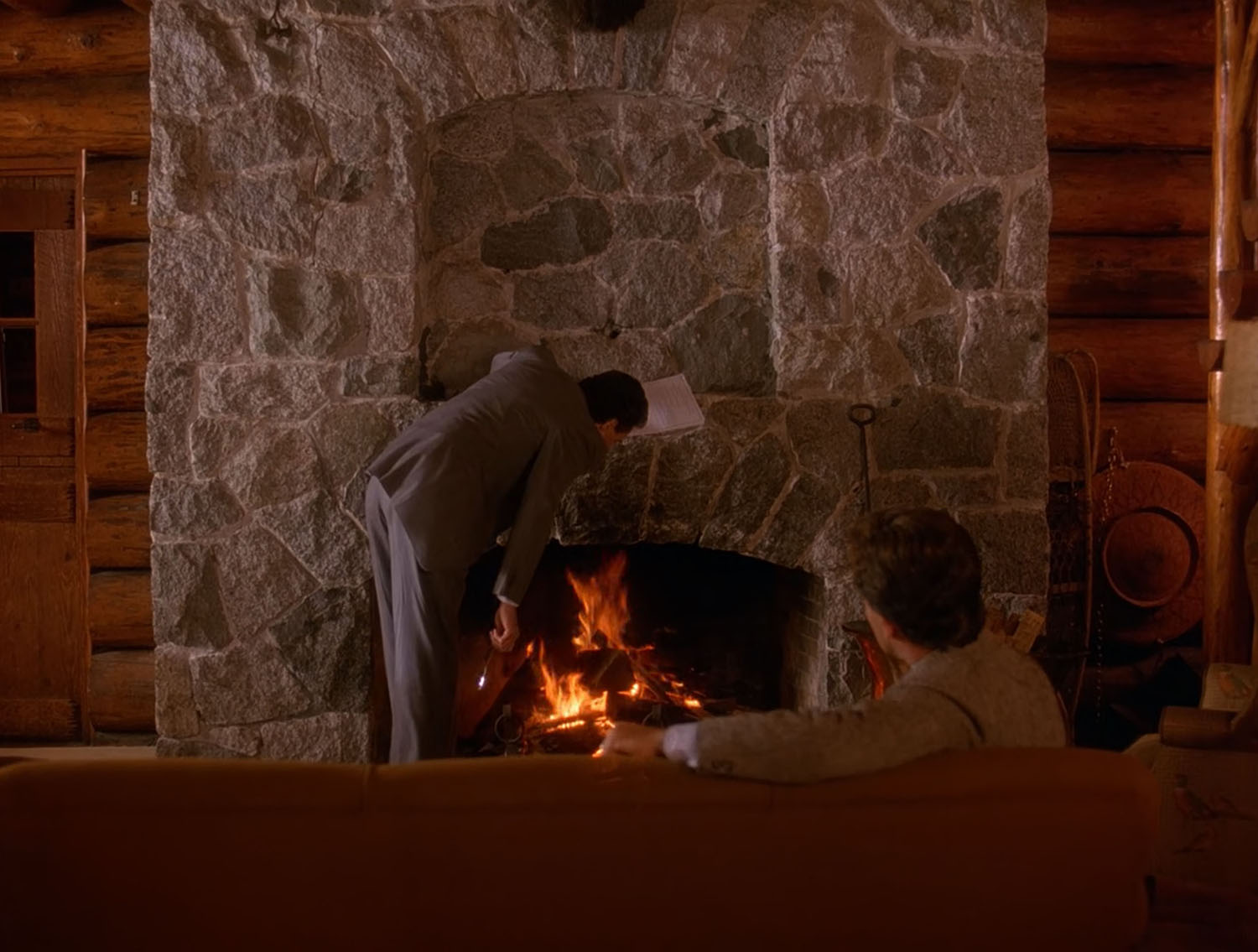
There’s wonderful comedy here, too. A businessman in a three-piece suit surprises his colleague by spitting into a crackling fireplace; a shrewish wife in an eye patch upbraids her husband for ducking out on hanging her drapes, completely ignoring the town’s melancholy preoccupation; a receptionist sticks a pencil into a Styrofoam cup full of coffee, gleefully spilling its contents all over a paper-cluttered desk.
“Twin Peaks” is a marvel. Its complexity and depth are such that you keep having to remind yourself it is television. There may be something to all the hype about this series. It just might goose sluggish, vacuous programming for the home screen in another direction – in the direction of art, to be precise.
Art and TV are supposed to be a contradiction, but “Twin Peaks” gets the closest yet to bringing the medium to aesthetic maturity. If Lynch succeeds in changing television even a little, we may find ourselves in the future tempted away from theaters that show bloated chase movies and staying home to watch small, intricate dramas with settings and characters that surprise and delight us.
Ron Garcia is the gifted director of photography. Angelo Badalamenti does the music score, with some songs by Lynch.
It’s incredible looking back at Joseph’s review as he predicted something that happened – Twin Peaks changed the television landscape. Today, viewers have the option of staying home to watch gripping television shows that have a direct line of influence to Frost and Lynch’s murder mystery that was unlike anything ever created for the small screen.
Author
Discover more from TWIN PEAKS BLOG
Subscribe to get the latest posts sent to your email.