
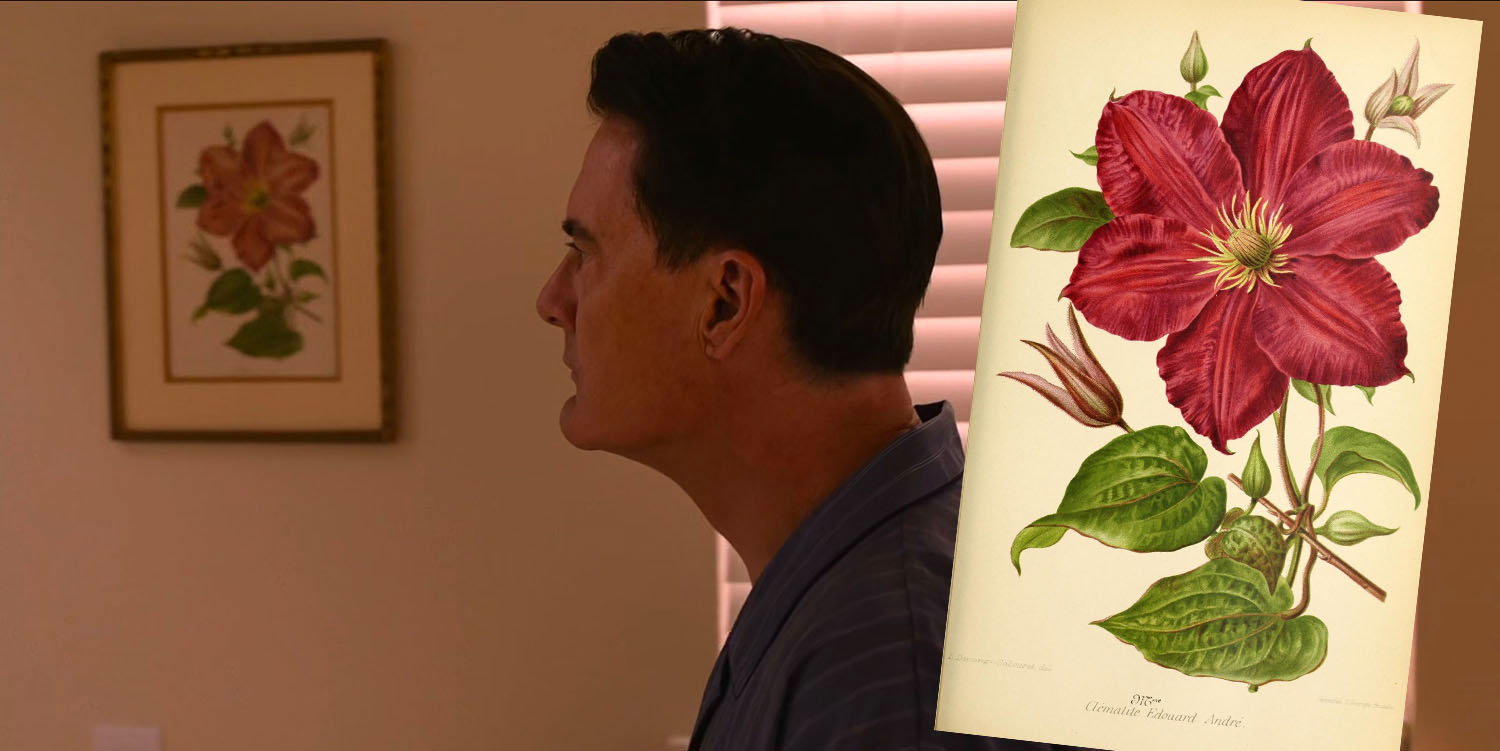
In Part 4 of Twin Peaks: The Return, Dougie Jones has a moment of self-reflection in his bathroom mirror following a great release. For years, I’ve wondered what framed floral image was hanging on the bathroom wall as Dougie approached the mirror. It didn’t take long for me to locate the original artwork first created in France in 1892, yet it’s the symbolic nature of this flower that has me thinking differently about this haunting scene.
CLEMATIS ARTWORK BY LOUISE-CÉCIL DESCAMPS-SABOURET IN JONES’ BATHROOM
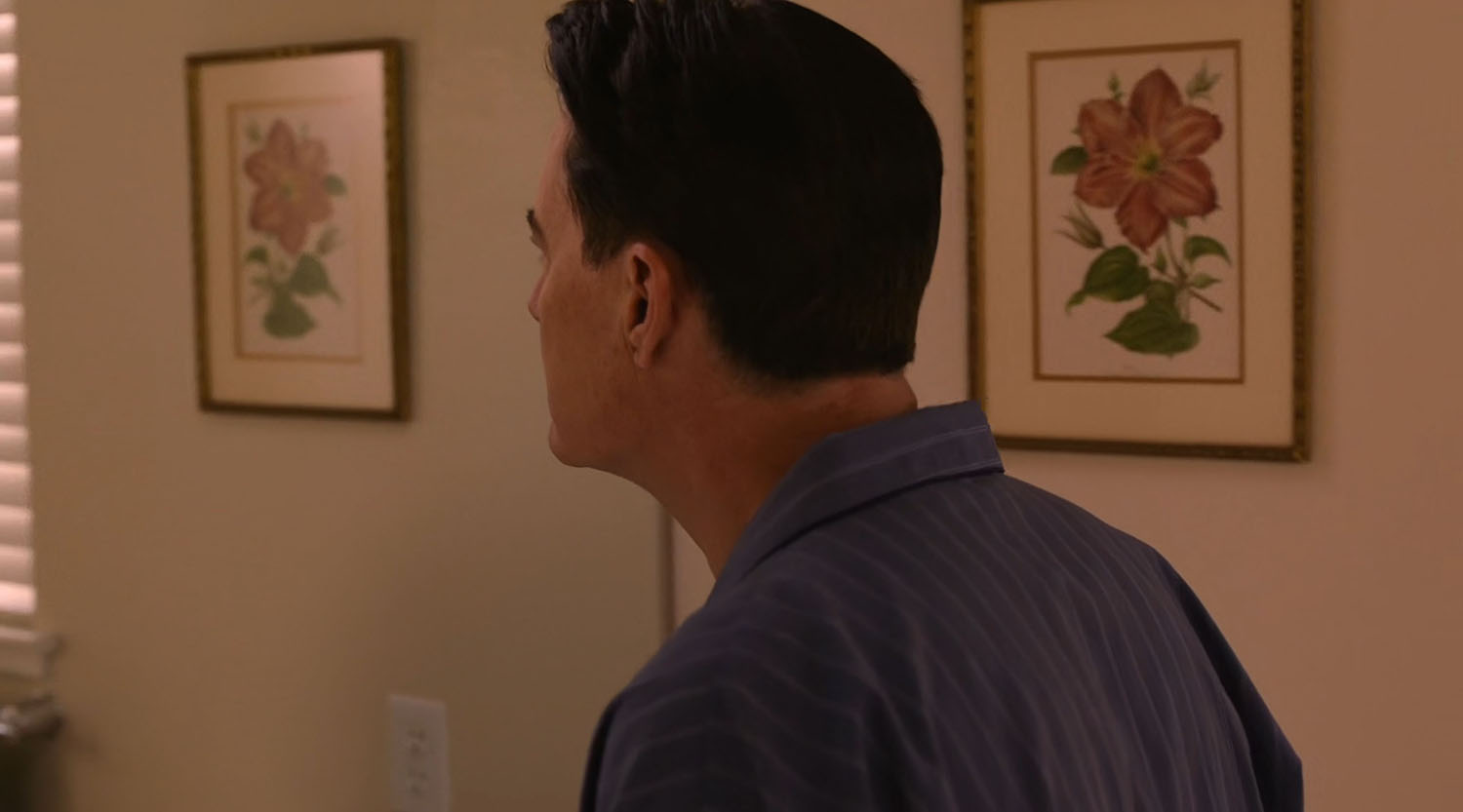
After a much-needed bathroom break, Dougie Jones catches his reflection in his home’s bathroom mirror. Shocked, he cautiously approaches as if it’s the first time he’s ever seen himself. The camera slowly pans toward Dougie and his reflection. Framed artwork of a flower hangs on the wall behind him, and at one point, it is also reflected in the mirror.
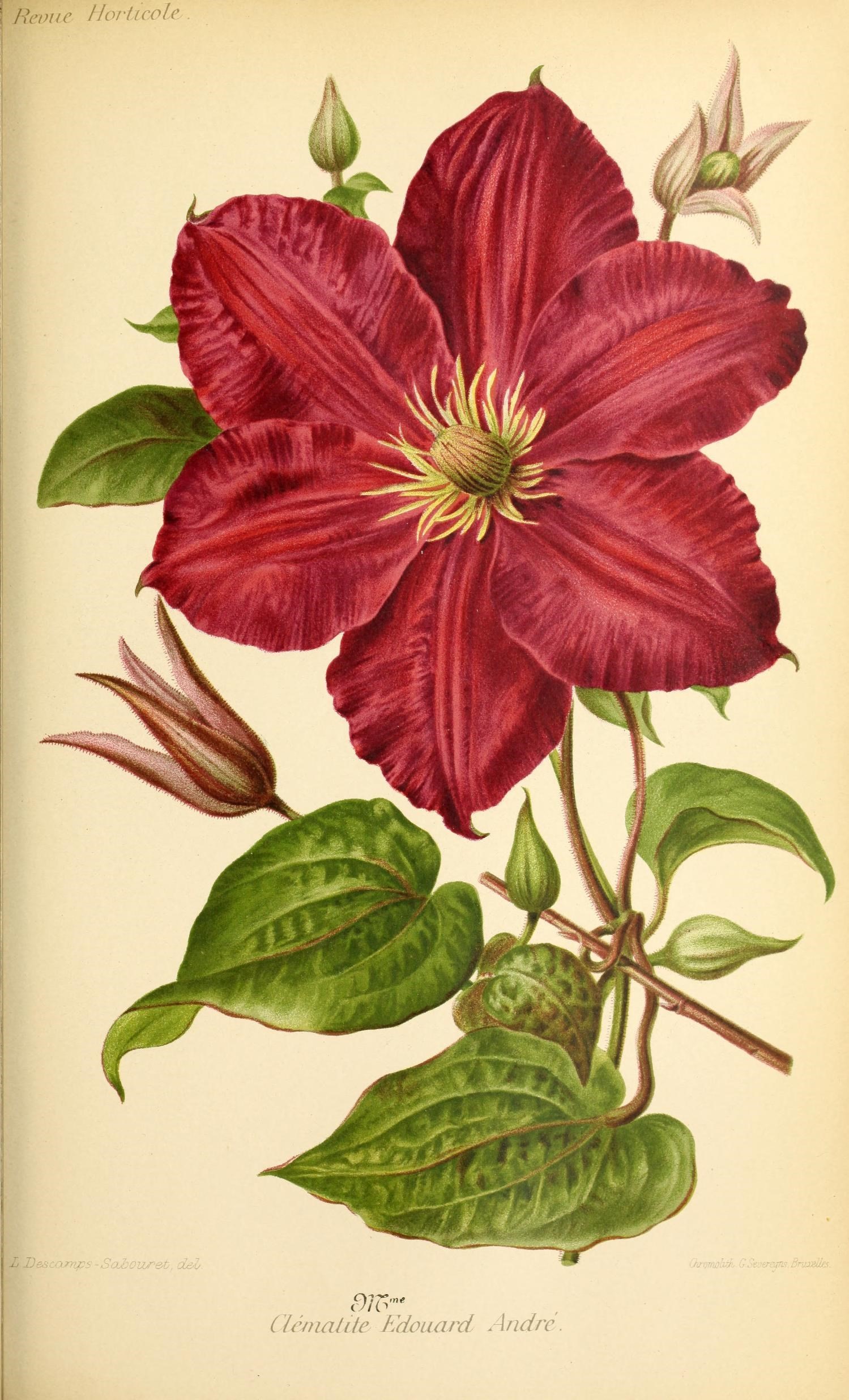
The floral image is the Clematis Madame Édouard André drawn by Louise-Cécile Descamps-Sabouret and published in the 1893 edition of “Revue Horticole: Journal D’Horticulture Pratique” which roughly translates to “Horticulture Review: Journal of Practical Horticulture.” The book was originally published by Georges Jacob Printing House once located at 8 Rue Saint-Étienne in Orléans, France. The public domain image was framed with a cream-colored and gold-stripe border.
It’s important to note this item would be considered a set decoration, not necessarily a prop (since an actor didn’t physically hold it). Nevertheless, I’m happy to have found the original.
The drawing contains a few inscriptions, one of which is seen in the episode.
- Revue Horticole – the book’s title in the upper left corner
- L. Descamps-Sabouret – the artists name in the bottom left
- Clematis Mme Édouard André – the name of the flower, Clematis Madame Édouard André. You can see part of this title in Part 4 as Dougie approached the mirror.
- Chromolith G. Severeyns Brussels – in the bottom right corner. Guillaume Michel Corneille Severeyns was a renowned 19th-century Belgian lithographer and artist based in Brussels His intricate, hand-colored botanical and horticultural chromolithographs frequently appeared in European agricultural and gardening publications.
WHO IS LOUISE CÉCILE DESCAMPS-SABOURET?
French painter and botanical artist Louise Cécile Descamps-Sabouret was born on October 3, 1855 in Paris. She studied under Tony Robert-Fleury and debuted her work at the 1879 Paris Salon. Robert-Fleury (September 1, 1837 – December 8, 1911) was a French painter and teacher who was known primarily for historical scenes. He taught as a professor for many years at the Académie Julian in Paris. In 1883, Descamps-Sabouret joined the Société des Artistes Français, an association of French painters and sculptors established in 1881.
Between 1891 to 1901, she created works for “La Revue Horticole” and the Journal des Roses. She died in 1929 at the age of 74. Sadly, I wan’t able to locate much information about her life yet the internet is smattered with her lovely floral drawings.
WHAT IS THE CLEMATIS MADAME ÉDOUARD ANDRÉ?
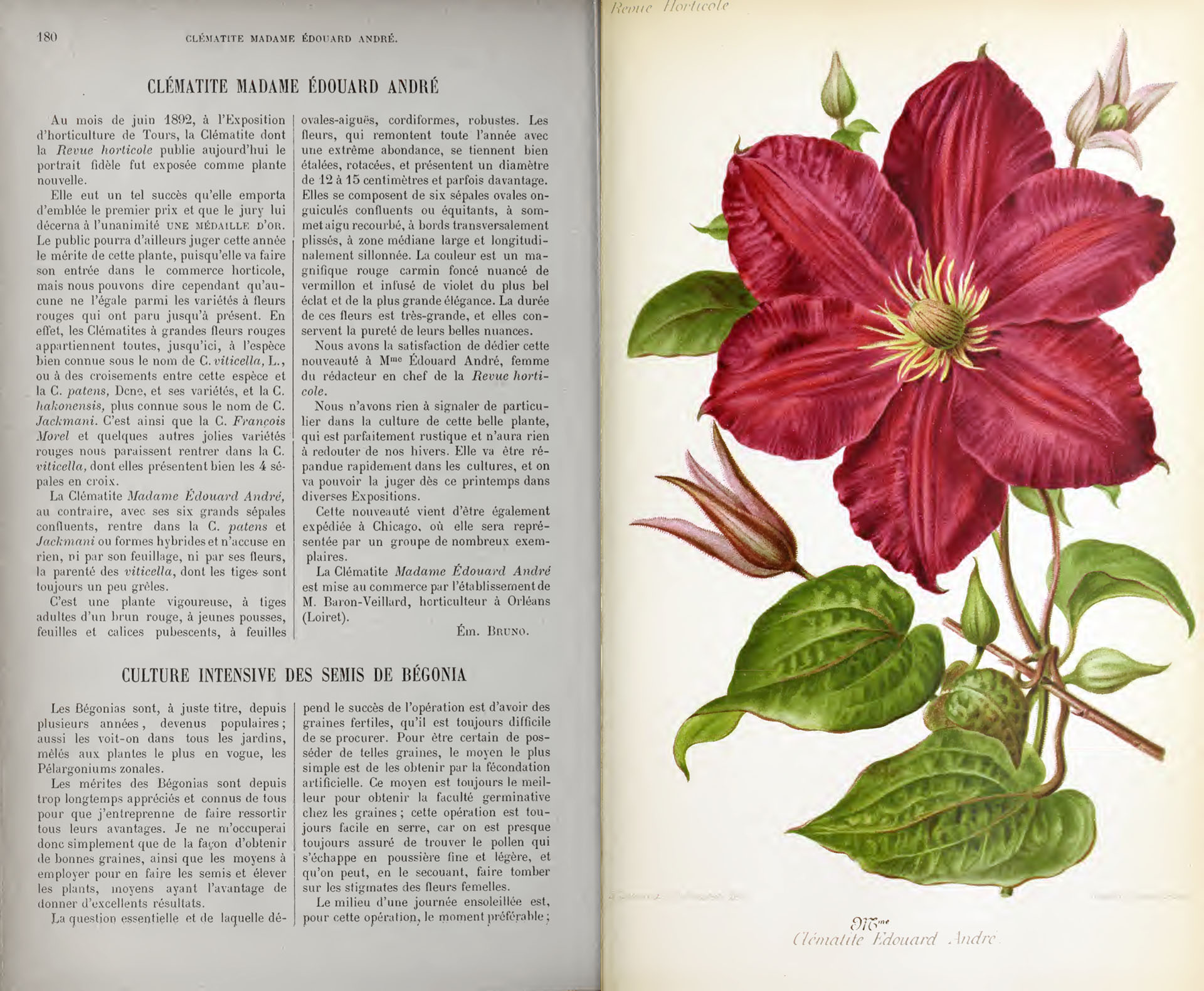
Descamps-Sabouret’s drawing of the Clematis Madame Édouard André first appeared on page 181 of the Revue Horticole: Journal D’Horticulture Pratique published in 1893. This annual book was first published in 1829 by the authors of The Good Gardener.
The flower was shown in June 1892 at the Tours Horticultural Exhibition by Mr. Baron-Veillard, horticulturist in Orleans (Loiret) where it unanimously won a gold medal at the show. It was named for the wife of the editor-in-chief of the Revue Horticole.
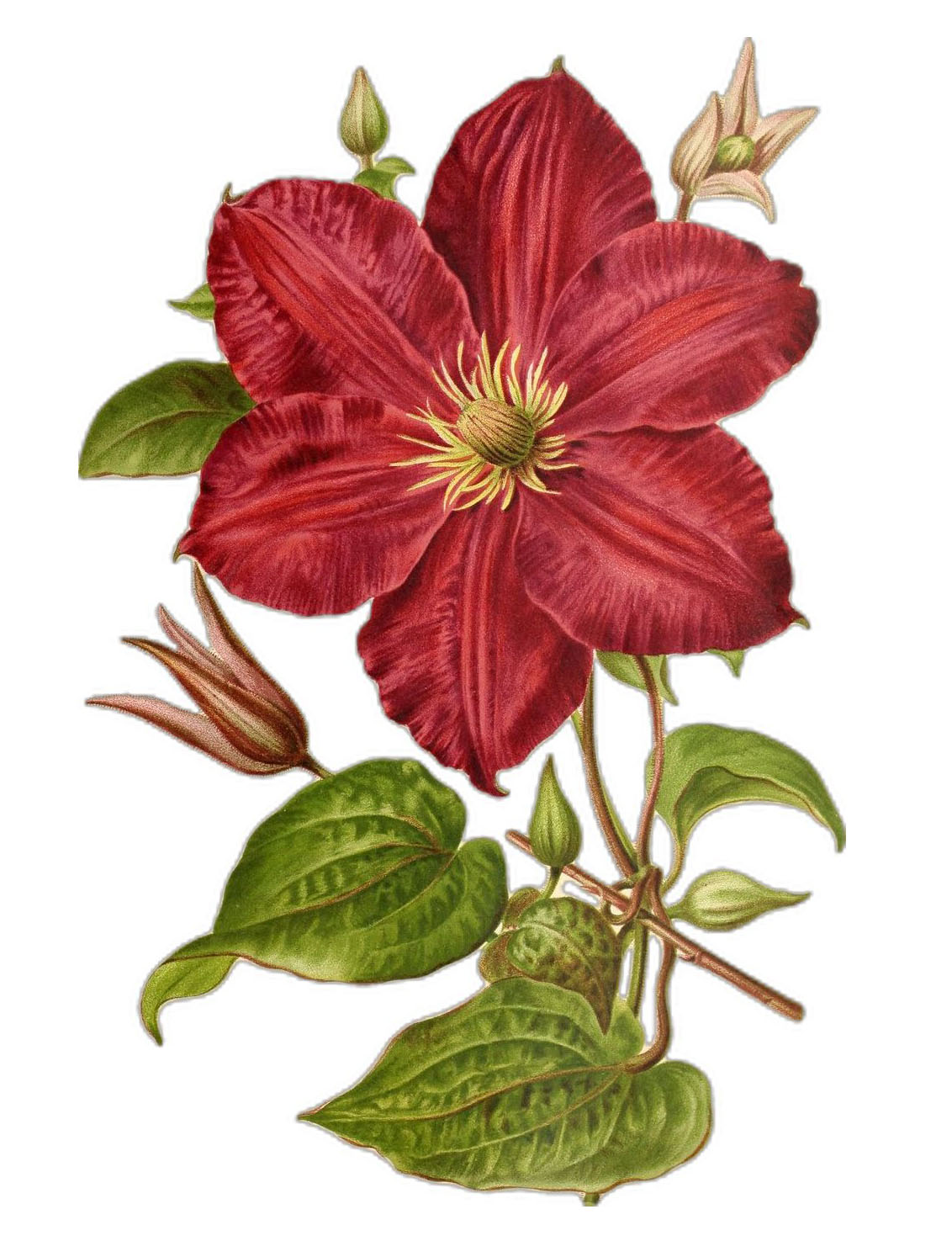
Em. Bruno wrote a description to accompany Descamps-Sabouret’s colorful artwork which I have translated below.
CLEMATIS MADAME ÉDOUARD ANDRÉ
In June 1892, at the Tours Horticultural Exhibition, the Clematis whose faithful portrait is published today in the Horticultural Review was exhibited as a new plant.
It was such a success that it immediately won first prize and the jury unanimously awarded it a GOLD MEDAL.
The public will be able to judge the merit of this plant this year, since it will be entering the horticultural trade, but we can say, however, that none equals it-among the red-flowered varieties that have appeared so far. Indeed, the large-flowered red Clematis all belong, until now, to the species well known as C. viticella, L., or to crosses between this species and C. patens, Dene, and its varieties, and Chakonensis, better known as C. Jackmani.
Thus, C. Francois Morel and some other pretty red varieties appear to fall under the category of C. viticella, whose four cross-shaped sepals they clearly display.
Clematis Madame Édouard André on the other hand, with its six large confluent sepals, falls under the category of C. patens and Jackmani or hybrid forms and shows no sign, either in its foliage or its flowers, , its relationship to the viticella, whose stems are always somewhat slender.
It is a vigorous plant, with reddish-brown mature stems, pubescent young shoots, leaves, and calyxes, with oval-acute, heart-shaped, robust leaves. The flowers, which bloom repeatedly throughout the year in extreme abundance, are well-spreading, rotating, and have a diameter 12 to 15 centimeters and sometimes more. They consist of six oval, on-guiculate sepals, confluent or equitant, with a recurved apex, transversely pleated edges, and a wide, longitudinally grooved midrib. The color is a magnificent dark carmine red nuanced with vermilion and infused with violet of the most beautiful brilliance and elegance. These flowers have a very long lifespan, and they retain the purity of their beautiful shades.
We have the satisfaction of dedicating this new variety to Mrs. Édouard André , wife of the editor-in-chief of the Revue Horticole.
We have nothing particular to report regarding the cultivation of this beautiful plant, which is perfectly hardy and will have nothing to fear from our winters. It will be quickly introduced into cultivation, and it will be possible to judge it this spring at various exhibitions This new variety has also just been shipped to Chicago, where it will be represented by a large group of specimens.
The Clematis Madame Édouard André is being marketed by the establishment of Mr. Baron-Veillard, horticulturist in Orleans (Loiret). Em. BRUNO.
APPEARANCES IN TWIN PEAKS: THE RETURN
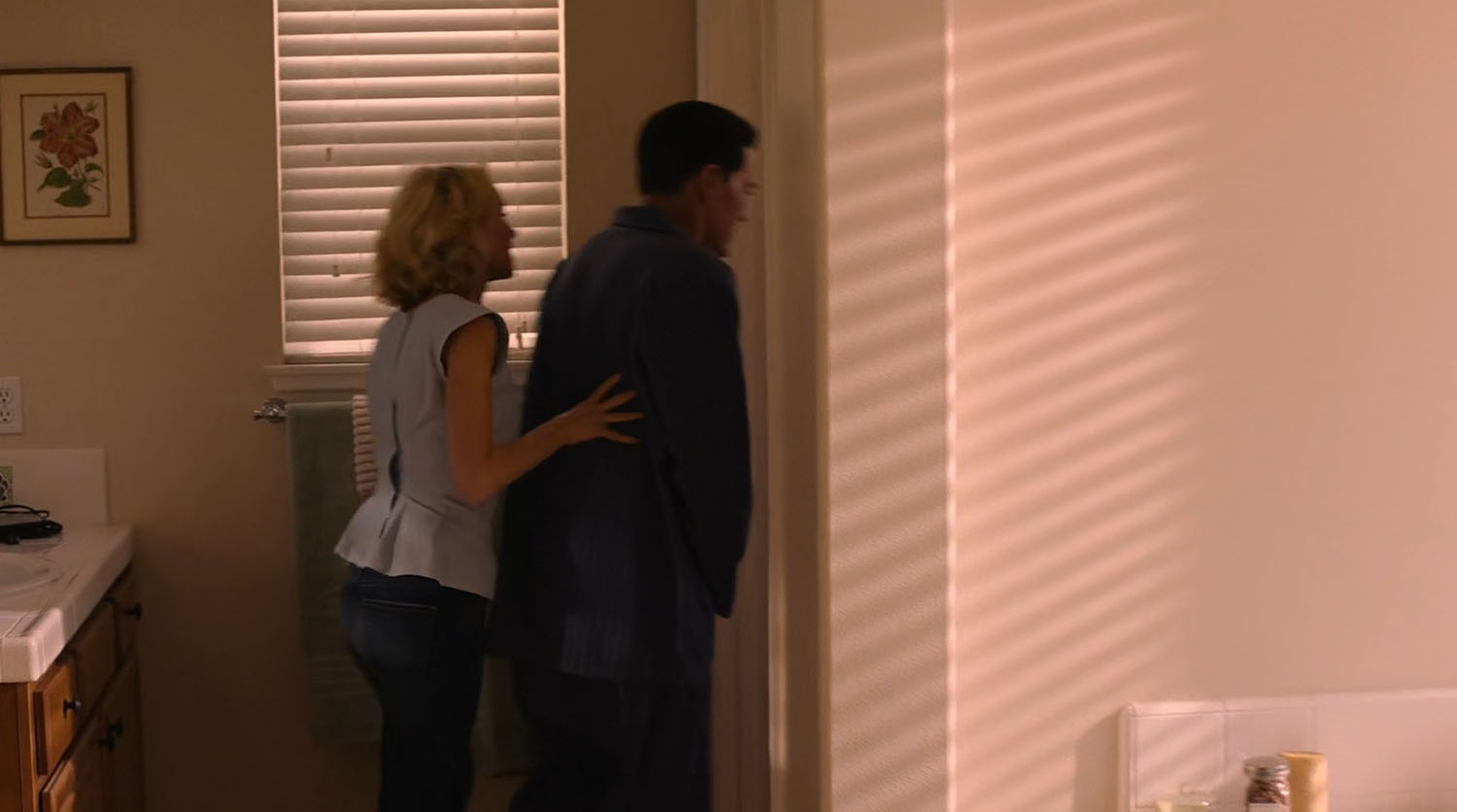
We first see this framed floral artwork in Part 4 of Twin Peaks: The Return when Janey-E Jones helps Dougie Jones find the bathroom.
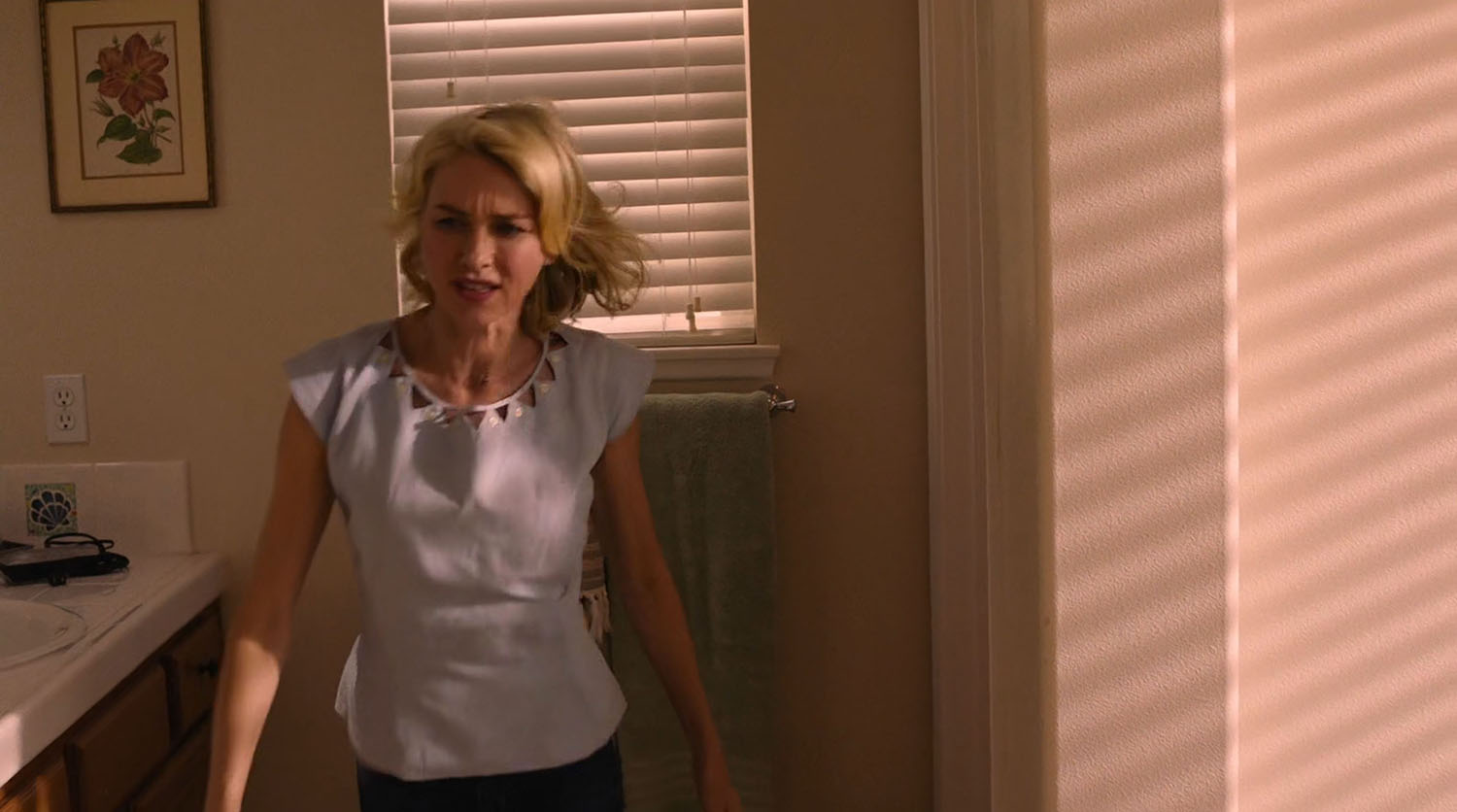
After shoving Dougie into the toilet room, she storms away from the scene.
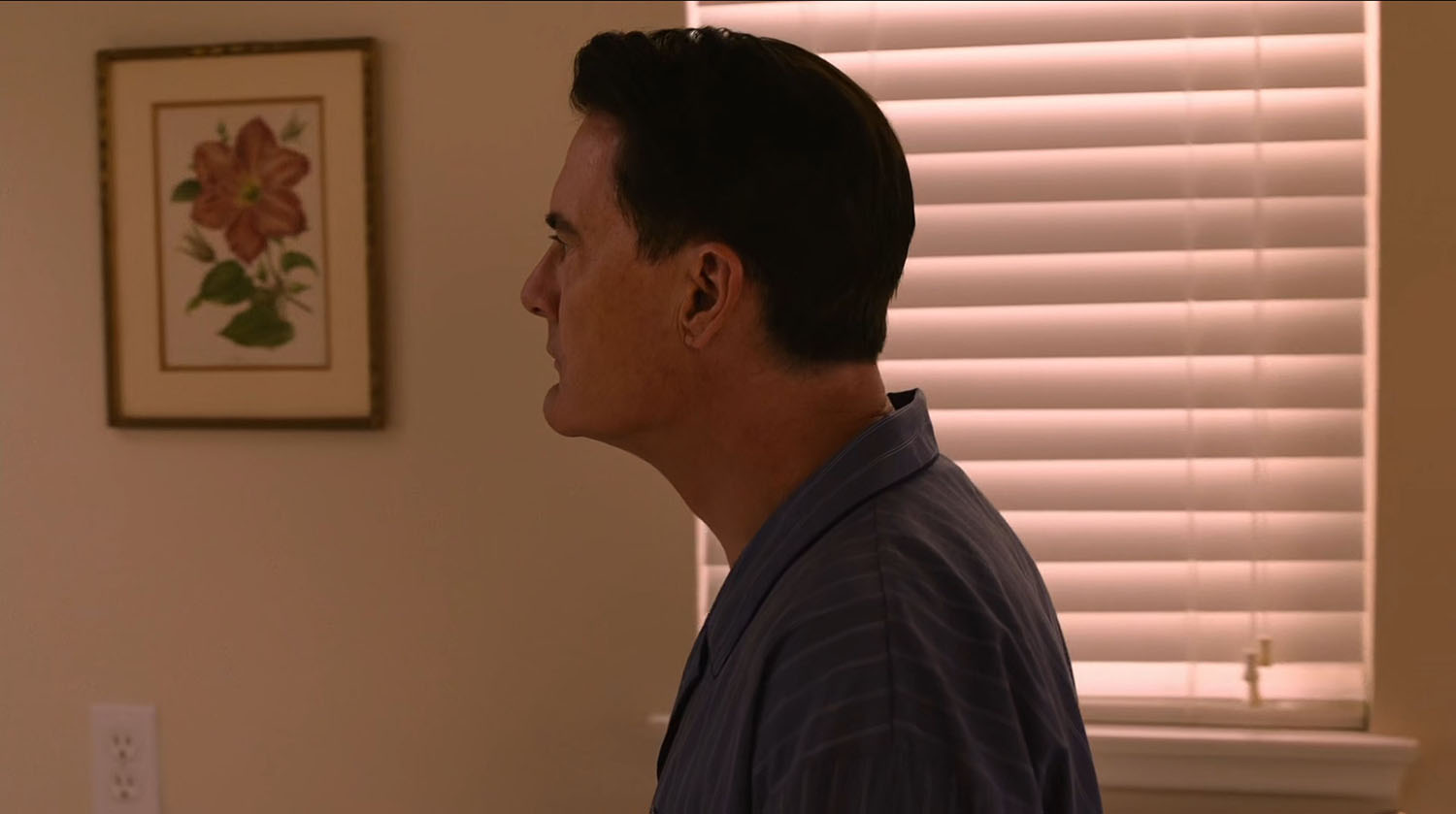
After urinating, Dougie Jones turns to leave the bathroom but catches his reflection. This is the part where I figured the artwork was intentionally included in this scene. According to an article titled “Clematis Flower Meaning – The Beauty and Symbolism of an Ethereal Flower” published on February 11, 2026 on Thursd.com, the Clematis “is a symbol of the continuous evolution of the soul.” The article gives further meaning behind the flower.
“Throughout history, the symbolic meaning of Clematis flowers has evolved across diverse cultural backdrops. The name itself, as noted, derives from a Greek word meaning vining branch, reflecting the ancient Greeks’ recognition of this plant’s climbing nature. In various Eastern traditions, the upward growth of Clematis symbolizes spiritual ascent and a journey towards enlightenment.”
According to The Martha Blog in July 2024, Clematis is a genus of about 300-species within the buttercup family Ranunculaceae. The name Clematis comes from the Greek word “klematis,” meaning vine.
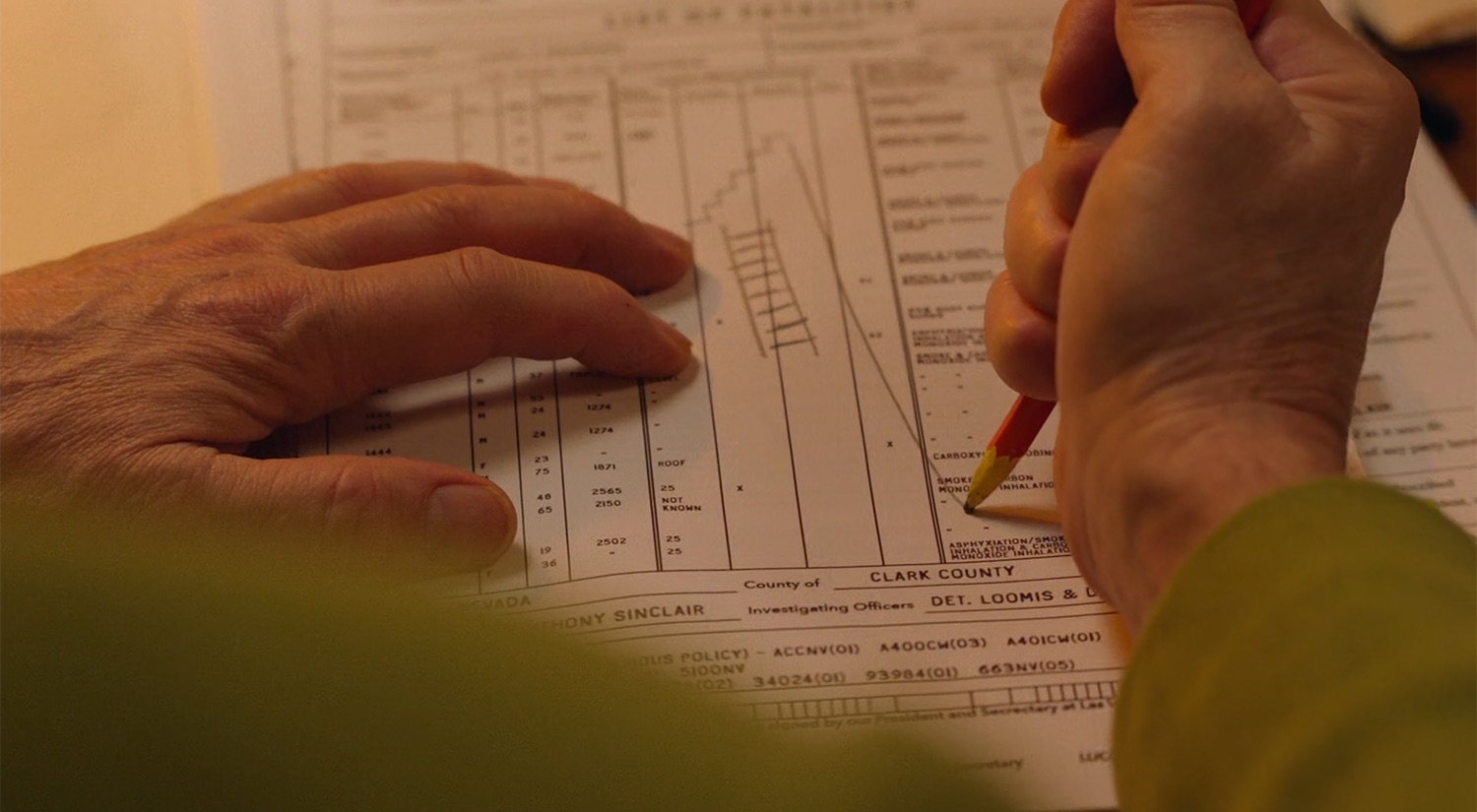
Considering a large theme of Twin Peaks: The Return is a journey to enlightenment, I can’t help but think of Dougie’s own ladder he climbs throughout the first 16 parts of the show’s third season. Granted, we may never know for certain if the artwork was intentionally placed, but I’d like believe this was more than just a “happy accident.”

The scene continues as Dougie looks carefully in the mirror at his reflection. The Clematis artwork is now reflected.

The last time we see the Clematis artwork is a close up of Dougie touching the hand of his reflection. I seriously doubt that Louise-Cécile Descamps-Sabouret would have ever thought her artwork would be included in one of the most wonderful and strange television shows 125 years after she first drew it.
Author

Discover more from TWIN PEAKS BLOG
Subscribe to get the latest posts sent to your email.