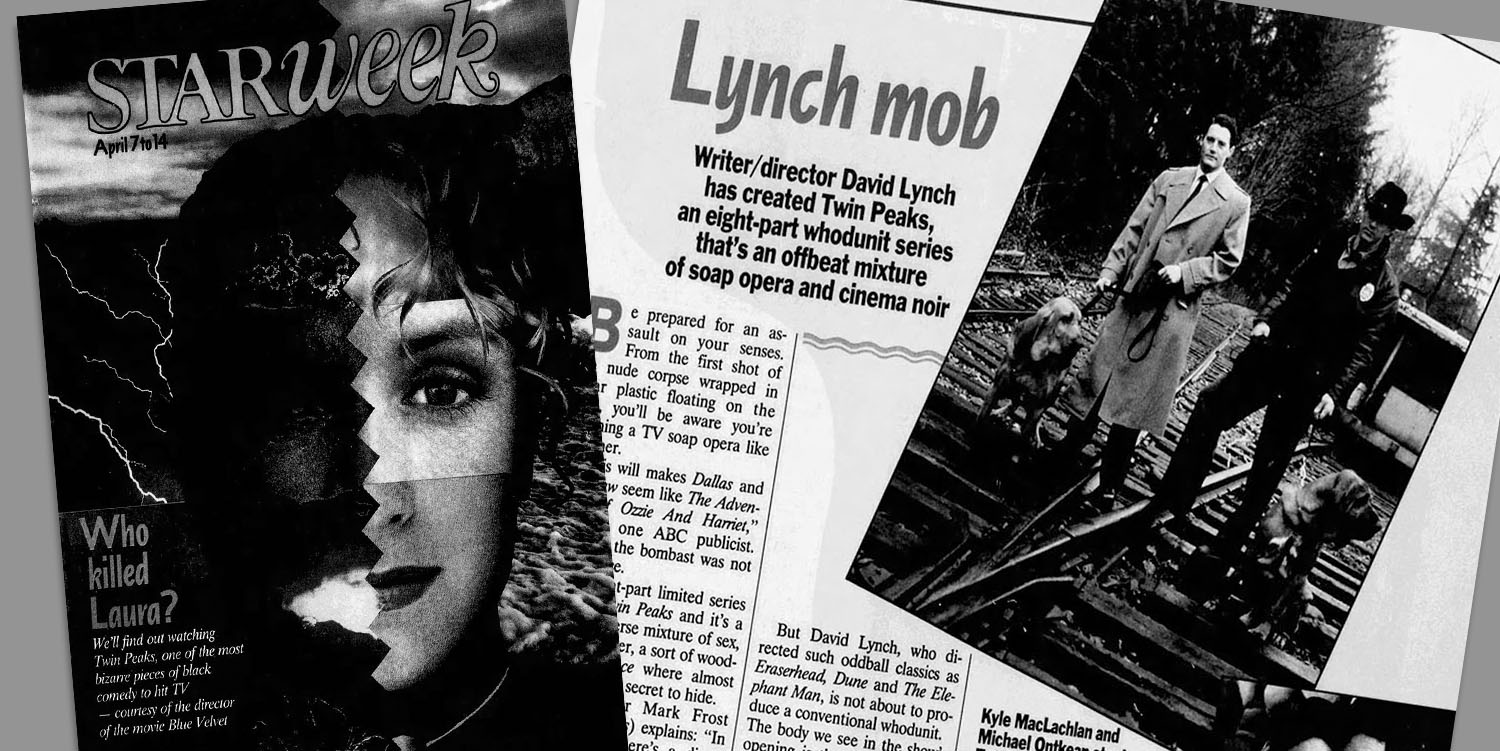
David Lynch and Mark Frost’s Twin Peaks sparked numerous articles leading up the North American debut on April 8, 1990. One example is Toronto Star’s supplemental to the Saturday Star called Starweek. The April 7-14, 1990 issue featured a story by Jim Bawden offering readers a first look at the wonderful and strange new show.
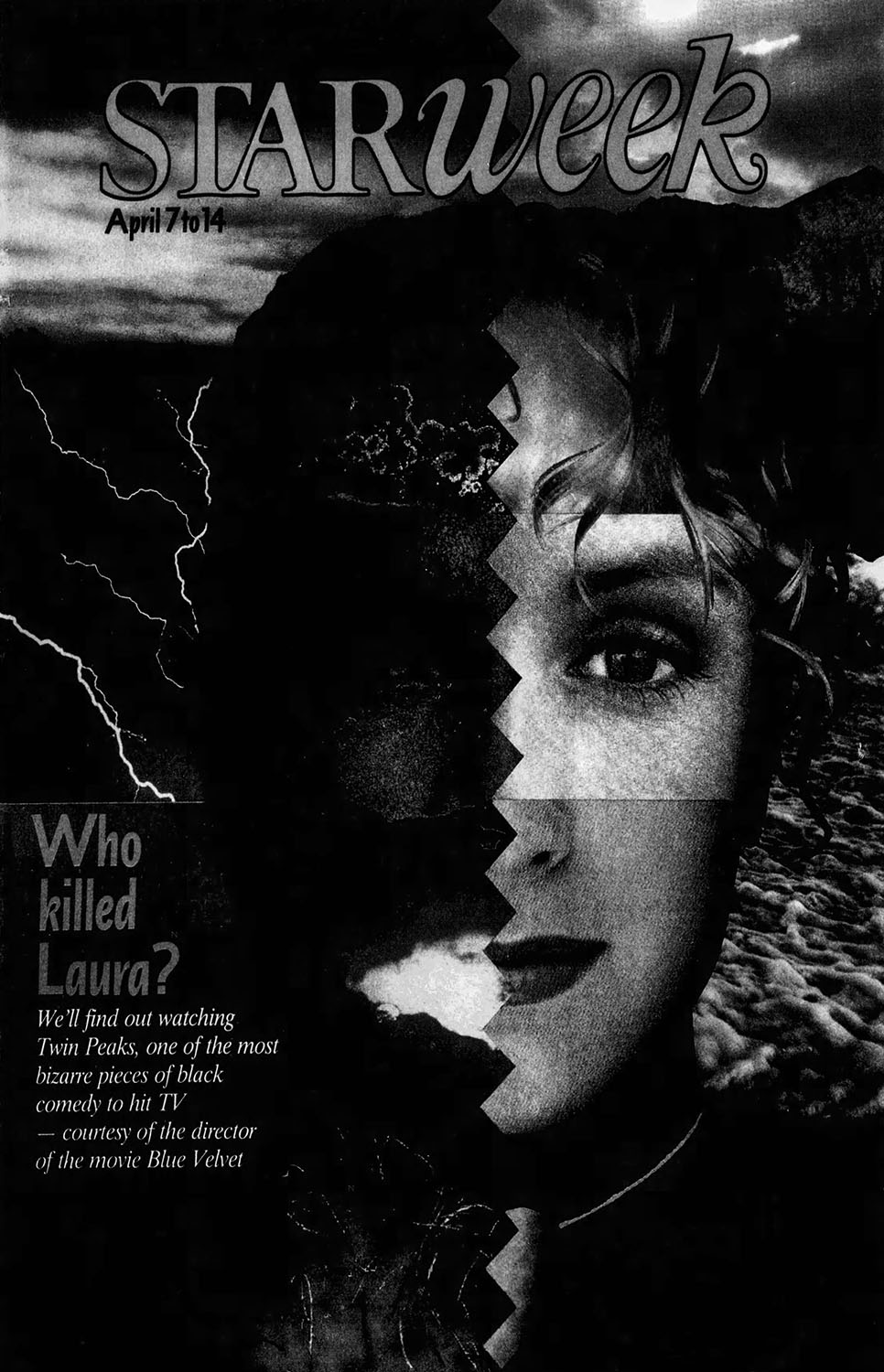
THE TORONTO STAR’S STARWEEK FROM APRIL 7-14, 1990 | COVER
The Toronto Star was created in 1892 by striking Toronto News printers and writers. Social reformer Horatio Clarence Hocken, who would become mayor of Toronto became the newspaper’s founder, along with another future mayor, Jimmy Simpson. The paper was established as the Evening Star and was later renamed the Toronto Daily Star in 1900 by Joseph E. Atkinson. The paper was renamed the Toronto Star in 1971 and introduced a Sunday edition in 1977. The
Starweek was a supplement to the Saturday edition and contained entertainment articles along with television programming listings. In 1990, the magazine’s editor was Alan Marshall and Starweek’s editor was Bob Hallam.
The April 7-14, 1990 issue of Starweek contained artwork by Kevin Ghiglione. According to his online bio, Kevin is a native of Saskatchewan and attended the Alberta College of Art and Ontario College of Art where he studied print making, experimental media, photography, communication arts and industrial design. His working career led him into various fields of art related careers. he brings over four decades of artist experiences to his encaustic painting process. Kevin is an encaustic artist based in Toronto.
The cover teases the story about Twin Peaks:
Who Killed Laura? We’ll find out watching Twin Peaks, one of the most bizarre pieces of black comedy to hit TV – courtesy of the director of the movie Blue Velvet
THE TORONTO STAR’S STARWEEK FROM APRIL 7-14, 1990 | PAGE 3
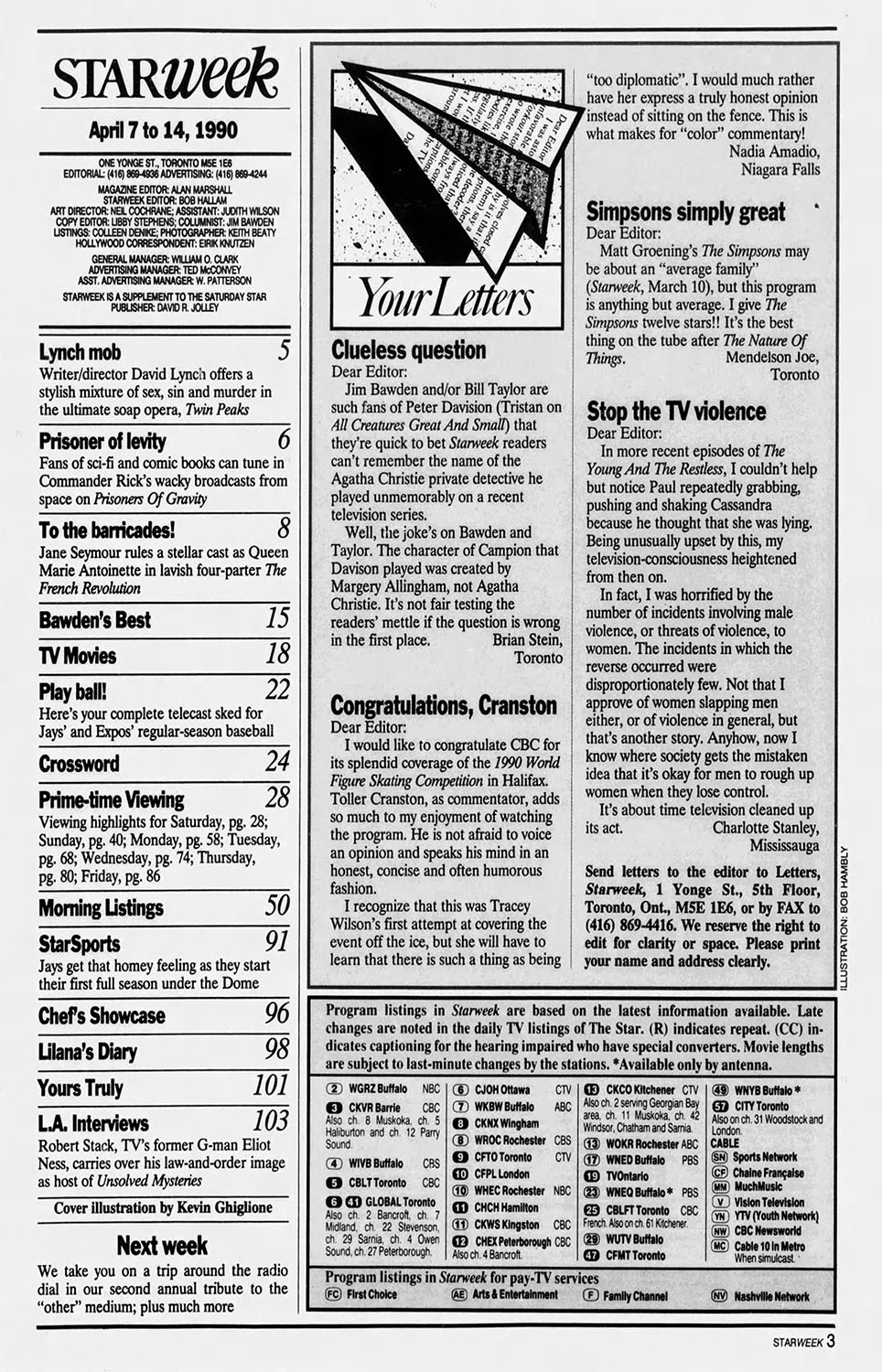
Page 3 of Starweek contains a Table of Contents which lists the Twin Peaks article on Page 5:
Lynch Mob / Writer/director David Lynch offers a stylish mixture of sex, sin and murder in the ultimate soap opera, Twin Peaks
THE TORONTO STAR’S STARWEEK FROM APRIL 7-14, 1990 | PAGE 5, 11
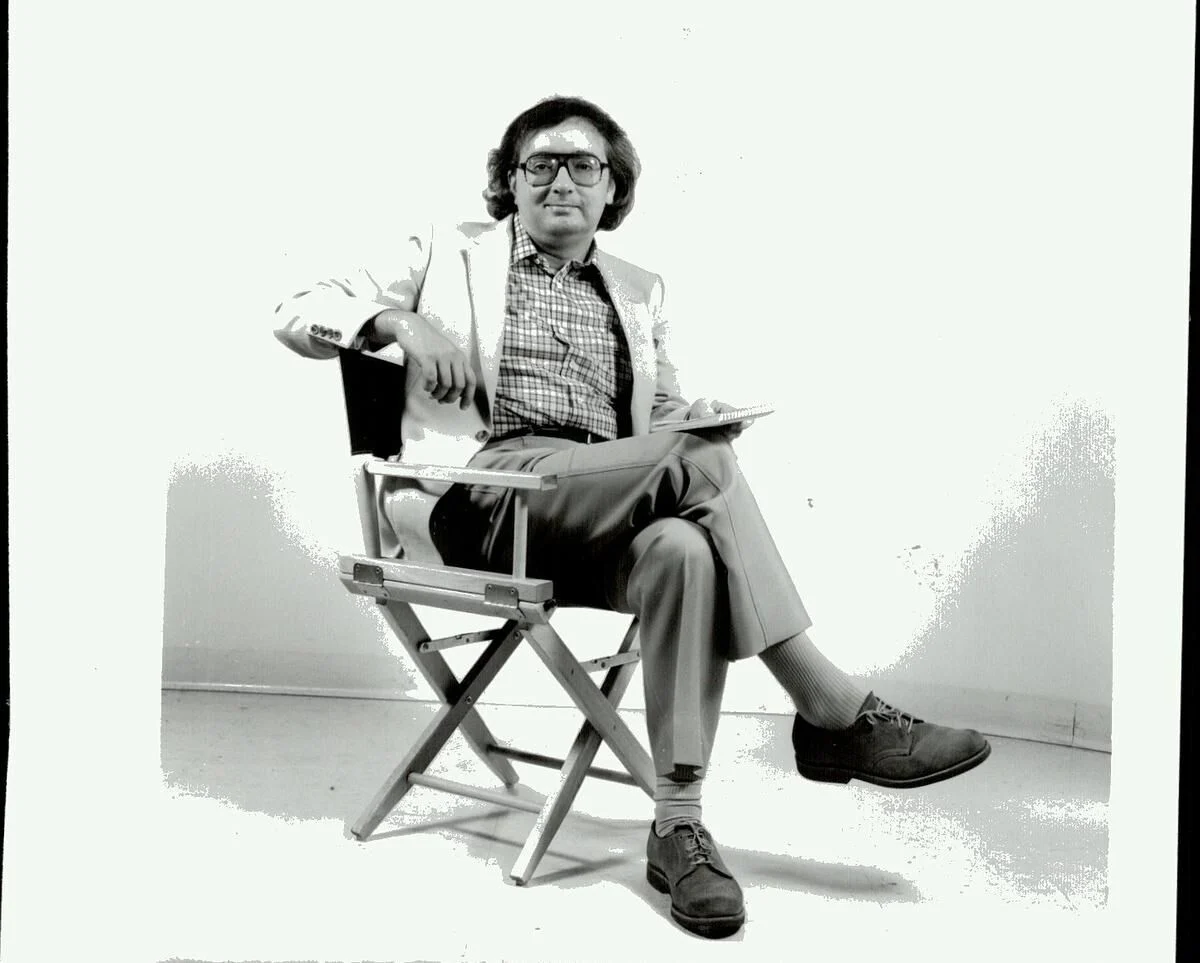
James Bawden had a 40-year career as a TV columnist and critic with the Toronto Star, Globe And Mail, Hamilton Spectator and CBC. During his time as a reporter, he cultivated a reputation as “one of the most knowledgeable and plugged-in Toronto personalities on television and movie history.” He retired from the Star in 2008 and continued writing for his blog, offering television show and documentary reviews, sprinkling in funny anecdotes of stars he interviewed. Bawden passed on January 24, 2021 at the age of 75.
According to Former Sun Media TV columnist Jim Slotek, Bawden never recorded his interviews.
“He never used a notepad to record his interviews,” Slotek said. “I soon realized that he didn’t record interviews because he offered his own interpretation of interviews.”
Bawden’s article about Twin Peaks began on Page 5 and concluded on page 11.
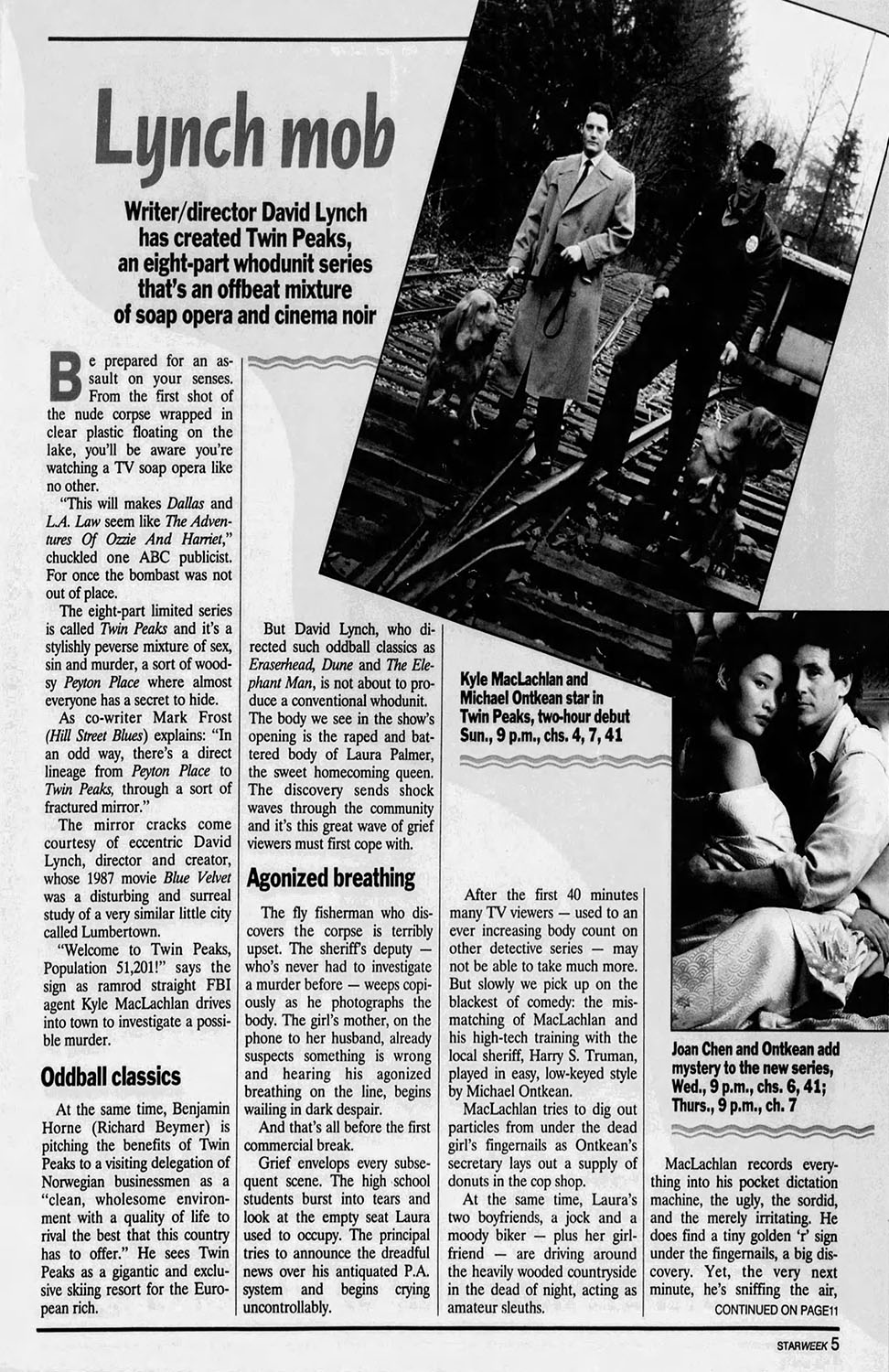
Lynch mob
Writer/director David Lynch has created Twin Peaks, an eight-part whodunit series that’s an offbeat mixture of soap opera and cinema noir
Be prepared for an assault on your senses. From the first shot of the nude corpse wrapped in clear plastic floating on the lake, you’ll be aware you’re watching a TV soap opera like no other.
“This will makes Dallas and L.A. Law seem like The Adventures Of Ozzie And Harriet,” chuckled one ABC publicist. For once the bombast was not out of place.
The eight-part limited series is called Twin Peaks and it’s a stylishly perverse mixture of sex, sin and murder, a sort of woodsy Peyton Place where almost everyone has a secret to hide.
As co-writer Mark Frost (Hill Street Blues) explains: “In an odd way, there’s a direct lineage from Peyton Place to Twin Peaks, through a sort of fractured mirror.”
The mirror cracks come courtesy of eccentric David Lynch, director and creator, whose 1987 movie Blue Velvet was a disturbing and surreal study of a very similar little city called Lumbertown.
“Welcome to Twin Peaks, Population 51,201!” says the sign as ramrod straight FBI agent Kyle MacLachlan drives into town to investigate a possible murder.
Oddball classics
At the same time, Benjamin Horne (Richard Beymer) is pitching the benefits of Twin Peaks to a visiting delegation of Norwegian businessmen as a “clean, wholesome environ-ment with a quality of life to rival the best that this country has to offer.” He sees Twin Peaks as a gigantic and exclusive skiing resort for the European rich.
But David Lynch, who directed such oddball classics as Eraserhead, Dune and The Elephant Man, is not about to produce a conventional whodunit. The body we see in the show’s opening is the raped and battered body of Laura Palmer, the sweet homecoming queen. The discovery sends shock waves through the community and it’s this great wave of grief viewers must first cope with.
Agonized breathing
The fly fisherman who discovers the corpse is terribly upset. The sheriffs deputy – who’s never had to investigate a murder before – weeps copiously as he photographs the body. The girl’s mother, on the phone to her husband, already suspects something is wrong and hearing his agonized breathing on the line, begins wailing in dark despair.
And that’s all before the first commercial break.
Grief envelops every subsequent scene. The high school students burst into tears and look at the empty seat Laura used to occupy. The principal tries to announce the dreadful news over his antiquated P.A. system and begins crying uncontrollably.
After the first 40 minutes many TV viewers — used to an ever increasing body count on other detective series — may not be able to take much more. But slowly we pick up on the blackest of comedy: the mismatching of MacLachlan and his high-tech training with the local sheriff, Harry S. Truman, played in easy, low-keyed style by Michael Ontkean.
MacLachlan tries to dig out particles from under the dead girl’s fingernails as Ontkean’s secretary lays out a supply of donuts in the cop shop.
At the same time, Laura’s two boyfriends, a jock and a moody biker — plus her girl-friend — are driving around the heavily wooded countryside in the dead of night, acting as amateur sleuths.
MacLachlan records every-thing into his pocket dictation machine, the ugly, the sordid, and the merely irritating. He does find a tiny golden ‘r’ sign under the fingernails, a big discovery. Yet, the very next minute, he’s sniffing the air, wondering about the aroma to the sheriff and recording Truman’s reply (Douglas firs) on his cassette with great satisfaction.
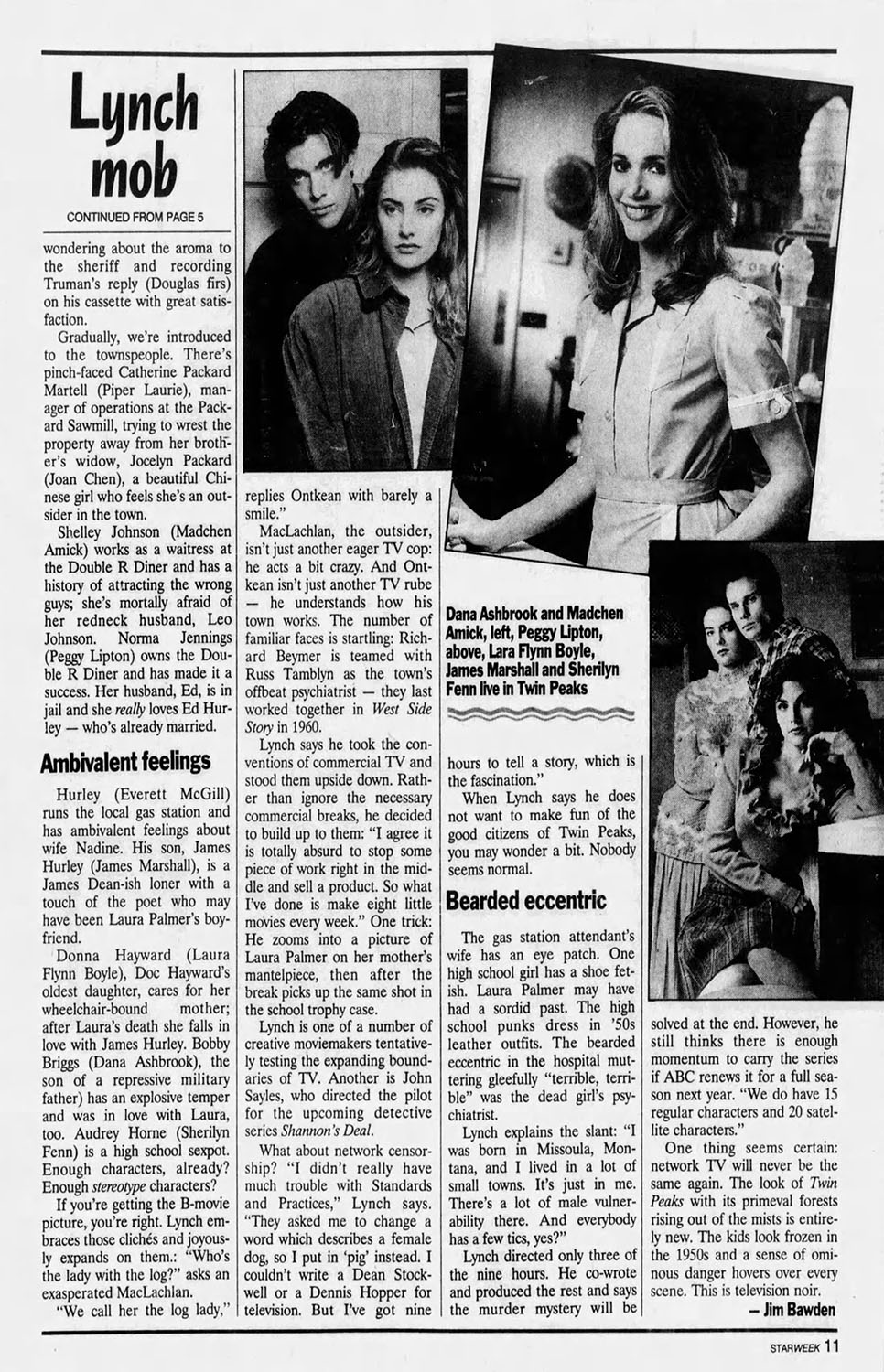
Gradually, we’re introduced to the townspeople. There’s pinch-faced Catherine Packard Martell (Piper Laurie), manager of operations at the Packard Sawmill, trying to wrest the property away from her brother’s widow, Jocelyn (Joan Chen), a beautiful Chinese girl who feels she’s an outsider in the town. Shelley [sic] Johnson (Madchen Amick) works as a waitress at the Double R Diner and has a history of attracting the wrong guys; she’s mortally afraid of her redneck husband, Leo Johnson. Norma Jennings (Peggy Lipton) owns the Double R Diner and has made it a success. Her husband, Ed, is in jail and she really loves Ed Hurley – who’s already married.
Ambivalent feelings
Hurley (Everett McGill) runs the local gas station and has ambivalent feelings about wife Nadine. His son, James Hurley (James Marshall), is a James Dean-ish loner with a touch of the poet who may have been Laura Palmer’s boyfriend.
Donna Hayward (Laura Flynn Boyle), Doc Hayward’s oldest daughter, cares for her wheelchair-bound mother; after Laura’s death she falls in love with James Hurley. Bobby Briggs (Dana Ashbrook), the son of a repressive military father) has an explosive temper and was in love with Laura, too. Audrey Horne (Sherilyn Fenn) is a high school sexpot. Enough characters, already? Enough stereotype characters?
If you’re getting the B-movie picture, you’re right. Lynch embraces those cliches and joyously expands on them.: “Who’s the lady with the log?” asks an exasperated MacLachlan.
“We call her the log lady,” replies Ontkean with barely a smile.
MacLachlan, the outsider, isn’t just another eager TV cop: he acts a bit crazy. And Ontkean isn’t just another TV rube – he understands how his town works. The number of familiar faces is startling: Richard Beymer is teamed with Russ Tamblyn as the town’s offbeat psychiatrist – they last worked together in West Side Story in 1960.
Lynch says he took the conventions of commercial TV and stood them upside down. Rather than ignore the necessary commercial breaks, he decided to build up to them: “I agree it is totally absurd to stop some piece of work right in the middle and sell a product. So what I’ve done is make eight little movies every week.” One trick: He zooms into a picture of Laura Palmer on her mother’s mantelpiece, then after the break picks up the same shot in the school trophy case.
Lynch is one of a number of creative moviemakers tentatively testing the expanding boundaries of TV. Another is John Sayles, who directed the pilot for the upcoming detective series Shannon’s Deal.
What about network censorship? “I didn’t really have much trouble with Standards and Practices,” Lynch says.
“They asked me to change a word which describes a female dog, so I put in ‘pig’ instead. I couldn’t write a Dean Stockwell or a Dennis Hopper for television. But I’ve got nine hours to tell a story, which is the fascination.”
When Lynch says he does not want to make fun of the good citizens of Twin Peaks, you may wonder a bit. Nobody seems normal.
Bearded eccentric
The gas station attendant’s wife has an eye patch. One high school girl has a shoe fetish. Laura Palmer may have had a sordid past. The high school punks dress in ’50s leather outfits. The bearded eccentric in the hospital muttering gleefully “terrible, terrible” was the dead girl’s psychiatrist.
Lynch explains the slant: “I was born in Missoula, Montana, and I lived in a lot of small towns. It’s just in me. There’s a lot of male vulnerability there. And everybody has a few tics, yes?”
Lynch directed only three of the nine hours. He co-wrote and produced the rest and says the murder mystery will be solved at the end. However, he still thinks there is enough momentum to carry the series if ABC renews it for a full season next year. “We do have 15 regular characters and 20 satellite characters.”
One thing seems certain: network TV will never be the same again. The look of Twin Peaks with its primeval forests rising out of the mists is entirely new. The kids look frozen in the 1950s and a sense of ominous danger hovers over every scene. This is television noir.

The line Lynch was asked to change is found the during the pilot when Bobby Briggs and Mike Nelson visit the Hayward house. Bobby stands on the hood of his car and yells to Mike, “Don’t take any oink-oink off that pretty pig.” Lynch references two actors that appeared in Blue Velvet which clearly had more colorful language not safe for primetime television.
These early reviews of the show are always quite fascinating as they capture the energy around something never before seen on network television.
Author
Discover more from TWIN PEAKS BLOG
Subscribe to get the latest posts sent to your email.