
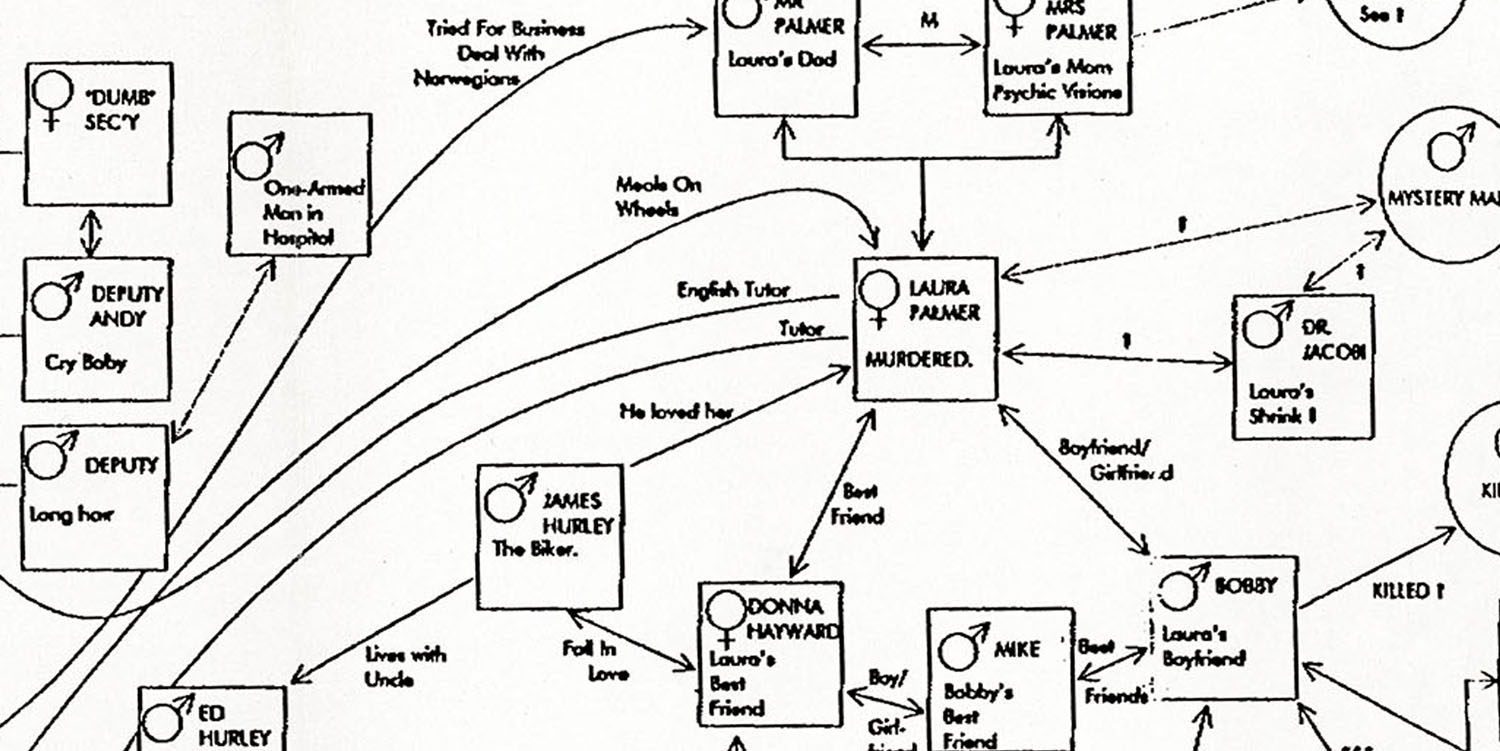
During my quest to archive and document David Lynch and Mark Frost’s Twin Peaks, there is no greater joy than finding a rarely seen artifact. I recently acquired a memo from Phil Marella with Worldvision Enterprises, Inc. that contained a character relationship chart circulated at ABC Television in April 1990. The memo was issued on April 26, just a few weeks after the pilot aired on April 8, 1990. It shows how the network tried explaining the connections between the numerous characters introduced during the first season of this groundbreaking show.
MEMO FROM WORLDVISION ENTERPRISES, INC. ON APRIL 26, 1990
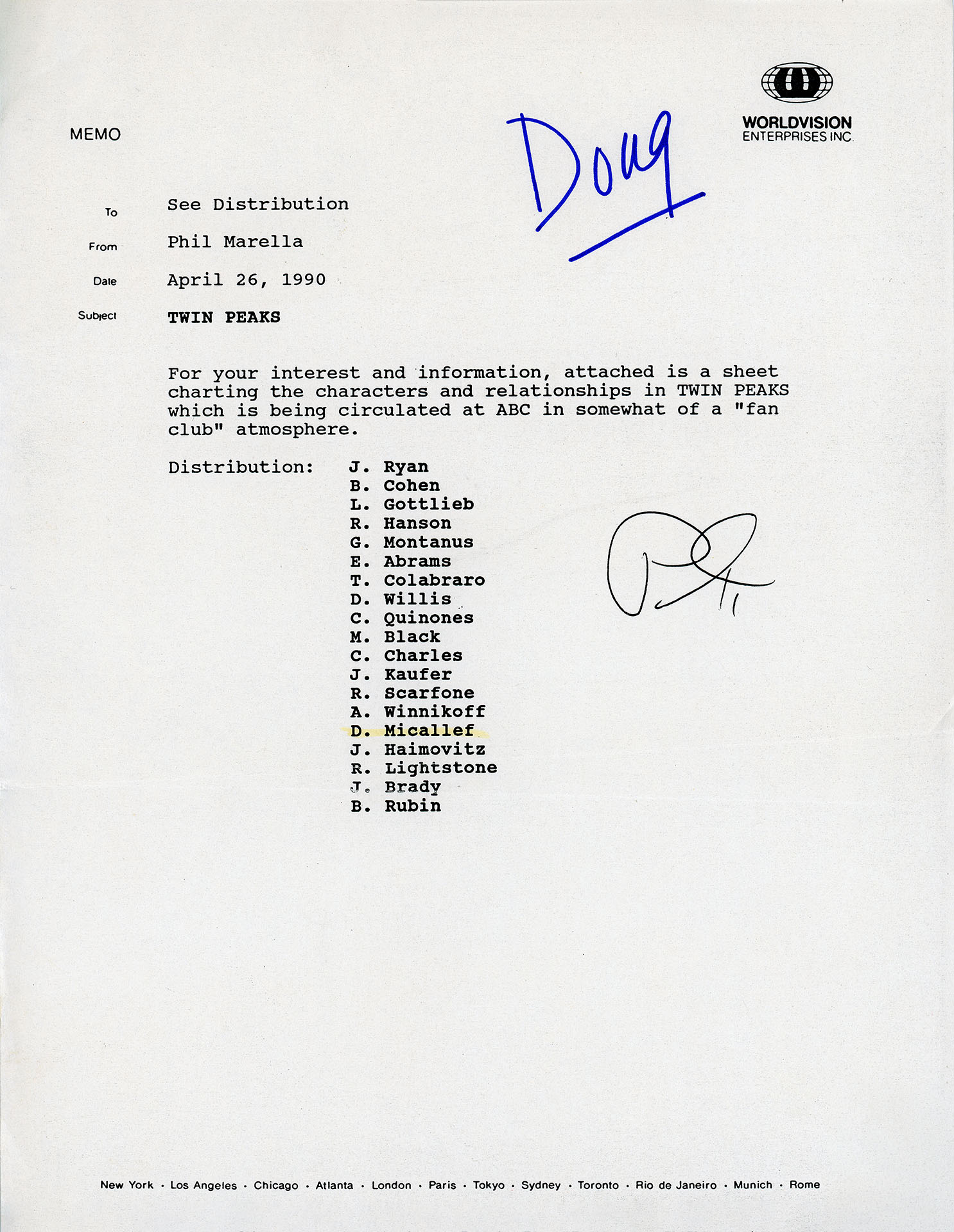
On Thursday, April 26, 1990, Phil Marella issued a memo to 19 employees on Worldvision Enterprises, Inc. letterhead. This is the same day that episode 1.004 aired on ABC Television.
Mr. Marella was the senior vice president, legal and business affairs for company that served as the global marketing and distribution subsidiary of Spelling Entertainment. They provided financing for production of the Twin Peaks pilot. The company also held the merchandising rights to the series in the early 1990s.
The memo appears to be addressed to Doug Micallef as his name is highlighted in yellow and a handwritten “Doug” appears in blue. In 1991, he was the vice president of program development for Worldvision.
Marella wrote: “For your interest and information, attached is a sheet charting the characters and relationships in TWIN PEAKS which is being circulated at ABC in somewhat of a ‘fan club’ atmosphere.”
Below is a list of individuals who received the memo. Only some were identified after cross-referencing newspaper reports. It’s unclear if these individuals held the specific titles listed below when Marella sent the memo.
- J. Ryan – John Ryan, president and chief executive officer of Worldvision Enterpirses
- B. Cohen – Bert Cohen, executive vice president and chief operating officer of Worldvision Enterprises
- L. Gottlieb – Lawrence Gottlieb, executive vice president, finance and administration
- R. Hanson – Randy Hanson, senior vice president of domestic sales
- G. Montanus – Gary Montanus, senior vice president for marketing
- E. Abrams – Elliot Abrams, senior vice president, acquisitions
- T. Colabraro – Tony Colabraro, senior vice president., finance and administration
- D. Willis – Dan Willis, vice president, international sales
- C. Quinones – Charles Quinones, president of operations, overseeing all operational aspects of domestic and foreign sales
- M. Black – Mitch Black, vice president, operations
- C. Charles
- J. Kaufer – Jerry Kaufer, vice president, creative services
- R. Scarfone – Rita Scarfone, vice president, advertising and promotions
- A. Winnikoff – Alan Winnikoff, director of communications
- D. Micallef – Doug Micallef, vice president of program development
- J. Haimovitz – Julie Haimovitz, president and chief operating officer
- R. Lightstone – Ronald Lightstone, executive vice president
- J. Brady – John Brady, senior vice president and chief financial officer
- B. Rubin
WHAT IS WORLDVISION ENTERPRISES, INC.?
The Federal Communications Commission (FCC) participation of networks in the syndication of their own programs between the years of 1971 to 1993. Five former ABC Films executives saw this as an opportunity. On March 30, 1973, they formed Worldvision Enterprises, Inc. as the successor of ABC Films.
According to the Audiovisual Identity Database, the company primarily licensed programs from other networks, like NBC, ABC and CBS, rather than producing their own content. In 1979, Worldvision was sold to Taft Broadcasting (later renamed to “Great American” in 1987 and “Citicasters” in 1993), and was later sold to Aaron Spelling in 1988 and became part of Spelling Entertainment Inc. The transaction was completed on March 11, 1989, and the company became the distributor of Spelling Television-produced shows.
According to the Audiovisual Identity Database, the company primarily licensed programs from other networks, like NBC, ABC and CBS, rather than producing their own content. In 1979, Worldvision was sold to Taft Broadcasting (later renamed to “Great American” in 1987 and “Citicasters” in 1993), and was later sold to Aaron Spelling in 1988 and became part of Spelling Entertainment Inc. The transaction was completed on March 11, 1989, and the company became the distributor of Spelling Television-produced shows.

With the rise of home video in the early 1980s, the company launched Worldvision Home Video, Inc., which distribute videocassette titles of content from the Taft Entertainment Company, most notably its Hanna-Barbera cartoon product, the Jack Nicklaus’ Golf My Way instructional video series. You may also recognize the company’s name if you owned any Twin Peaks video cassettes released in the early 1990s.
On April 6, 1991, Spelling Entertainment Inc. was acquired by the Charter Company, an oil refining, insurance, and communications company. Spelling and Charter merged on October 5, 1992 and Charter was renamed as “Spelling Entertainment Group”. Exactly a year later, Blockbuster Entertainment Corporation acquired a 67% stake in the Spelling Entertainment Group and later merged with Viacom on September 29, 1994.

In 1997, the production arm of Worldvision Enterprises was incorporated into Republic Pictures, and in 1999, Viacom (later “CBS Corporation” and “ViacomCBS”, now “Paramount Global”, then “Paramount Skydance Corporation”) acquired the rest of the Spelling Entertainment Group, and folded the distribution arm of Worldvision into Paramount Domestic Television (now “CBS Media Ventures”).
TWIN PEAKS CHARACTER RELATIONSHIP CHART FROM ABC TELEVISION ON APRIL 18, 1990

The hand-drawn character relationship chart was made on an 11-inch by 14-inch piece of paper. It was revised on April 18, 1990, the day before episode 1.002 aired on ABC. Since there is a revision date, I’m wondering if other charts exist or if this was updated before after episodes aired.
You’ll find some gems if you click on the image to enlarge the chart. Here are a couple of observations:
- Lucy Moran is referred to as “Dumb Sec’y” or “Dumb Secretary”
- Deputy Hawk is referred to as “Long Hair.”
- Jacques Renault’s last name is spelled, “Renau”
- Norma Jennings is a “waitress at diner” not the “owner of diner”
- Major Briggs is referred to as “Bobby’s Dad” and he is listed as an “Army Man” yet he is part of the U.S. Air Force
- The Horne family is missing an “e” for “Horne.”
Despite these minor errors, the chart is a fascinating piece of Twin Peaks history. Thank you Mr. Micallef for saving it!
Author


Discover more from TWIN PEAKS BLOG
Subscribe to get the latest posts sent to your email.