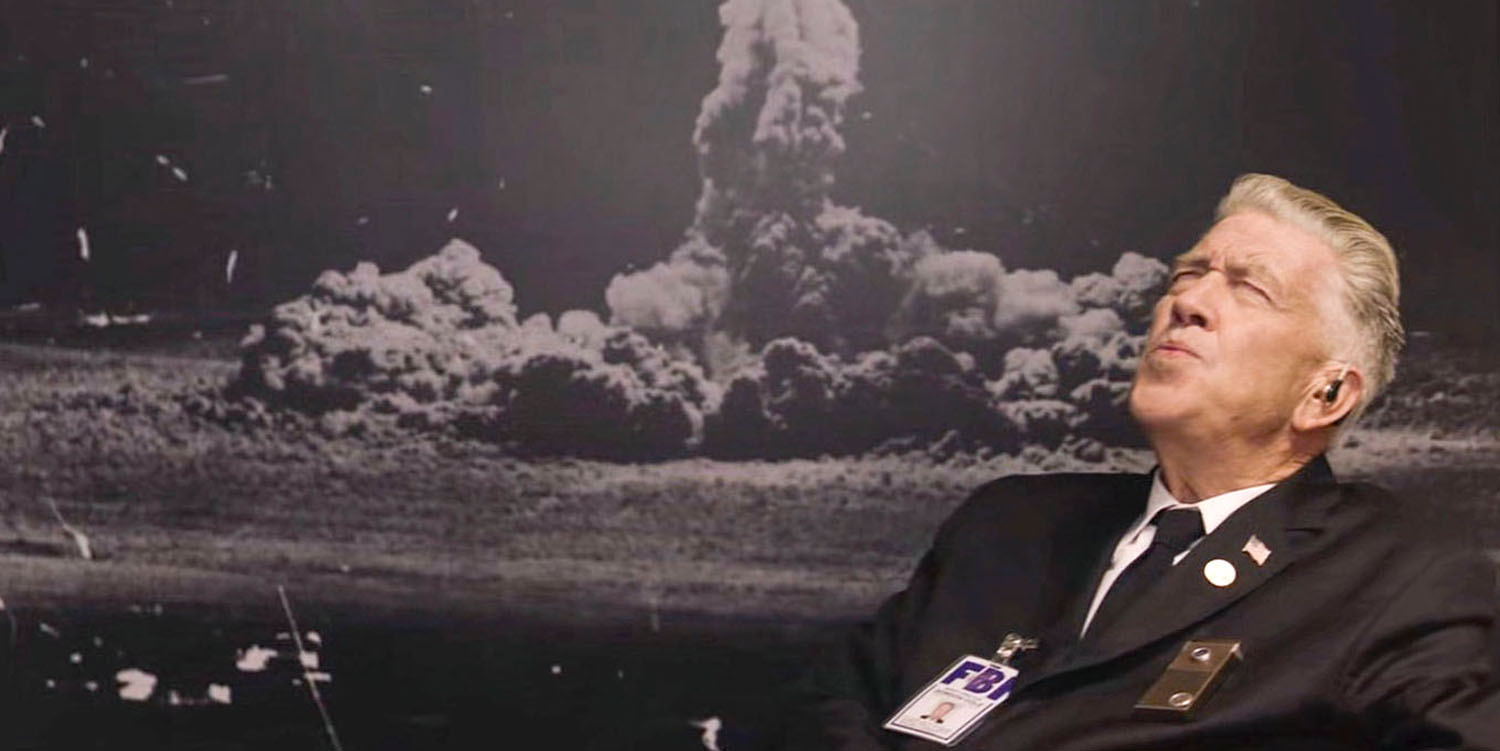
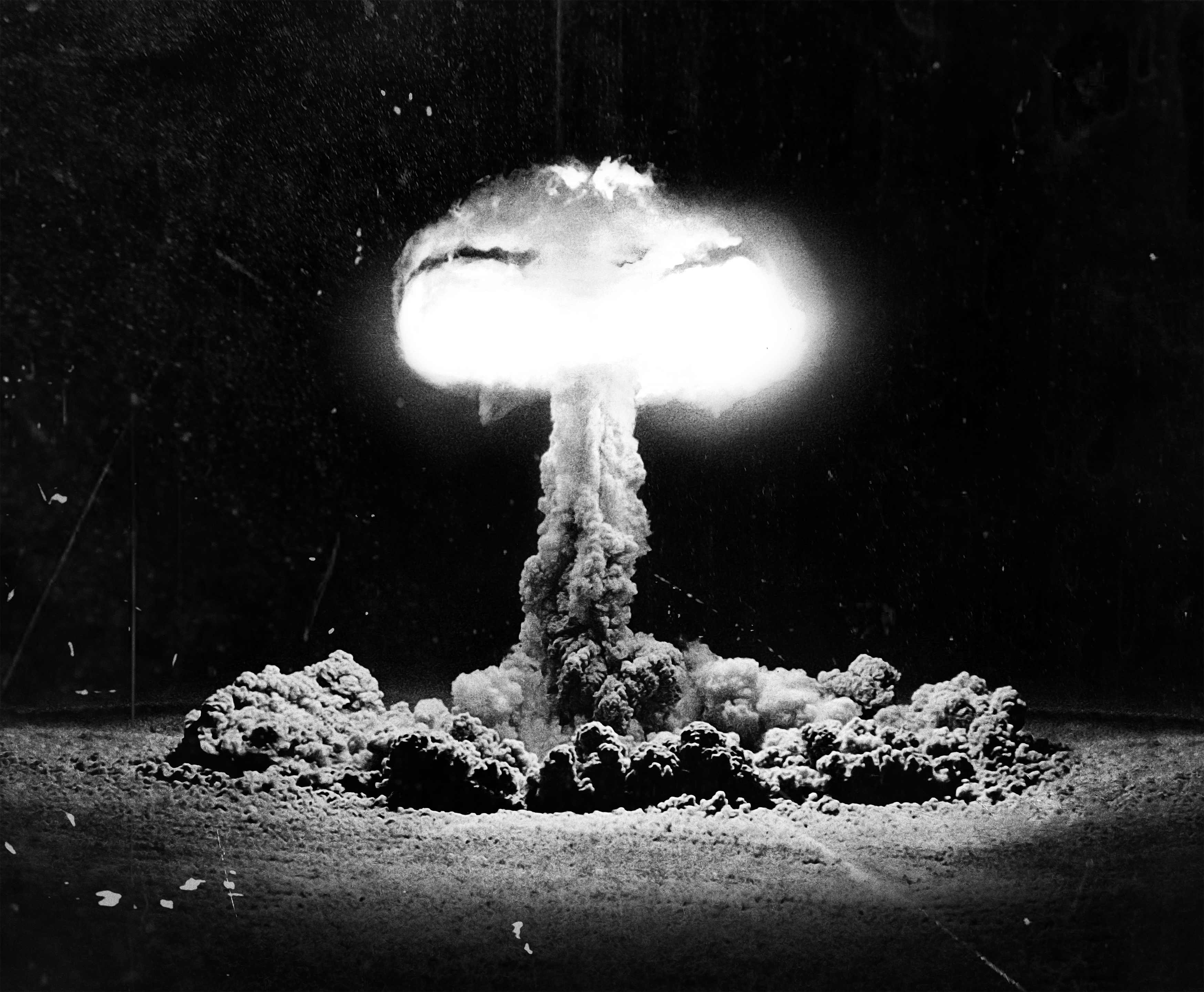
One of the more iconic images from Twin Peaks: The Return is seen behind Gordon Cole’s desk at FBI Headquarters in Philadelphia, PA. The massive framed photo of a nuclear explosion recently sold for $45,500 at an auction of David Lynch’s personal items presented by Julien’s Auctions and Turner Classic Movies. While it was way out of my budget, this lot offered me a unique opportunity to identify the item as part of a ever-growing list of props and set decor found in the show.
FRAMED OPERATION PLUMBBOB HOOD PHOTO IN GORDON COLE’S OFFICE
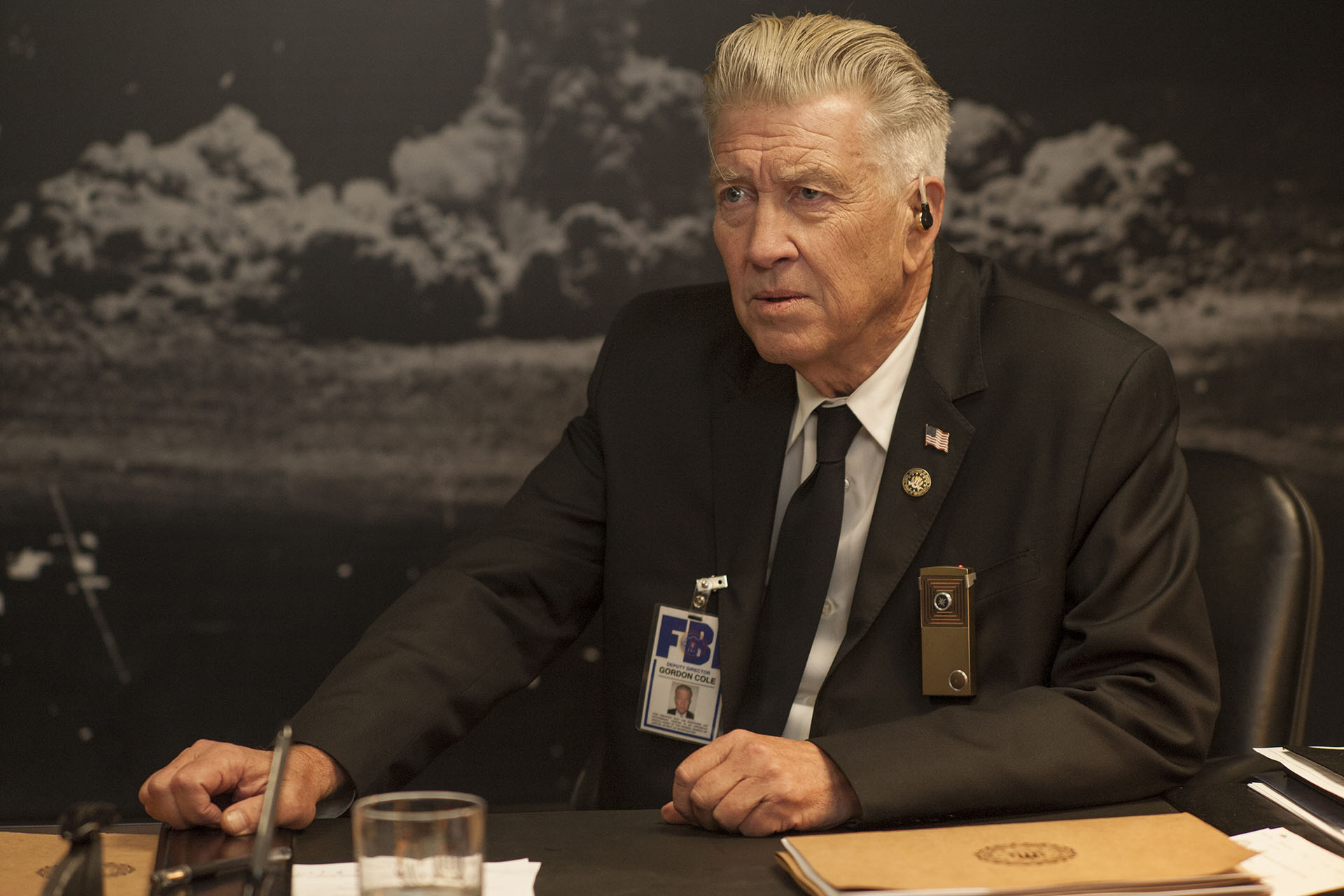
The first time we see the framed nuclear explosion image was in an early publicity photo of David Lynch as Gordon Cole. We’d have to wait until Twin Peaks Parts 3 and 7 to get a better look at the image.
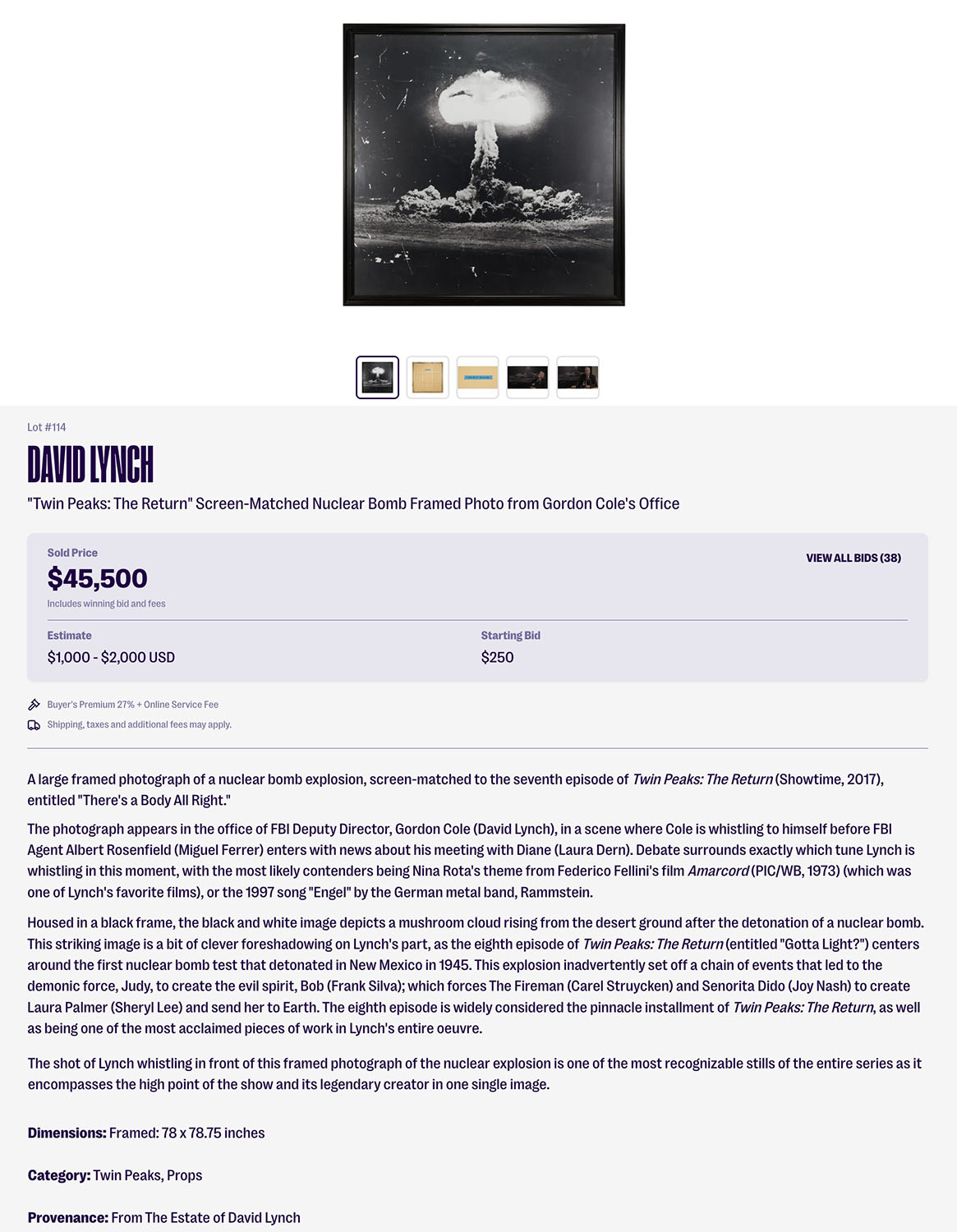
The Julien’s auction listing provided details about where this framed images was used in the show’s third season. It was estimated to sell between $1,000-$2,000 USD but after 38 bids, the final sale price was $45,500.
A large framed photograph of a nuclear bomb explosion, screen-matched to the seventh episode of Twin Peaks: The Return (Showtime, 2017), entitled “There’s a Body All Right.”
The photograph appears in the office of FBI Deputy Director, Gordon Cole (David Lynch), in a scene where Cole is whistling to himself before FBI Agent Albert Rosenfield (Miguel Ferrer) enters with news about his meeting with Diane (Laura Dern). Debate surrounds exactly which tune Lynch is whistling in this moment, with the most likely contenders being Nina Rota’s theme from Federico Fellini’s film Amarcord (PIC/WB, 1973) (which was one of Lynch’s favorite films), or the 1997 song “Engel” by the German metal band, Rammstein.
Housed in a black frame, the black and white image depicts a mushroom cloud rising from the desert ground after the detonation of a nuclear bomb.
This striking image is a bit of clever foreshadowing on Lynch’s part, as the eighth episode of Twin Peaks: The Return (entitled “Gotta Light?”) centers around the first nuclear bomb test that detonated in New Mexico in 1945. This explosion inadvertently set off a chain of events that led to the demonic force, Judy, to create the evil spirit, Bob (Frank Silva); which forces The Fireman (Carel Strucken [sic]) and Senorita Dido (Joy Nash) to create Laura Palmer (Sheryl Lee) and send her to Earth. The eighth episode is widely considered the pinnacle installment of Twin Peaks: The Return, as well as being one of the most acclaimed pieces of work in Lynch’s entire oeuvre.
The shot of Lynch whistling in front of this framed photograph of the nuclear explosion is one of the most recognizable stills of the entire series as it encompasses the high point of the show and its legendary creator in one single image.
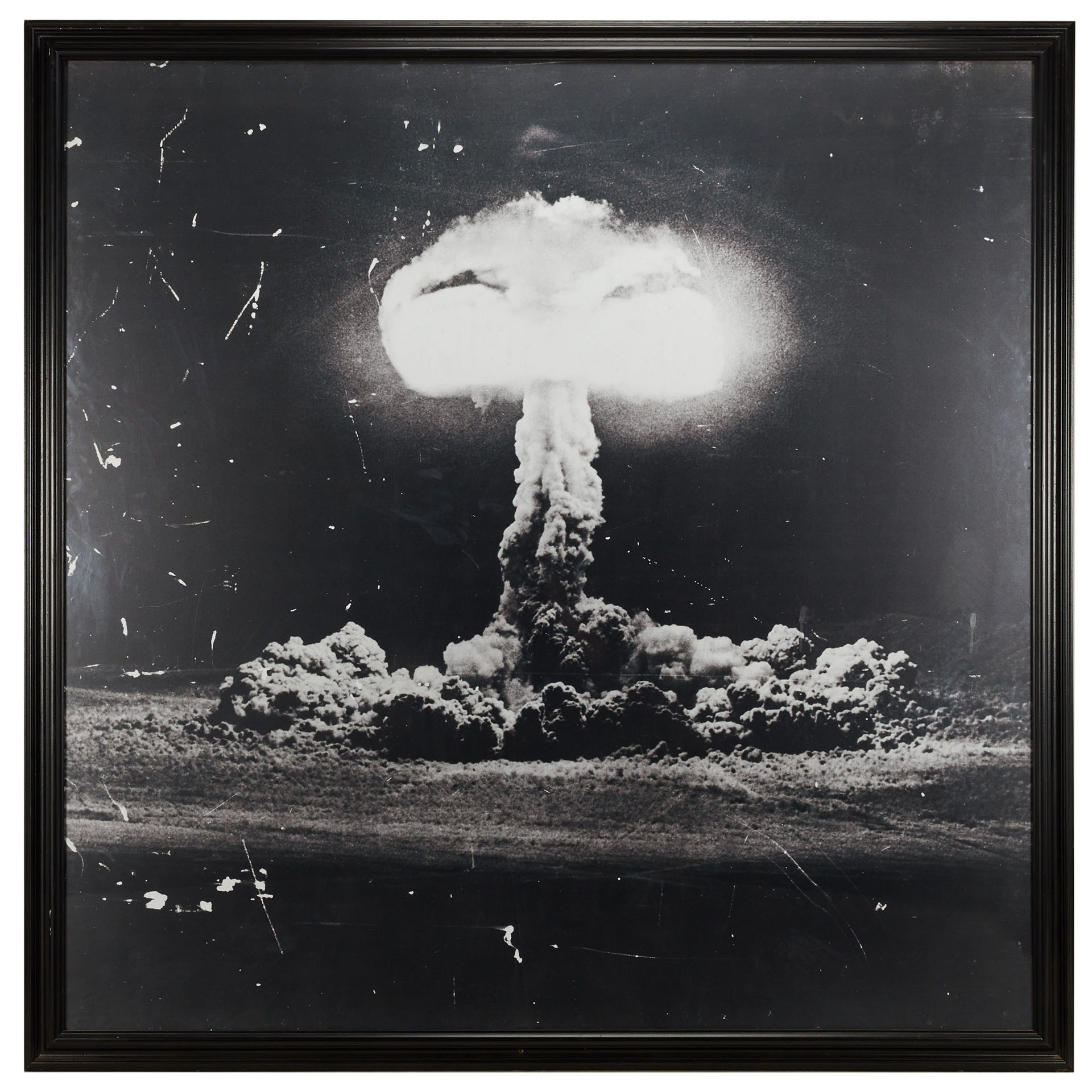
The framed image measured 78 x 78.75 inches.
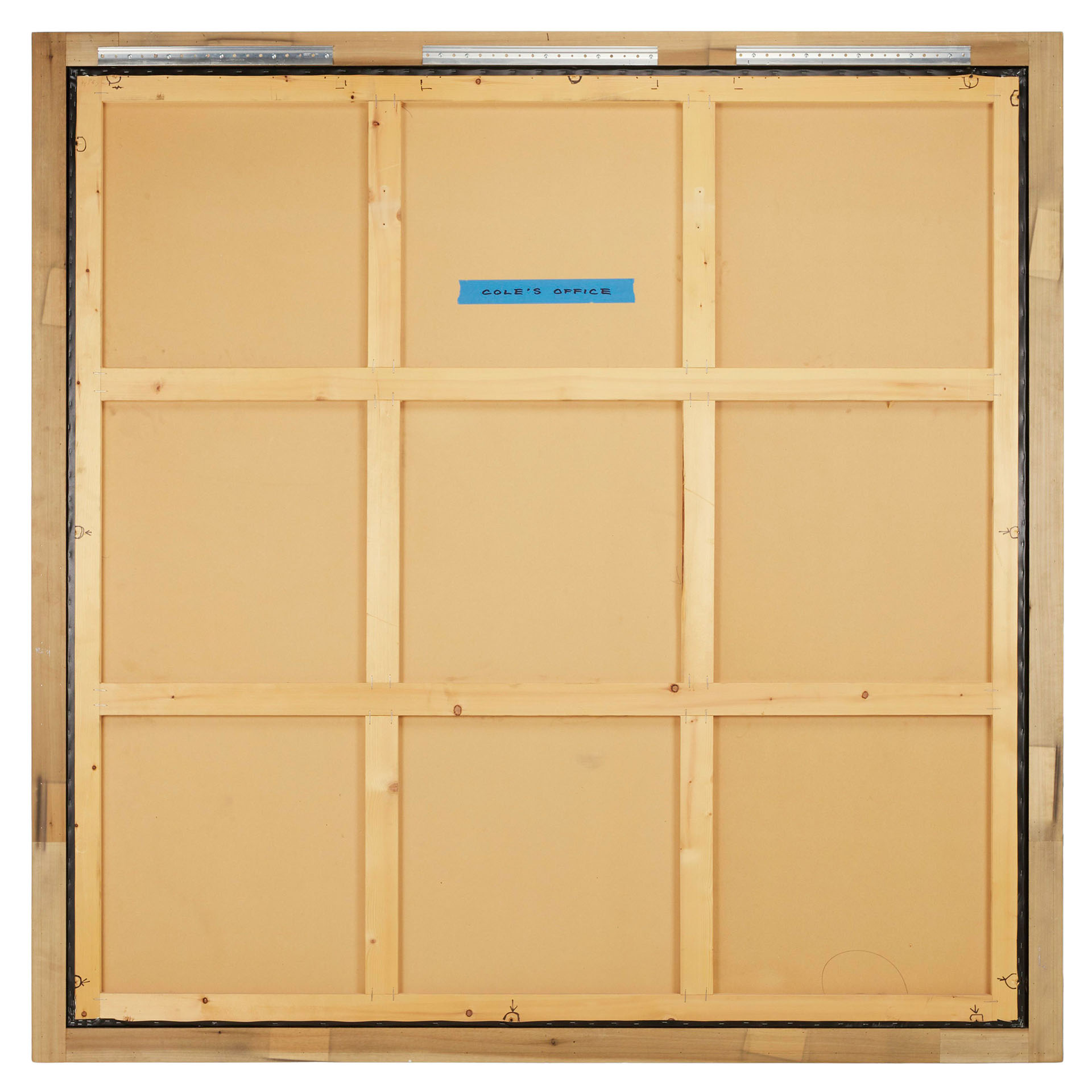
I’m glad the auction listing also contained the back of the frame as it’s a rare detail never seen in the show.
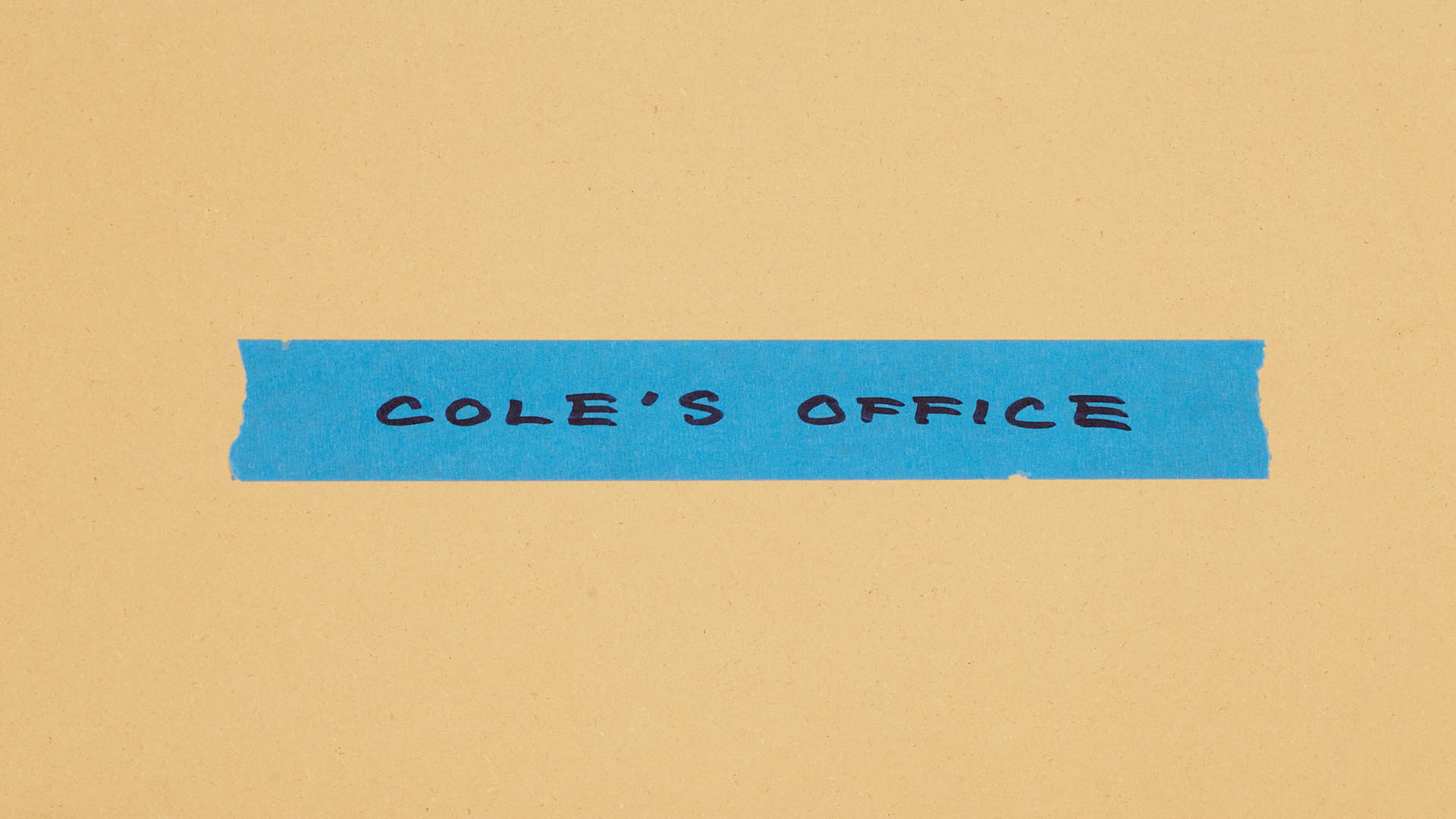
They also included the blue tape label with the words “Cole’s Office” written in black ink.
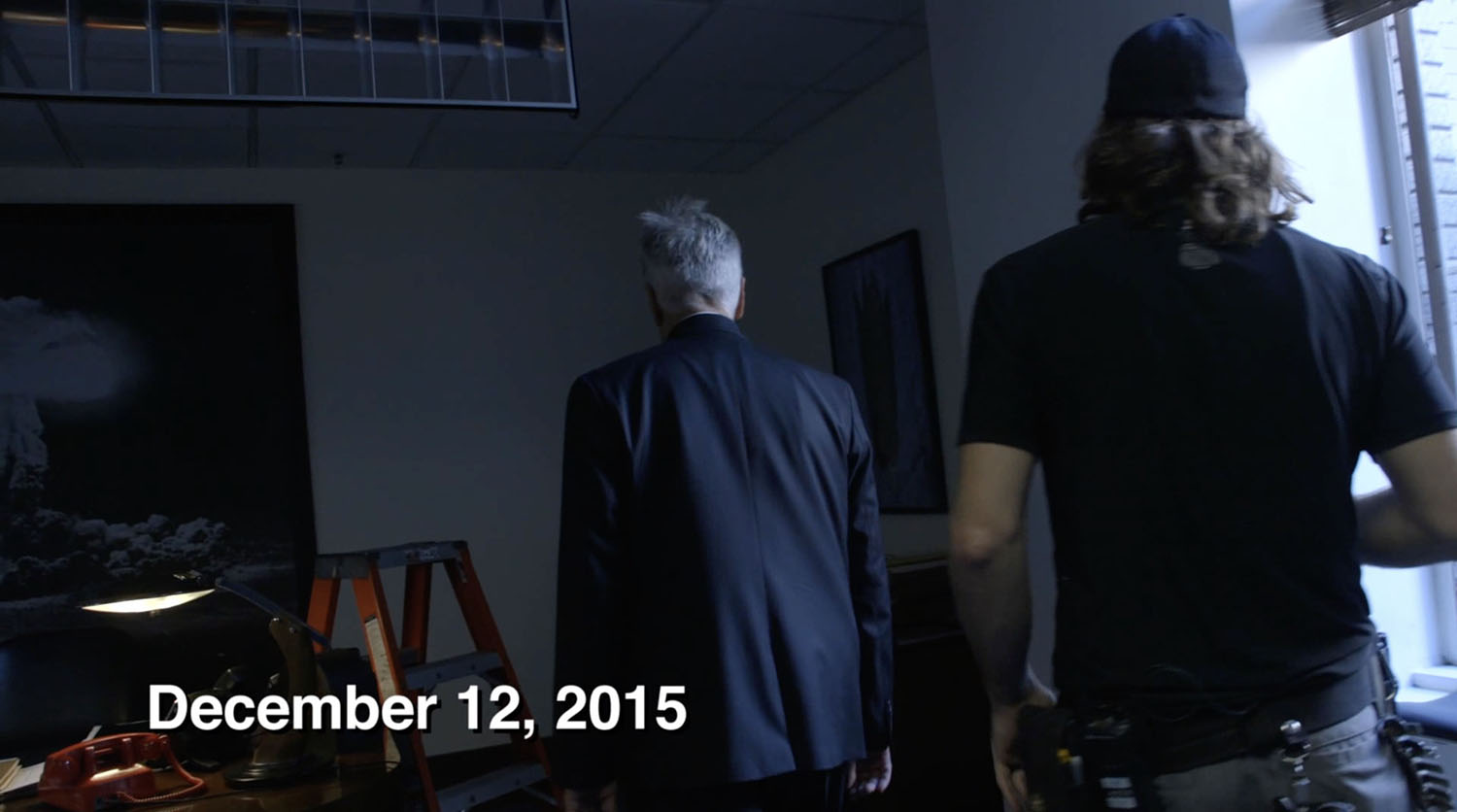
In the Behind the Curtain footage from Part 3 on the Twin Peaks: From Z to A Collection, we learn this scene was filmed on Saturday, Dec. 12, 2015. The location was the Los Angeles City Hall building is located at 200 North Spring Street in Los Angeles, California. They also filmed the scene between Gordon Cole and Federal Bureau of Investigation Chief of Staff Denise Bryson on the same day.
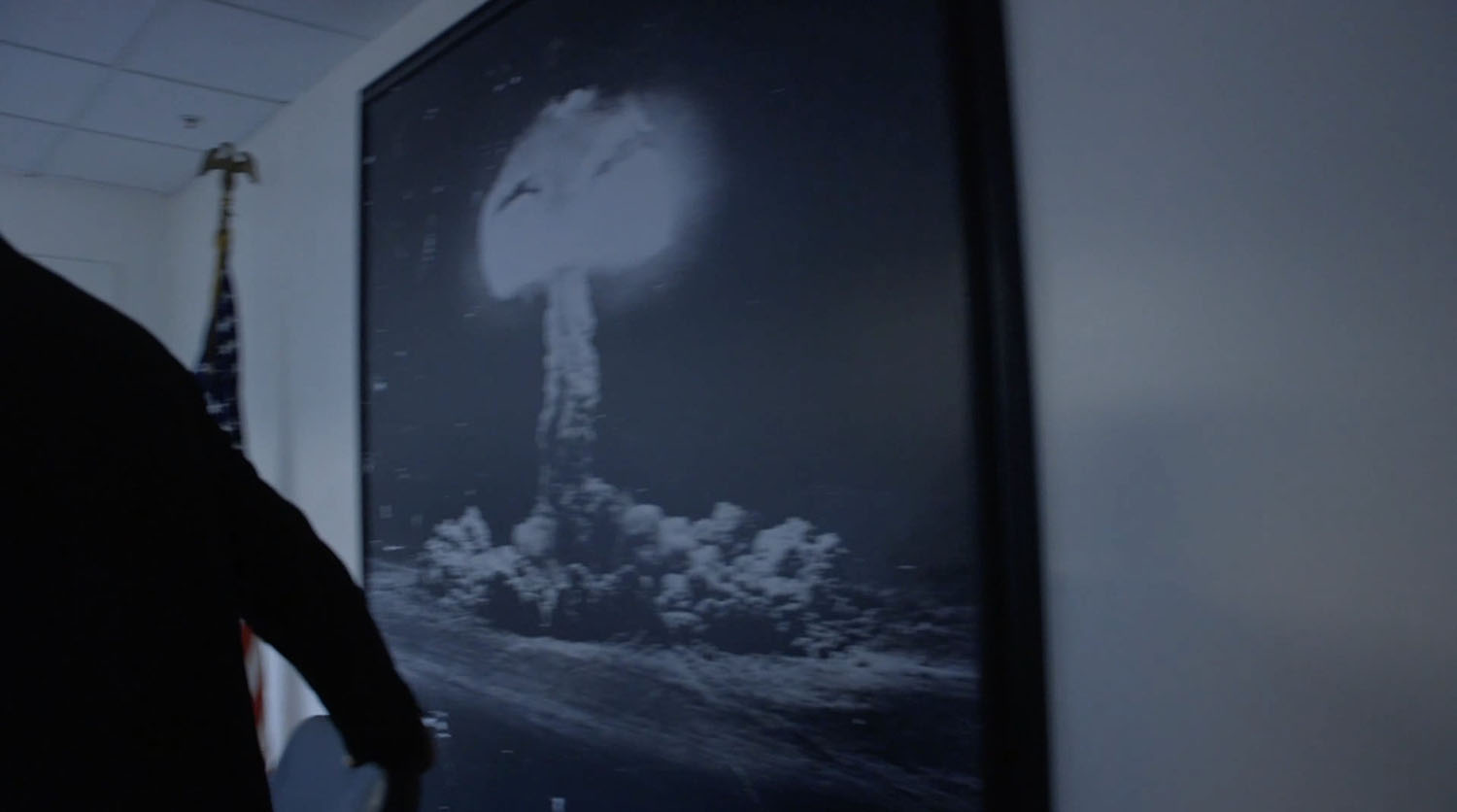
As the camera follows Lynch on set, we get a unique look at the framed image hanging on the wall behind his desk.
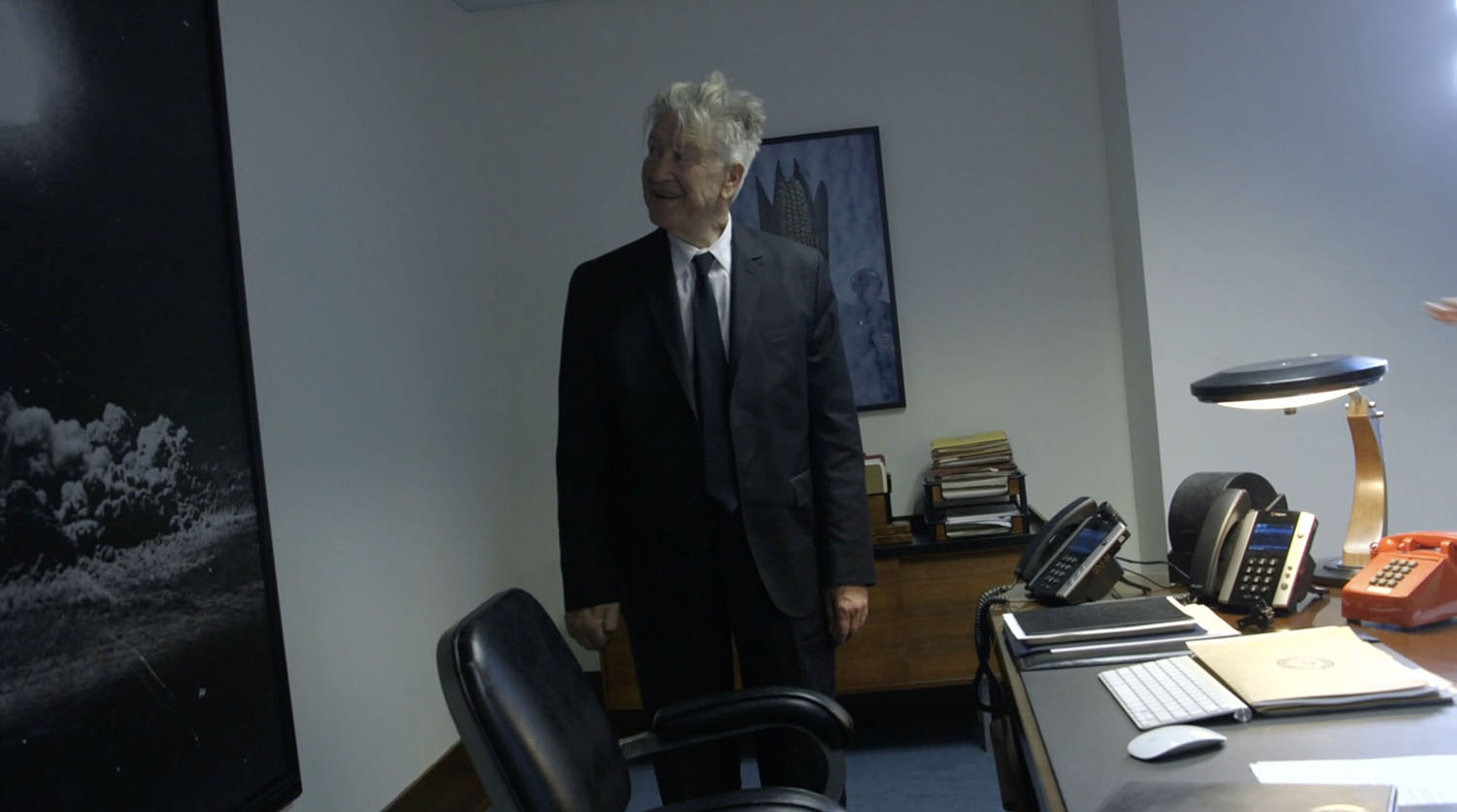
Later in the behind-the-scenes footage, we see Lynch welcome Miguel Ferrer, whom he calls “Albert,” and ChrystaBell, whom Lynch calls “Tammy.” After exchanging greetings,
“Killer, this looks like,” ChrystaBell says gesturing to the framed image.
“That’s fantastic,” Ferrer remarks off camera about the photo.
“That’s a good one, huh?,” Lynch retorts to Miguel’s comment.
ChrystaBell cheers off camera, first yelling “Woohoo!” and the says, “It definitely sets the scene.”
Lynch agrees, moving over to a red telephone on his desk, and saying, “Especially with this red phone.”
Based on the reactions of the cast, the framed image must have been quite impressive in person.
OPERATION PLUMBBOB HOOD ON JULY 5, 1957
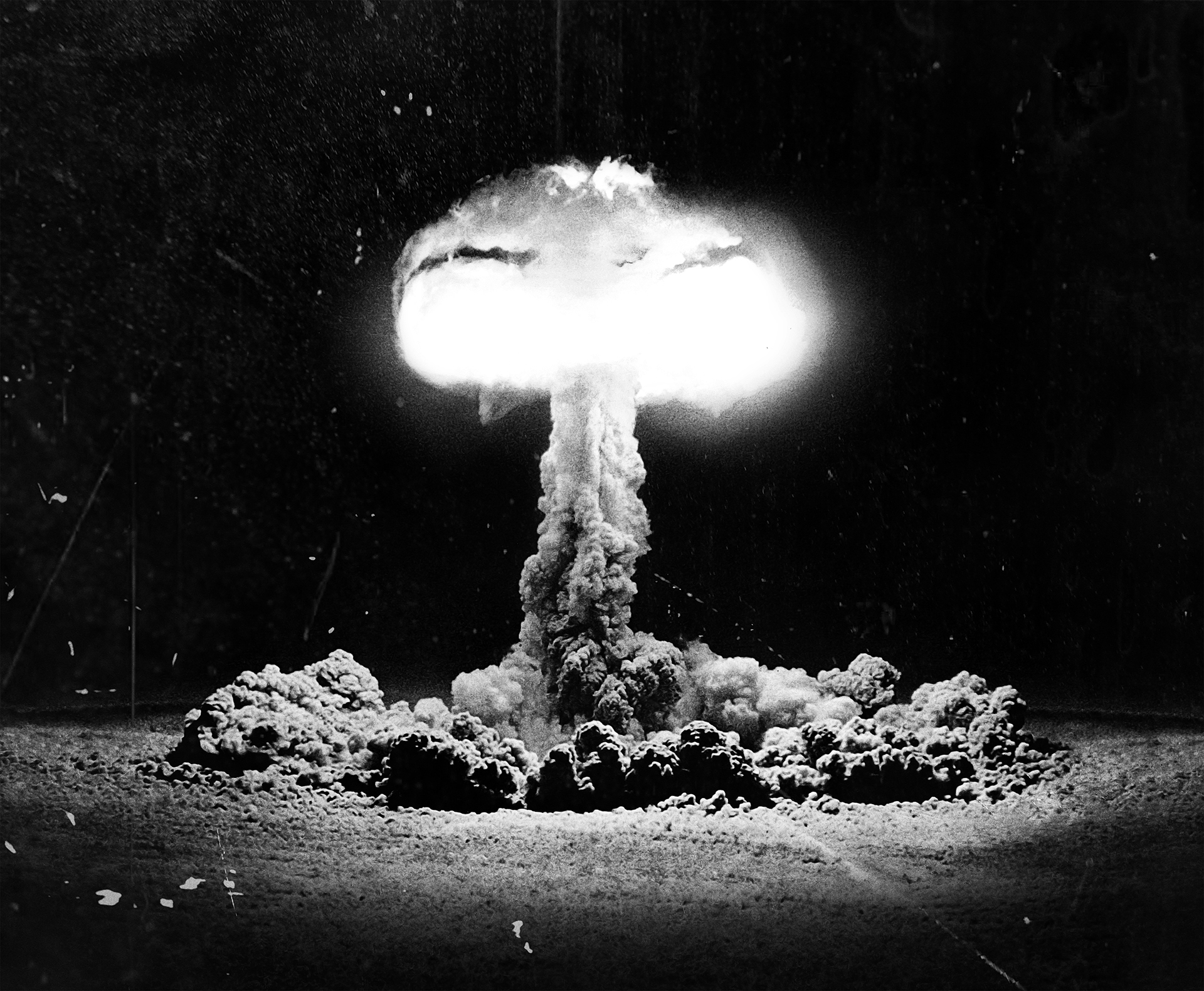
The framed photo behind Gordon Cole’s test is an image taken around 0440 hours on July 5, 1957 in Area 9 of the Yucca Flat at the Nevada National Security Site (NTS). Part of top-secret nuclear tests known as Operation Plumbbob, this particular test was called Shot HOOD by the Defense Threat Reduction Agency. At the time, this shot was largest ever carried out by the United States Government, and the largest atmospheric detonation at the NTS.
The test was named HOOD after Oregon’s snowcapped peak, Mount Hood according to a story in the Las Vegas Daily Sun on July 5, 1957. Fittingly, the flash from this nuclear explosion was seen in Oregon.
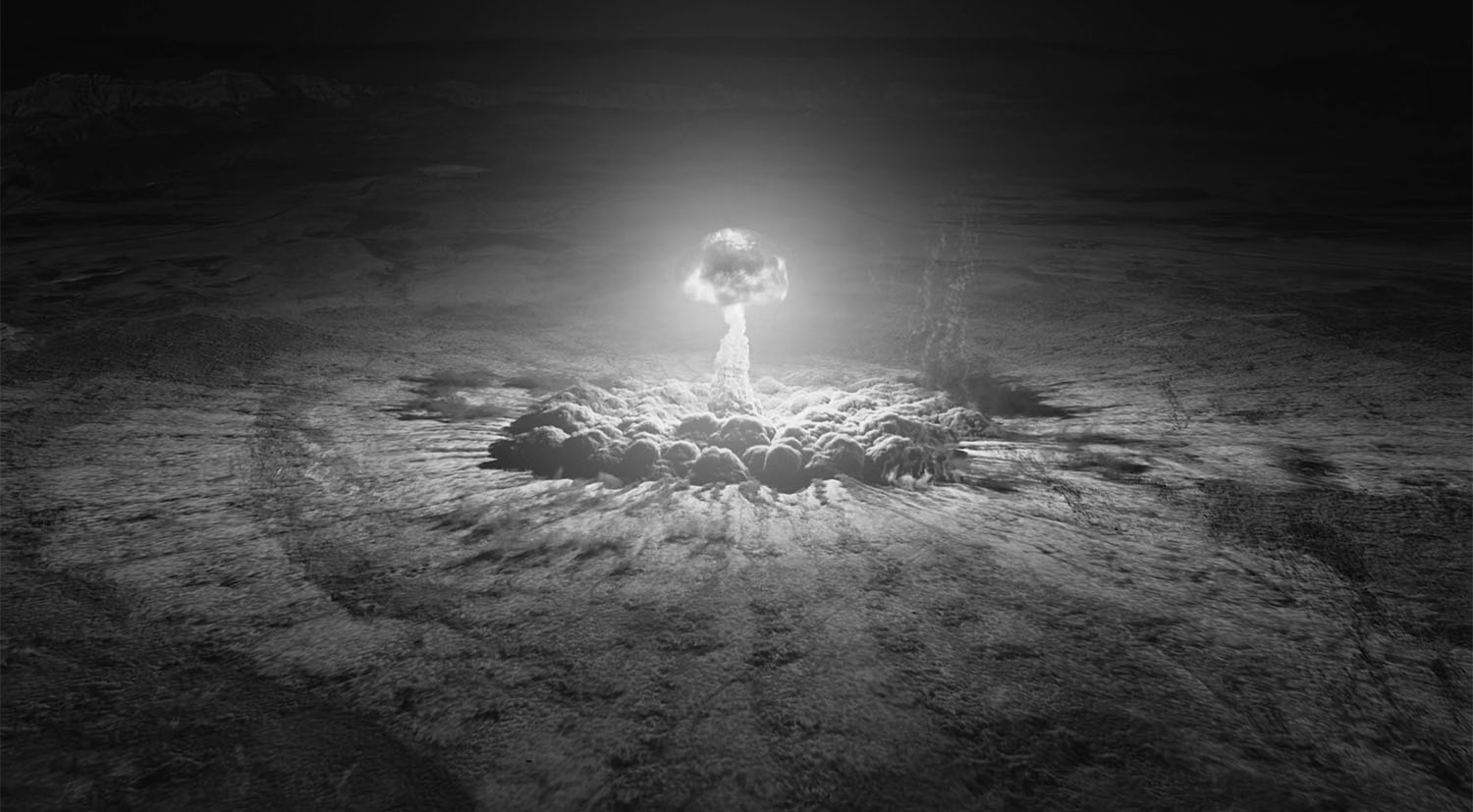
At first glance, one might think the image was a nod to the nuclear bomb test on July 16, 1945 at 5:29 A.M. (MWT) in White Sands, New Mexico. This explosion seen in Twin Peaks Part 8 certainly appears similar, which may have been by design.

Operation Plumbbob was a series of 29 nuclear tests conducted by the United States military between May 28 and October 7, 1957, at the NTS. According to the Atomic Heritage Foundation, it was one of the longest and most comprehensive test series in the continental U.S., and became controversial after much of the operation was declassified. Hood was the sixth test in the series.
There were several objectives during Operation Plumbbob, including improving tactical weapon design, conducting bio-medical experiments, safety testing, and component and design testing for thermonuclear systems to be detonated in future operations.

With a yield of 74 kilotons Plumbbob Shot HOOD was a 2-stage thermonuclear device, it sent thermal wave across the desert, igniting bushes and other foliage. The shot was originally scheduled for June 27, 1957, but it was delayed due to a technical difficulties of the Plumbbob DIABLO shot that was to be detonated prior to HOOD.
Its radius of visibility was 1,000 miles or more. Reports at the time said, an airline pilot flying to Honolulu, Hawaii saw the explosion. The powerful shock waves from the blast skipped over Las Vegas, Nevada but were felt in many California towns more than 300 miles away. A man in St. George, Utah located 100 miles away said the flash was like “looking at the sun.”
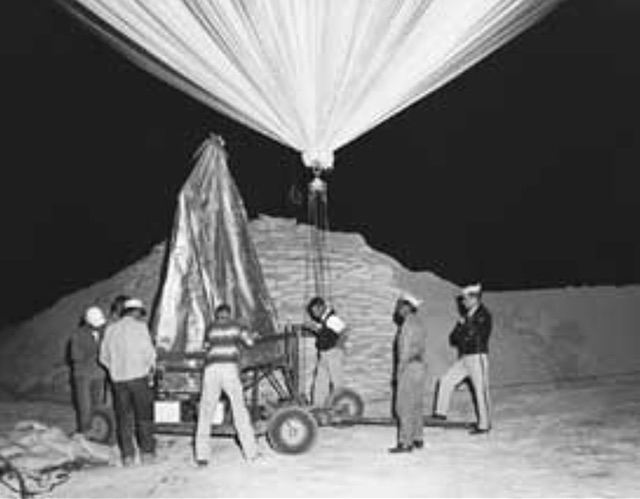
Shot HOOD was dropped via a weather balloon which, according to Lawrence Livermore National Laboratory, “eliminated steel tower contamination from vaporized metal that occurred during tower shots. In all, 13 devices were detonated at elevations ranging from 500 to 1,500 feet during the Operation Plumbbob tests. Shot HOOD’s device was detonated from a balloon located approximately 1,500 feet (460 m) above northeastern portions of the Yucca Flat.
The Orgeon Journal reported on the test in a front page article on July 5, 1957.
“[The] gigantic atomic explosion – mightiest ever tested in the United States – shook entrenched marines ‘like an earthquake’ today and set fire to brush and trees on distant mountains. It flared spectacularly over the nation’s western half – including southern Oregon – and its shock wave rumbled through communities more than 300 miles away.”
Nearly 1,090 U.S. Marines watched the explosion from trenches dug 5,700 yards away from ground zero of the explosion. Brig. Gen. Harvey Tschrigl reported: “It was pretty rough. Lots of dust. It shook its like an earthquake. I felt like I was on roller skates for a few seconds.”
Pfc. Theodore Sturgeion of St. Louis, Mo., was buried up to his neck by a cave in. He said that “only by grabbing a buddy was he able to keep the dirt from covering him. It took 15 minutes to dig him out, unhurt.”
APPEARANCES IN TWIN PEAKS: THE RETURN
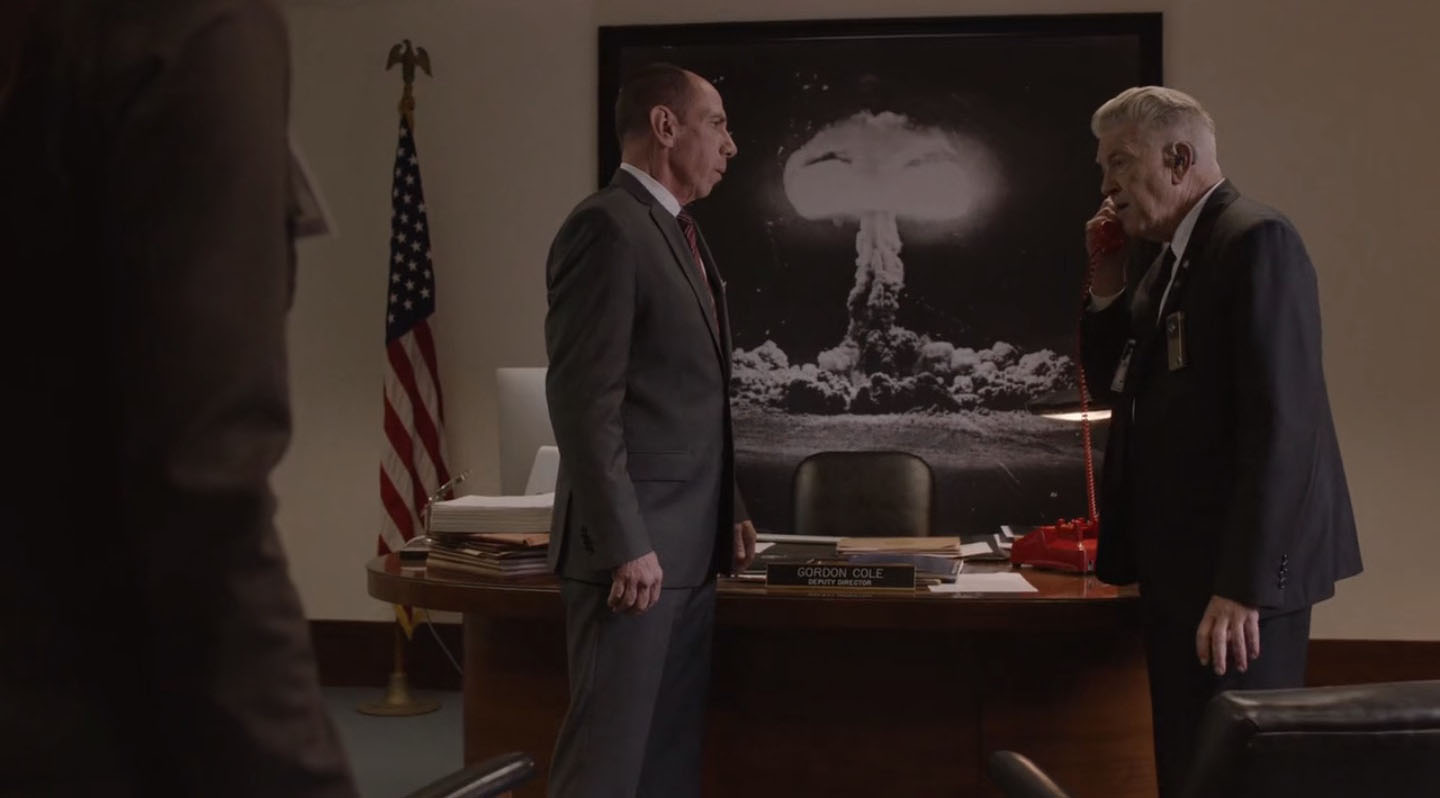
The first time we see this framed photo is in Twin Peaks Part 3 when Gordon Cole receives a phone call, on the red phone, with an update about Dale Cooper.
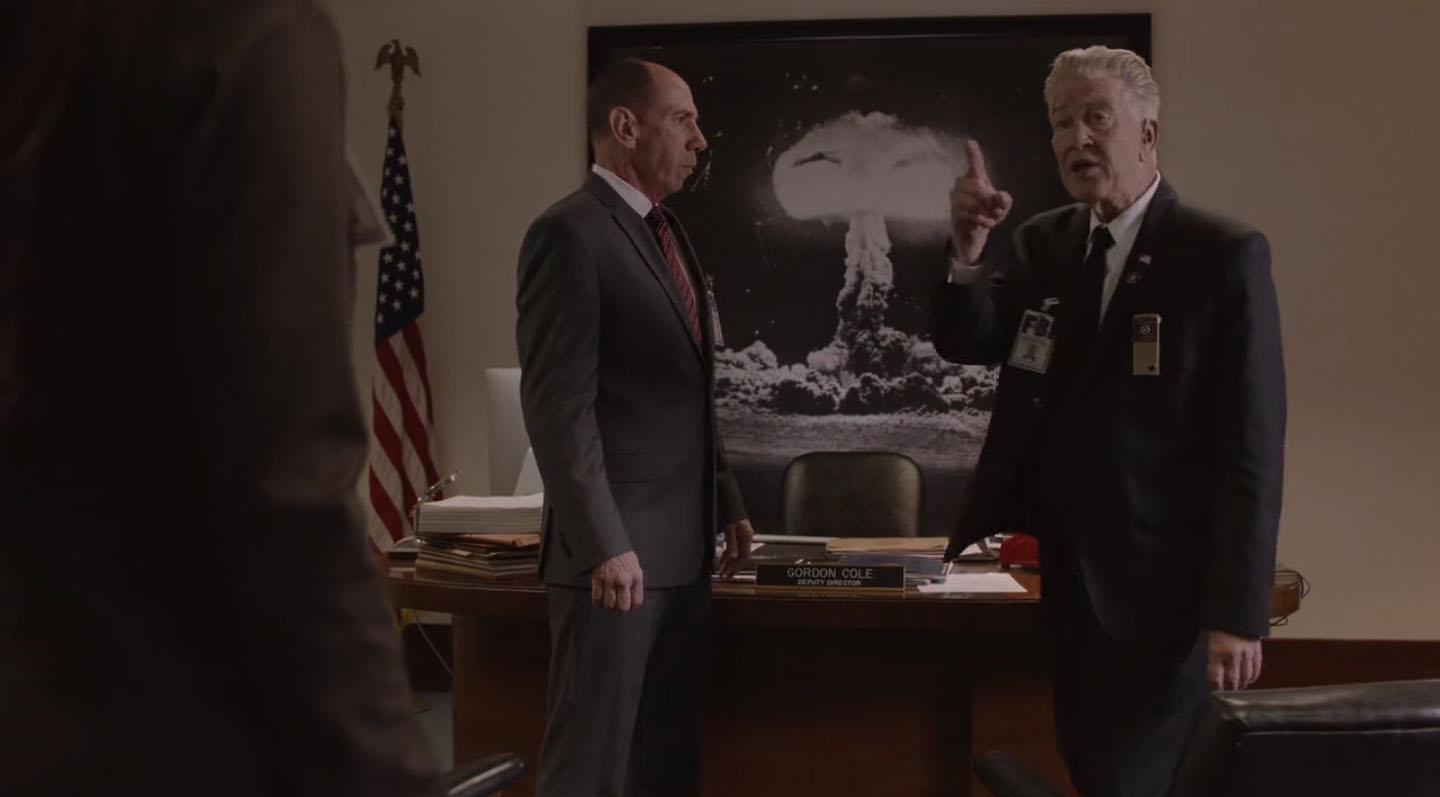
Cole directs Special Agents Albert Rosenfield and Tammy Preston on next steps; they are headed to the black hills of South Dakota.
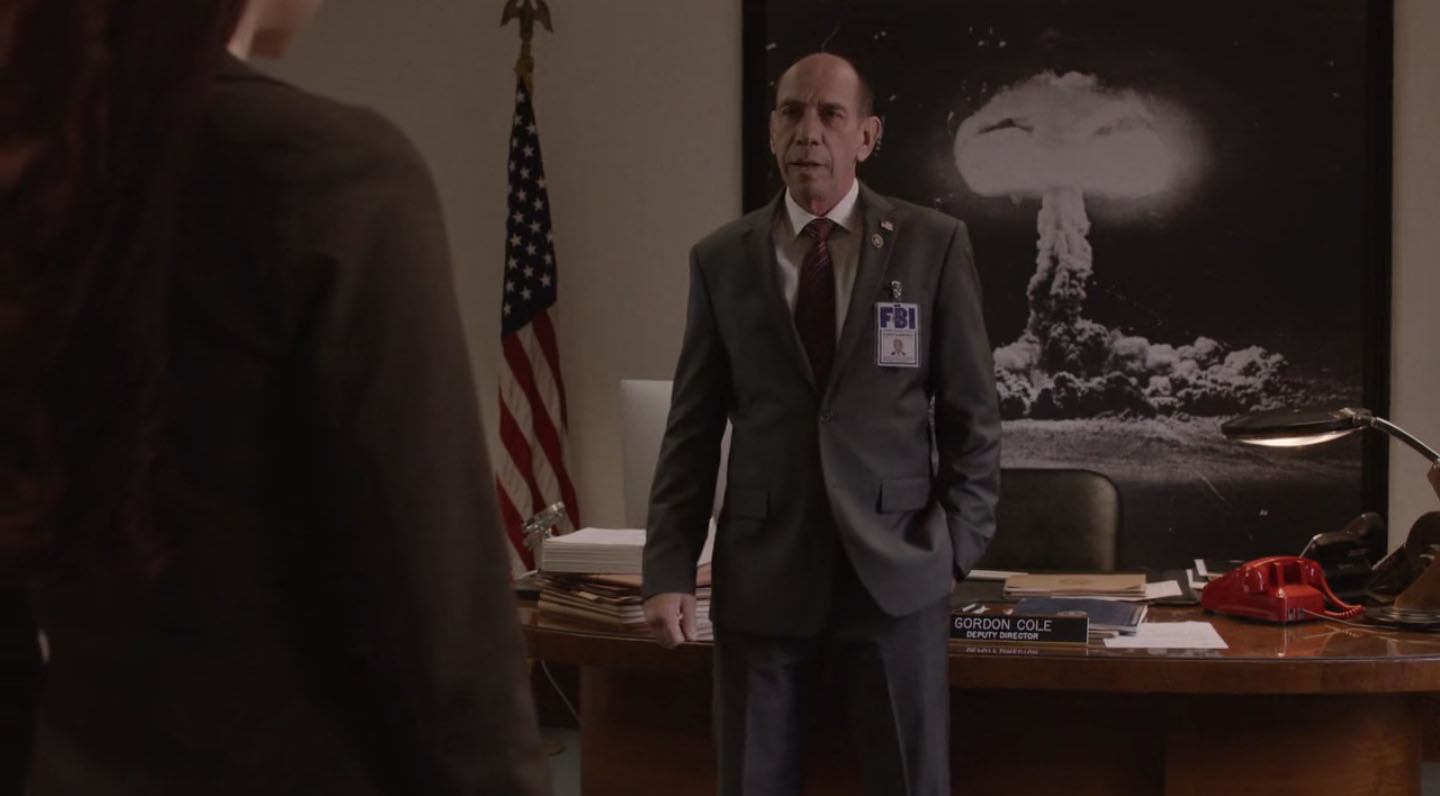
After Cole departs the scene, Albert is seen standing solo in front of the image during an exchange with Tammy.
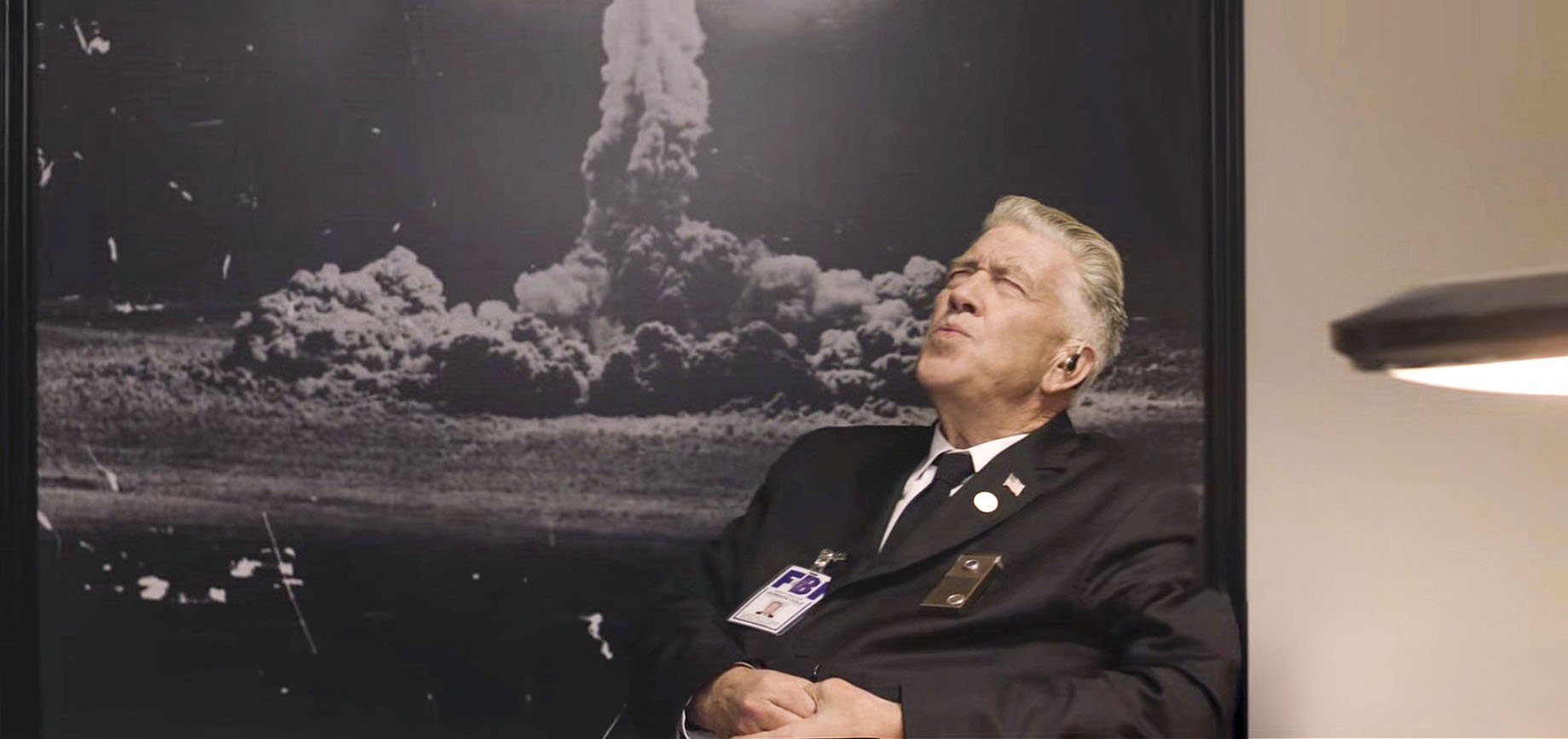
The image returns in Twin Peaks Part 7 with a shot panning over to Gordon Cole whistling. I combined those individual frames to get this panoramic view of Lynch behind the his FBI desk.
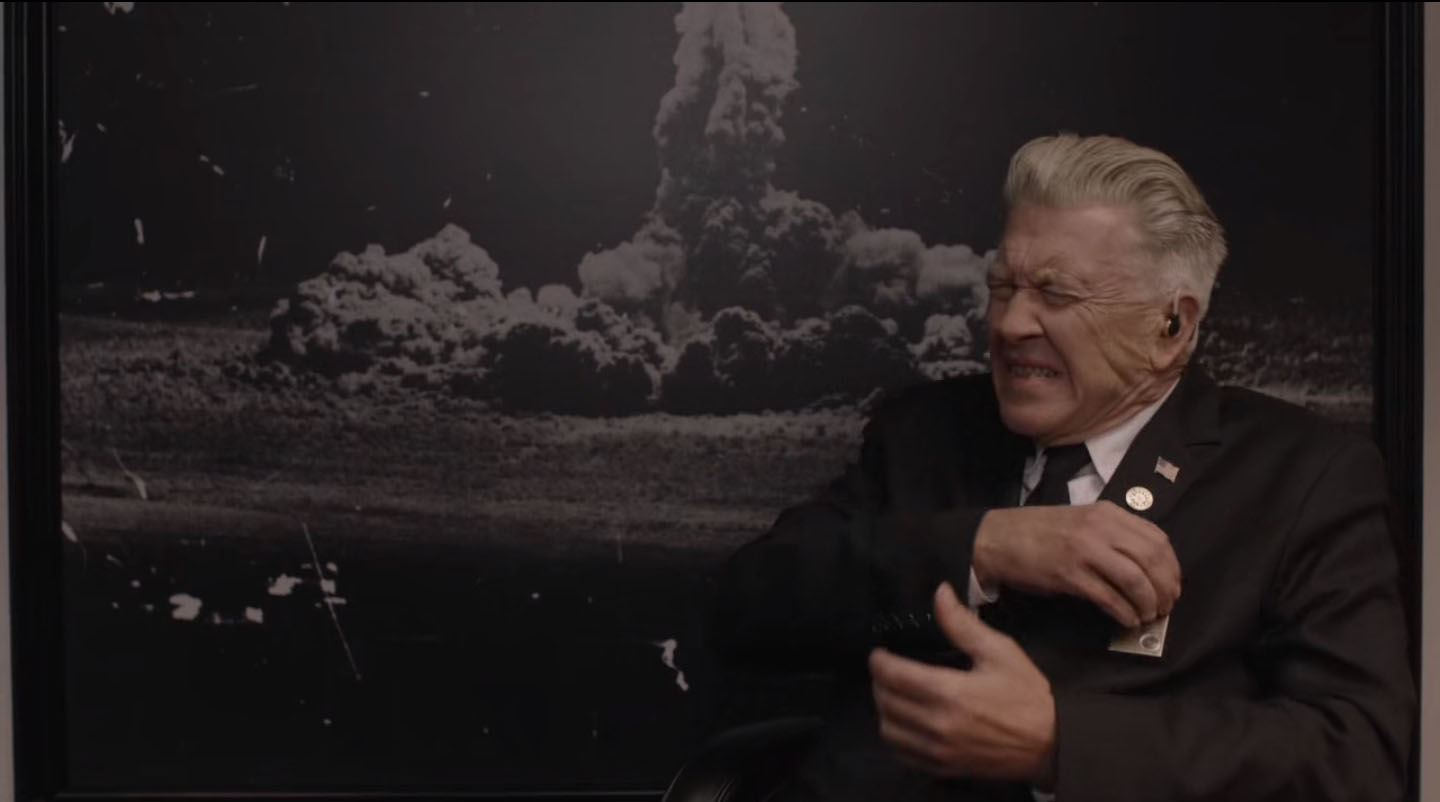
He is then seen adjusting his hearing aid device.
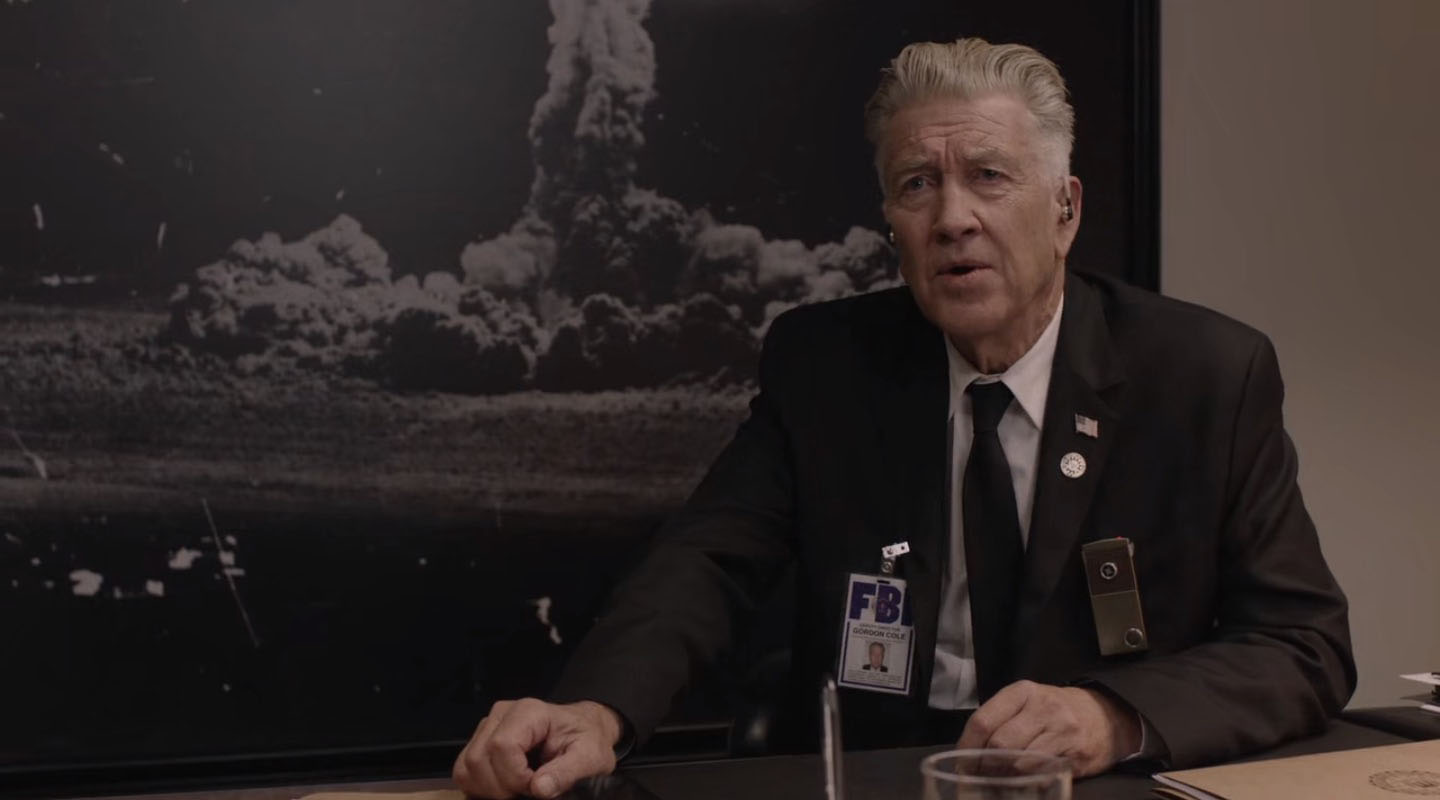
The final shot of Gordon Cole with the framed nuclear explosion image happens during an exchange with Albert who knows Cole can hear what he says.
Congratulations to the mysterious winning bidder of this auction. Maybe one day I’ll get to see this item in person.
Author
Discover more from TWIN PEAKS BLOG
Subscribe to get the latest posts sent to your email.