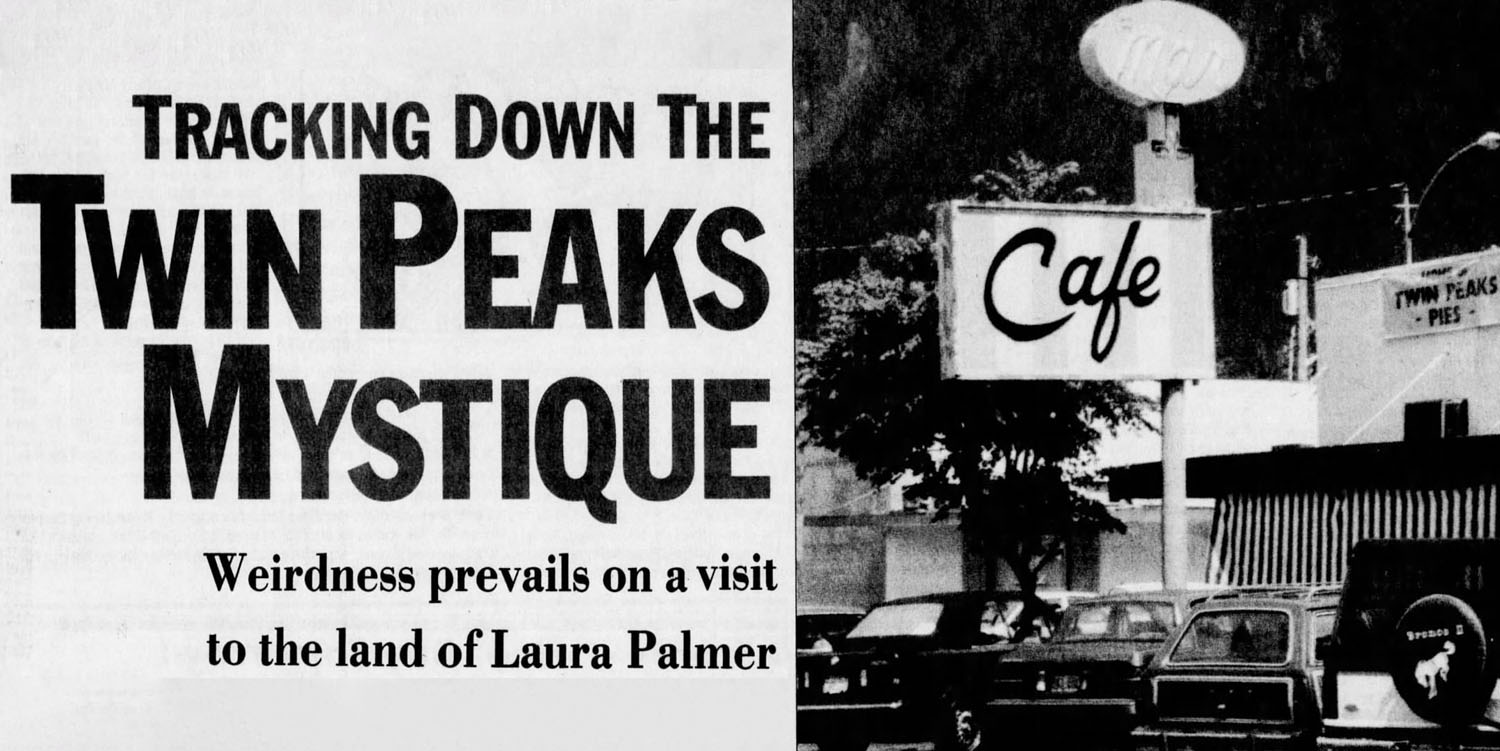
During the Summer of 1990, television viewers and reporters descended on Snoqualmie Valley, Washington in search of damn fine coffee, cherry pie and the locations where Mark Frost and David Lynch filmed their groundbreaking series Twin Peaks. St. Louis-born Eric Mink from the St. Louis Post-Dispatch was one of those reporters who penned this trip report to both small towns east of Seattle and the nondescript warehouse in Van Nuys, California where sets were constructed for the show. His article titled “Track Down the Twin Peaks Mystic” ran on September 30, 1990, just two days after the season two premiere.
WHO IS ERIC MINK?

According to St. Louis Media History, St. Louis-born Eric Mink joined the St. Louis Post-Dispatch in 1977 and became its television critic in 1979. He accepted a role as the television critic for the New York Daily News in 1993. During his 25-year career, Mink wrote “more than 4,000 opinion columns, reviews, analyses, news stories and investigative reports that were distributed to newspapers throughout North and South America.”
He also did freelance work which was published by The New York Times, Atlantic Monthly, Time magazine, the Washington Journalism Review, andTV Guide.
In 2003, Eric returned to St. Louis to edit the Post’s commentary page and write an “often controversial op-ed column.” Mink left the paper in 2009 and began teaching film studies at Webster University. He also offered writing and editing services to freelance clients. Mink published “This is Today: A Window on Our Times” in 2003 that documented a 50 year history of NBC’s Today show.
‘TRACKING DOWN THE TWIN PEAKS MYSTIQUE’ | ST. LOUIS POST-DISPATCH, PAGE 21
Eric and his sister-in-law Jane visited the Real Twin Peaks of Washington state in late summer 1990. While in Snoqualmie Valley, he visited the towns of Snoqualmie and North Bend. He then visited Van Nuys, California where he toured the Twin Peaks sets constructed at City Studios.
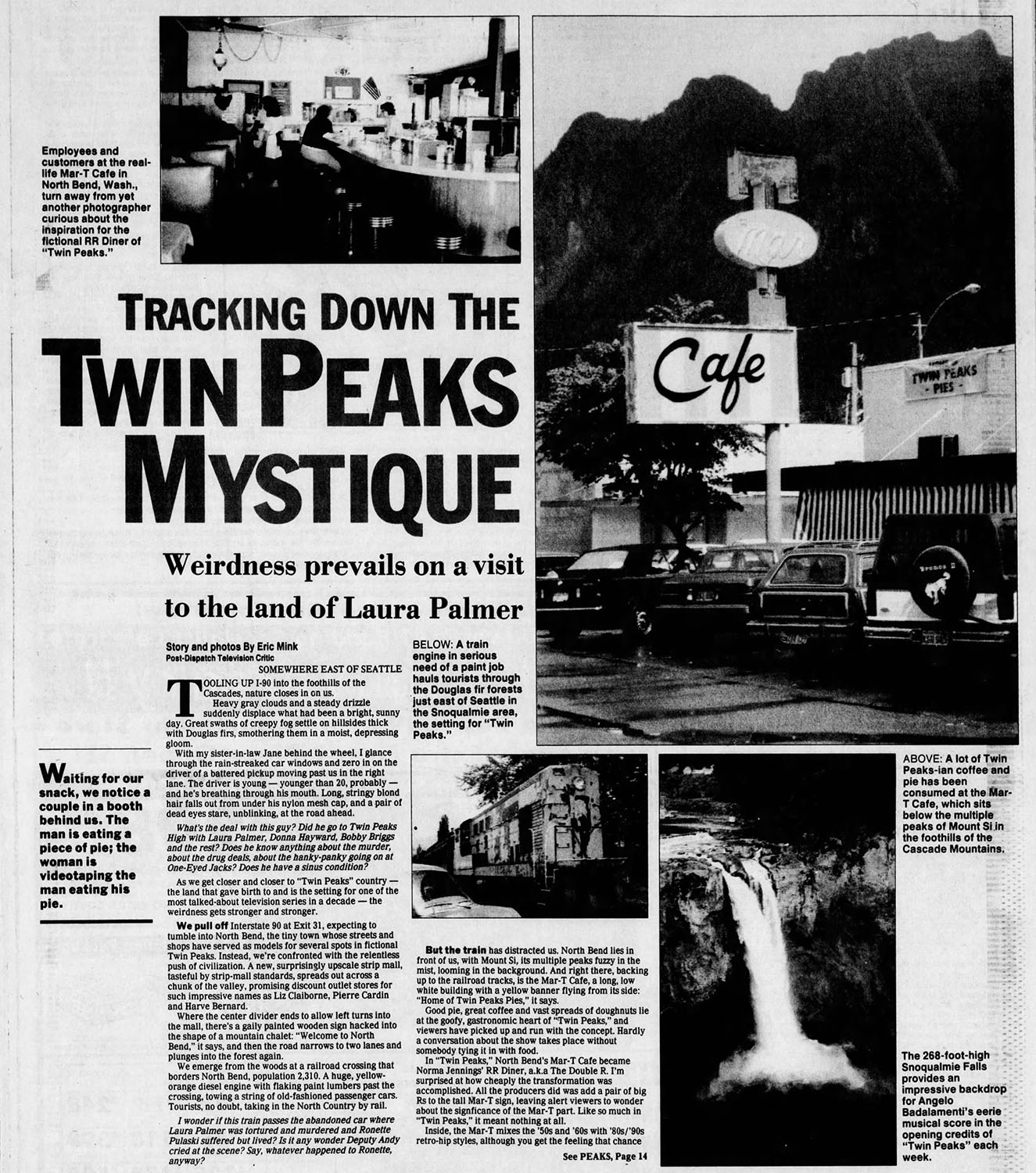
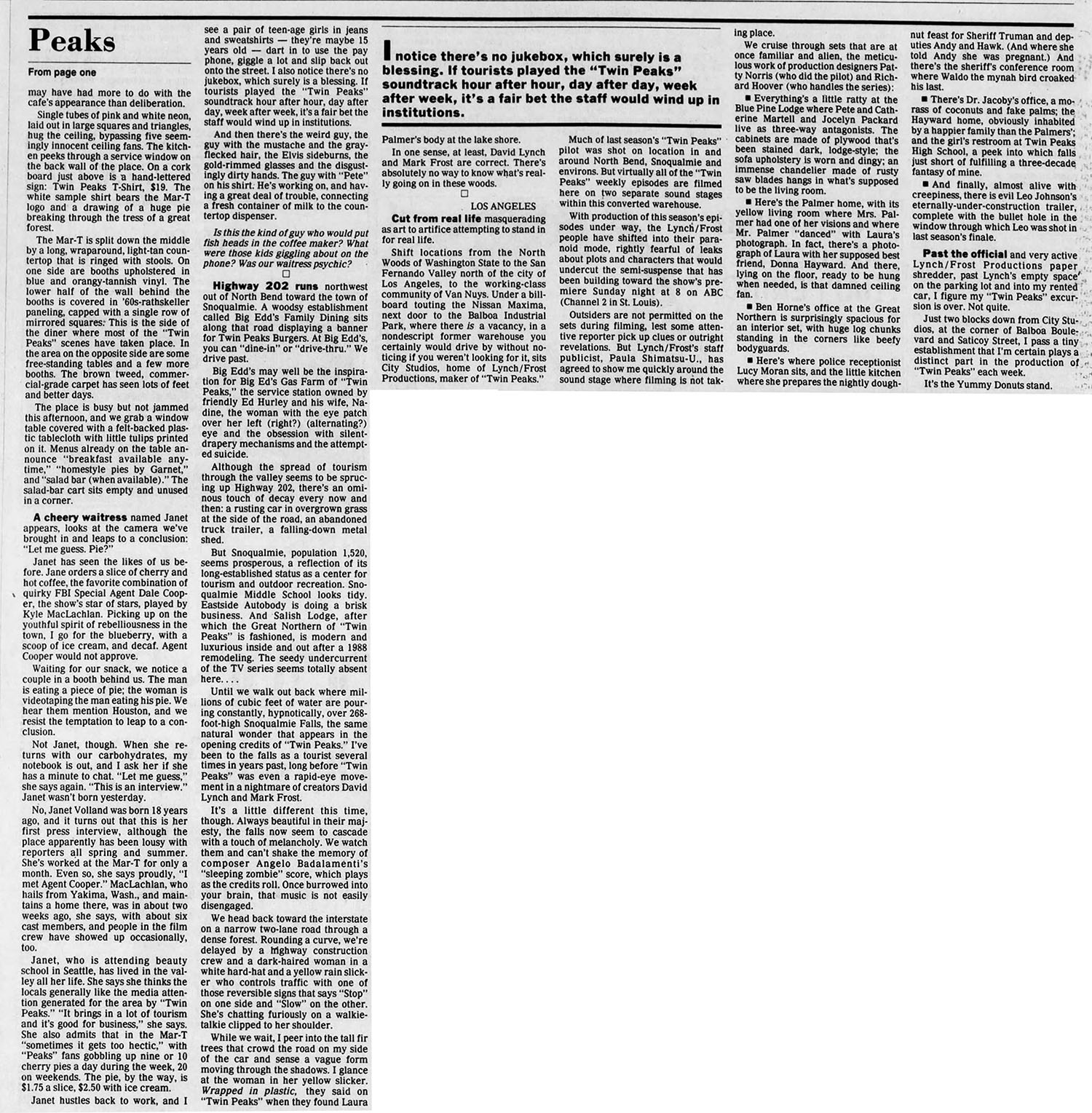
The first part of his article along with several photos he took during his visit appeared on page 21 of the St. Louis Post-Dispatch‘s paper for September 30, 1990. The article’s conclusion is found on page 34. I’ve provided the text of Mink’s article, “Tracking Down the Twin Peaks Mystique: Weirdness prevails on a visit to the land of Laura Palmer,” along with additional commentary and photos related to his story.
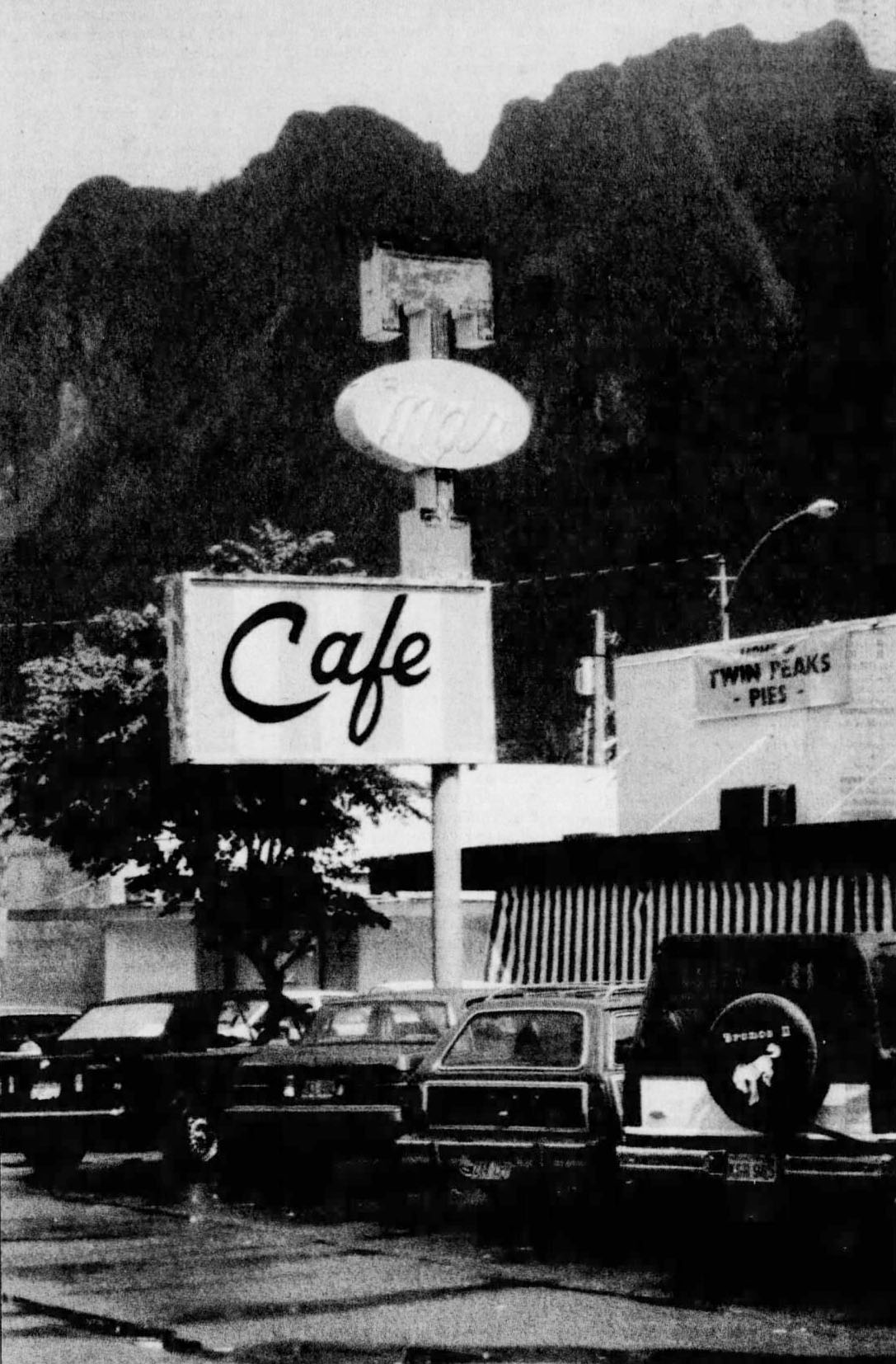
This exterior image of the Mar-T Cafe shows a yellow banner hanging close to the Mid-Century modern sign – “Home of Twin Peaks Pies.” This banner was hung by previous cafe owner Pat Cokewell to capitalize on the huge volume of visitors to the Real Twin Peaks following the first season of Lynch and Frost’s show.
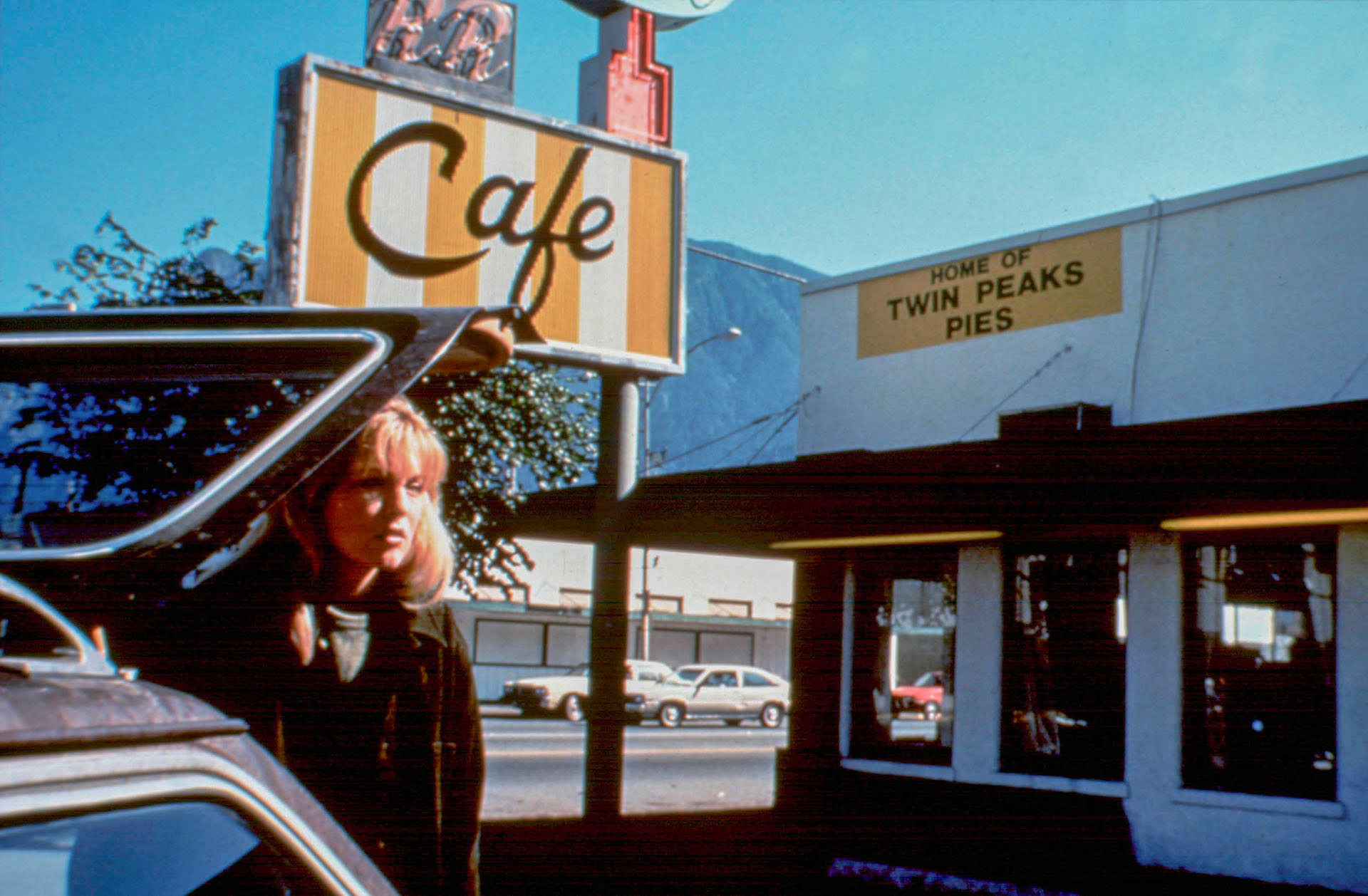
The sign would become more permanent in subsequent years with it being painted on the building’s exterior. It even appears in a publicity photo from Twin Peaks: Fire Walk With Me.
SOMEWHERE EAST OF SEATTLE
Tooling up I-90 into the foothills of the Cascades, nature closes in on us.
Heavy gray clouds and a steady drizzle suddenly displace what had been a bright, sunny day. Great swaths of creepy fog settle on hillsides thick with Douglas firs, smothering them in a moist, depressing gloom.
With my sister-in-law Jane behind the wheel, I glance through the rain-streaked car windows and zero in on the driver of a battered pickup moving past us in the right lane. The driver is young – younger than 20, probably – and he’s breathing through his mouth. Long, stringy blond hair falls out from under his nylon mesh cap, and a pair of dead eyes stare, unblinking, at the road ahead.
What’s the deal with this guy? Did he go to Twin Peaks High with Laura Palmer, Donna Hayward, Bobby Briggs and the rest? Does he know anything about the murder, about the drug deals, about the hanky-panky going on at One-Eyed Jacks? Does he have a sinus condition?
As we get closer and closer to “Twin Peaks” country – the land that gave birth to and is the setting for one of the most talked-about television series in a decade — the weirdness gets stronger and stronger.
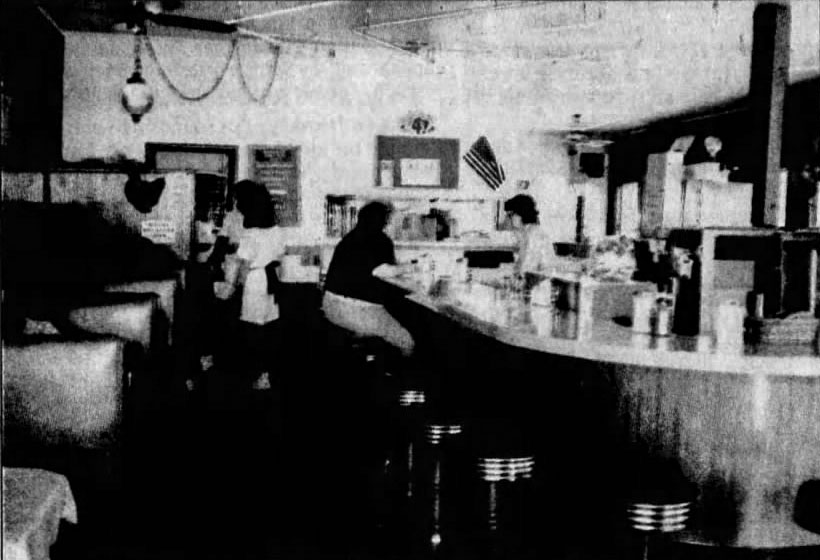
The photo above is a rare (and muddied) look at the Mar-T Cafe interior in 1990. It appears similar to what television viewers saw in the Twin Peaks pilot episode a few month earlier in April. The interior would remain like this until former cafe owner Pat Cokewell sold the diner to Kyle Twede in June 1997. Twede would make significant updates to the restaurant’s interior until filming for Twin Peaks: The Return in September 2015 returned the dinner to a look similar to the photo above.
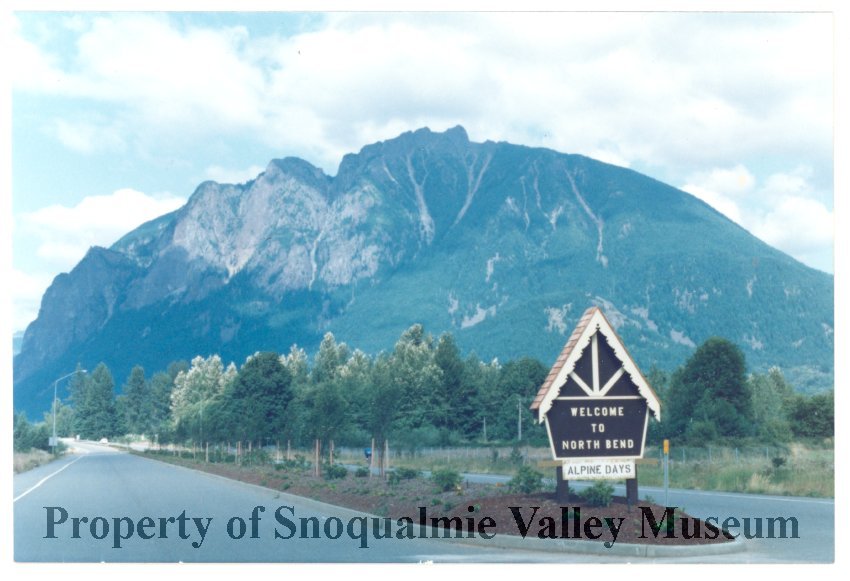
We pull off Interstate 90 at Exit 31, expecting to tumble into North Bend, the tiny town whose streets and shops have served as models for several spots in fictional Twin Peaks. Instead, we’re confronted with the relentless push of civilization. A new, surprisingly upscale strip mall, tasteful by strip-mall standards, spreads out across a chunk of the valley, promising discount outlet stores for such impressive names as Liz Claiborne, Pierre Cardin and Harve Bernard.
Where the center divider ends to allow left turns into the mall, there’s a gaily painted wooden sign hacked into the shape of a mountain chalet: “Welcome to North Bend,” it says, and then the road narrows to two lanes and plunges into the forest again.
We emerge from the woods at a railroad crossing that borders North Bend, population 2,310. A huge, yellow-orange diesel engine with flaking paint lumbers past the crossing, towing a string of old-fashioned passenger cars.
Tourists, no doubt, taking in the North Country by rail.
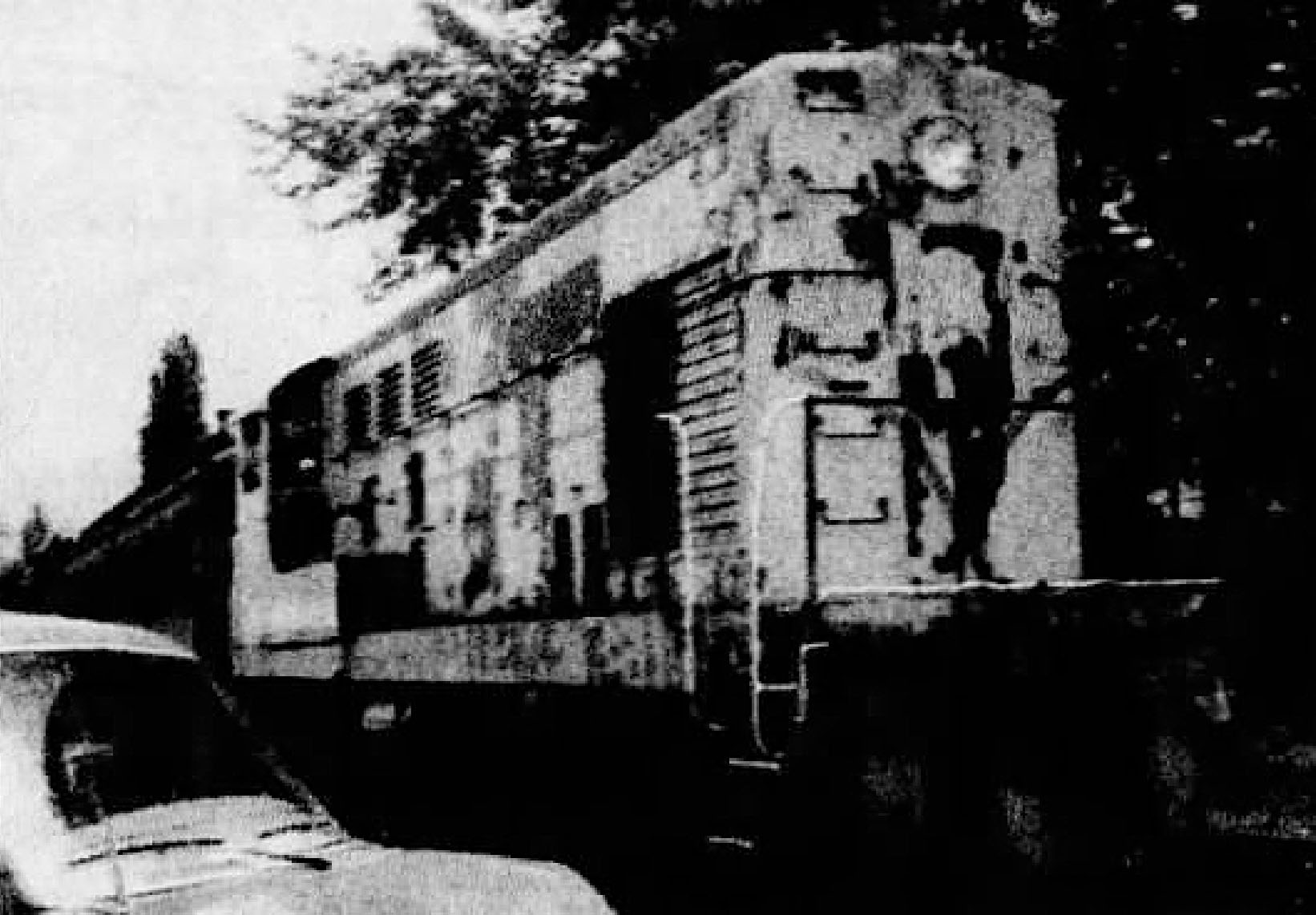
I wonder if this train passes the abandoned car where Laura Palmer was tortured and murdered and Ronette Pulaski suffered but lived? Is it any wonder Deputy Andy cried at the scene? Say, whatever happened to Ronette, anyway?
Note – the train graveyard seen in the Twin Peaks pilot no longer exists. It was located along Snoqualmie Parkway and is now occupied by a housing community.
But the train has distracted us. North Bend lies in front of us, with Mount Si, its multiple peaks fuzzy in the mist, looming in the background. And right there, backing up to the railroad tracks, is the Mar-T Cafe, a long, low white building with a yellow banner flying from its side: “Home of Twin Peaks Pies,” it says.
Good pie, great coffee and vast spreads of doughnuts lie at the goofy, gastronomic heart of “Twin Peaks.” and viewers have picked up and run with the concept. Hardly a conversation about the show takes place without somebody tying it in with food.
In “Twin Peaks,” North Bend’s Mar-T Cafe became Norma Jennings’ RR Diner, a.k.a The Double R. I’m surprised at how cheaply the transformation was accomplished. All the producers did was add a pair of big Rs to the tall Mar-T sign, leaving alert viewers to wonder about the significance of the Mar-T part. Like so much in “Twin Peaks,” it meant nothing at all.
‘TRACKING DOWN THE TWIN PEAKS MYSTIQUE’ | ST. LOUIS POST-DISPATCH, PAGE 34
Mink’s article concludes on page 34 of the September 30, 1990 edition of the St. Louis Post-Dispatch.
Inside, the Mar-T mixes the ’50s and ’60s with ’80s/’90s retro-hip styles, although you get the feeling that chance may have had more to do with the cafe’s appearance than deliberation.
Single tubes of pink and white neon, laid out in large squares and triangles, hug the ceiling, bypassing five seemingly innocent ceiling fans. The kitchen peeks through a service window on the back wall of the place. On a cork board just above is a hand-lettered sign: Twin Peaks T-Shirt, $19. The white sample shirt bears the Mar-T logo and a drawing of a huge pie breaking through the tress of a great forest.
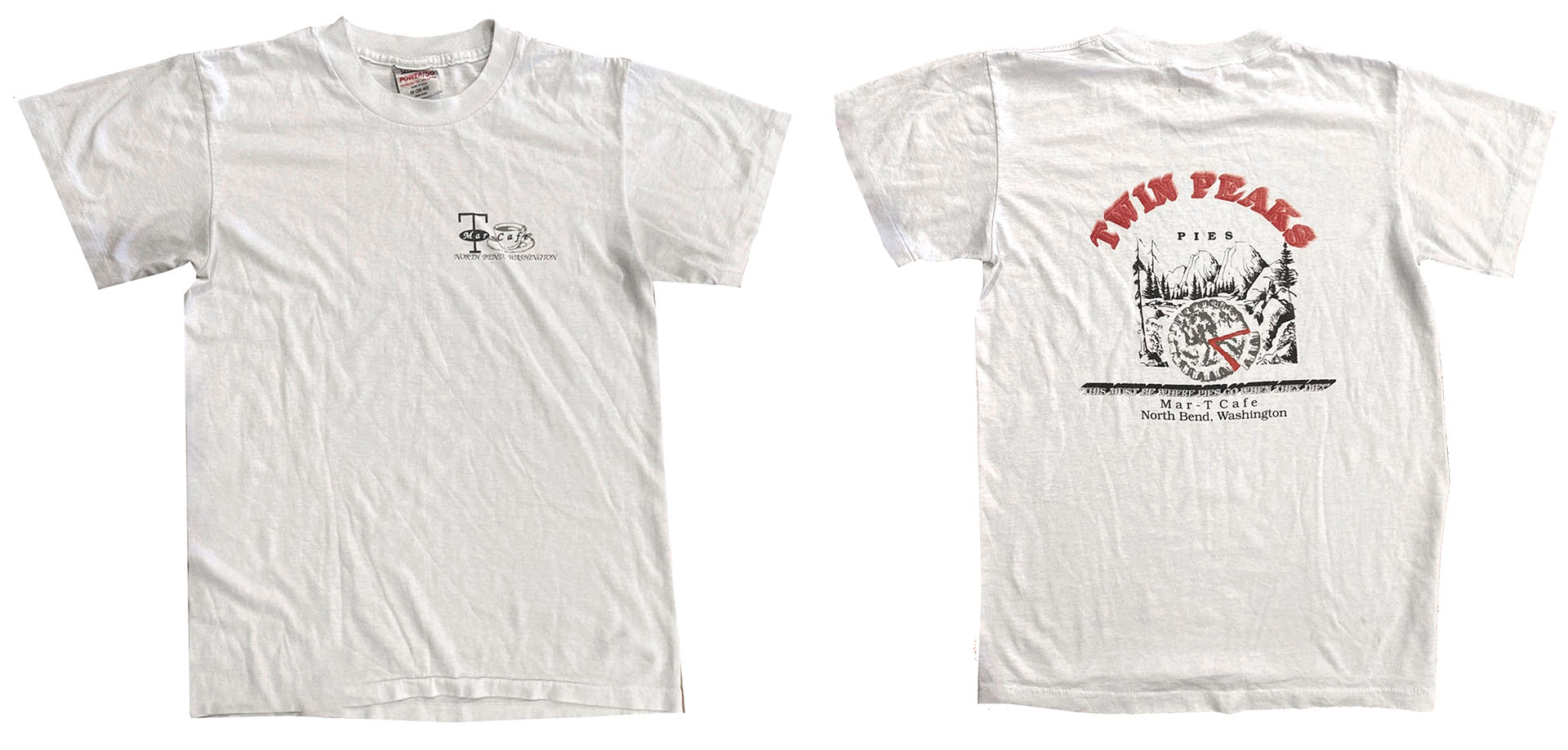
Most likely, this is the Mar-T Cafe t-shirt that Eric saw during his visit. I recall purchasing one when I first visited North Bend in August 1996 for the Twin Peaks Fan Festival. I loved this shirt until I decided to wash it with a plaid green flannel shirt in college which gave the shirt a light green hue. I wish I still had it.
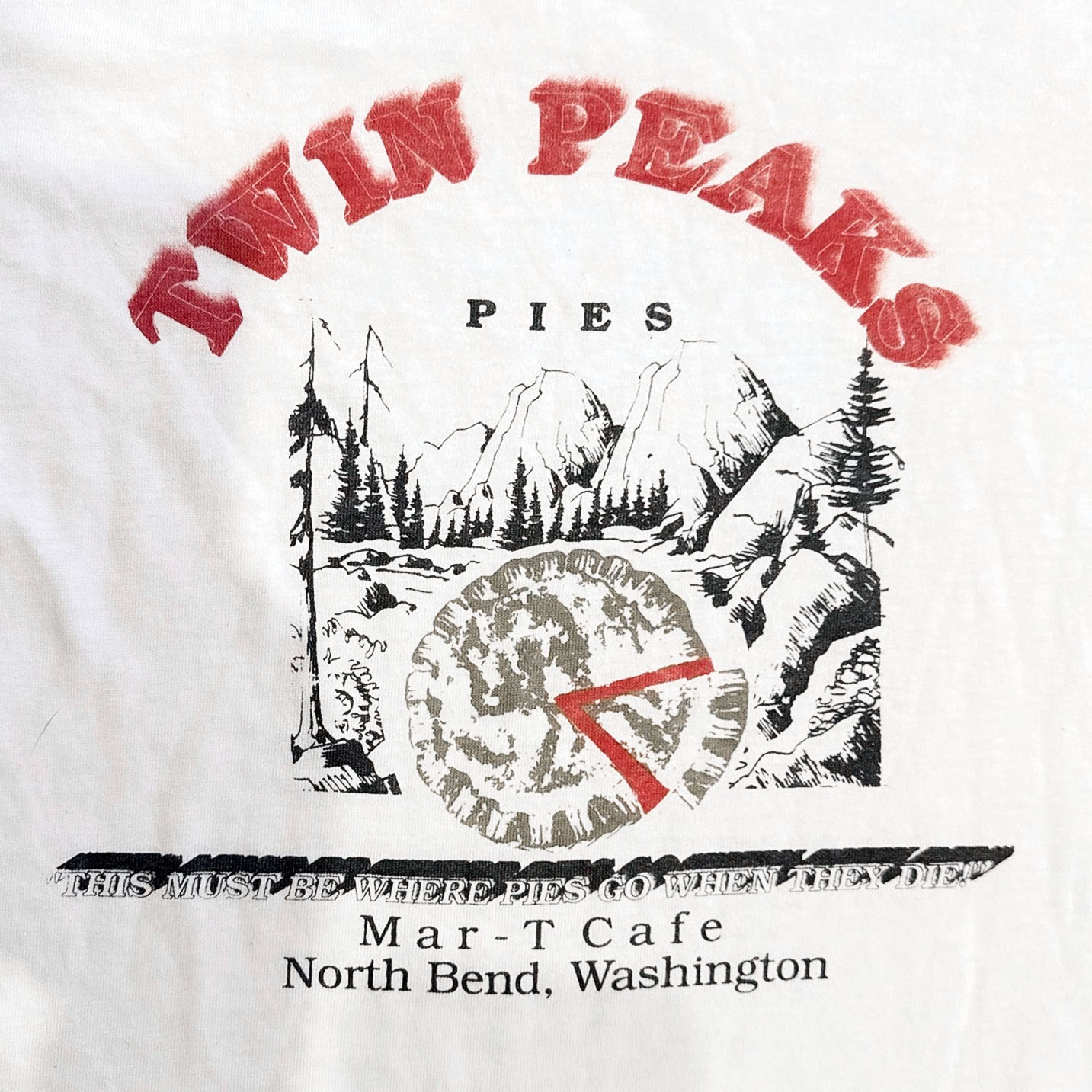
The graphic SCREAMS 1990s design, especially the quote from Special Agent Dale Cooper complete with a shadowing effect. I would love to know who designed this shirt and I wish I could recreate it.
The Mar-T is split down the middle by a long, wraparound, light-tan countertop that is ringed with stools. On one side are booths upholstered in blue and orangy-tannish vinyl. The lower half of the wall behind the booths is covered in ’60s-rathskeller paneling, capped with a single row of mirrored squares: This is the side of the diner where most of the ‘Twin Peaks” scenes have taken place. In the area on the opposite side are some free-standing tables and a few more booths. The brown tweed, artificial-grade carpet has seen lots of feet and better days.

Interestingly, Mr. Mink states that “most of the Double R Diner” scenes have taken place on the diner’s east side. The only scenes filmed inside the Mar-T Cafe for the pilot were Heidi the waitress’ arrival, Bobby Briggs speaking with Shelly Johnson and Norma Jennings (“I’ll see you in my dreams”) and a phone call Norma places to Big Ed Hurley from the diner’s kitchen later in that initial episode.
I’m unsure if he thought the other first season scenes found in episodes 1.001-1.007 were shot on location in Washington. Those interior scenes were all filmed on sets constructed in Southern California (like the scene with The Log Lady with Special Agent Cooper and Sheriff Harry Truman in episode 1.001 shown above).
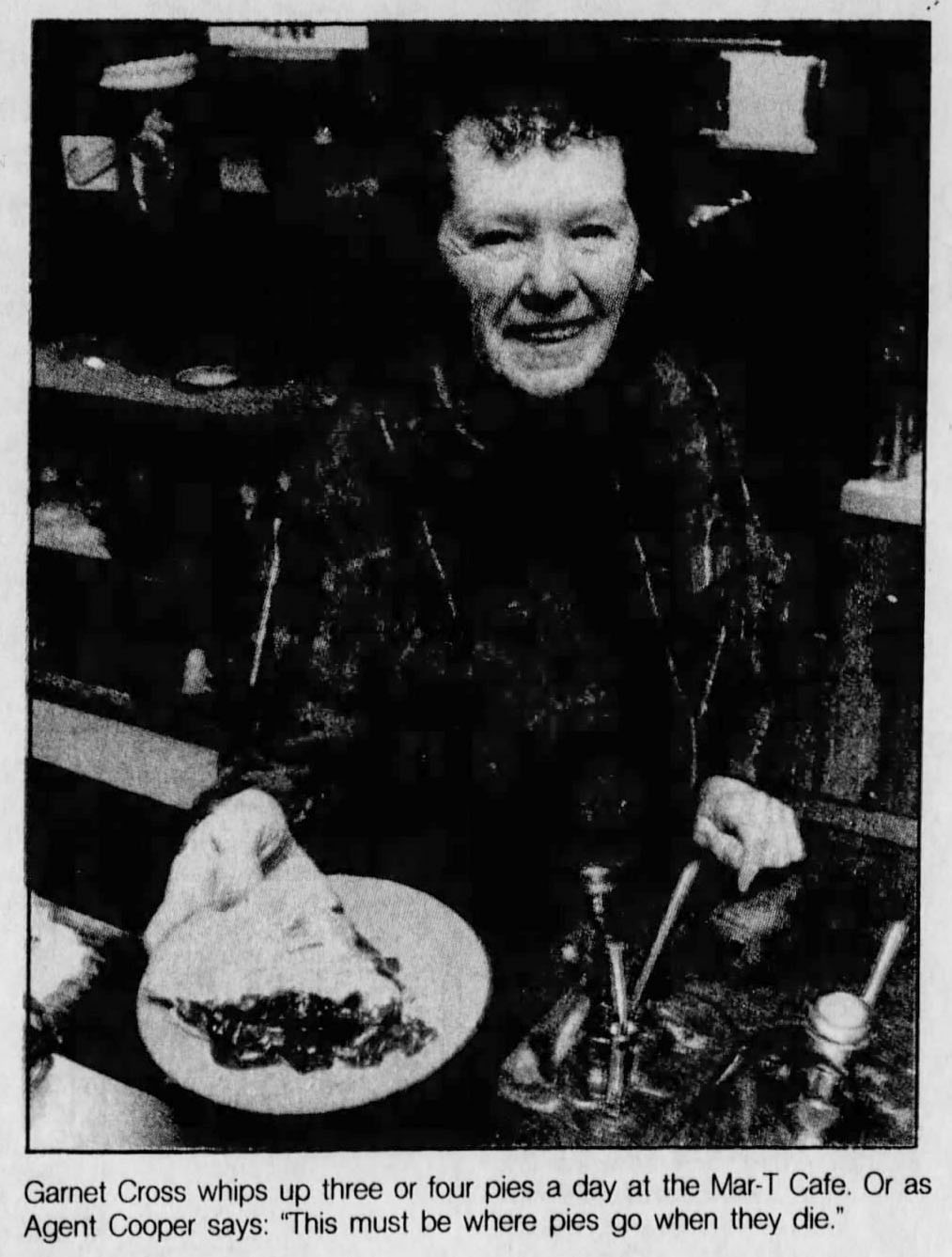
The place is busy but not jammed this afternoon, and we grab a window table covered with a felt-backed plastic tablecloth with little tulips printed on it. Menus already on the table announce “breakfast available anytime,” “homestyle pies by Garnet,” and “salad bar (when available).” The salad-bar cart sits empty and unused in a corner.
Garnet Cross was the pie baker who began working at the Mar-T Cafe in 1981. She went from making one pie a week to more than 20 once Twin Peaks hit the airwaves. I highlighted her work in this article where she discusses her pie crust.
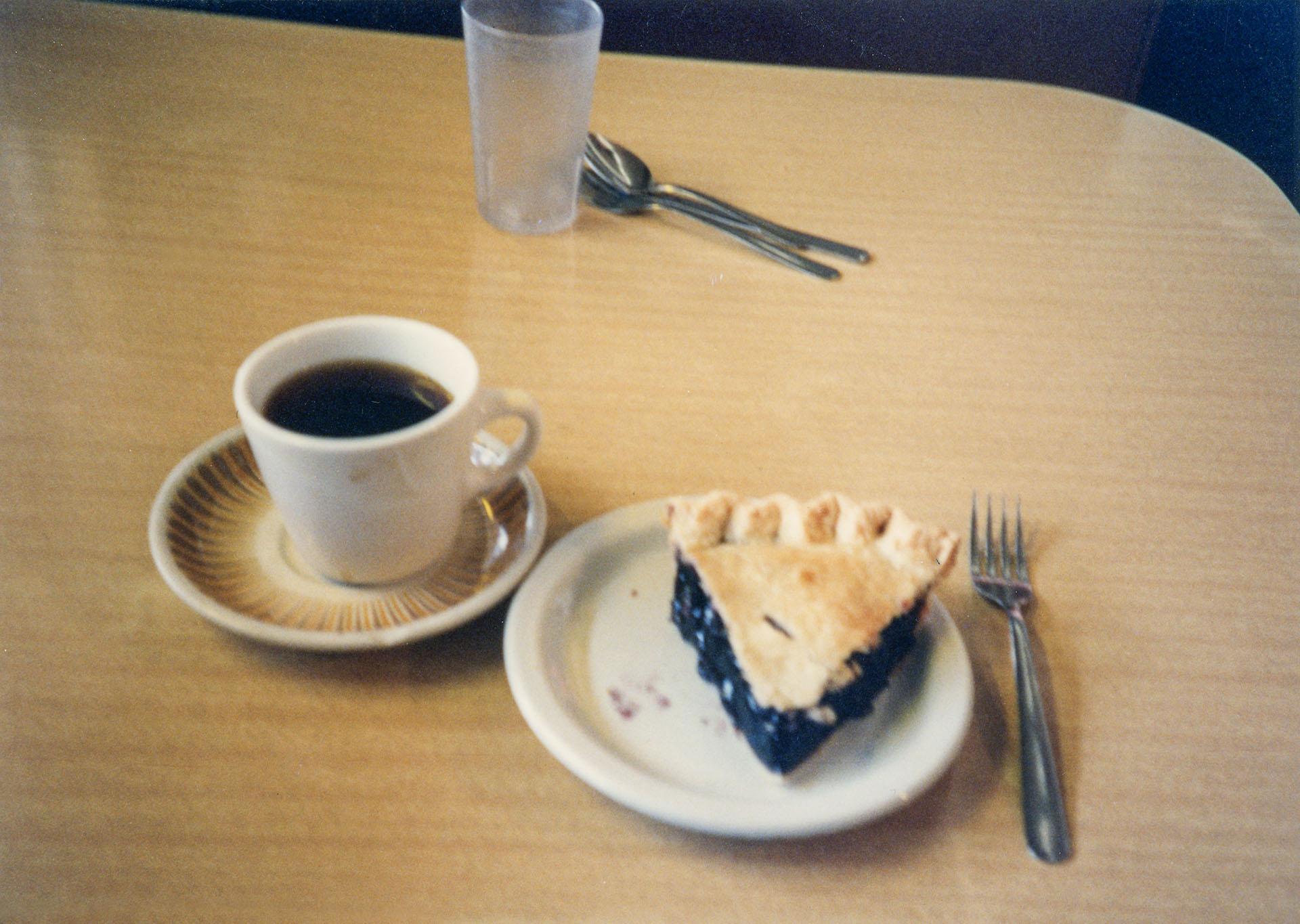
A cheery waitress named Janet appears, looks at the camera we’ve brought in and leaps to a conclusion: “Let me guess. Pie?”
Janet has seen the likes of us before. Jane orders a slice of cherry and hot coffee, the favorite combination of quirky FBI Special Agent Dale Cooper, the show’s star of stars, played by Kyle MacLachlan. Picking up on the youthful spirit of rebelliousness in the town, I go for the blueberry, with a scoop of ice cream, and decaf. Agent Cooper would not approve.
Waiting for our snack, we notice a couple in a booth behind us. The man is eating a piece of pie; the woman is videotaping the man eating his pie. We hear them mention Houston, and we resist the temptation to leap to a conclusion.
Not Janet, though. When she returns with our carbohydrates my notebook is out, and I ask her if she has a minute to chat. “Let me guess,” she says again. “This is an interview.” Janet wasn’t born yesterday.
No, Janet Volland was born 18 years ago, and it turns out that this is her first press interview, although the place apparently has been lousy with reporters all spring and summer.
She’s worked at the Mar-T for only a month. Even so, she says proudly, met Agent Cooper.” MacLachlan, who hails from Yakima, Wash., and maintains a home there, was in about two weeks ago, she says, with about six cast members, and people in the film crew have showed up occasionally, too.
Janet, who is attending beauty school in Seattle, has lived in the valley all her life. She says she thinks the locals generally like the media attention generated for the area by “Twin Peaks.” “It brings in a lot of tourism and it’s good for business,” she says.
She also admits that in the Mar-T “sometimes it gets too hectic,” with “Peaks” fans gobbling up nine or 10 cherry pies a day during the week, 20 on weekends. The pie, by the way, is $1.75 a slice, $2.50 with ice cream.
Janet hustles back to work, and I see a pair of teen-age girls in jeans and sweatshirts — they’re maybe 15 years old — dart in to use the pay phone, giggle a lot and slip back out onto the street. I also notice there’s no jukebox, which surely is a blessing. If tourists played the “Twin Peaks” soundtrack hour after hour, day after day, week after week, it’s a fair bet the staff would wind up in institutions.
And then there’s the weird guy, the guy with the mustache and the gray-flecked hair, the Elvis sideburns, the gold-rimmed glasses and the disgustingly dirty hands. The guy with “Pete” on his shirt. He’s working on, and having a great deal of trouble, connecting a fresh container of milk to the countertop dispenser.
Is this the kind of guy who would put fish heads in the coffee maker? What were those kids giggling about on the phone? Was our waitress psychic?
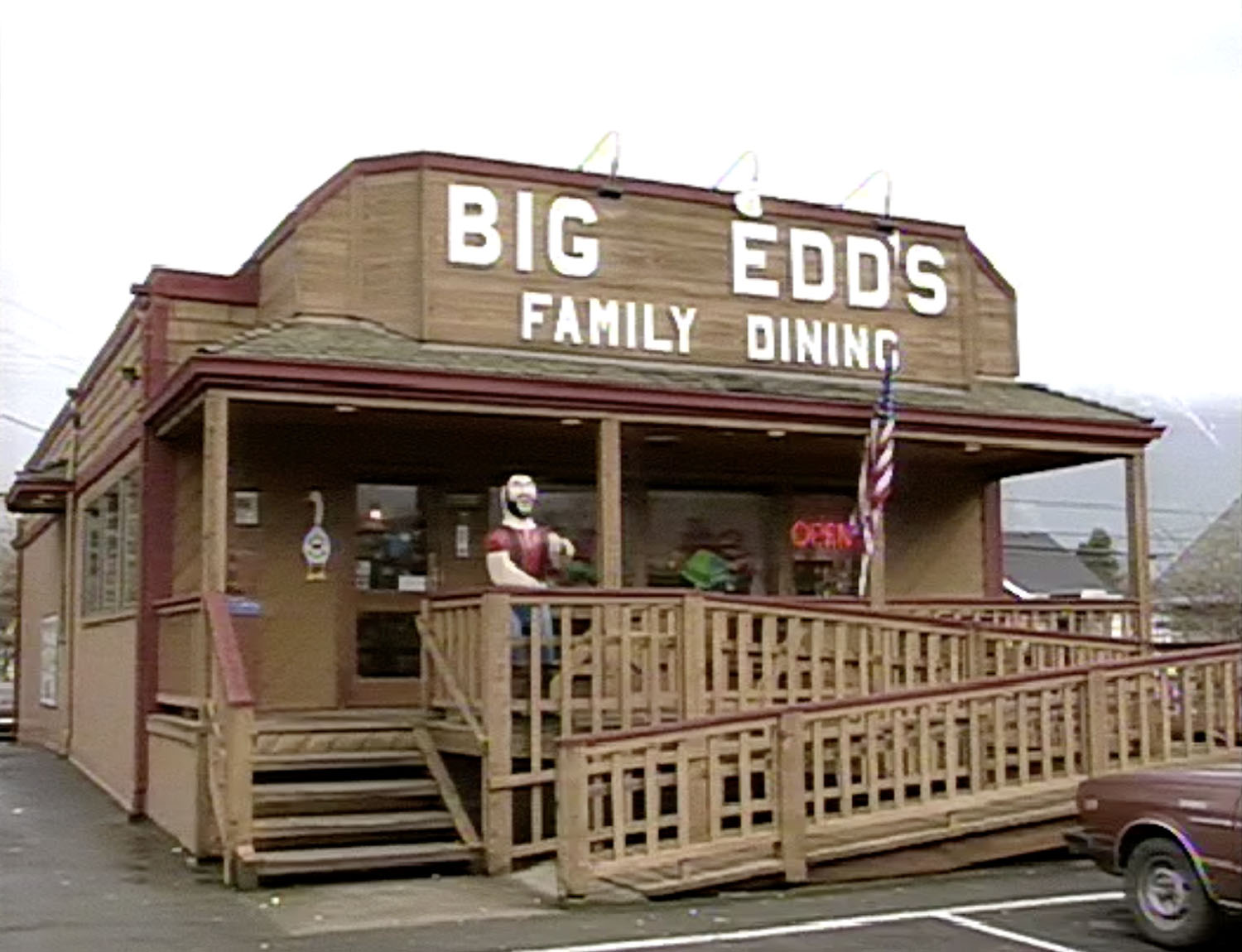
Highway 202 runs northwest out of North Bend toward the town of Snoqualmie. A woodsy establishment called Big Edd’s Family Dining sits along that road displaying a banner for Twin Peaks Burgers. At Big Edd’s, you can “dine-in” or “drive-thru.” We drive past.
Big Edd’s may well be the inspiration for Big Ed’s Gas Farm of “Twin Peaks,” the service station owned by friendly Ed Hurley and his wife, Nadine, the woman with the eye patch over her left (right?) (alternating?) eye and the obsession with silent-drapery mechanisms and the attempted suicide.
Although the spread of tourism through the valley seems to be sprucing up Highway 202, there’s an ominous touch of decay every now and then: a rusting car in overgrown grass at the side of the road, an abandoned truck trailer, a falling-down metal shed.
But Snoqualmie, population 1,520, seems prosperous, a reflection of its long-established status as a center for tourism and outdoor recreation. Snoqualmie Middle School looks tidy. Eastside Autobody is doing a brisk business. And Salish Lodge, after which the Great Northern of “Twin Peaks” is fashioned, is modern and luxurious inside and out after a 1988 remodeling. The seedy undercurrent of the TV series seems totally absent here….
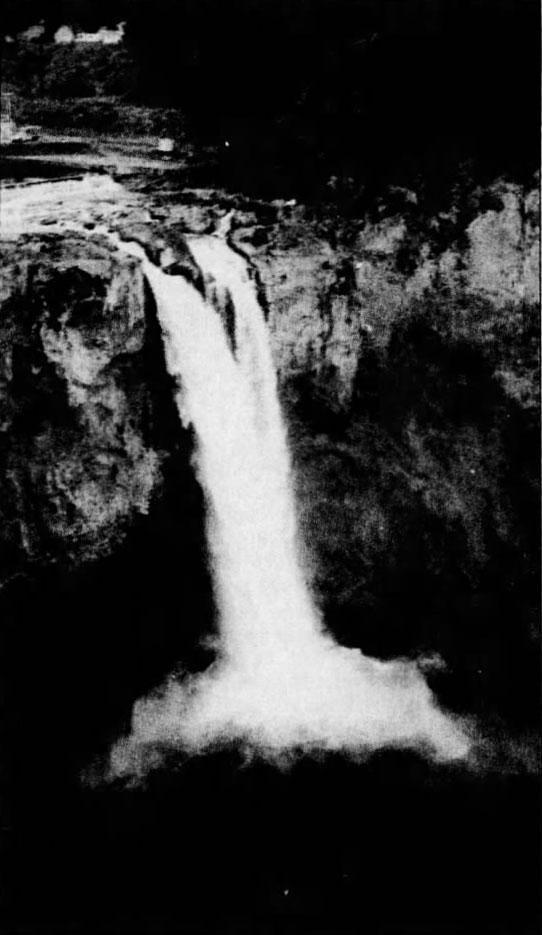
Until we walk out back where millions of cubic feet of water are pouring constantly, hypnotically, over 268-foot-high Snoqualmie Falls, the same natural wonder that appears in the opening credits of “Twin Peaks.” I’ve been to the falls as a tourist several times in years past, long before “Twin Peaks” was even a rapid-eye move-ment in a nightmare of creators David Lynch and Mark Frost.
It’s a little different this time, though. Always beautiful in their majesty, the falls now seem to cascade with a touch of melancholy. We watch them and can’t shake the memory of composer Angelo Badalamenti’s “sleeping zombie” score, which plays as the credits roll. Once burrowed into your brain, that music is not easily disengaged.
We head back toward the interstate on a narrow two-lane road through a dense forest. Rounding a curve, we’re delayed by a highway construction crew and a dark-haired woman in a white hard-hat and a yellow rain slicker who controls traffic with one of those reversible signs that says “Stop” on one side and “Slow” on the other. She’s chatting furiously on a walkie-talkie clipped to her shoulder.
While we wait, I peer into the tall fir trees that crowd the road on my side of the car and sense a vague form moving through the shadows. I glance at the woman in her yellow slicker. Wrapped in plastic, they said on “Twin Peaks” when they found Laura Palmer’s body at the lake shore.
In one sense, at least, David Lynch and Mark Frost are correct. There’s absolutely no way to know what’s really going on in these woods.
LOS ANGELES

Cut from real life masquerading as art to artifice attempting to stand in for real life.
Shift locations from the North Woods of Washington State to the San Fernando Valley north of the city of Los Angeles, to the working-class community of Van Nuys. Under a bill-board touting the Nissan Maxima, next door to the Balboa Industrial Park, where there is a vacancy, in a nondescript former warehouse you certainly would drive by without noticing if you weren’t looking for it, sits City Studios, home of Lynch/Frost Productions, maker of “Twin Peaks.”

Much of last season’s “Twin Peaks” pilot was shot on location in and around North Bend, Snoqualmie and environs. But virtually all of the “Twin Peaks” weekly episodes are filmed here on two separate sound stages within this converted warehouse.
With production of this season’s episodes under way, the Lynch/Frost people have shifted into their paranoid mode, rightly fearful of leaks about plots and characters that would undercut the semi-suspense that has been building toward the show’s premiere Sunday night at 8 on ABC (Channel 2 in St. Louis).
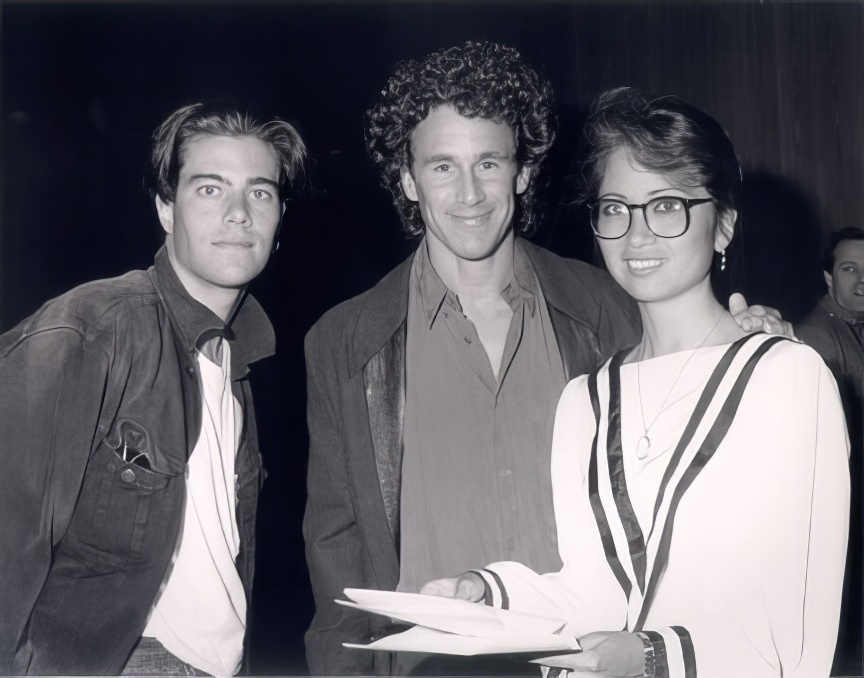
Outsiders are not permitted on the sets during filming, lest some attentive reporter pick up clues or outright revelations. But Lynch/Frost’s staff publicist, Paula Shimatsu-U., has agreed to show me quickly around the sound stage where filming is not taking place. We cruise through sets that are at once familiar and alien, the meticulous work of production designers Patty Norris (who did the pilot) and Richard Hoover (who handles the series):
- Everything’s a little ratty at the Blue Pine Lodge where Pete and Catherine Martell and Jocelyn Packard live as three-way antagonists. The cabinets are made of plywood that’s been stained dark, lodge-style; the sofa upholstery is worn and dingy; an immense chandelier made of rusty saw blades hangs in what’s supposed to be the living room.
- Here’s the Palmer home, with its yellow living room where Mrs. Palmer had one of her visions and where Mr. Palmer “danced” with Laura’s photograph. In fact, there’s a photograph of Laura with her supposed best friend, Donna Hayward. And there, lying on the floor, ready to be hung when needed, is that damned ceiling fan.
- Ben Horne’s office at the Great Northern is surprisingly spacious for an interior set, with huge log chunks standing in the corners like beefy bodyguards.
- Here’s where police receptionist Lucy Moran sits, and the little kitchen where she prepares the nightly doughnut feast for Sheriff Truman and deputies Andy and Hawk. (And where she told Andy she was pregnant.) And there’s the sheriff’s conference room where Waldo the mynah bird croaked his last.
- There’s Dr. Jacoby’s office, a morass of coconuts and fake palms; the Hayward home, obviously inhabited by a happier family than the Palmers’; and the girl’s restroom at Twin Peaks High School, a peek into which falls just short of fulfilling a three-decade fantasy of mine.
- And finally, almost alive with creepiness, there is evil Leo Johnson’s eternally-under-construction trailer, complete with the bullet hole in the window through which Leo was shot in last season’s finale.
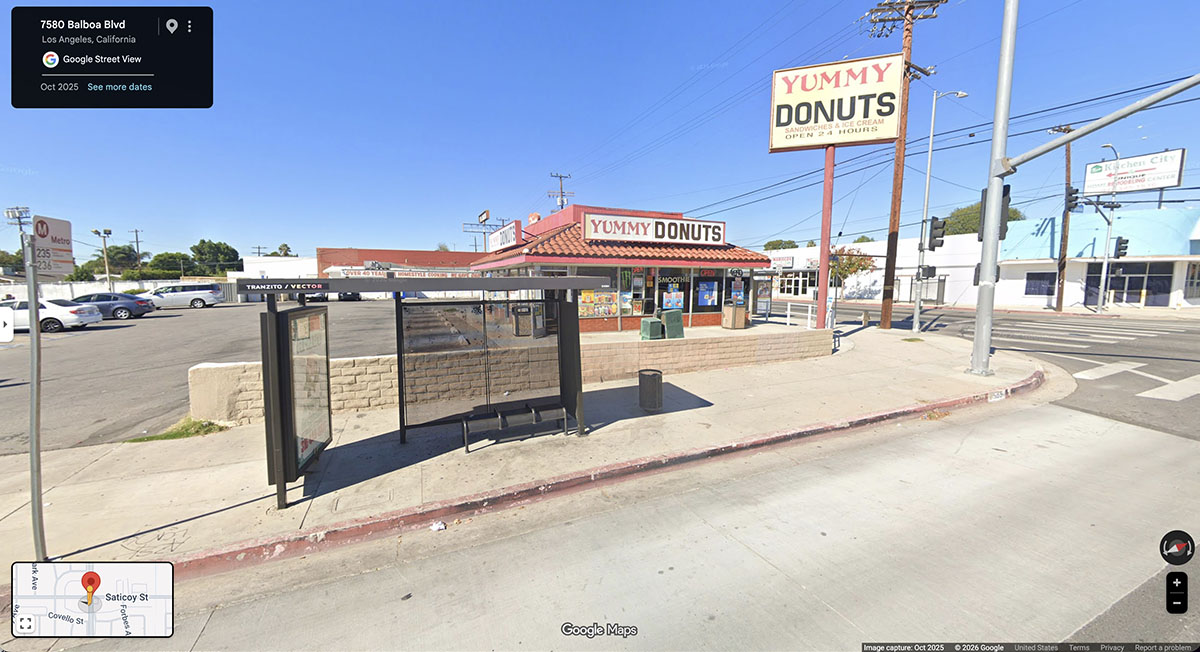
Past the official and very active Lynch/Frost Productions paper shredder, past Lynch’s empty space’ on the parking lot and into my rented car, I figure my “Twin Peaks” excursion is over. Not quite. Just two blocks down from City Studios, at the corner of Balboa Boulevard and Saticoy Street, I pass a tiny establishment that I’m certain plays a distinct part in the production of “Twin Peaks” each week.
It’s the Yummy Donuts stand.
Author
Discover more from TWIN PEAKS BLOG
Subscribe to get the latest posts sent to your email.