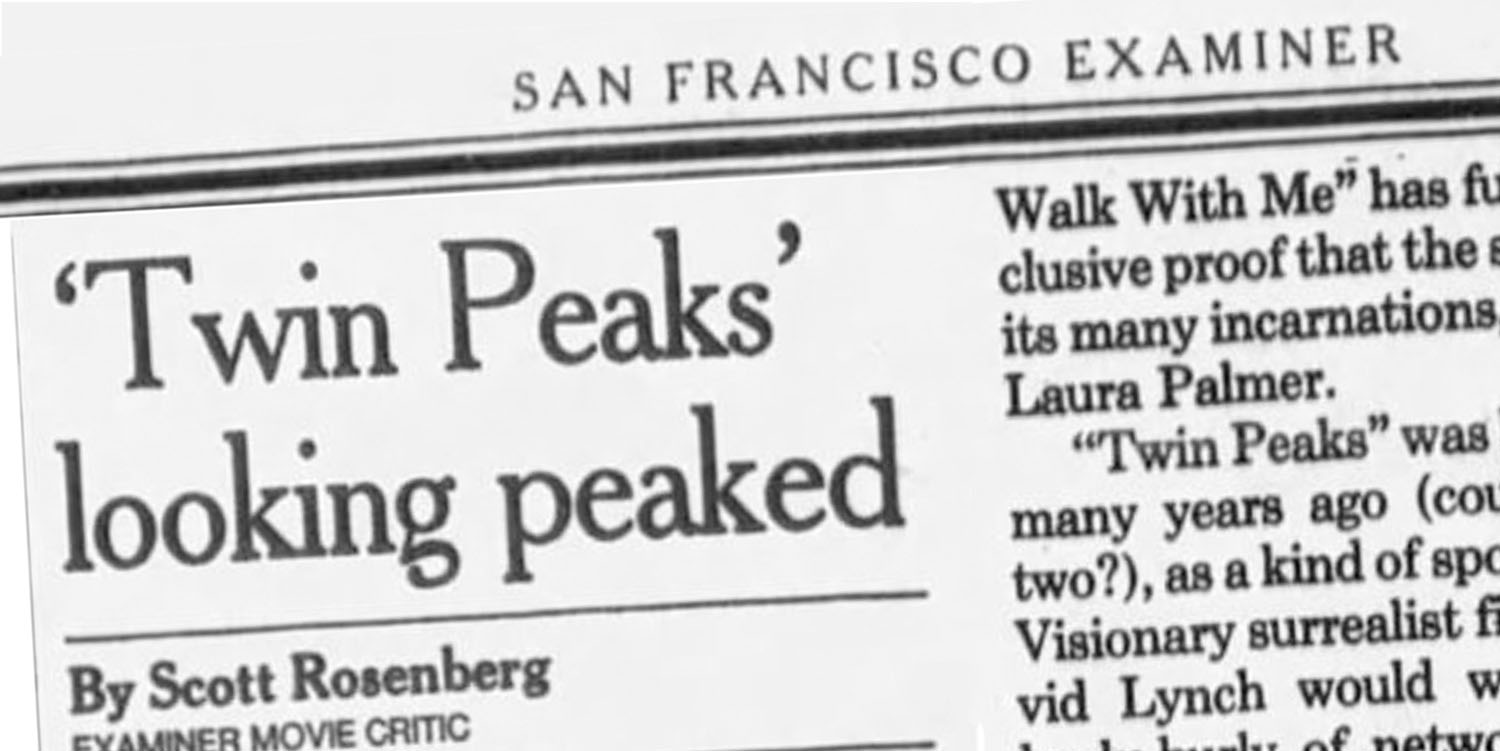
For this Reviewing Peaks article, I feature Scott Rosenberg’s review of David Lynch’s 1992 masterpiece, Twin Peaks: Fire Walk With Me. The one-and-a-half star review appeared in the August 30, 1992 edition of the San Francisco Examiner.
WHO IS SCOTT ROSENBERG?
Scott Rosenberg worked at the San Francisco Examiner from June 1989 to September 1995 serving as the Theatre, Movie Critic and Digital Culture Columnist. Rosenberg was born in Queens, New York to Jeanne and Coleman Rosenberg and attended Harvard University. While in college, he worked for The Harvard Crimson before graduating with a degree in history and literature.

Upon leaving the Examiner, he founded Salon.com in 1995 where he served as managing editor from 1999 to 2004. He left the website in 2007 to write Dreaming in Code which offers a detailed perspective on collaboration and massive software endeavors, particularly the open source calendar application Chandler (PIM). His second book Say Everything, on the history of blogging, was published in 2009.
Rosenberg worked at Grist from 2011 to 2014. He then joined Axios as its managing editor of technology from March 2018 to October 2025. He has a blog called Wordyard
REVIEW IN SAN FRANCISCO EXAMINER, AUGUST 30, 1992
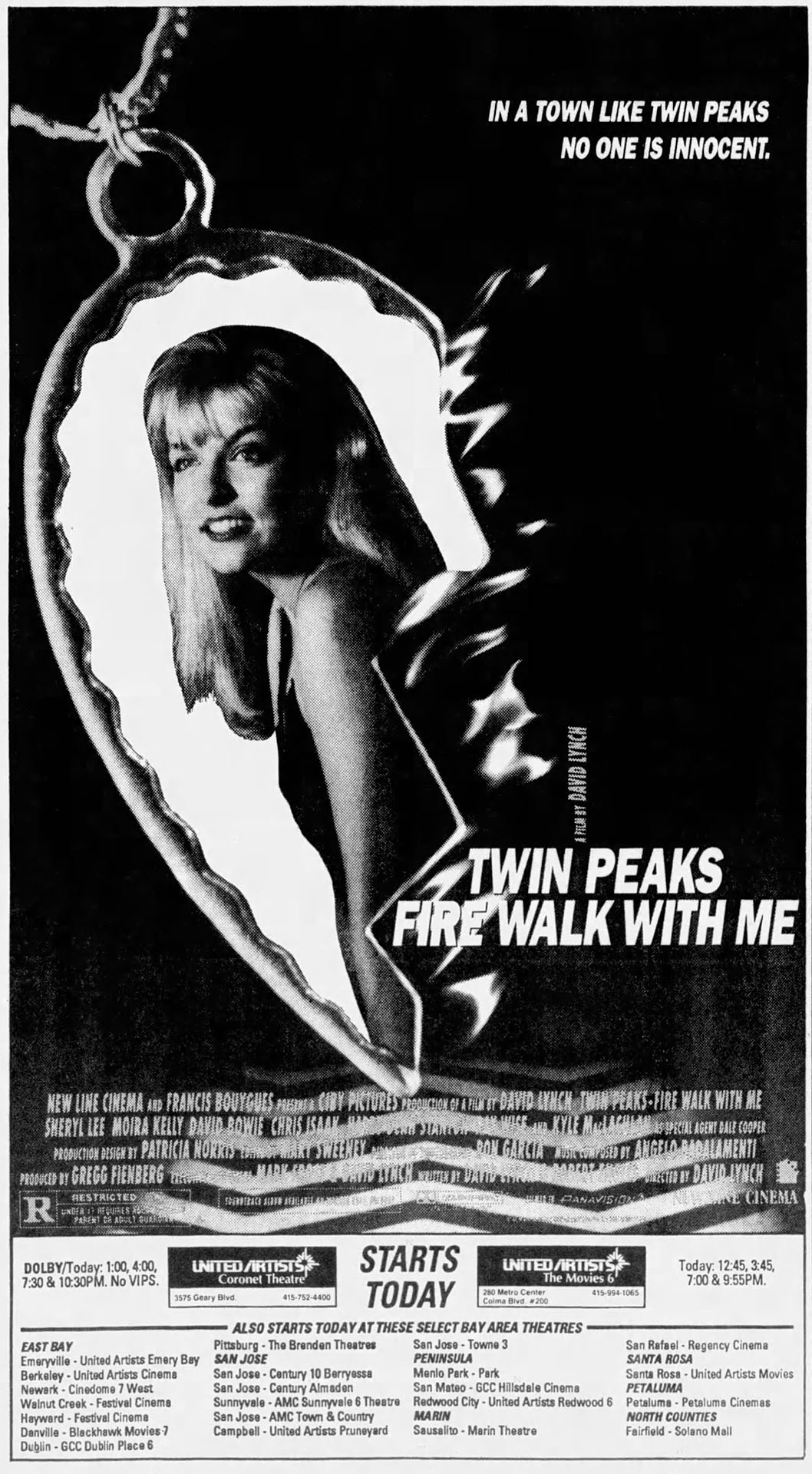
Rosenberg’s review of David Lynch’s prequel film was published on August 30, 1992. You may recall that New Line Cinema did not hold review screenings for the film following the negative reaction from some journalists at the Cannes Film Festival earlier in may that year.
‘TWIN PEAKS’ LOOKING PEAKED
A reasonable-sized audience had gathered Friday afternoon at the Coronet for the first showing of “Twin Peaks – Fire Walk With Me,” the new movie spinoff of the cult-hit TV series. The crowd sat through the lengthy film patiently and respectfully – more so, probably, than it deserved. A muted cheer even greeted the first appearance of Special Agent Dale Cooper.
But nothing in “Twin Peaks – Fire Walk With Me aroused anything like the whoops and howls that greeted a trailer for “Husbands and Wives,” the new Woody Allen film, which is being rushed out by its distributors to capitalize on the Allen/Farrow foofaraw.
They know exactly what they’re doing; our pop culture’s eyes are easily tired out and easily distracted. Who can tell what beastly story will next slouch out of the tabloid underbrush and muscle Woody and Mia from the limelight?
As we wait to find out, “Twin Peaks” itself – which once served as apple to the media eye provides an instructive case study in the life cycle of a pop phenomenon.
The investigation might aptly be termed an autopsy, now that “Fire Walk With Me” has furnished conclusive proof that the show, in all of its many incarnations, is as dead as Laura Palmer.
“Twin Peaks” was born, lo these many years ago (could it be just two?), as a kind of sporting gamble. Visionary surrealist filmmaker David Lynch would wade into the hurly-burly of network television; on that medium’s largely unexplored creative frontiers, he’d shatter old sensibilities and awaken new ones.
The show thrived as a groundbreaking succes d’estime for Lynch and his collaborators, then petered out as its creative trajectory grew more erratic. Now it has found a fitting burial place on the heap of movies that are so ill-regarded, even by their distributors, that they’re dumped into the movie houses without advance screen-ings. The film will play just long enough to provide some PR for the home video release – thereby bringing “Twin Peaks” full circle, back into the living room.
“Twin Peaks” didn’t fit TV’s categories, but programmers insisted on selling the show as a mystery, using as bait that infernal question, “Who killed Laura Palmer?” Anybody who really cared to know the answer would have tuned out long before the show sauntered around to it. Those of us who stuck with “Twin Peaks” through its many loopy contortions did so not because it presented one big, suspenseful mystery, but rather because its form generated thousands of little mysteries with no solutions in sight.
“Twin Peaks” worked because Lynch used the Palmer murder as an excuse to build a whole fictional world — one dreamier and wilder than any other on TV, in which cornball Americana and sleazeball erotica shared the same roots and, in some cases, bodies.
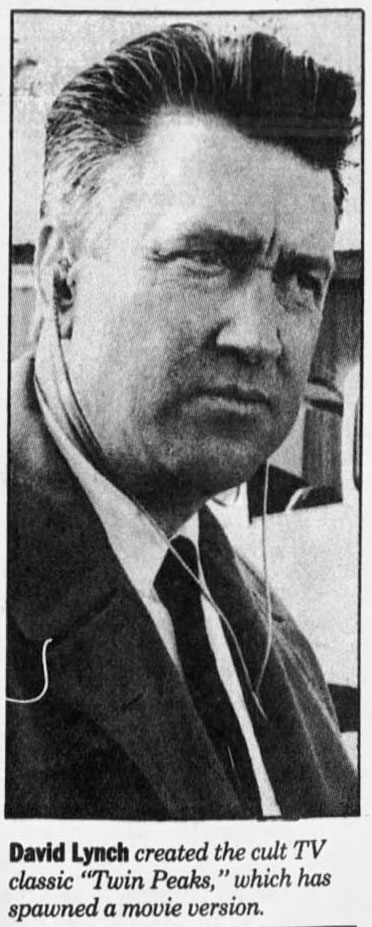
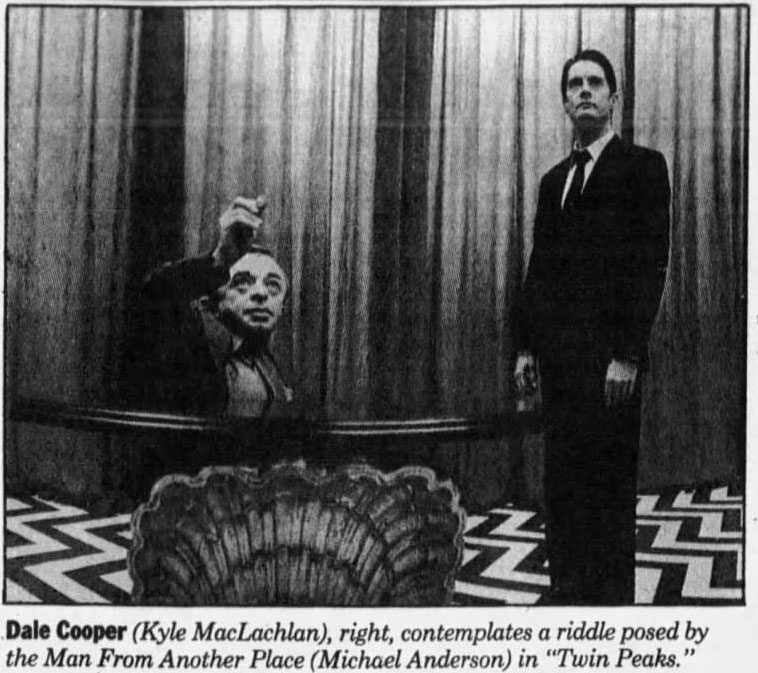
As Agent Cooper (Kyle MacLachlan) followed his case’s threads through the Northwest logging town that gave the show its name, we tagged along for a bumpy ride past scheming lumber heiresses and venal hoteliers, romantic bikers and drug-dealing delinquents, weary waitresses and weepy deputies. They were what gave the show its unpredictable life; their reality — the world of doughnuts, cherry pie and “damn good coffee” – served as both foil and anchor for the more inscrutable passages of spirit-possession, ESP and tiny men talking back-wards in red-velvet-curtained rooms.
Alas, “Fire Walk With Me” is all demons and no doughnuts. A “prequel” to the series, it offers a , lengthy, draggy reply to the question “How’d they kill Laura Palm-er?” The answer is more grisly and explicit than anything shown on TV; but so what? Cooper already unraveled for us, in prime time, the mysteries of Laura’s coke habit, her S&M scene in the backwoods shack, her incestuous liaison with her father, his possession by an evil spirit named Bob, even the savage part played by a mynah bird named Waldo. Do we need more details?
The movie strips the “Twin Peaks” cosmos down and cuts it into halves: The metaphysically off-kilter world of the FBI-accord-ing-to-Lynch and the good-girl-gone-bad world of Laura Palmer’s last days.
The first 45 minutes of the film feel like a prologue borrowed from another screenplay, featuring Chris Isaak as a stone-faced G-man, with Kiefer Sutherland as his sidekick, tracking down a murder case a year before Palmer’s death. David Bowie makes a brief, garbled appearance as a disappear-ing FBI agent. Then, as the twangy theme music swells, the scene finally shifts to Twin Peaks proper.
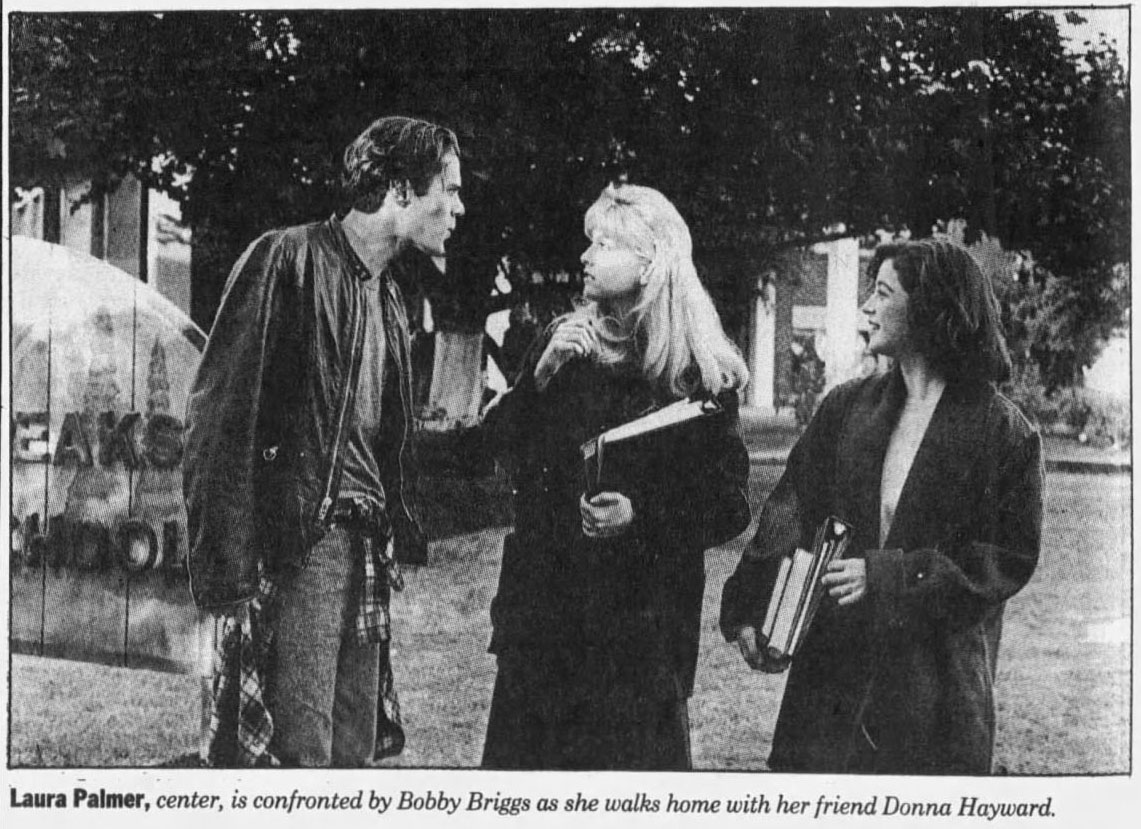
But it’s not the Peaks you remember. Many of the TV characters (Sheriff Truman, Josie Packard, Catherine Martell, Audrey Horne and her father Ben) are absent; others (the Log Lady, Leo and Shelly Johnson, Albert Rosenfeld [sic]) just pay their respects; one, Laura’s best friend Donna Hayward, is played by a different performer (Moira Kelly instead of Lara Flynn Boyle); Cooper himself makes only a few appearances, mostly in dreams.
Even more sorely missed than the characters are the show’s rhythms. The best “Twin Peaks” episodes kept up a steady shuffle between the mundane and the arcane. When things got incomprehensible, there was always hope – maybe next week we’d understand.
There’s no hope for “Fire Walk With Me”; tired and slapped together, it marks the clear end of this line of Lynch’s work. When the TV series flagged, it was common for “Peaks” partisans to blame the medium itself – as if Lynch’s imagination were too large to be contained by the tube. (It can’t be a coincidence that the film’s opening shot shows a TV screen getting smashed.)
“Fire Walk With Me” gives the lie to such excuses. In 2 1/2 hours of big screen time, “Twin Peaks” becomes just another small town on he Hollywood map – a place where loose women get gorily tortured to death and drug users meet untimely ends, but somehow angels still look down from the heavens.
Each of Lynch’s best works, prom “Eraserhead” to “The Elephant Man” to “Blue Velvet,” has built a world unto itself. The director has simply stayed too long in his one – it’s time for him to pack up and move on.
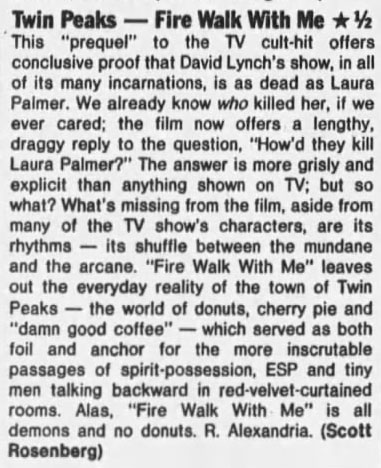
A shorter review from Rosenberg ran in the September 18, 1992 edition of the San Francisco Examiner.
This “prequel” to the TV cult-hit offers conclusive proof that David Lynch’s show, in all of its many incarnations, is as dead as Laura Palmer. We already know who killed her, if we ever cared; the film now offers a lengthy. draggy reply to the question, “How’d they kill Laura Palmer?” The answer is more grisly and explicit than anything shown on TV; but so what? What’s missing from the film, aside from many of the TV show’s characters, are its rhythms – its shuffle between the mundane and the arcane. “Fire Walk With Me” leaves out the everyday reality of the town of Twin Peaks – the world of donuts, cherry pie and “damn good coffee” – which served as both foil and anchor for the more inscrutable passages of spirit-possession, ESP and tiny men talking backward in red-velvet-curtained rooms. Alas, “Fire Walk With Me” is all demons and no donuts.
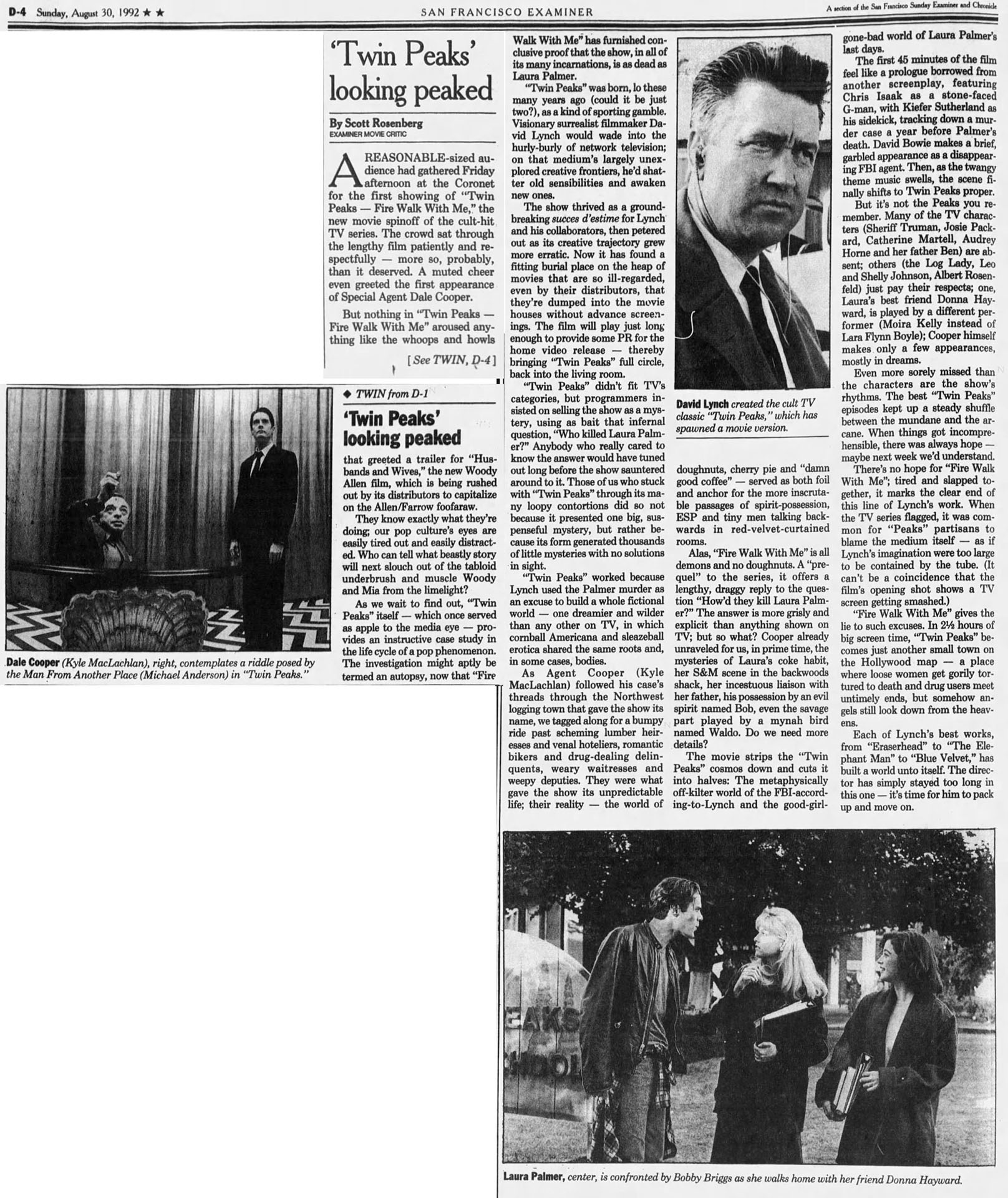
Below is the original article from August 30, 1992 as published in the San Francisco Examiner.
Author
#/media/File:Scott_Rosenberg_1a.jpg)
Discover more from TWIN PEAKS BLOG
Subscribe to get the latest posts sent to your email.