
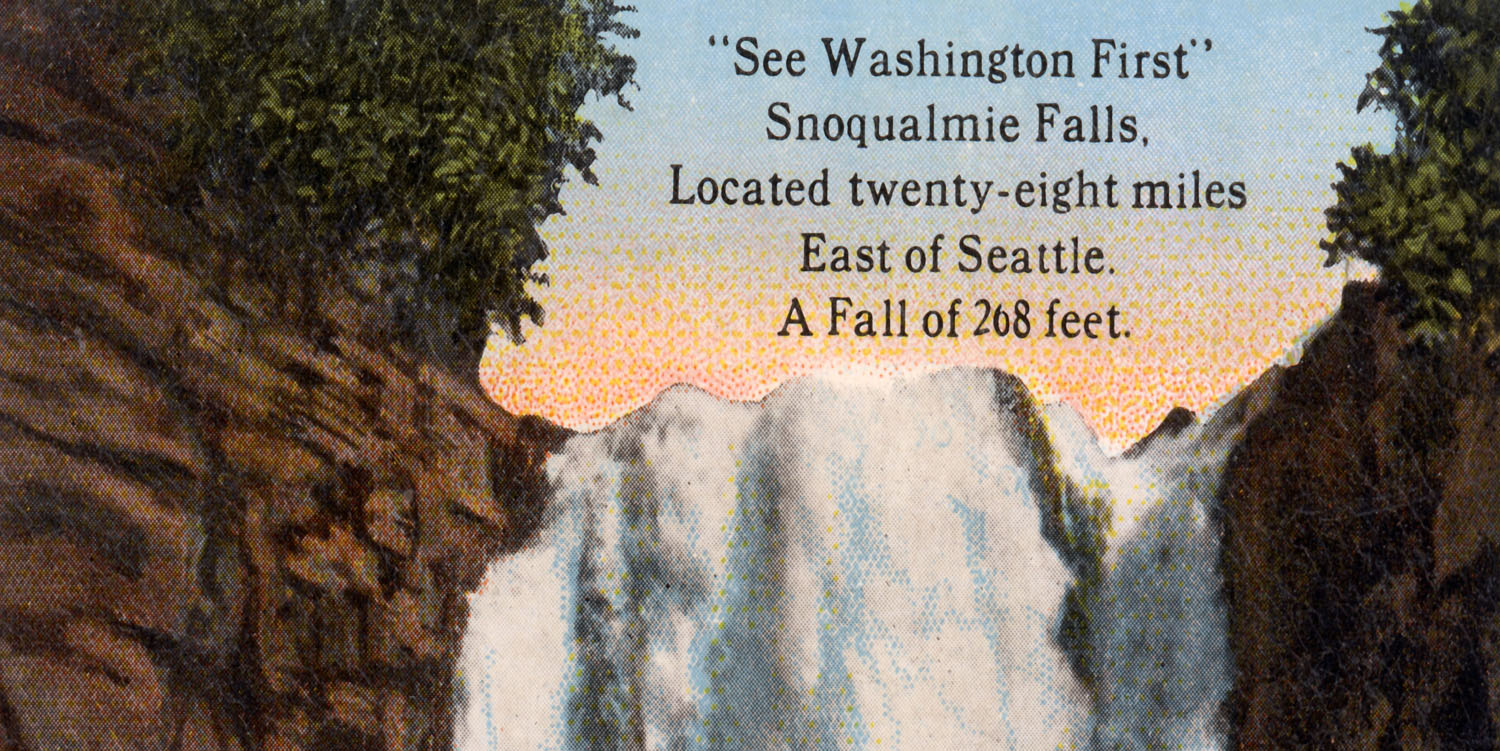
Seattle-based Lowman and Hanford produced a number of postcards of scenes from Washington state including the majestic and sacred Snoqualmie Falls in Snoqualmie, Washington. This postcard encouraged folks to “See Washington First” more than 100 years ago.
SNOQUALMIE FALLS POSTCARD BY LOMAN AND HANFORD – A-34476
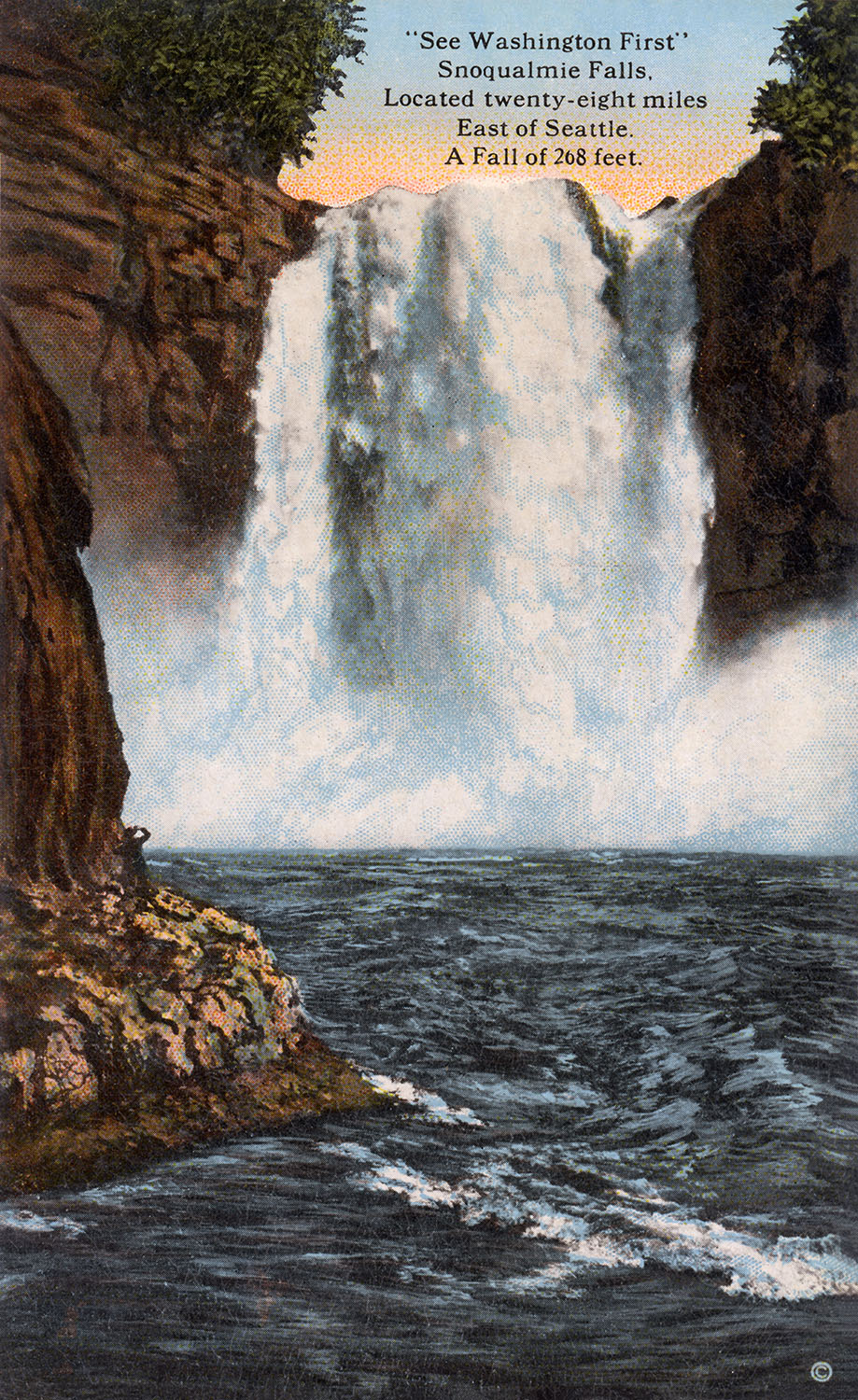
This view of Snoqualmie Falls was captured at dawn as the sun rises from the lower observation area. You’ll notice the spot where Snoqualmie Falls Lodge was eventually constructed is covered by tall fir trees.
The front also contains an inscription: “See Washington First” / Snoqualmie Falls, located twenty-eight miles East of Seattle, A Fall of 268 feet.”
It appears “See Washington First” may have been a campaign from around the mid-1910s that encouraged in-state tourism. The phrase appears on several Washington state postcards I’ve found from around that time. Newspaper searches have proved unconclusive.
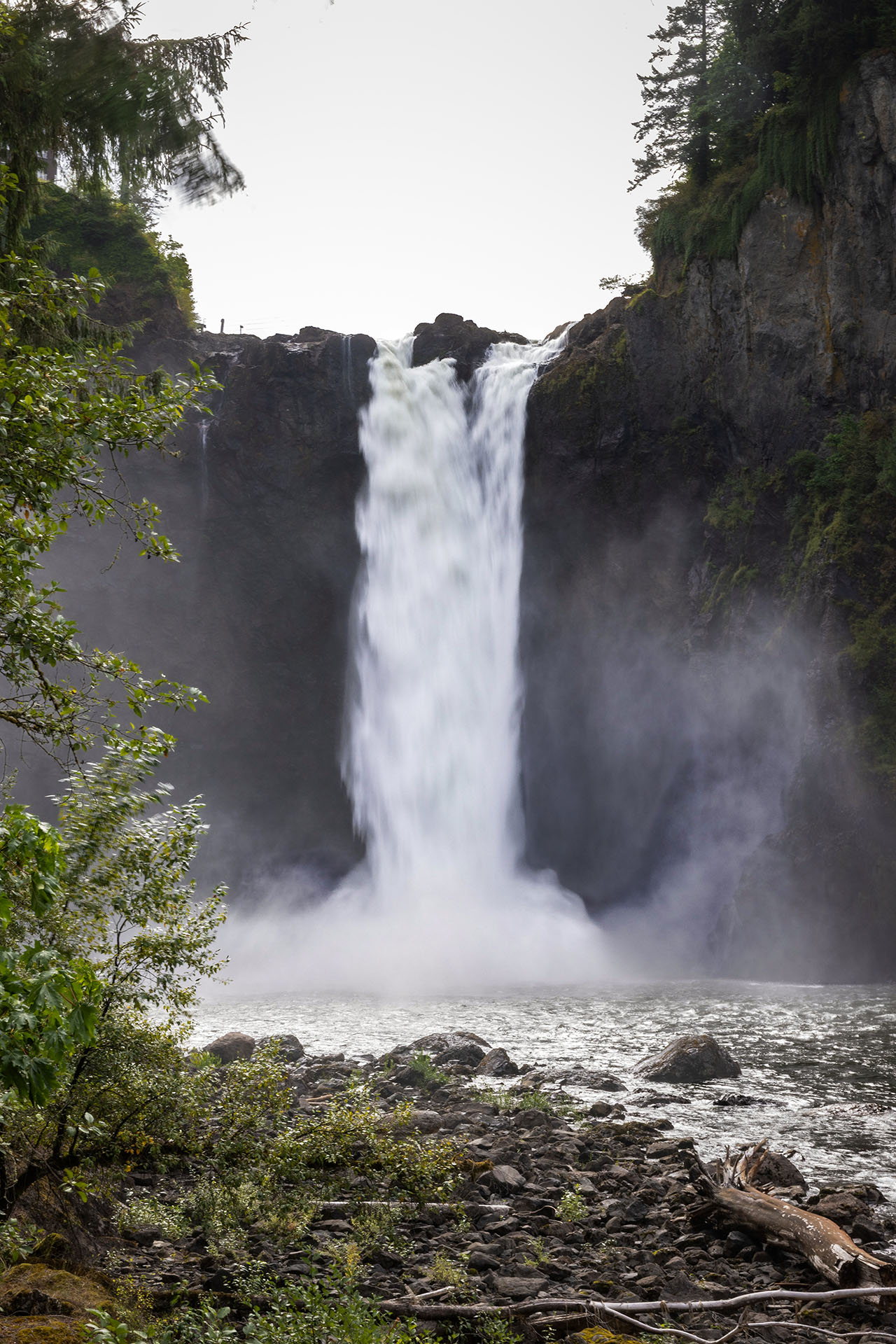
The 268-foot Snoqualmie Falls are considered sacred ancestral lands of the Snoqualmie Indian Tribe—(sdukʷalbixʷ) the People of the Moon. The falls holds profound spiritual significance for the Snoqualmie people as it is central to the Tribe’s creation story.
Today, more than 2 million people visit this site annually. You can learn more about the Snoqualmie Tribe Ancestral Lands movement and how to protect and respect this area during your visit.
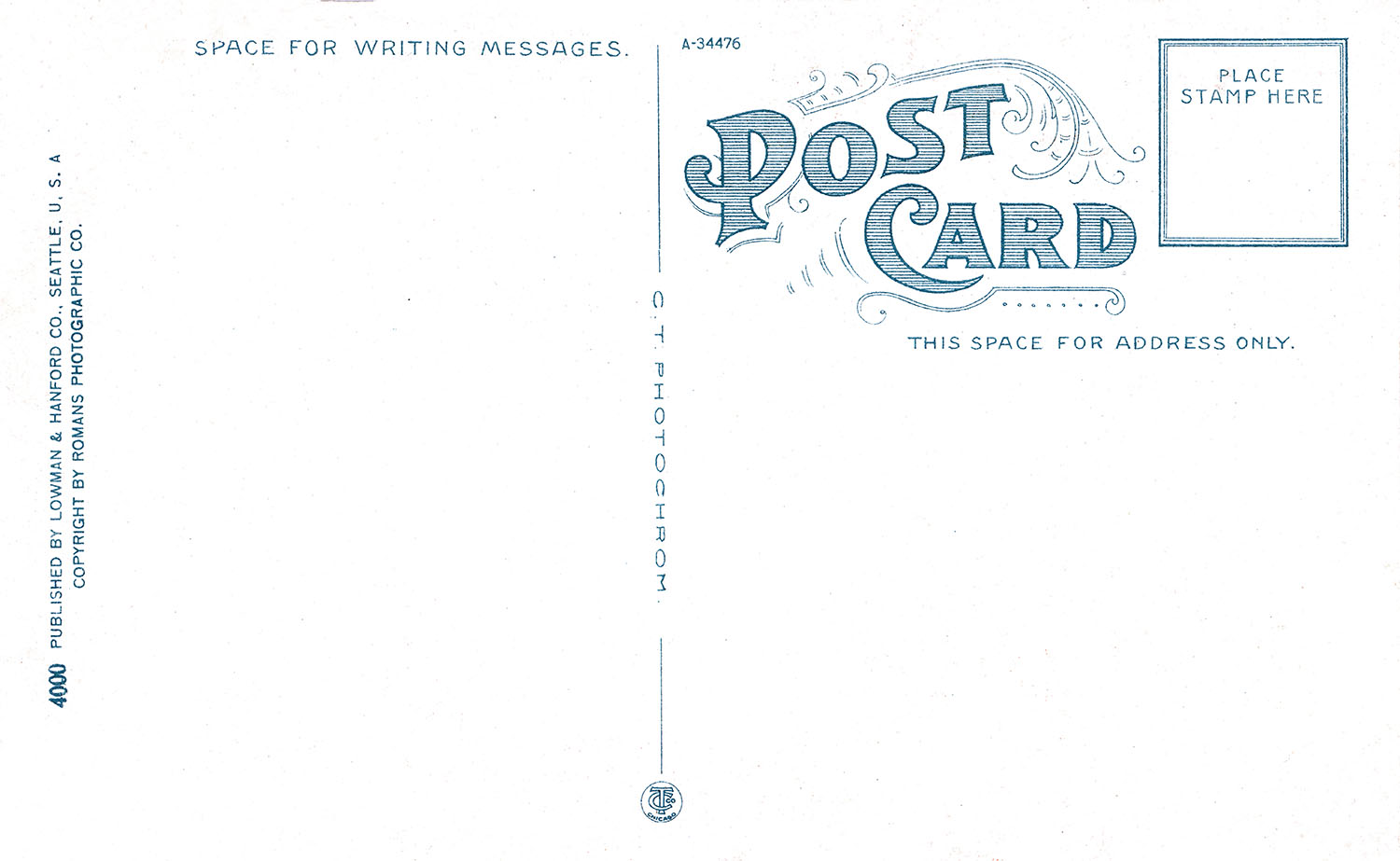
The postcard was published by Lowman & Hanford Printing and Stationery Company, Co. in Seattle, Washington, a printing company that dates from around 1882. This card is has the production number A-34476.
Romans Photographic Co. owned the copyright to the image, which another Seattle-based company formed in 1901 by William P. Romans and Asahel Curtis. An advertisement in The Post-Intelligencer on Feb. 8, 1903 lists the company as the “successors to Curtis and Romans commercial photographers.” At the time, the company was located at 713 First Avenue, 52 Union Block.
Curtis had left the company shortly after this advertisement to work in San Francisco and Tacoma as an occasional photoengraver. You may recognize the name as he took the photo of the tall tree seen in the Twin Peaks Sheriff’s Department lobby in the Twin Peaks pilot.
Three years later, Romans Photographic Co. was incorporated with capital stock by William P., Marion L. and John B Romans on Friday, April 6, 1906. Curtis returned to the company from about 1907 to 1911, becoming president and manager of the firm. The company appears to have been disbanded around 1920.
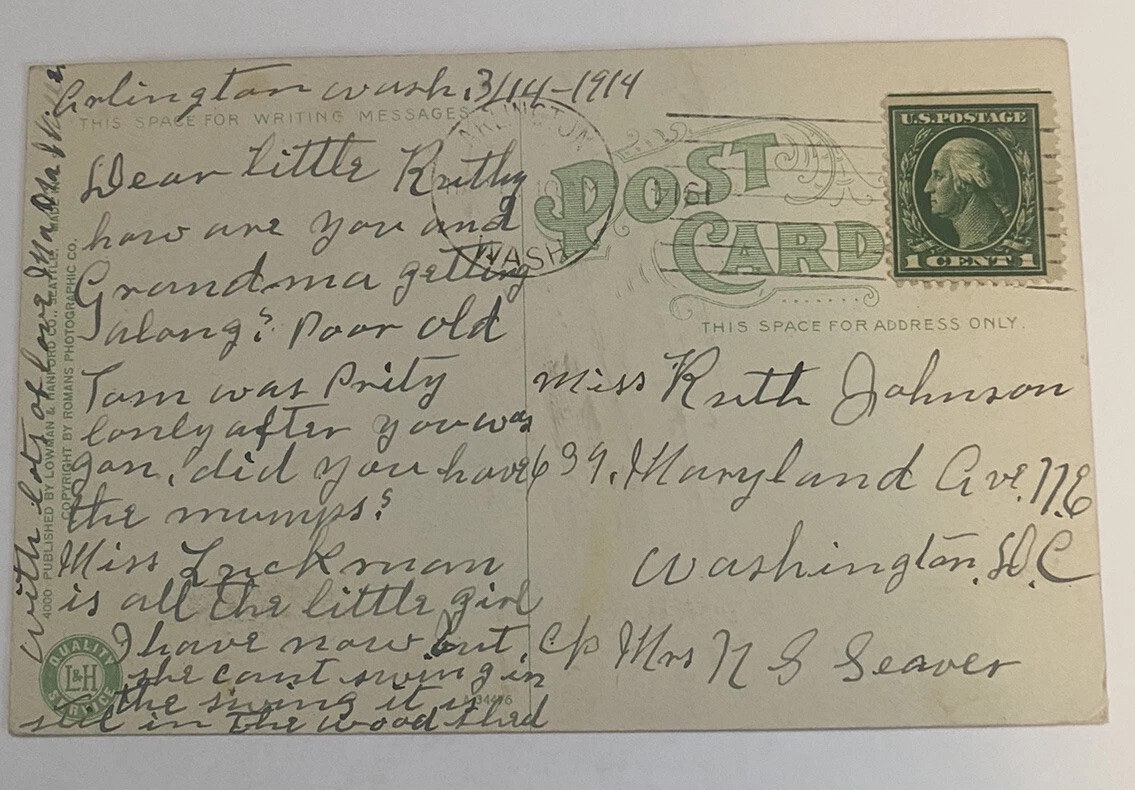
The card may date from sometime after 1914-1915 as I found the image above with the same “See Washington First” image on front. The back, however, was different than the card back shown earlier in this article.
WHO ARE LOWMAN AND HANFORD PRINTING AND STATIONERY COMPANY IN SEATTLE?
Clarence E. Hanford was a Seattle, Washington native born on May 13, 1857 to Washington Territory pioneers. His older brother Thaddeus Hanford was the publisher of the Seattle Post-Intelligencer. At age 13, Clarence began learning the printing trade at the newspaper’s office, eventually becoming foreman of the printing department.
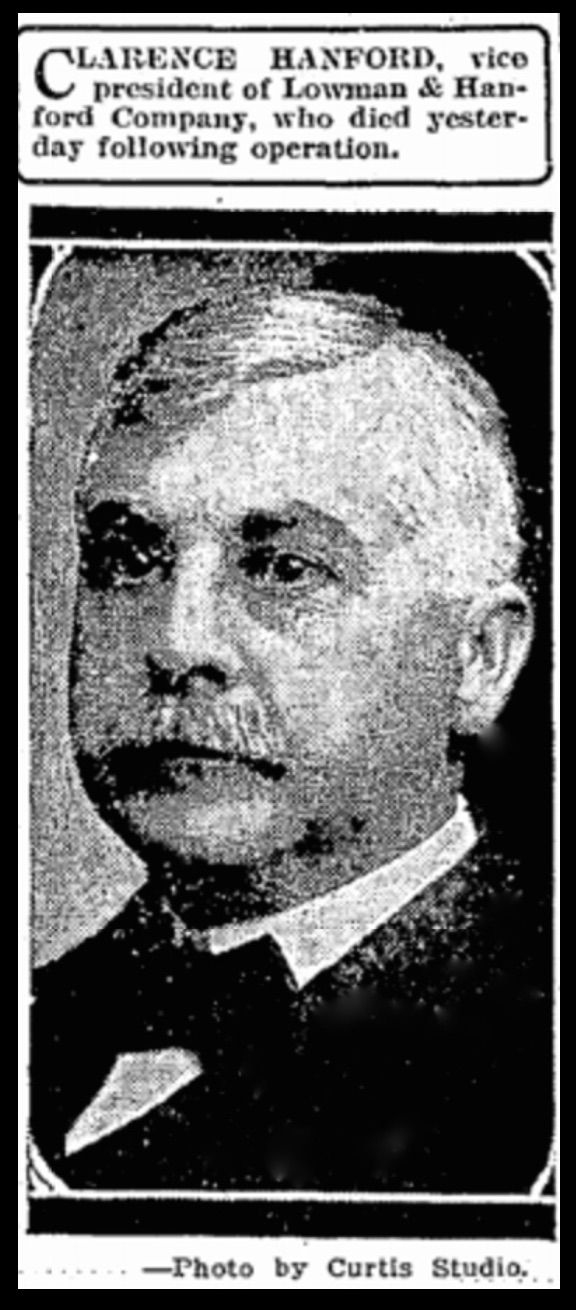
He later bought out the job-printing department to form a new printing office with J.H. McClair in 1879. A few years later in 1881, Hanford purchased McClair’s interest and would form the Lowman and Hanford Printing and Stationery Company the following year. Hanford died on his birthday in 1920 due to complications from surgery.
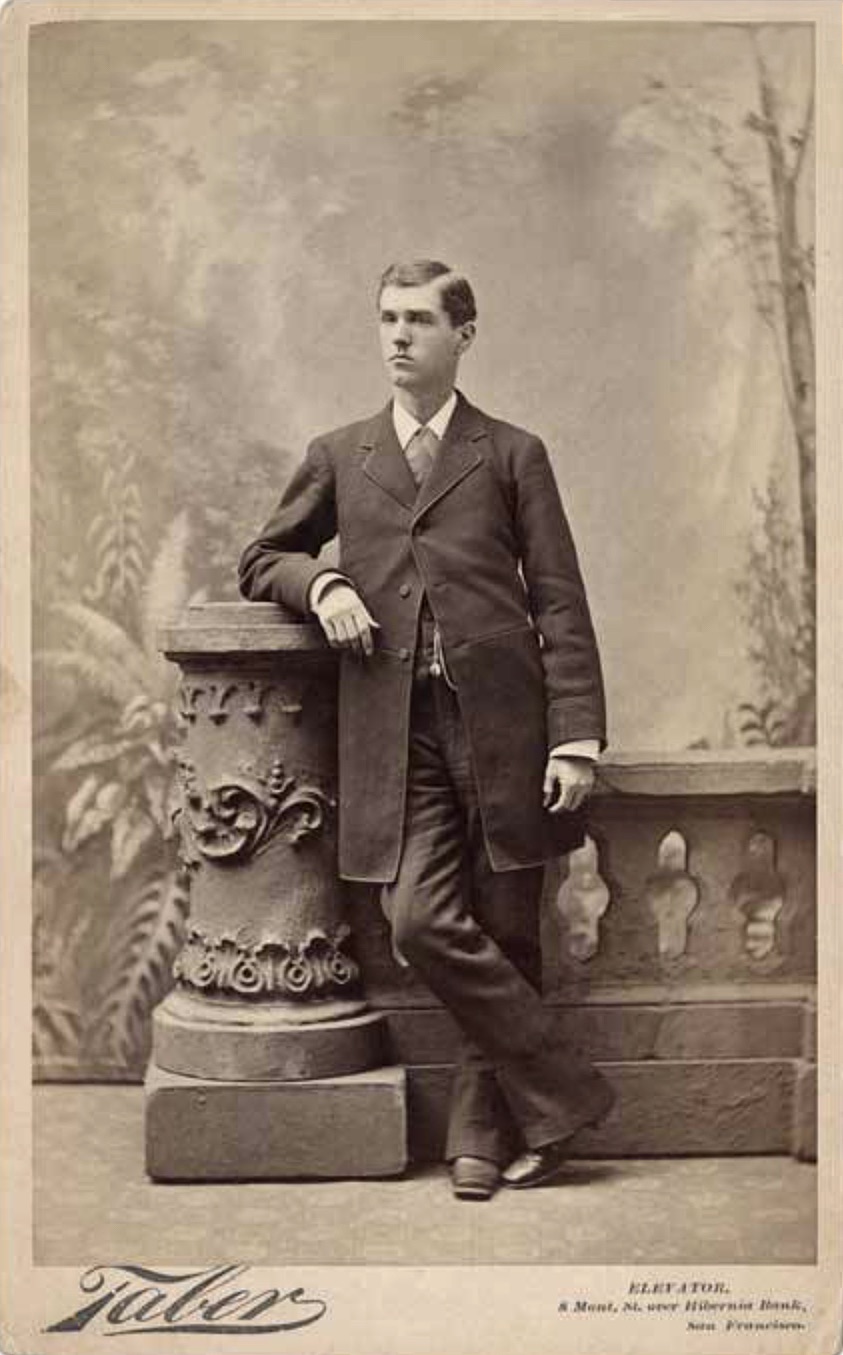
James D. Lowman was born in Hagerstown, Maryland on October 5, 1856. At 21-years old Lowman arrived in Seattle in 1877 at the invitation of his cousin, Henry Yesler, then mayor of Seattle. Lowman quickly rose in the ranks while in Seattle, going from a dock’s assistant master to businessman.
In 1882, he joined forces with Clarence Hanford to open their stationery and printing firm. This partnership was operated under the name of Lowman & Hanford until April, 1884, when it was incorporated as the Lowman & Hanford Stationery and Printing Company.
According to the Seattle Times, Lowman owned banks, buildings, hotels and electric trolleys. He also served as the first president of the Seattle Theatre, helped found the Seattle Golf Club and was a charter member of the Seattle Tennis Club. He was also president of the Seattle Chamber of Commerce from 1909 to 1911 and was honored with a life membership in 1947 at age 91. He lived in his First Hill home for 66 years and bequeathed his mansion and property to the Seattle Swedish Hospital. On this property, there now stands the Fred Hutchinson Cancer Research Center and the Swedish Nursing Facility.
Loman died at the age of 91 in 1947.
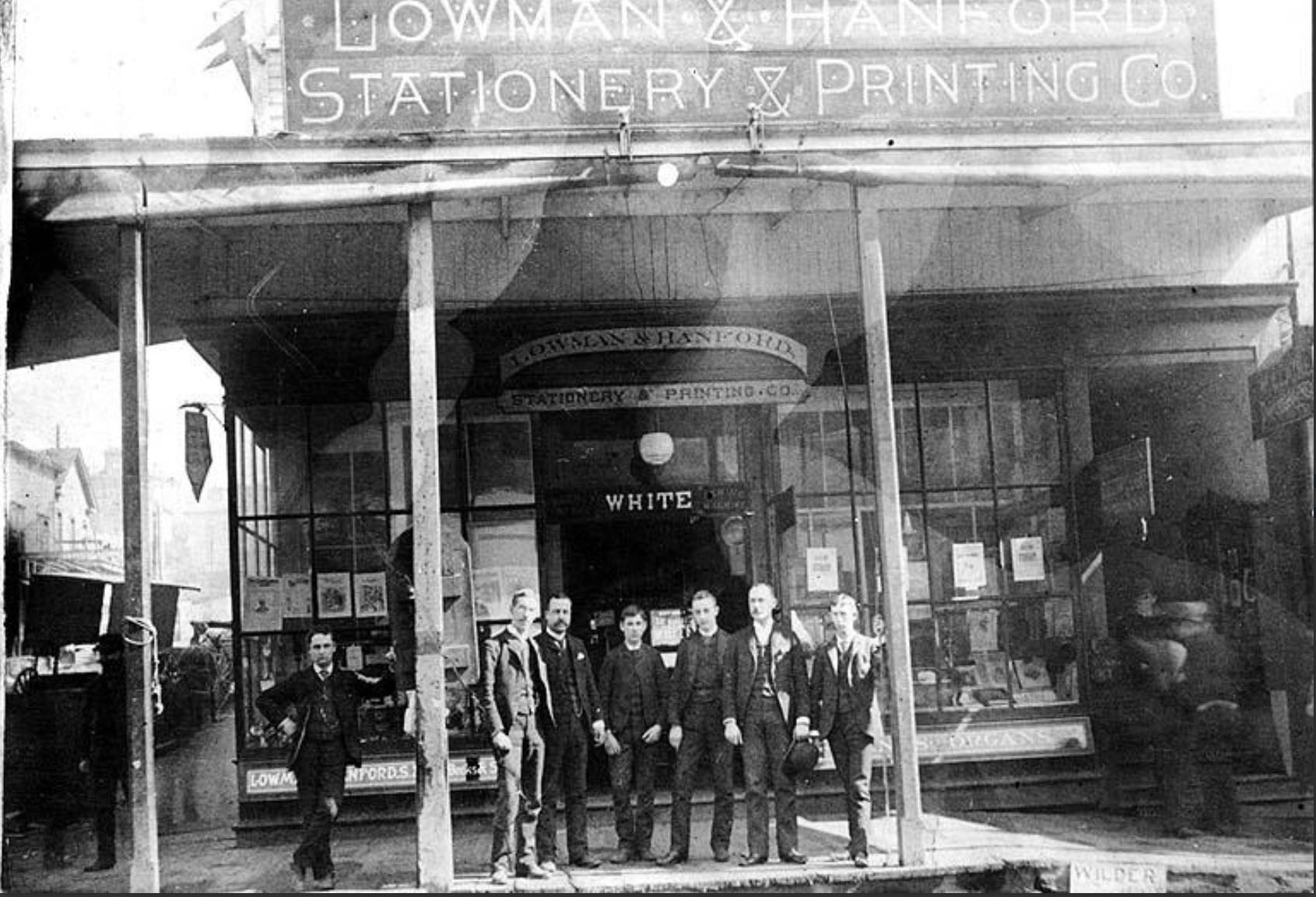
This was the first building housing the Lowman and Hanford Printing and Stationery Company but it burned down in a fire on June 6, 1889. Two months after the fire, the duo constructed a new two-story building stood on the site. By 1892, the company constructed a four-story building on 1st Avenue and Cherry Street in downtown Seattle.
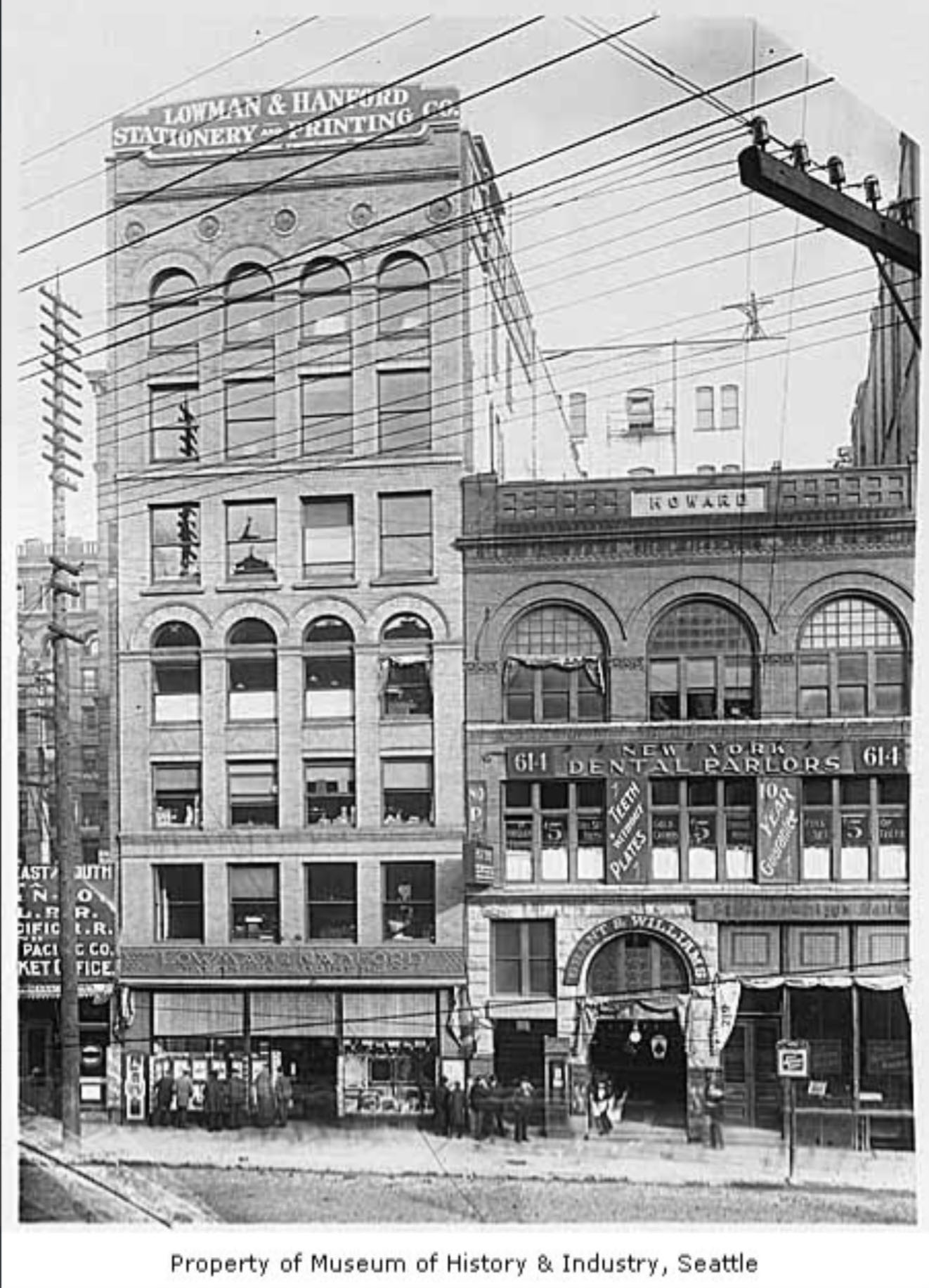
By 1899, they had constructed a seven story building around 1514-1516 3rd Avenue in Seattle. A fifth office building was constructed at 68 S. Washington Street in Pioneer Square following the Great Seattle Fire of 1899.

For a long time, a L&H company emblem painted on that building was seen from the Alaskan Way Viaduct. During a building renovation in 2023, the company logo was removed. The printing company eventually moved to Elliott Avenue in 1982.
Throughout the 1900s, the printing shop was known by several names – L&H Printing Co. and then L&H Engraving Co. before The Ligature bought the shop in 1995. They operated the location until July 2006 when a major client pulled business from the location forcing its closure. Printing presses were relocated to Los Angeles and San Francisco.
The Ligature was acquired by the Taylor Company in 2011 and merged with two other businesses to form Echelon Fine Printing.
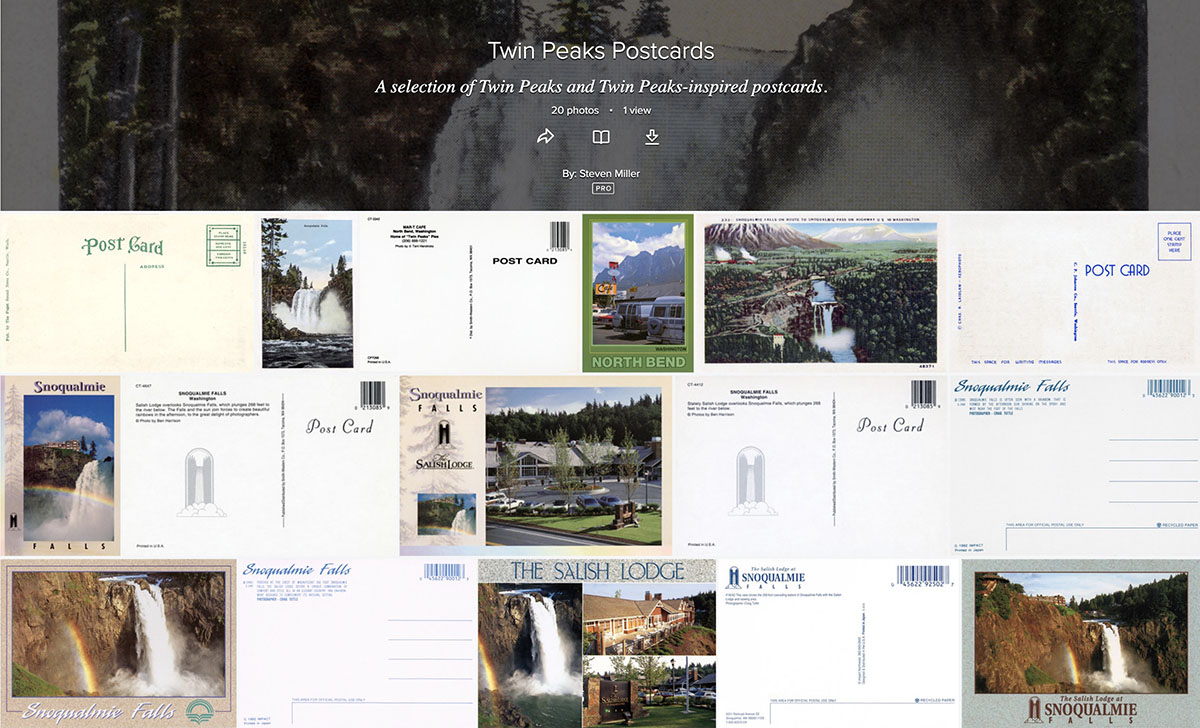
You can see this post card and more high-resolution postcard images on my Flickr account.
Author

Discover more from TWIN PEAKS BLOG
Subscribe to get the latest posts sent to your email.