
In this installment of “Reviewing Peaks,” I revisit the end of the show’s second season with a review by William Grimes with the New York Times. A few months earlier, an aggressive letter writing campaign by fans brought Twin Peaks back to ABC Television following a brief five-week hiatus. But the honeymoon didn’t last long and the show was subsequently canceled after episode 2.020 (episode #27) aired. The network showed the final two episodes – 2.021 and 2.022 – as a Monday Night Movie of the week on June 10, 1991. Grimes looked back at the groundbreaking series in his May 5, 1991 article that was picked up by local newspapers like the Huntsville Times a day later.
WHO IS WILLIAM GRIMES?
According to his New York Times bio, William Grimes was born in 1950 in Houston, Texas. He received a B.A. in English from Indiana University, Bloomington, in 1973 and an M.A. in English from the University of Chicago in 1974. He completed his Ph.D. in comparative literature in 1982. Prior to joining the Times, he was executive editor of Avenue Magazine and a copy editor for Esquire. He also served as associate editor of Macmillan Publishing.

In 1989, Grimes joined the paper as a story editor and writer for The New York Times Magazine. He was a reporter on the Culture Desk starting 1991, covering “independent film, visual art and books, and writing a weekly theater column.” Mr. Grimes was the Times restaurant critic from 1999 until 2003, after having written for the Dining section beginning 1997. Today, he serves as a writer for the Obituaries department.
He is the author of several books including “Straight Up or on the Rocks: The Story of the American Cocktail” (North Point Press, 2001), “My Fine Feathered Friend” (North Point Press, 2002), and “Appetite City: A Culinary History of New York” (North Point Press, 2010). He also edited “The Times of the Eighties,” an anthology of articles on the decade taken from the pages of The Times (Black Dog and Leventhal, 2013).
Considering he’s been working the obituaries desk for years, maybe it’s fitting that he wrote about the “death” of my favorite television show long ago.
GRIMES’ REVIEW – “WELCOME TO TWIN PEAKS AND VALLEYS”
Below is a clipping of Grimes’ syndicated review from the Huntsville Times on May 6, 1991. This was a day after his original review was published in the Times titled, “Welcome to Twin Peaks and Valleys.” The Huntsville Times editor gave the article a different title, “Was ‘Twin Peaks’ victim of success?”
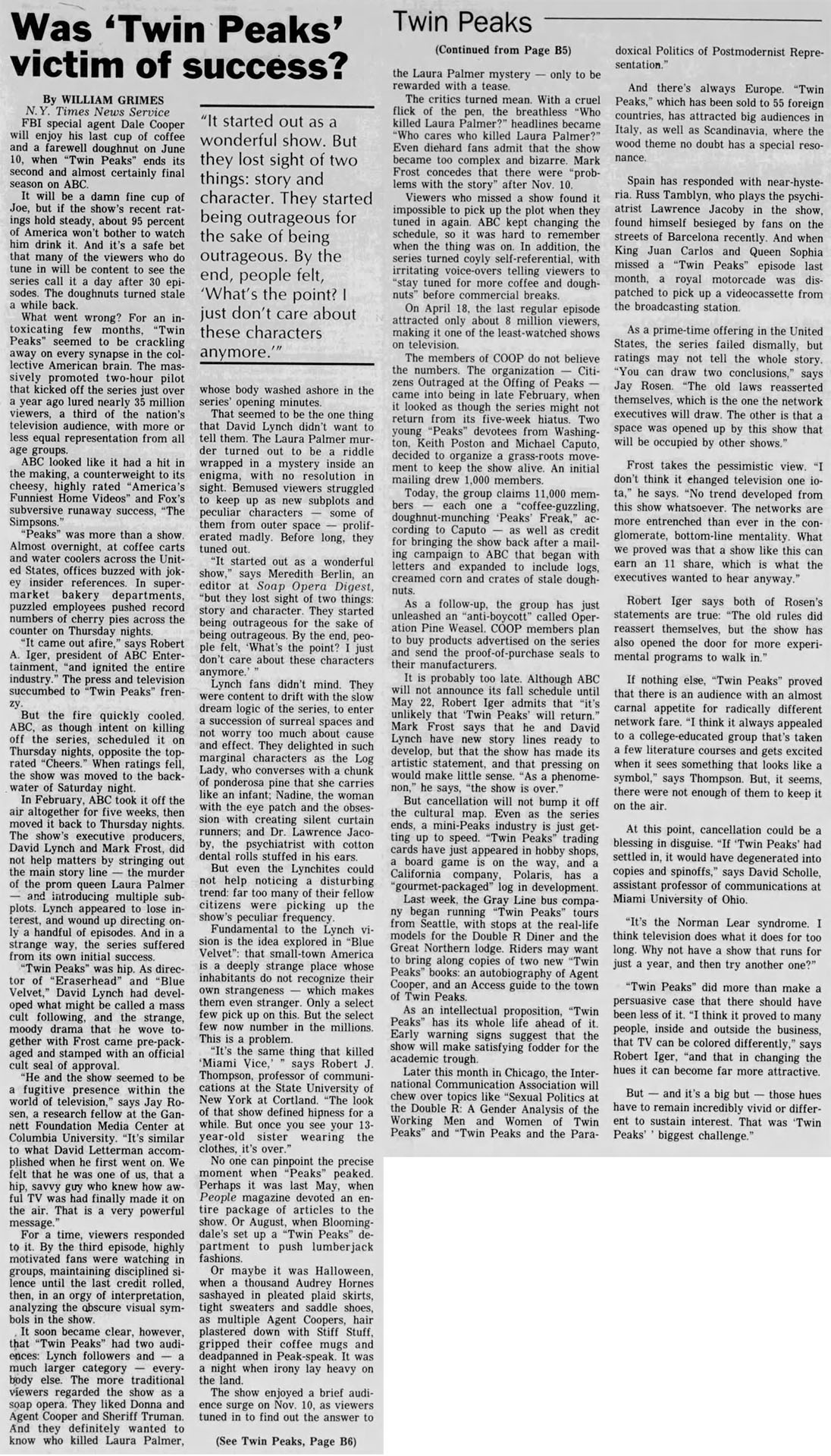
Versions of Grimes’ article would later appear in select papers on June 10 when the season two finale aired on ABC Television as a two-hour movie of the week.
Let’s take a closer look at his review.
FBI special agent Dale Cooper will enjoy his last cup of coffee and a farewell doughnut on June 10, when “Twin Peaks” ends its second and almost certainly final season on ABC.
It will be a damn fine cup of Joe, but if the show’s recent ratings hold steady, about 95 percent of America won’t bother to watch him drink it. And it’s a safe bet that many of the viewers who do tune in will be content to see the series call it a day after 30 episodes. The doughnuts turned stale a while back.

What went wrong? For an intoxicating few months, “Twin Peaks” seemed to be crackling away on every synapse in the collective American brain. The massively promoted two-hour pilot that kicked off the series just over a year ago lured nearly 35 million viewers, a third of the nation’s television audience, with more or less equal representation from all age groups.
ABC looked like it had a hit in the making, a counterweight to its cheesy, highly rated “America’s Funniest Home Videos” and Fox’s subversive runaway success, “The Simpsons.”
“Peaks” was more than a show. Almost overnight, at coffee carts and water coolers across the United States, offices buzzed with jokey insider references. In super-market bakery departments, puzzled employees pushed record numbers of cherry pies across the counter on Thursday nights.
“It came out afire,” says Robert A. Iger, president of ABC Entertainment, “and ignited the entire industry.” The press and television succumbed to “Twin Peaks” frenzy. But the fire quickly cooled. ABC, as though intent on killing off the series, scheduled it on Thursday nights, opposite the top-rated “Cheers.”
When ratings fell, the show was moved to the backwater of Saturday night. In February, ABC took it off the air altogether for five weeks, then moved it back to Thursday nights. The show’s executive producers, David Lynch and Mark Frost, did not help matters by stringing out the main story line— the murder of the prom queen Laura Palmer — and introducing multiple sub-plots. Lynch appeared to lose interest, and wound up directing only a handful of episodes. And in a strange way, the series suffered from its own initial success.
At this point, it’s interesting to look at viewership for the first two seasons. You can read a longer analysis about how many viewers watched Twin Peaks when it aired in 1990-1991 in this Twin Peaks Blog article.
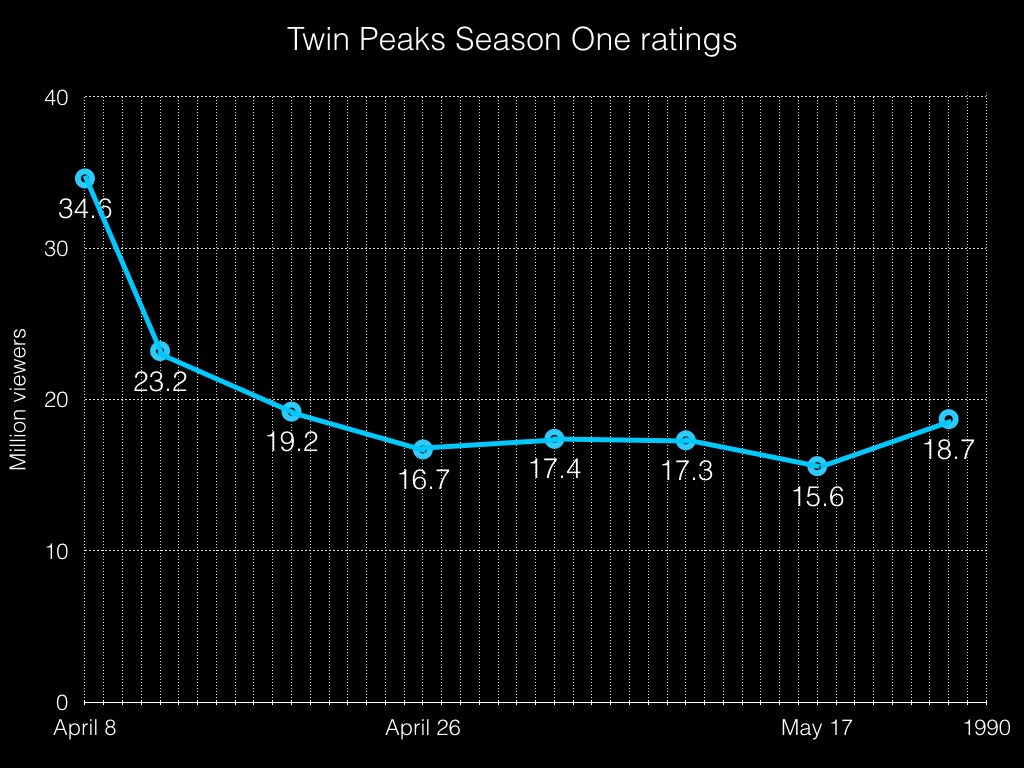
Long time fan Christian Hartleben published this graph to the Facebook group Twin Peaks: Between Two Worlds on Feb. 1, 2018. It shows the millions of viewers for the show’s first season.
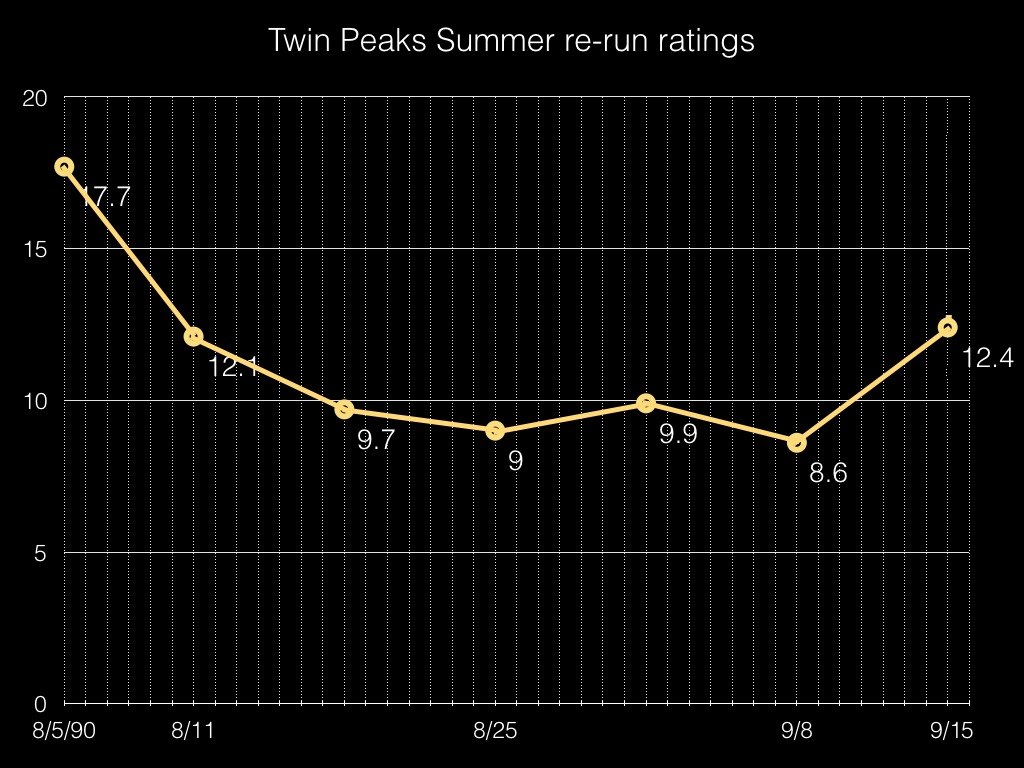
ABC Television showed the first season again from August through mid-September 1990 in advance of the second season premiere. This graph shows the millions of viewers for the re-runs.
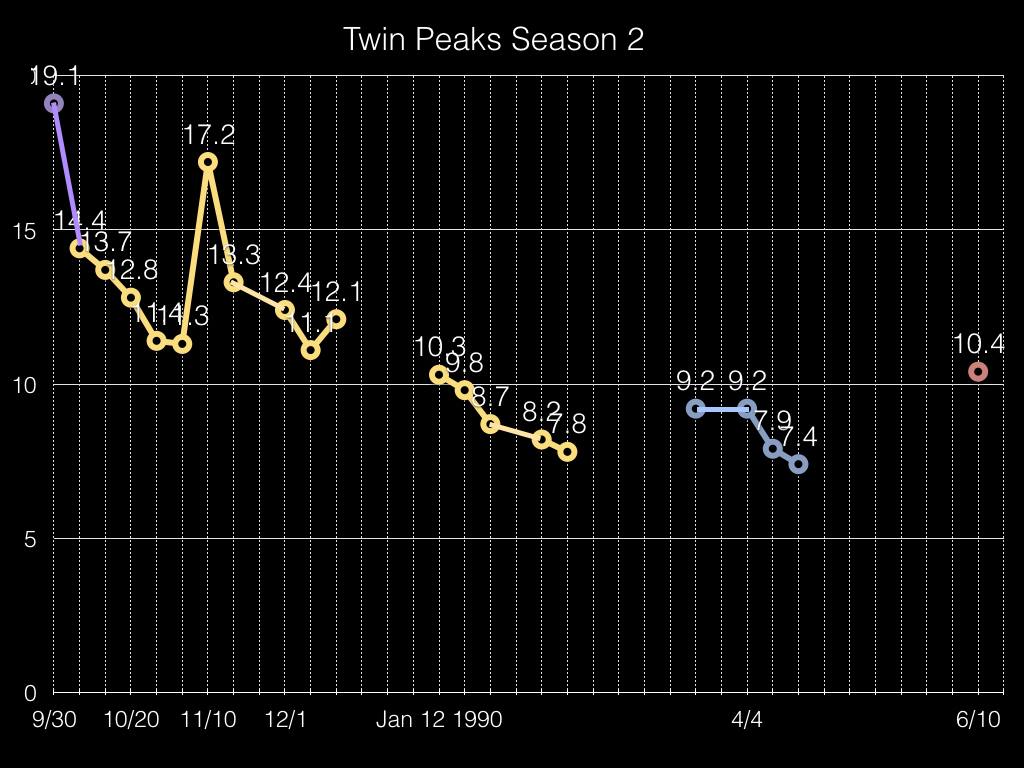
A third graph from Christian highlights the second season viewers in the millions. One can see how episode 2.020 (#27) was the lowest rated episode of the entire run (and yet it’s such a great episode!).
Grimes continues.
“Twin Peaks” was hip. As director of “Eraserhead” and “Blue Velvet,” David Lynch had developed what might be called a mass cult following, and the strange, moody drama that he wove together with Frost came pre-packaged and stamped with an official cult seal of approval.
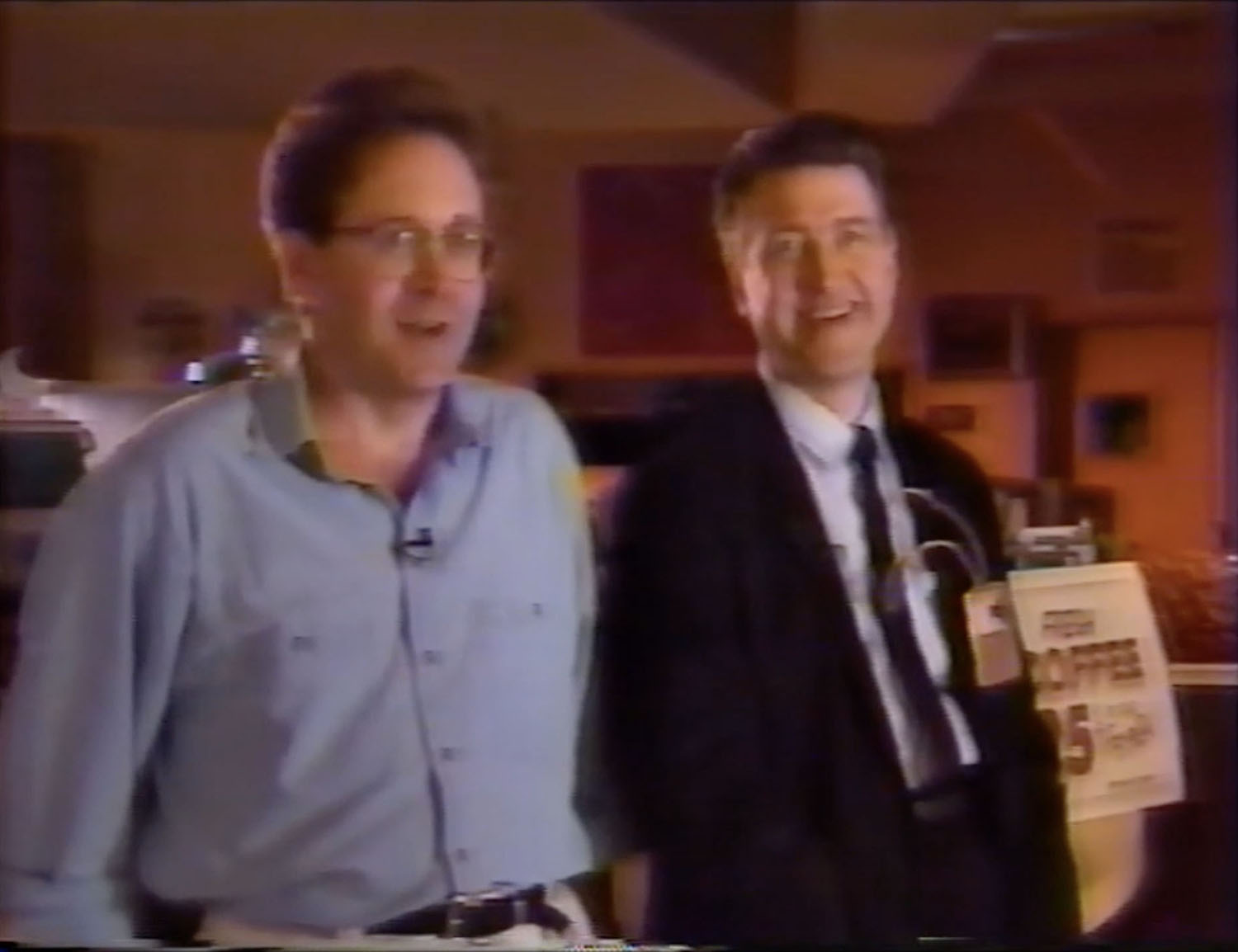
“He and the show seemed to be a fugitive presence within the world of television,” says Jay Rosen, a research fellow at the Gannett Foundation Media Center at Columbia University. “It’s similar to what David Letterman accomplished when he first went on. We felt that he was one of us, that a hip, savvy guy who knew how awful TV was had finally made it on the air. That is a very powerful message.”
For a time, viewers responded to it. By the third episode, highly motivated fans were watching in groups, maintaining disciplined silence until the last credit rolled, then, in an orgy of interpretation, analyzing the obscure visual symbols in the show.
It soon became clear, however, that “Twin Peaks” had two audiences: Lynch followers and — a much larger category — everybody else. The more traditional viewers regarded the show as a soap opera. They liked Donna and Agent Cooper and Sheriff Truman. And they definitely wanted to know who killed Laura Palmer, whose body washed ashore in the series’ opening minutes.

That seemed to be the one thing that David Lynch didn’t want to tell them. The Laura Palmer murder turned out to be a riddle wrapped in a mystery inside an enigma, with no resolution in sight. Bemused viewers struggled to keep up as new subplots and peculiar characters — some of them from outer space — proliferated madly. Before long, they tuned out.
“It started out as a wonderful show,” says Meredith Berlin, an editor at Soap Opera Digest, “but they lost sight of two things: story and character. They started being outrageous for the sake of being outrageous. By the end, people felt, ‘What’s the point? I just don’t care about these characters anymore.'”
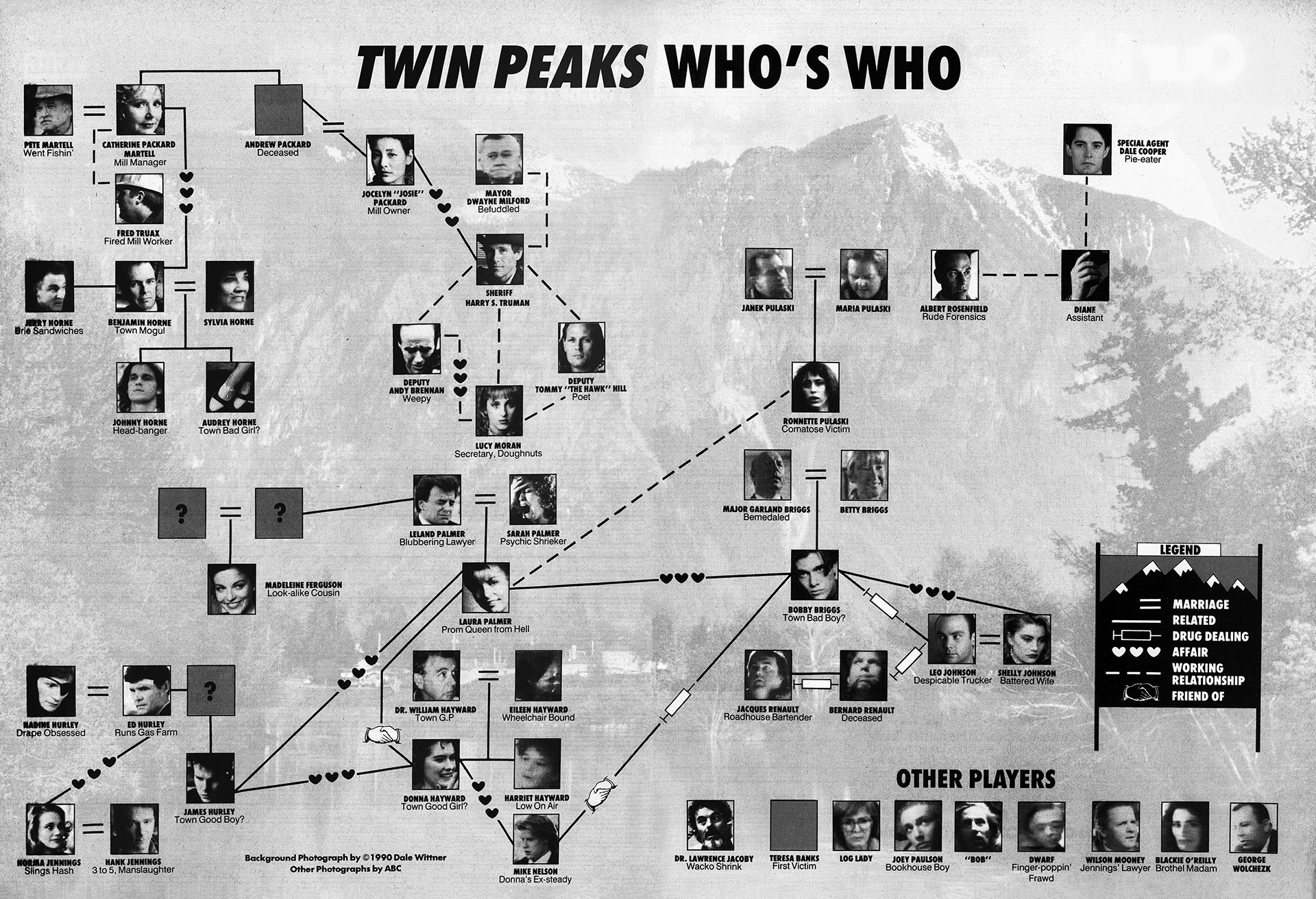
Lynch fans didn’t mind. They were content to drift with the slow dream logic of the series, to enter a succession of surreal spaces and not worry too much about cause and effect. They delighted in such marginal characters as the Log Lady, who converses with a chunk of ponderosa pine that she carries like an infant; Nadine, the woman with the eye patch and the obsession with creating silent curtain runners; and Dr. Lawrence Jacoby, the psychiatrist with cotton dental rolls stuffed in his ears. But even the Lynchites could not help noticing a disturbing trend: far too many of their fellow citizens were picking up the show’s peculiar frequency.
Fundamental to the Lynch vision is the idea explored in “Blue Velvet”: that small-town America is a deeply strange place whose inhabitants do not recognize their own strangeness — which makes them even stranger. Only a select few pick up on this. But the select few now number in the millions. This is a problem.
“It’s the same thing that killed ‘Miami Vice,’ ” says Robert J. Thompson, professor of communications at the State University of New York at Cortland. “The look of that show defined hipness for a while. But once you see your 13-year-old sister wearing the clothes, it’s over.”
No one can pinpoint the precise moment when “Peaks” peaked. Perhaps it was last May, when People magazine devoted an entire package of articles to the show. Or August, when Bloomingdale’s set up a “Twin Peaks” department to push lumberjack fashions.
Or maybe it was Halloween, when a thousand Audrey Homes sashayed in pleated plaid skirts, tight sweaters and saddle shoes, as multiple Agent Coopers, hair plastered down with Stiff Stuff, gripped their coffee mugs and deadpanned in Peak-speak. It was a night when irony lay heavy on the land.

The show enjoyed a brief audience surge on Nov. 10, as viewers tuned in to find out the answer to the Laura Palmer mystery — only to be rewarded with a tease.
The critics turned mean. With a cruel flick of the pen, the breathless “Who killed Laura Palmer?” headlines became “Who cares who killed Laura Palmer?” Even diehard fans admit that the show became too complex and bizarre. Mark Frost concedes that there were “problems with the story” after Nov. 10.
Viewers who missed a show found it impossible to pick up the plot when they tuned in again. ABC kept changing the schedule, so it was hard to remember when the thing was on. In addition, the series turned coyly self-referential. with irritating voice-overs telling viewers to “stay tuned for more coffee and dough-nuts” before commercial breaks.
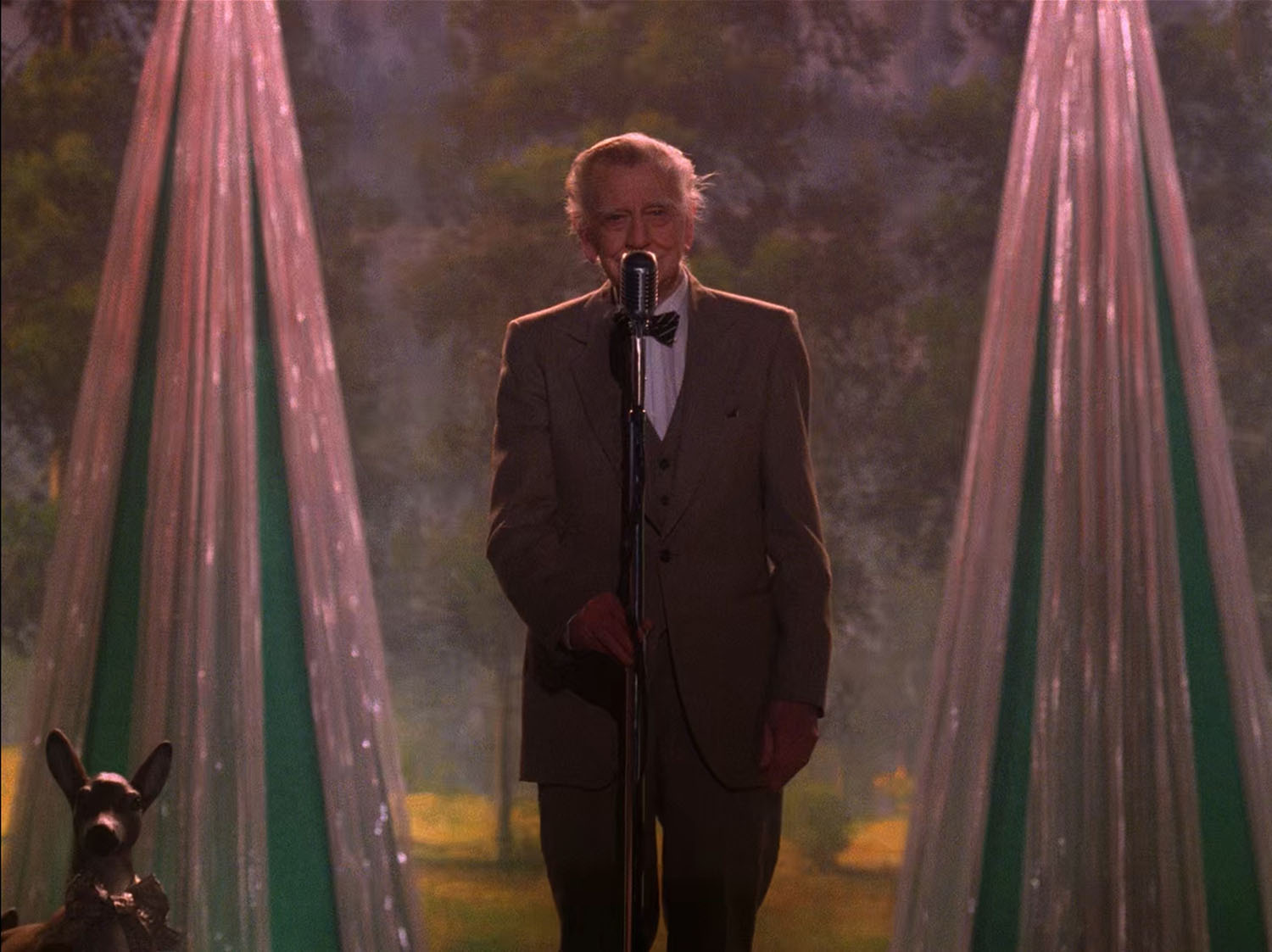
On April 18, the last regular episode (2.020 or #27) attracted only about 8 million viewers, making it one of the least-watched shows on television.
The members of COOP do not believe the numbers. The organization — Citizens Outraged [ed. note – should be “Opposing the”] at the Offing of Peaks —came into being in late February, when it looked as though the series might not return from its five-week hiatus. Two young “Peaks” devotees from Washington, Keith Poston and Michael Caputo, decided to organize a grassroots movement to keep the show alive. An initial mailing drew 1,000 members.
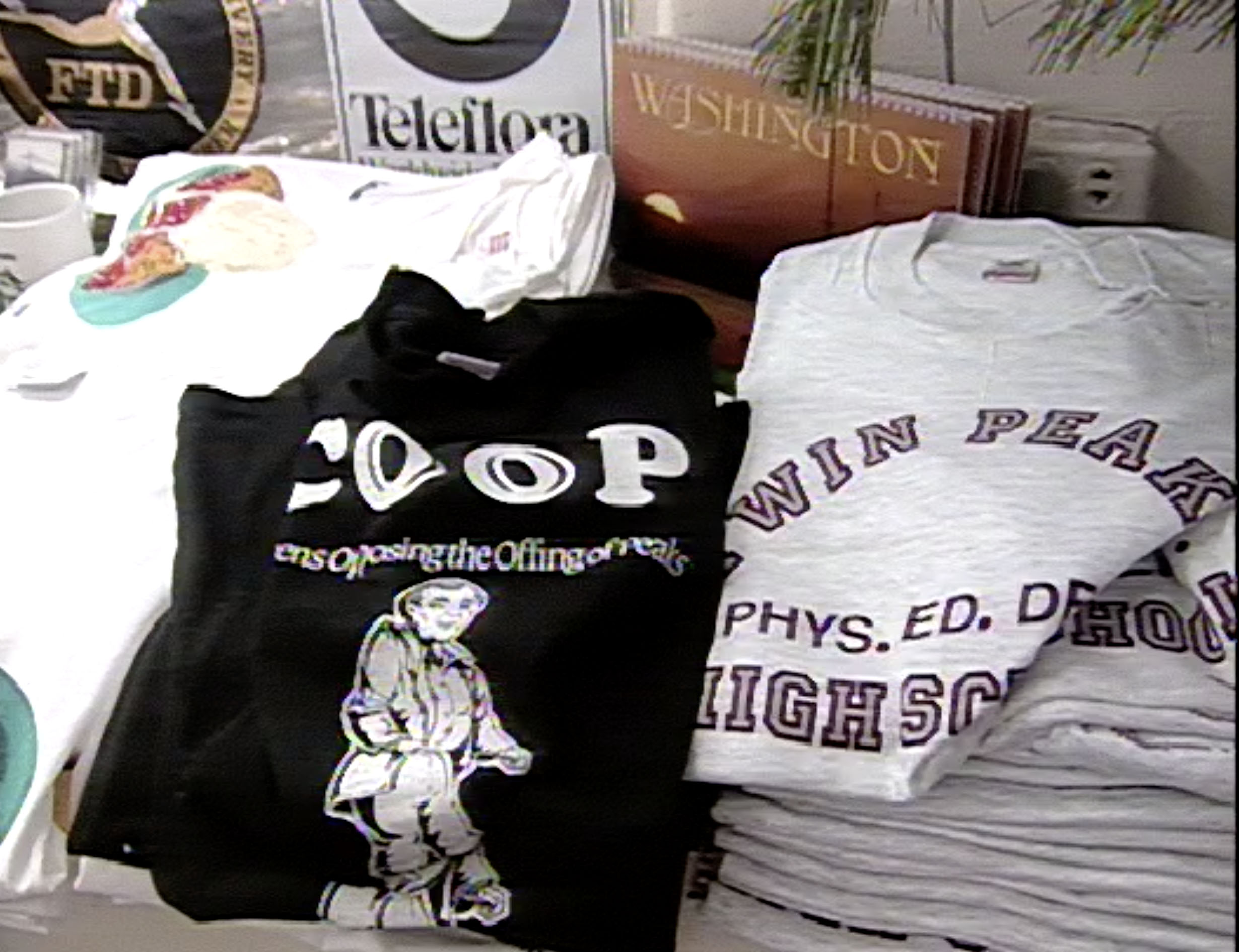
Today, the group claims 11,000 members — each one a “coffee-guzzling, doughnut-munching ‘Peaks’ Freak,” according to Caputo — as well as credit for bringing the show back after a mail-ing campaign to ABC that began with letters and expanded to include logs, creamed corn and crates of stale doughnuts.
As a follow-up, the group has just unleashed an “anti-boycott” called Operation Pine Weasel. COOP members plan to buy products advertised on the series and send the proof-of-purchase seals to their manufacturers.
It is probably too late. Although ABC will not announce its fall schedule until May 22, Robert Iger admits that “it’s unlikely that ‘Twin Peaks’ will return.” Mark Frost says that he and David Lynch have new story lines ready to develop, but that the show has made its artistic statement, and that pressing on would make little sense. “As a phenomenon,” he says, “the show is over.”
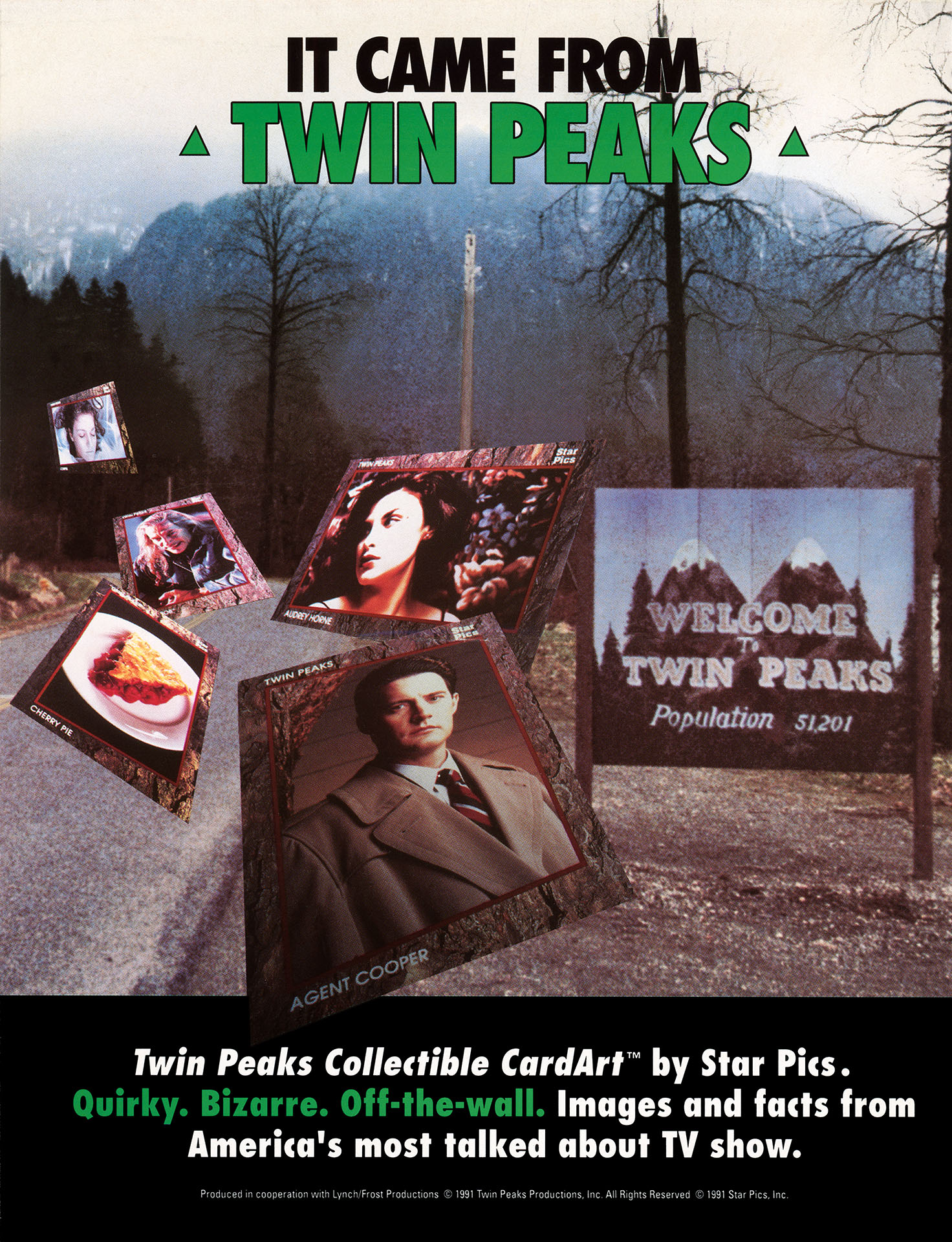
But cancellation will not bump it off the cultural map. Even as the series ends, a mini-Peaks industry is just getting up to speed. “Twin Peaks” trading cards have just appeared in hobby shops, a board game is on the way, and a California company, Polaris, has a “gourmet-packaged” log in development.
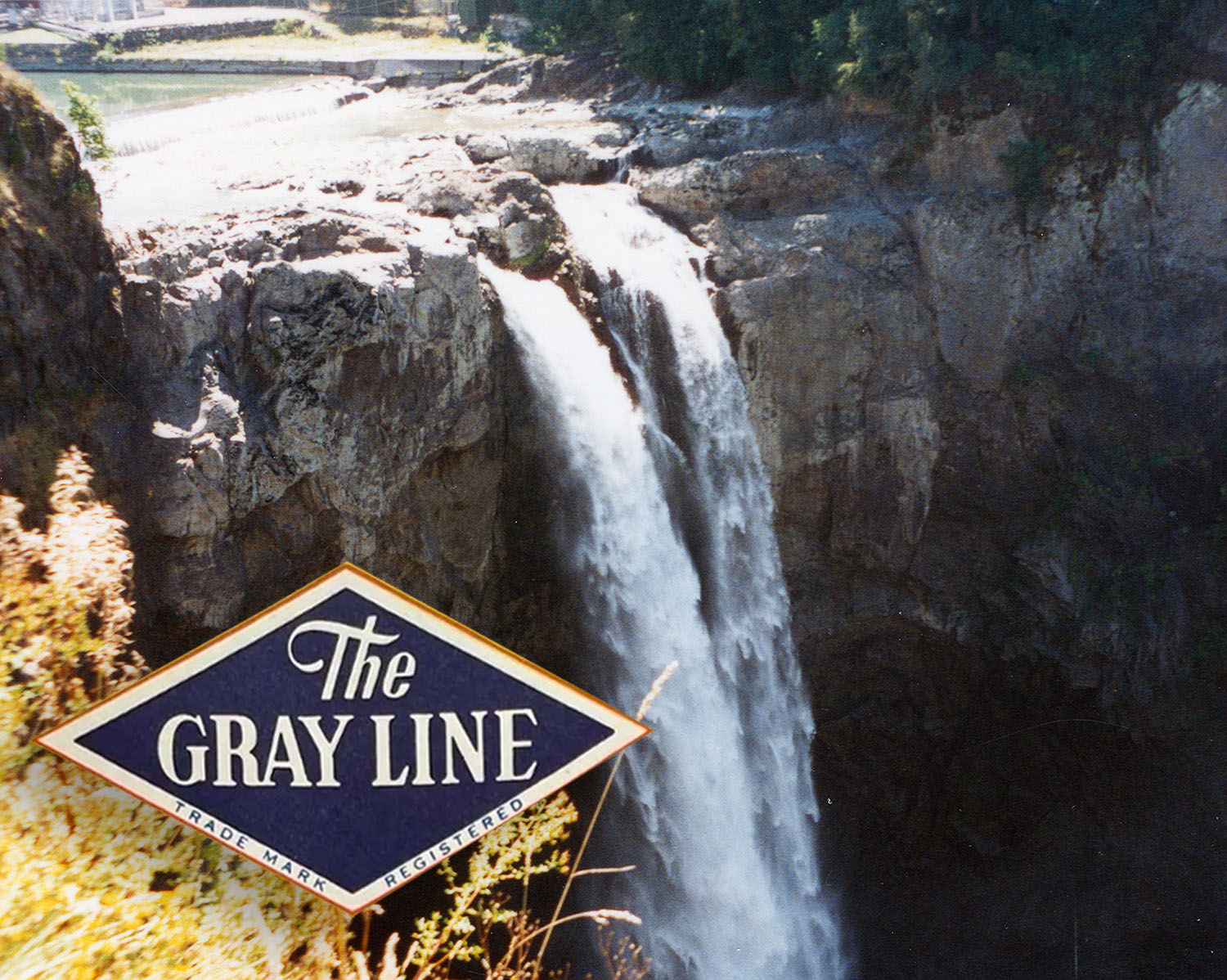
Last week. the Gray Line bus company began running “Twin Peaks” tours from Seattle, with stops at the real-life models for the Double R Diner and the Great Northern lodge. Riders may want to bring along copies of two new “Twin Peaks” books: an autobiography of Agent Cooper, and an Access guide to the town of Twin Peaks.
As an intellectual proposition, “Twin Peaks” has its whole life ahead of it. Early warning signs suggest that the show will make satisfying fodder for the academic trough.
Later this month in Chicago, the International Communication Association will chew over topics like “Sexual Politics at the Double R: A Gender Analysis of the Working Men and Women of Twin Peaks” and “Twin Peaks and the Paradoxical Politics of Postmodernist Representation.”
And there’s always Europe. “Twin Peaks,” which has been sold to 55 foreign countries, has attracted big audiences in Italy, as well as Scandinavia, where the wood theme no doubt has a special resonance.
Spain has responded with near-hysteria. Russ Tamblyn, who plays the psychiatrist Lawrence Jacoby in the show, found himself besieged by fans on the streets of Barcelona recently. And when King Juan Carlos and Queen Sophia missed a “Twin Peaks” episode last month, a royal motorcade was dispatched to pick up a videocassette from the broadcasting station.
As a prime-time offering in the United States, the series failed dismally, but ratings may not tell the whole story. “You can draw two conclusions,” says Jay Rosen. “The old laws reasserted themselves, which is the one the network executives will draw. The other is that a space was opened up by this show that will be occupied by other shows.”

Frost takes the pessimistic view. “I don’t think it changed television one iota,” he says. No trend developed from this show whatsoever. The networks are more entrenched than ever in the conglomerate, bottom-line mentality. What we proved was that a show like this can earn an 11 share, which is what the executives wanted to hear anyway.”
As a side note, Frost would accept a Heritage Award at the 40th Annual Television Critics Association on July 12, 2024. Clearly the show left an impact!
Robert Iger says both of Rosen’s statements are true: “The old rules did reassert themselves, but the show has also opened the door for more experimental programs to walk in.”
If nothing else, “Twin Peaks” proved that there is an audience with an almost carnal appetite for radically different network fare. “I think it always appealed to a college-educated group that’s taken a few literature courses and gets excited when it sees something that looks like a symbol,” says Thompson. But, it seems, there were not enough of them to keep it on the air.
At this point, cancellation could be a blessing in disguise. “If ‘Twin Peaks’ had settled in, it would have degenerated into copies and spinoffs,” says David Scholle, assistant professor of communications at Miami University of Ohio. “It’s the Norman Lear syndrome. I think television does what it does for too long. Why not have a show that runs for just a year, and then try another one?”
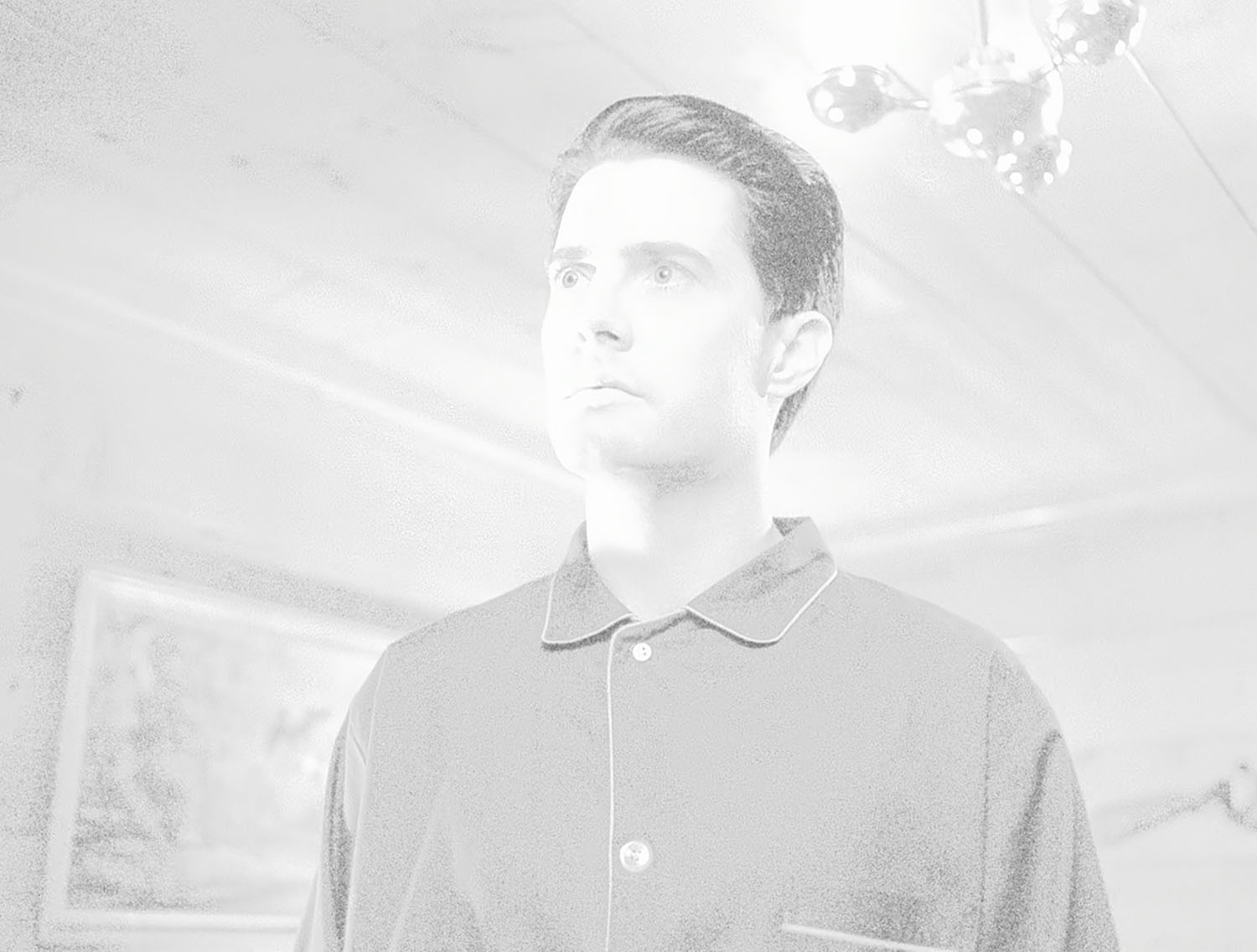
“Twin Peaks” did more than make a persuasive case that there should have been less of it. “I think it proved to many people, inside and outside the business, that TV can be colored differently,” says Robert Iger, “and that in changing the hues it can become far more attractive.
But — and it’s a big but — those hues have to remain incredibly vivid or different to sustain interest. That was ‘Twin Peaks’ biggest challenge.”
REFLECTING ON GRIMES’ ARTICLE
I love finding articles like this as they were written during a specific moment in time. The author (and possibly the show’s creators) never thought the show would take on the kind of following that’s seen today. More than three decades later, it continues to remain an incredibly vivid dream in the minds of many.
Grimes’ article included some interesting tidbits I’ll need to research further (i.e., the company planning to make a gourmet log or the Bloomingdale’s clothing display).

The original broadcast in 1990-1991 showed audiences something never before seen on network television. Twenty-five years later, Frost and Lynch did it again with Twin Peaks: The Return, creating a hypnotic, artistic endeavor that remains unmatched. While no one can predict the future, I believe we’ll still be discussing this wonderful and strange world for decades to come.
Author

Discover more from TWIN PEAKS BLOG
Subscribe to get the latest posts sent to your email.