

When Twin Peaks splashed onto television screens in April 1990, millions of television viewers tuned into the show. Viewership was measured by Nielsen TV Ratings, an audience measurement system operated by Nielsen Media Research. Measurement of viewers have changed over the years with the advent of streaming services, yet these reports and statistics continue helping networks and advertisers understand where to make investments. During my research for Twin Peaks Blog, I’ve often wondered, how many U.S. viewers watched Twin Peaks during initial runs 1990-1991 and 2017? I’ve looked up these numbers countless times, so I figured an article was needed.
WHO IS ARTHUR C. NIELSON, SR. AND THE A.C. NIELSON CO.?
In 1923 at the age of 26, Arthur C. Nielsen, Sr. founded A.C. Nielsen Co. Five years earlier, he had graduated from the University of Wisconsin in 1918. According to a profile in The Huntsville Times on Aug. 19, 1958, he started the company with six employees, borrowed money and ‘youthful enthusiasm.” Nielsen almost fell into bankruptcy twice before finding success. He worked 12 to 14-hour days calling clients and selling his research service.
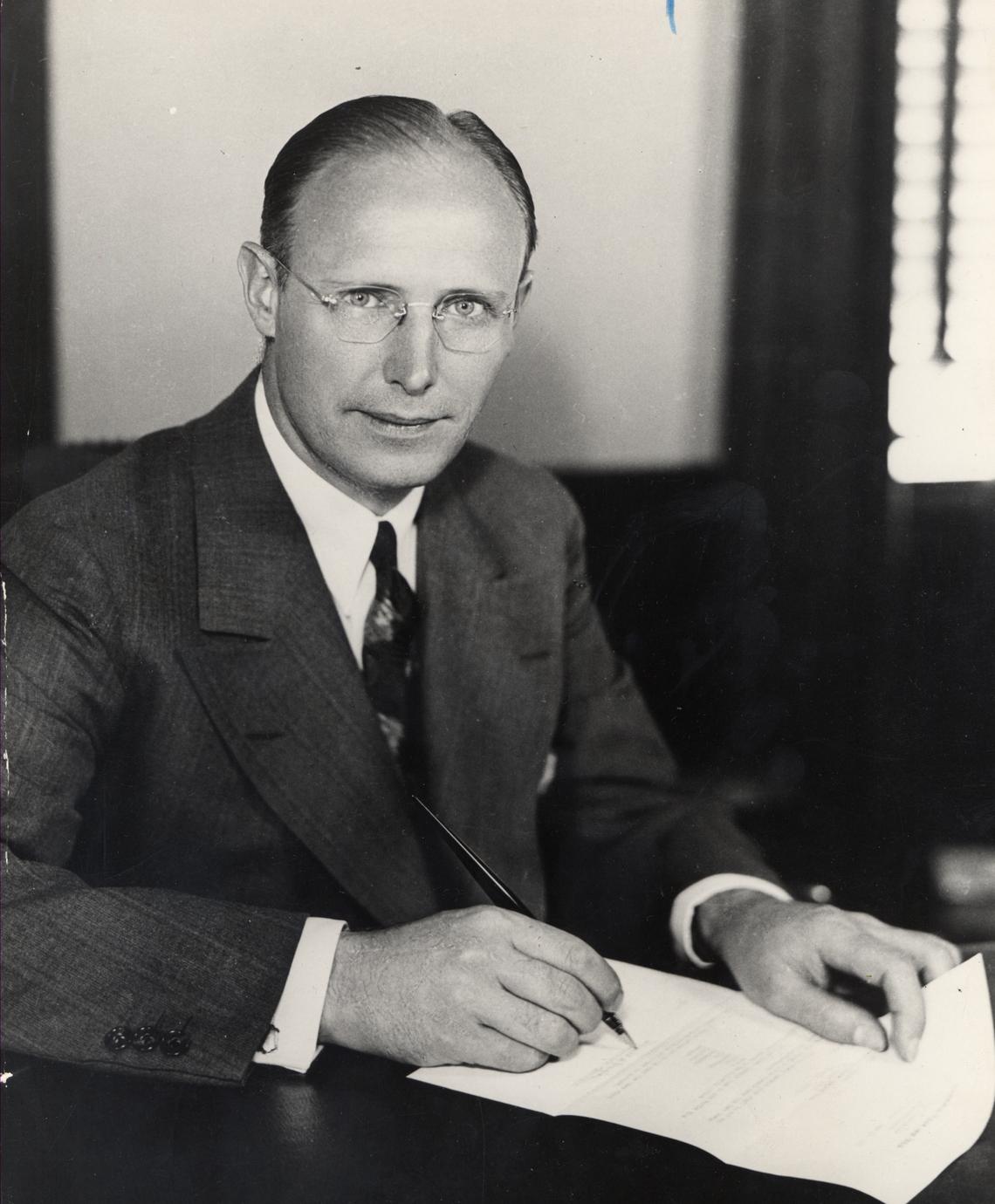
The company expanded into radio market analysis in the late 1930s introducing the Nielsen Radio Index in 1942. This report provided statistics to marketers of radio shows with the first Nielsen ratings for radio programs released first week of Dec. 1947.

By 1950, televisions had become staples in living rooms across the United States, with 7.5 million sets were produced that year. Three years earlier, fewer than 200,000 were made.
Nielsen expanded his research into this new medium, developing a rating system based on his radio measurement methods. It became the primary source of audience measurement information for the U.S. television industry, especially for executives who wanted to know how many people actually watched their programming. This data helped attract advertising revenue from major corporations. If networks knew millions of people tuned into a show, they could justify higher ad costs.
In the late 1950s, the company was making about $24 million annually with television being around 22-percent of their business. This number would grow in subsequent years as television programming became a primary focus.
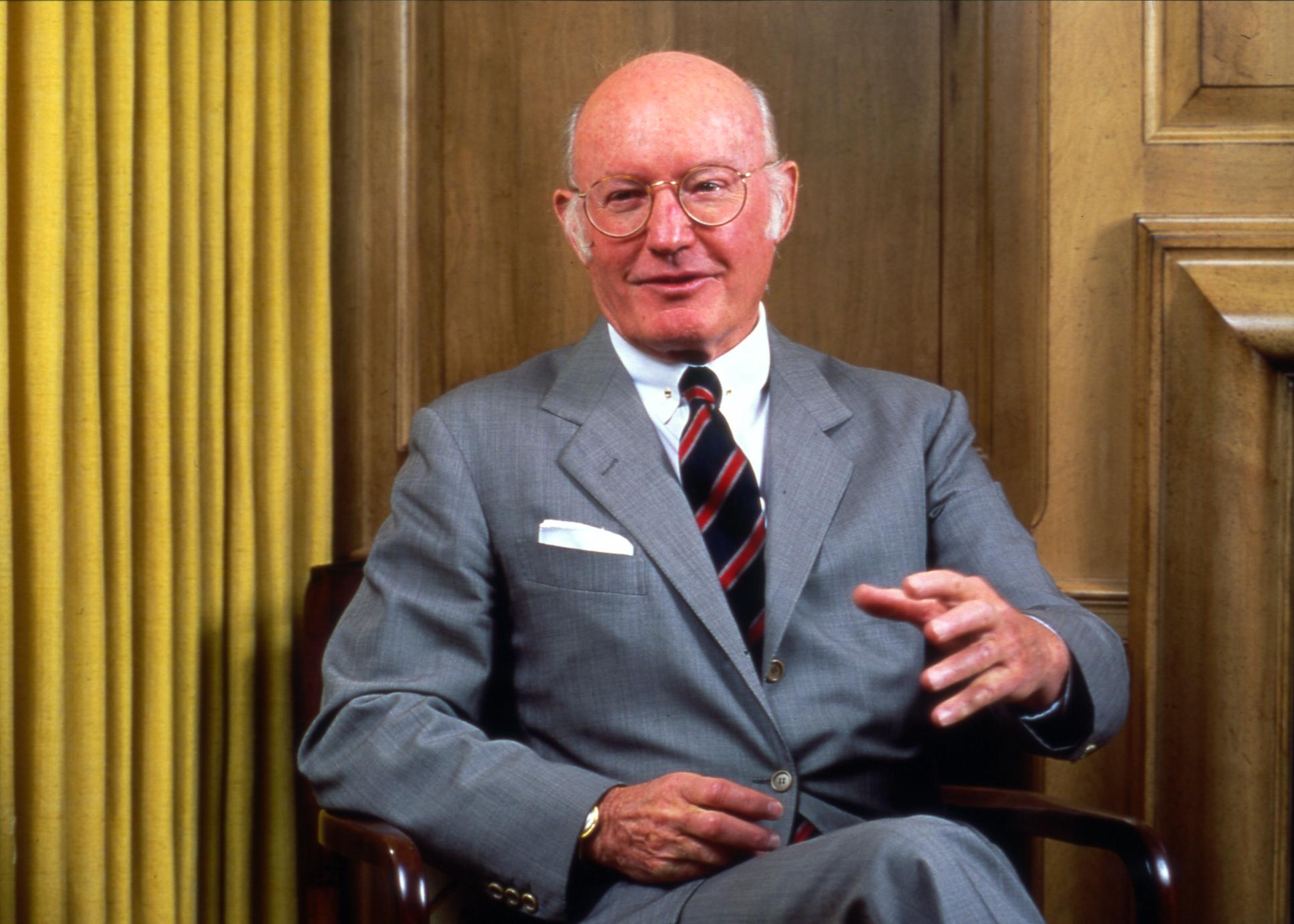
Arthur “Art” C. Nielsen Jr. joined his father’s business after World War II, growing in the ranks until retiring from the company in 1984. His father had passed four years earlier in 1980 at the age of 83.
Art was instrumental in pushing the company to use computers and other new technologies, partly because of his Army engineering experiences. He also helped oversee Nielsen’s expansion into virtually every corner of the globe. By 1958, Nielsen employed 3,500 full-time employees at 21 office buildings. The staff used tabulation machines that “cost millions of dollars a year to lease.” These early computers generated 50 billion statistical tabulations a year.
“If you can put a number on it, then you know something.” Nielsen Jr. said his father once told him.
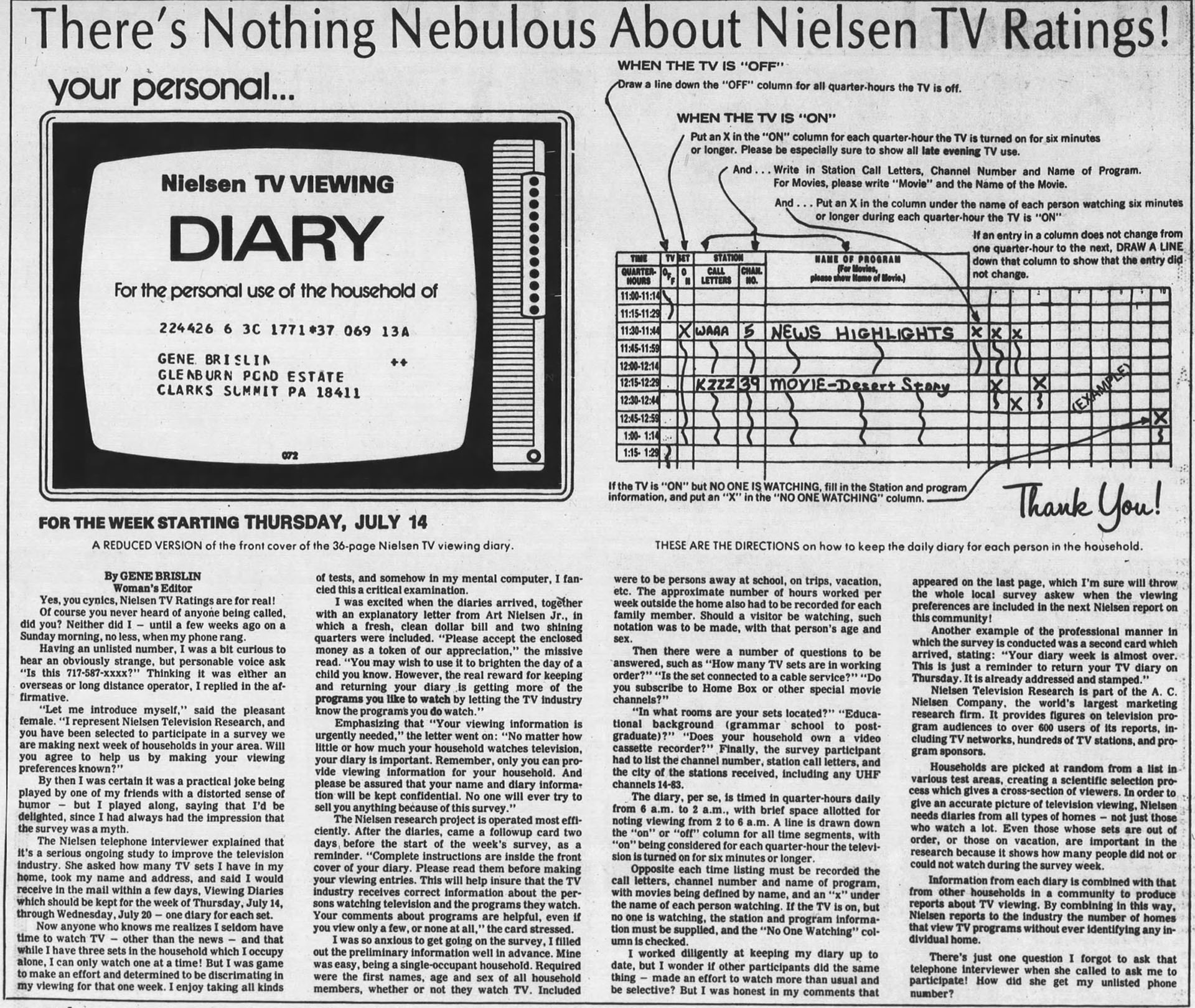
The Nielsens’ rating system sampled a small portion of television viewers in the United States. These “Nielsen families” completed viewing diaries documenting shows they watched. In 1987, the company introduced an electronic “people meter” system that automatically recorded viewers’ watching habits in real time.
After retirement, Art Nielsen retained an active interest in the company according to his obituary in The Los Angeles Times on Oct. 6, 2011. Nielsen, Jr. served on the board of Dun & Bradstreet, which had acquired his company in 1984 and later split it in half. Nielsen complained publicly that his father’s legacy had not been well managed by D&B. In 2001, the Dutch conglomerate VNU purchased and recombined the companies. After VNU was bought by a group of private-equity firms, the entire company was renamed Nielsen in 2007.
You can find them online today at Nielsen.com, where they state the company is “a global leader in audience measurement, data and analytics, shaping the future of media.” They measure behavior “across all channels and platforms to discover what audiences love, we empower our clients with trusted intelligence that fuels action.”
For an extremely detailed view as to how television ratings work, the “Intro to Nielsen Ratings: Basics and Definitions” article from Sept. 2013 offers interesting insight.
HOW MANY U.S. VIEWERS WATCHED “TWIN PEAKS” IN 1990-1991?
The first season aired from April 8 through May 23, 1990 with ABC re-airing the season from Aug. 5 to Sept. 15, 1990. The latter had episodes 1.005 and 1.006 airing back-to-back on Sept. 8. The second season aired between Sept. 30, 1991 through June 10, 1991, with a few weeks where the show was placed on hiatus.

For the list below, I pulling statistics from newspaper articles cited on Wikipedia along with other research provided by long-time Twin Peaks fan Christian Hartleben in 2018.
The list below includes original production codes (i.e., 1.001 = first season, episode #1; 2.001 = second season, episode #1) – along with the episode number starting with 1.001 = #1. I did not include those pesky episode titles which were “added” later after the original ABC Television broadcast.
| EPISODE | AIR DATE | U.S. VIEWERS (MILLIONS) |
| Pilot | April 8, 1990 | 34.6 |
| 1.001 (#1) | April 12, 1990 | 23.2 |
| 1.002 (#2) | April 19, 1990 | 19.2 |
| 1.003 (#3) | April 26, 1990 | 16.7 |
| 1.004 (#4) | May 3, 1990 | 17.4 |
| 1.005 (#5) | May 10, 1990 | 17.3 |
| 1.006 (#6) | May 17, 1990 | 15.6 |
| 1.007 (#7) | May 23, 1990 | 18.7 |
| Pilot (rerun) | August 5, 1990 | 17.7 |
| 1.001 (#1) (rerun) | August 11, 1990 | 12.1 |
| 1.002 (#2) (rerun) | August 18, 1990 | 9.0 |
| 1.003 (#3) (rerun) | August 25, 1990 | 9.7 |
| 1.004 (#4) (rerun) | September 1, 1990 | 9.9 |
| 1.005 (#5) (rerun) | September 8, 1990 | 8.6 |
| 1.006 (#6) (rerun) | September 8, 1990 | 8.6 |
| 1.007 (#7) (rerun) | September 15, 1990 | 12.4 |
| 2.001 (#8) | September 30, 1990 | 19.1 |
| 2.002 (#9) | October 6, 1990 | 14.4 |
| 2.003 (#10) | October 13, 1990 | 13.7 |
| 2.004 (#11) | October 20, 1990 | 12.8 |
| 2.005 (#12) | October 27, 1990 | 11.4 |
| 2.006 (#13) | November 3, 1990 | 11.3 |
| 2.007 (#14) | November 10, 1990 | 17.2 |
| 2.008 (#15) | November 17, 1990 | 13.3 |
| 2.009 (#16) | December 1, 1990 | 12.4 |
| 2.010 (#17) | December 8, 1990 | 11.1 |
| 2.011 (#18) | December 15, 1990 | 12.1 |
| 2.012 (#19) | January 12, 1991 | 10.3 |
| 2.013 (#20) | January 19, 1991 | 9.8 |
| 2.014 (#21) | February 2, 1991 | 8.7 |
| 2.015 (#22) | February 9, 1991 | 8.2 |
| 2.016 (#23) | February 16, 1991 | 7.8 |
| 2.017 (#24) | March 28, 1991 | 9.2 |
| 2.018 (#25) | April 4, 1991 | 9.2 |
| 2.019 (#26) | April 11, 1991 | 7.9 |
| 2.020 (#27) | April 18, 1991 | 7.4 |
| 2.021 (#28) | June 10, 1991 | 10.4 |
| 2.022 (#29) | June 10, 1991 | 10.4 |
On February 1, 2018, Christian Hartleben shared several ratings graphics on the private Facebook group, Twin Peaks: Between Two Worlds.
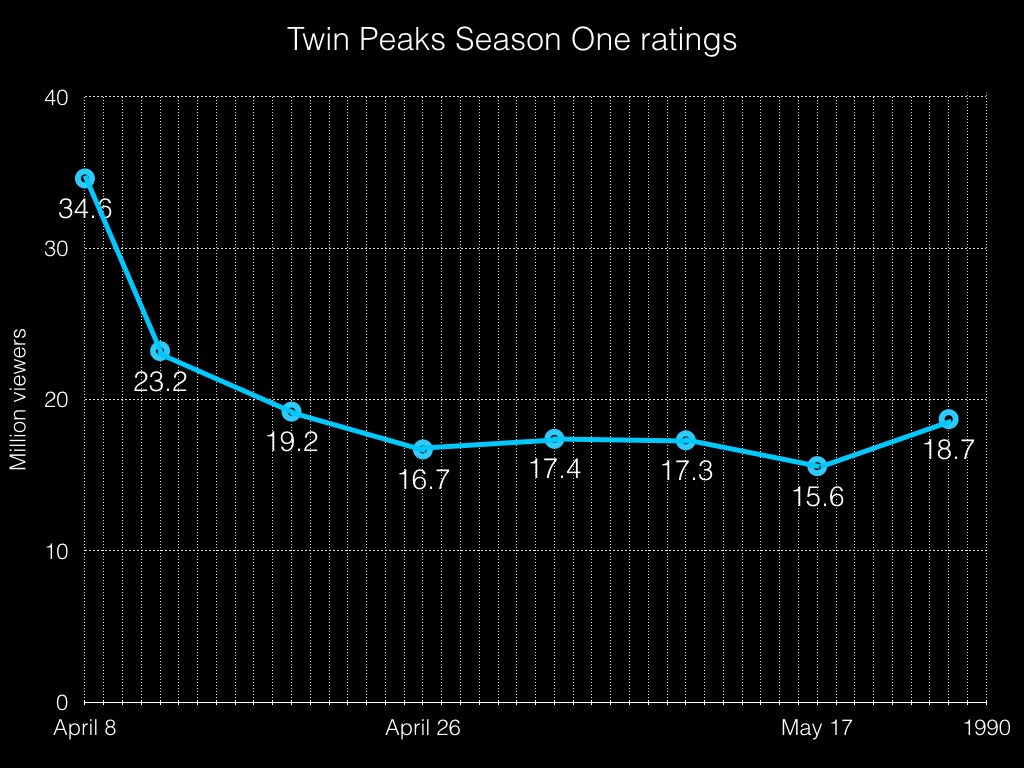
Christian wrote a small paragraph to accompany his ratings graphics.
Ratings: Once they were destiny. Perhaps that curse is behind us. These graphs of mine chronicle Twin Peaks popularity on U.S. televisions in 1990 and 1991.
Are they true? Do they tell enough of the whole story? There are plenty of ways to think about how Twin Peaks was received; and why it lasted only so long as it did. I know there are many ways because over 25 years I held many of those theories, before I let so many go. It’s easy to think you know exactly what wrong; or could have gone right. I encourage you to keep guessing, and learning.
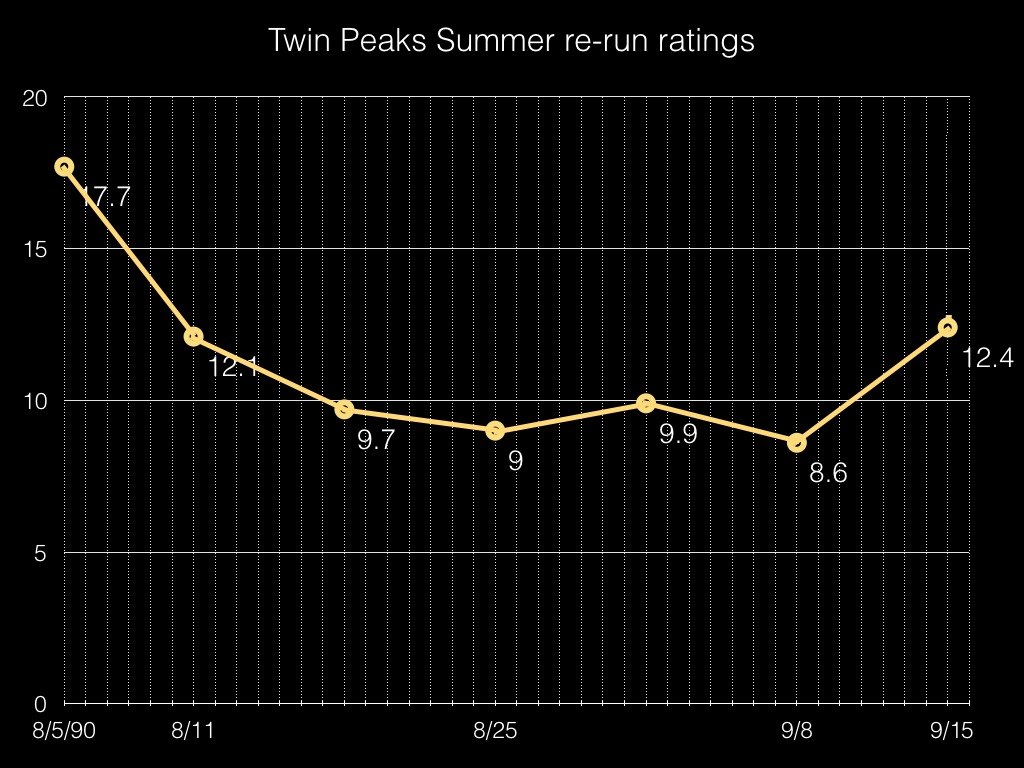
Looking at the overall numbers, it appears episode 1.006 (#6) had the fewest number of U.S. viewers for the first season (15.6 million) excluding the summer re-runs. For the second season, episode 2.020 (#27) was the lowest with 7.4 million viewers.
Conversely, the most watched episode was the pilot with 34.6 million viewers. This is not surprising based on the hype and advertising surrounding the debut in April 1990.
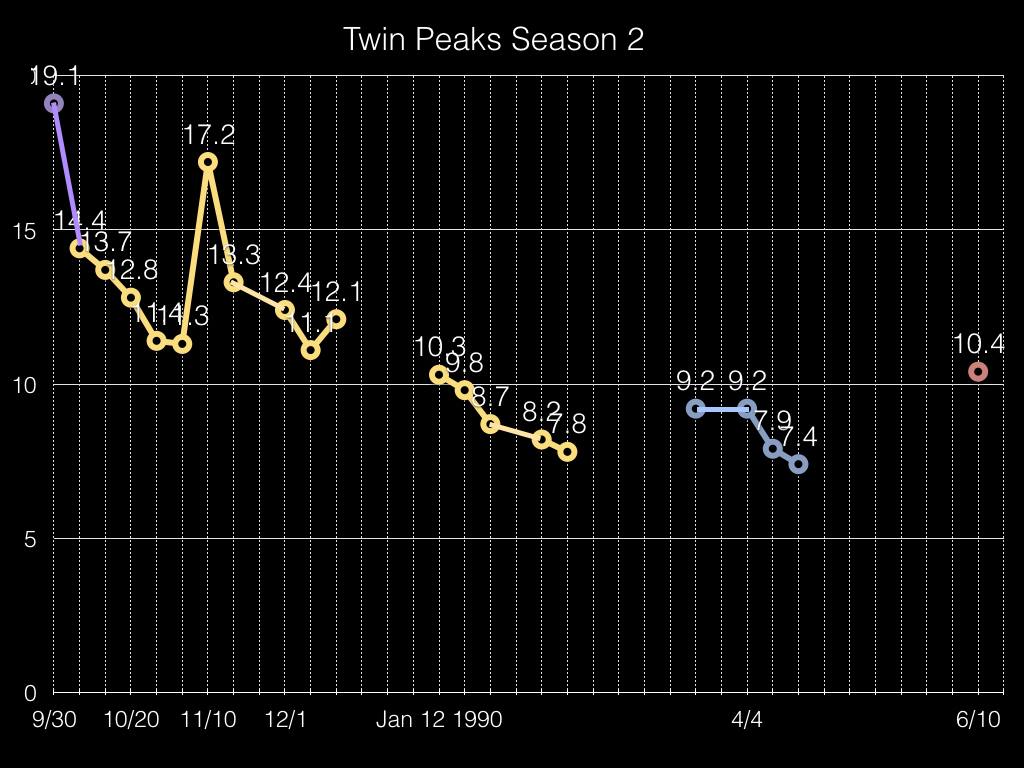
The second season opener had 19.1 million viewers, while the David Lynch-directed episode 2.007 where Laura Palmer’s murderer was finally revealed garnered 17.2 million viewers.
HOW MANY U.S. VIEWERS WATCHED “TWIN PEAKS” IN 2017?
Twin Peaks: The Return aired on Showtime from May 21 through September 3, 2017.

I included the viewer totals in millions but this is only for the initial airing. I omitted the episode titles added for The Return.
| EPISODE | AIR DATE | U.S. VIEWERS (MILLIONS) |
| Part 1 | May 21, 2017 | 0.506 |
| Part 2 | May 21, 2017 | 0.506 |
| Part 3 | May 28, 2017 | 0.195 |
| Part 4 | May 28, 2017 | 0.195 |
| Part 5 | June 4, 2017 | 0.254 |
| Part 6 | June 11, 2017 | 0.270 |
| Part 7 | June 18, 2017 | 0.294 |
| Part 8 | June 25, 2017 | 0.246 |
| Part 9 | July 9, 2017 | 0.355 |
| Part 10 | July 16, 2017 | 0.267 |
| Part 11 | July 23, 2017 | 0.219 |
| Part 12 | July 30, 2017 | 0.240 |
| Part 13 | August 6, 2017 | 0.280 |
| Part 14 | August 13, 2017 | 0.253 |
| Part 15 | August 20, 2017 | 0.329 |
| Part 16 | August 27, 2017 | 0.267 |
| Part 17 | September 3, 2017 | 0.254 |
| Part 18 | September 3, 2017 | 0.240 |
According to archived article by TV By The Numbers, Twin Peaks: The Return drew just “506,000 viewers and a 0.2 rating among adults 18-49 when it first aired on May 21, 2017. It finished well out of the Top 25 original shows on cable for the day.” A replay of the premiere drew an additional 120,000 viewers, and Showtime said streaming and on-demand viewing added 450,000 more viewers for a nightly total of 1.08 million.
Parts 3 and 4 brought in 195,000 viewers for its initial on-air showing. Showtime made the episodes available to stream immediately after the premiere a week earlier, which likely accounts for some of the drop off from the debut’s 506,000 viewers.
With DVRs, streaming and on-demand viewing beyond the first three days factored in, the average viewership was approximately 2 million per episode, according to Showtime in a Variety article by Cynthia Littlejohn published on Sept. 3, 2017.
“Showtime emphasized that the majority of ‘Twin Peaks’ viewing came via streaming and on-demand platforms that can be hard to translate into traditional ratings,” wrote Littlejohn. “But the live turnout demonstrates that ‘Twin Peaks’ did not rise to the level of can’t-miss appointment TV.
To date, the first episode has garnered 4.3 million viewers across all platforms. Of all Showtime series, ‘Twin Peaks’ has the biggest proportion of its audience come from the cabler’s authenticated and standalone streaming platforms.”
Showtime felt the limited run series was a “win” because it drove a “record number of people to sign up for a free trial of the Showtime standalone streaming service.” CBS Corp.’s third and fourth quarter earnings reports in 2017 stated the cable earnings for the second quarter indicated a “Twin Peaks” bounce, “with revenue up 7% and operating income up 11% year-over-year.”
THE LEGACY OF TWIN PEAKS DESPITE THE RATINGS

Twin Peaks faced ratings challenges throughout all three seasons. Despite the roller coaster of numbers, Joel Stein wrote for the Copley News Service on August 7, 1990, that the show did something beyond the numbers for ABC Television (and one could argue for Showtime decades later).
“Equally important, perhaps, ‘Twin Peaks’ has stirred tremendous interest and gotten the public, which has become blase as a result of so many other diversions such as movies, cable and video rentals, talking about network television again,” mused Stein.
More than 35 years after its debut, we are still talking about this “whole damn town” and all the “wonderful and strange” things its created and inspired.. This blog wouldn’t exist if the show had not left an indelible mark on the world.
Author

Discover more from TWIN PEAKS BLOG
Subscribe to get the latest posts sent to your email.