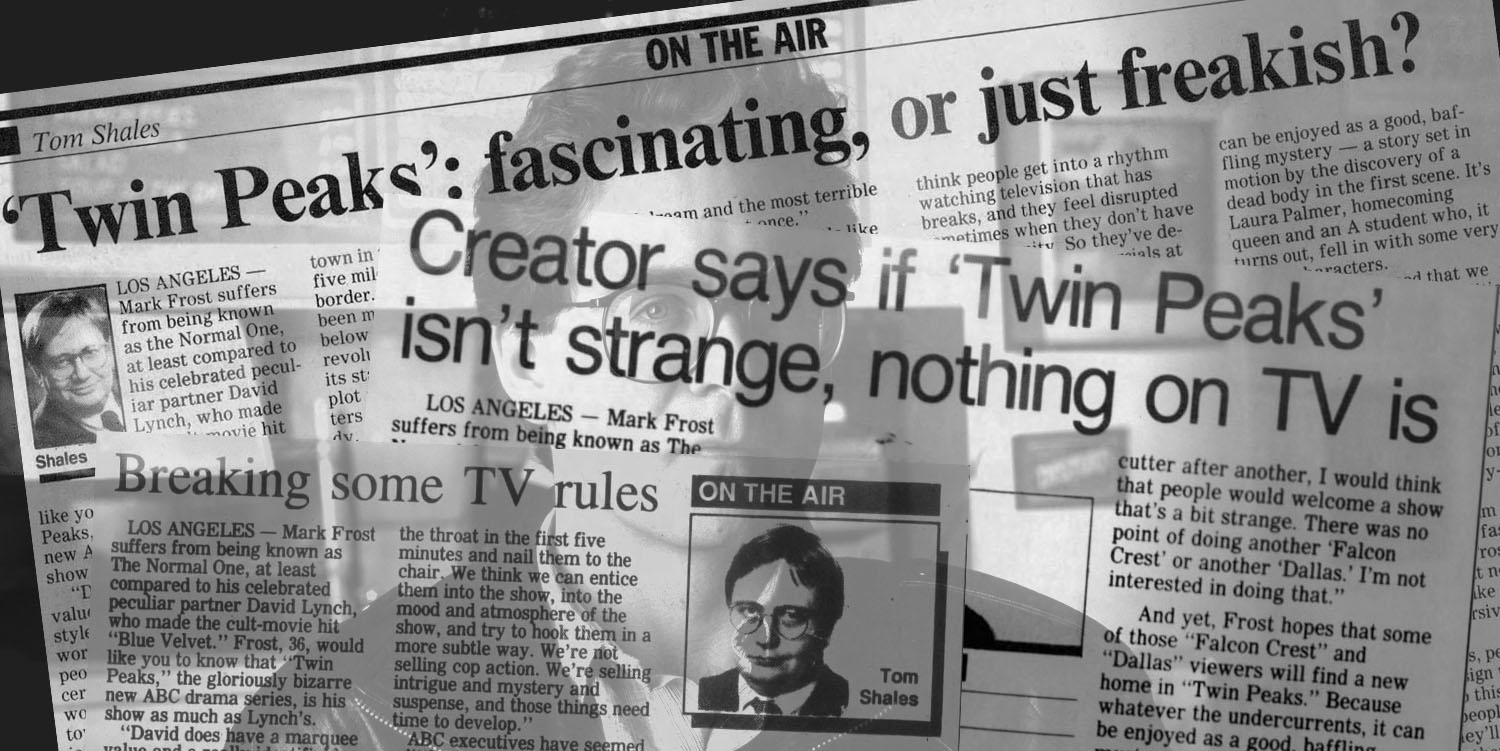
The Washington Post syndicated columnist Tom Shales was one of the earliest supporters of Twin Peaks. In early Sept. 1989, Shales published a positive review of the mesmerizing pilot episode, claiming it was “must see television.” A few days before the first episode debuted on the ABC Television Network, he published an interview with the show’s co-creator, Mark Frost.
TOM SHALES PROFILES MARK FROST ABOUT “TWIN PEAKS” IN APRIL 1990
Thomas William Shales (Nov 3, 1944 – Jan. 13, 2024) was an American writer and television critic for The Washington Post from 1977 to 2010, for which he received the Pulitzer Prize for Criticism in 1988. His syndicated column appeared on Thursdays in newspapers across the nation. On April 5, 1990, he published a story about Twin Peaks co-creator Mark Frost.
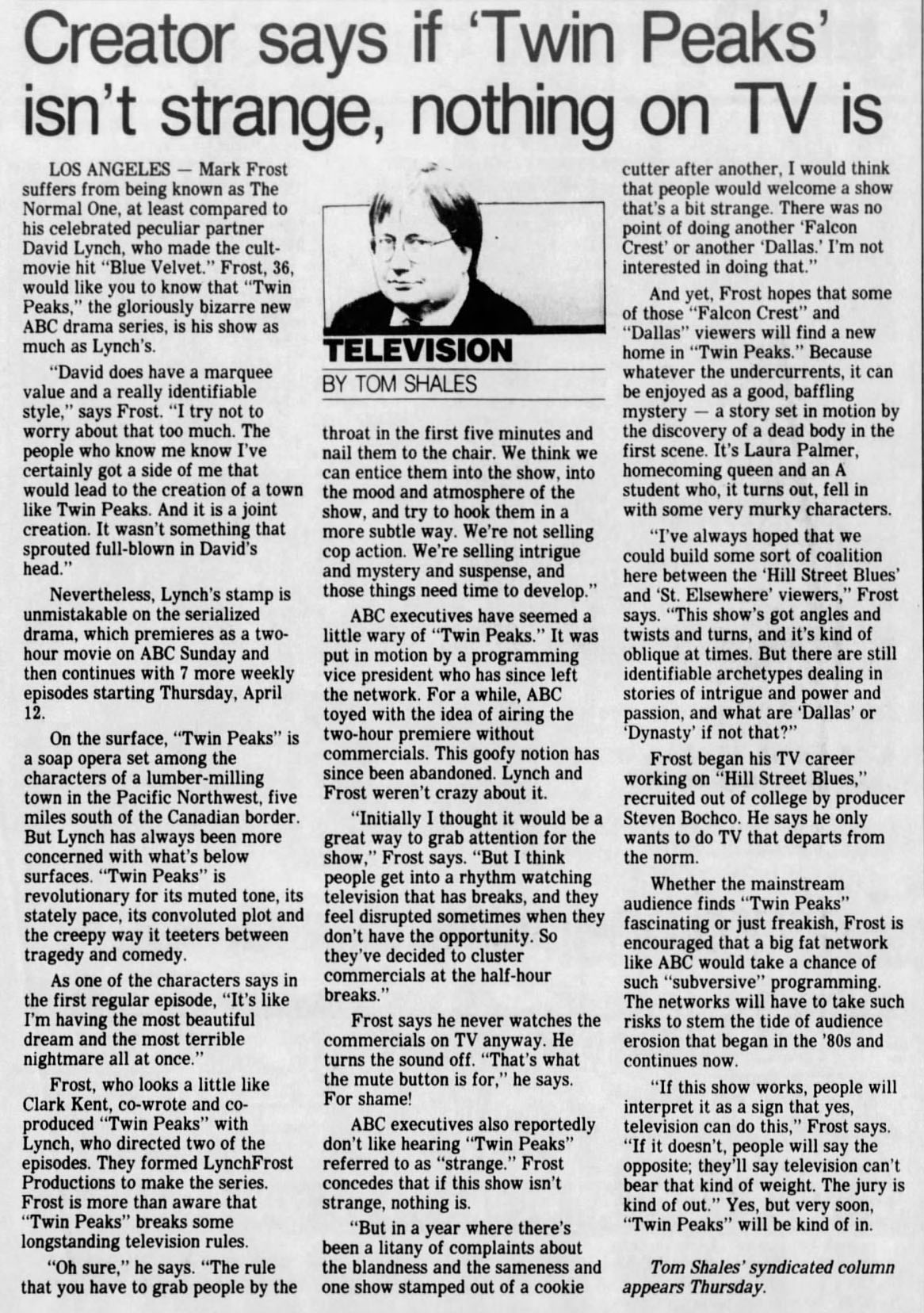
Interviews with Mark Frost from the early days of Twin Peaks are a treat as Lynch’s notoriety often over-shadowed Frost’s contributions to the show. Here is an archival look at Shales’ spotlight filled with some great quotes.
Mark Frost suffers from being known as The Normal One, at least compared to his celebrated peculiar partner David Lynch, who made the cult-movie hit “Blue Velvet.” Frost, 36, would like you to know that “Twin Peaks,” the gloriously bizarre new ABC drama series, is his show as much as Lynch’s.
“David does have a marquee value and a really identifiable style,” says Frost. “I try not to worry about that too much. The people who know me know I’ve certainly got a side of me that would lead to the creation of a town like Twin Peaks. And it is a joint creation. It wasn’t something that sprouted full-blown in David’s head.”

Nevertheless, Lynch’s stamp is unmistakable on the serialized drama, which premieres as a two-hour movie on ABC Sunday and then continues with 7 more weekly episodes starting Thursday, April 12.
On the surface, “Twin Peaks” is a soap opera set among the characters of a lumber-milling town in the Pacific Northwest, five miles south of the Canadian border. But Lynch has always been more concerned with what’s below surfaces. “Twin Peaks” is revolutionary for its muted tone, its stately pace, its convoluted plot and the creepy way it teeters between tragedy and comedy.
As one of the characters says in the first regular episode, “It’s like I’m having the most beautiful dream and the most terrible nightmare all at once.”

Frost, who looks a little like Clark Kent, co-wrote and co-produced “Twin Peaks” with Lynch, who directed two of the episodes. They formed Lynch/Frost Productions to make the series. Frost is more than aware that “Twin Peaks” breaks some longstanding television rules.
“Oh sure,” he says. “The rule that you have to grab people by the throat in the first five minutes and nail them to the chair. We think we can entice them into the show, into the mood and atmosphere of the show, and try to hook them in a more subtle way. We’re not selling cop action. We’re selling intrigue and mystery and suspense, and those things need time to develop.”
ABC executives have seemed a little wary of “Twin Peaks.” It was put in motion by a programming vice president who has since left the network. For a while, ABC toyed with the idea of airing the two-hour premiere without commercials. This goofy notion has since been abandoned. Lynch and Frost weren’t crazy about it.
“Initially I thought it would be a great way to grab attention for the show,” Frost says. “But I think people get into a rhythm watching television that has breaks, and they feel disrupted sometimes when they don’t have the opportunity. So they’ve decided to cluster commercials at the half-hour breaks.”
Frost says he never watches the commercials on TV anyway. He turns the sound off. “That’s what the mute button is for,” he says. For shame!
ABC executives also reportedly don’t like hearing “Twin Peaks” referred to as “strange.” Frost concedes that if this show isn’t strange, nothing is.
“But in a year where there’s been a litany of complaints about the blandness and the sameness and one show stamped out of a cookie cutter after another, I would think that people would welcome a show that’s a bit strange. There was no point of doing another ‘Falcon Crest’ or another ‘Dallas.’ I’m not interested in doing that.”
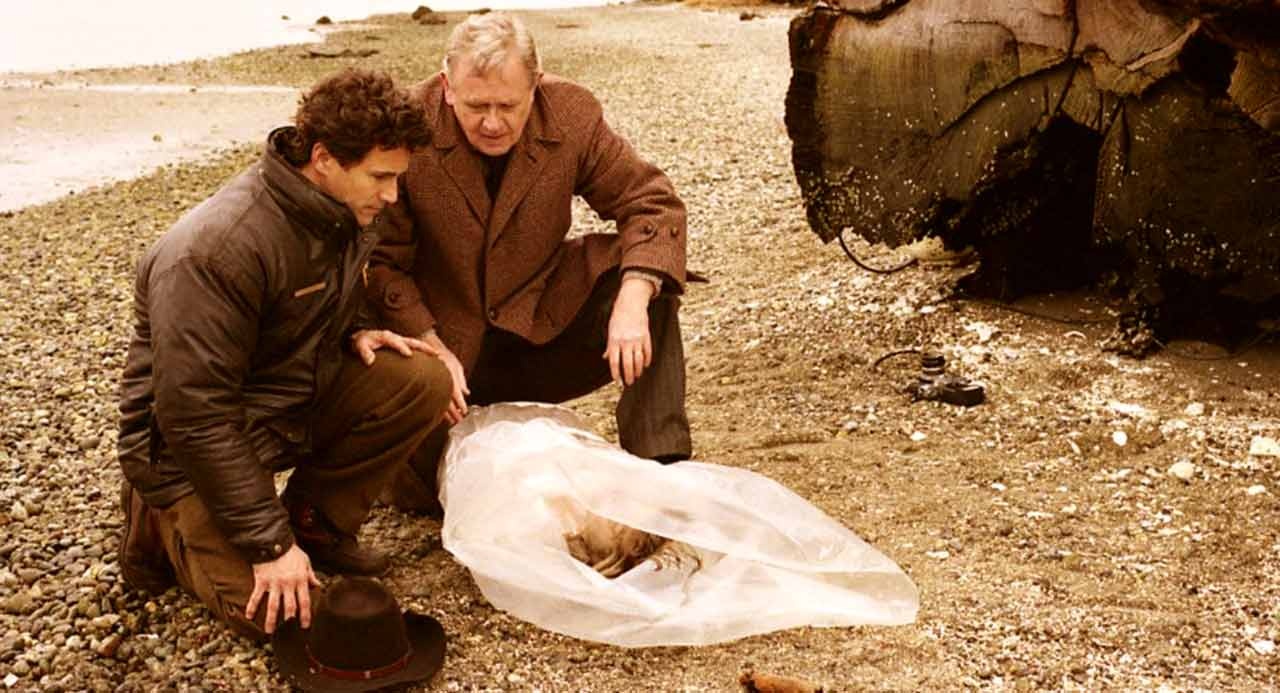
And yet, Frost hopes that some of those “Falcon Crest” and “Dallas” viewers will find a new home in “Twin Peaks.” Because whatever the undercurrents, it can be enjoyed as a good, baffling mystery — a story set in motion by the discovery of a dead body in the first scene. It’s Laura Palmer, homecoming queen and an A student who, it turns out, fell in with some very murky characters.
“I’ve always hoped that we could build some sort of coalition here between the ‘Hill Street Blues’ and ‘St. Elsewhere’ viewers,” Frost says. “This show’s got angles and twists and turns, and it’s kind of oblique at times. But there are still identifiable archetypes dealing in stories of intrigue and power and passion. and what are ‘Dallas’ or ‘Dynasty’ if not that?” Frost began his TV career working on “Hill Street Blues,” recruited out of college by producer Steven Bochco. He says he only wants to do TV that departs from the norm.
Whether the mainstream audience finds ”Twin Peaks” fascinating or just freakish, Frost is encouraged that a big fat network like ABC would take a chance of such “subversive” programming. The networks will have to take such risks to stem the tide of audience erosion that began in the ’80s and continues now.
“If this show works, people will interpret it as a sign that yes, television can do this,” Frost says. “If it doesn’t, people will say the opposite; they’ll say television can’t bear that kind of weight. The jury is kind of out.” Yes, but very soon, “Twin Peaks” will be kind of in.
HEADLINES FOR TOM SHALES’ INTERVIEW WITH MARK FROST
One of the more interesting details about syndicated articles is local newspaper editors often changed headlines to grab readers’ attention. Below are a handful of headlines that accompanied Shales’ article.
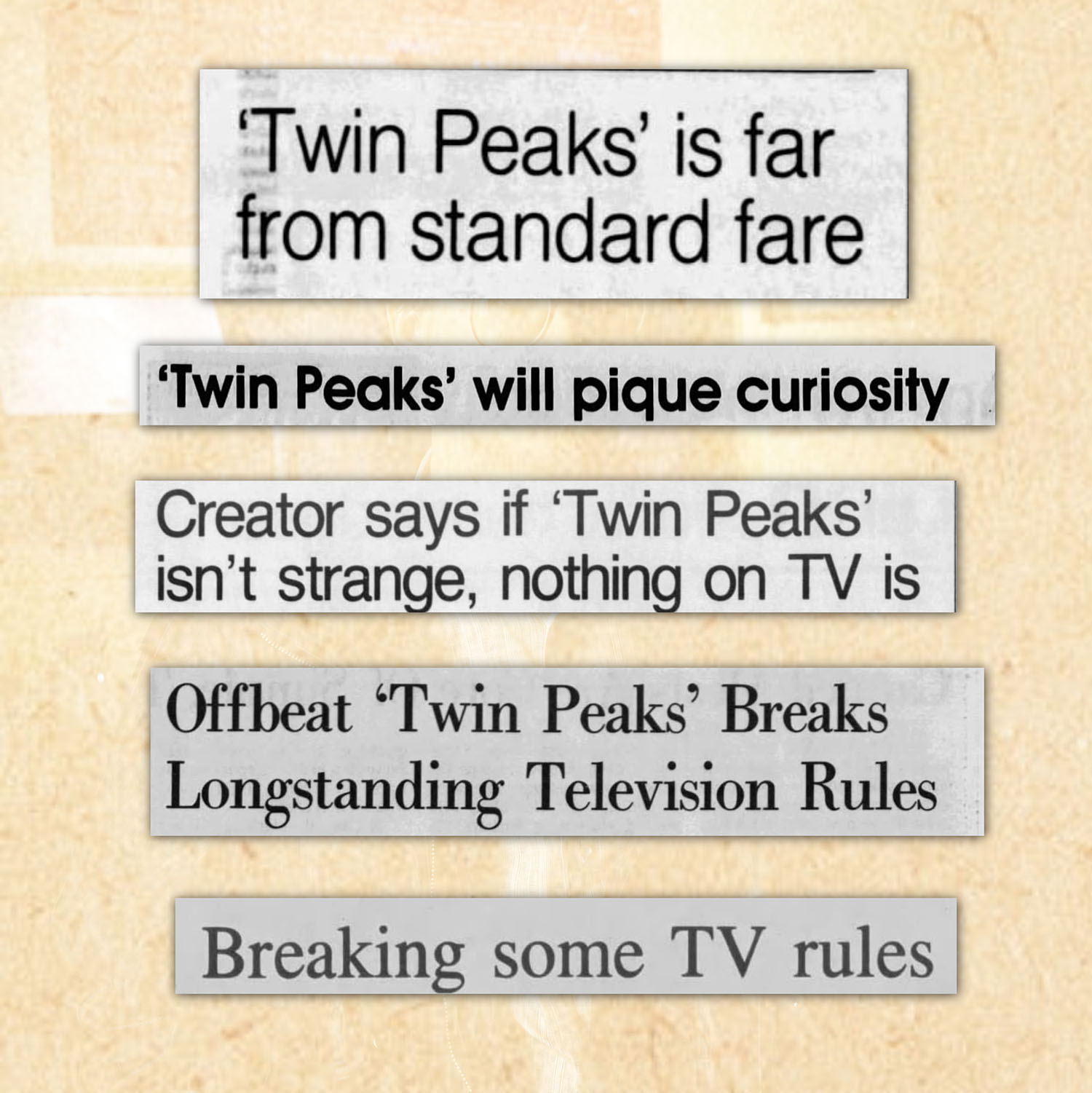
Newspapers included (from top to bottom) Tarrytown Daily News, The Naples Daily News, The Journal News, Palm Beach Daily News and Enterprise Record.
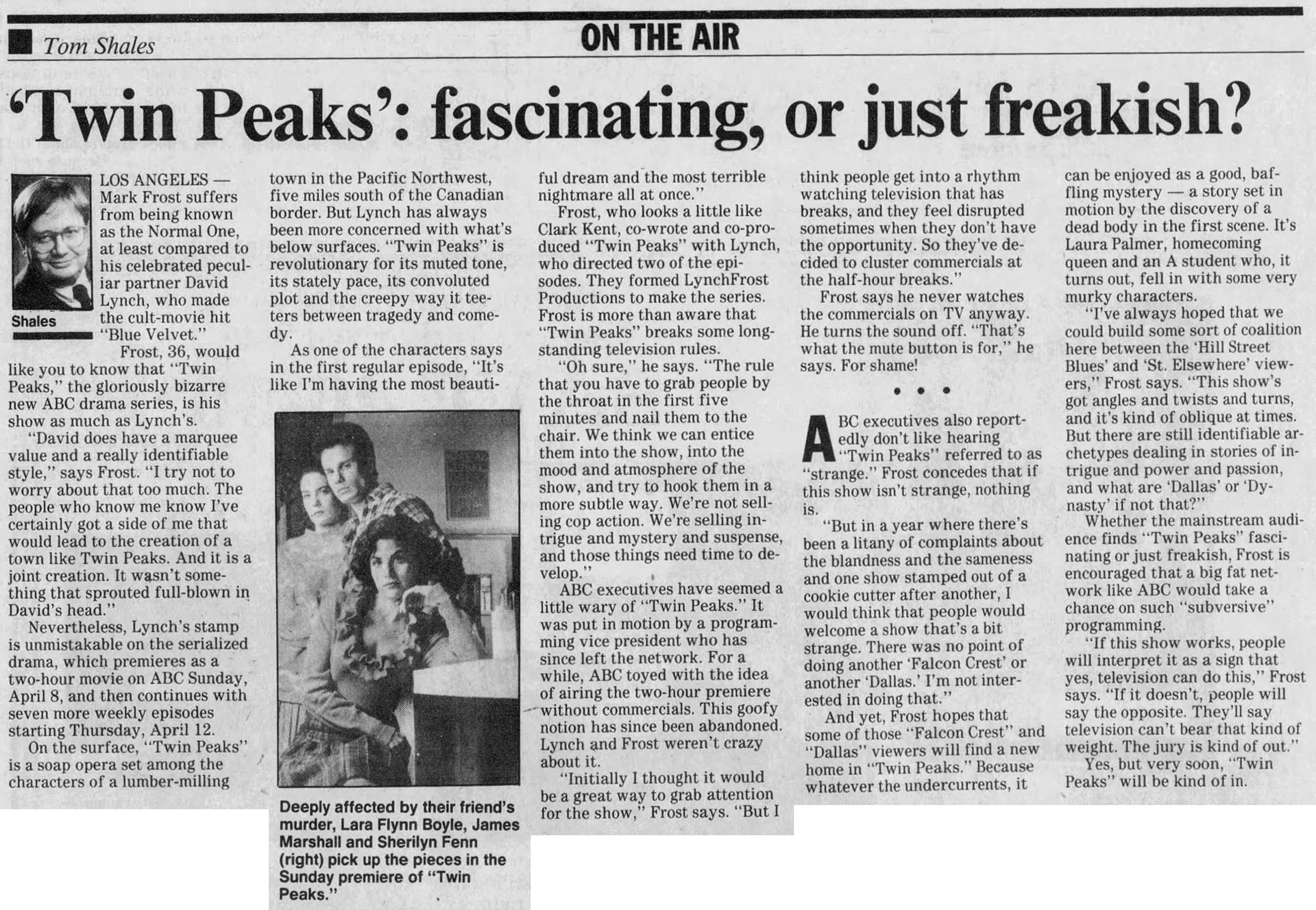
Other times, local newspapers like The Capital Times, included publicity photos along with Shales article. This one was titled, “‘Twin Peaks’: fascinating, or just freakish?
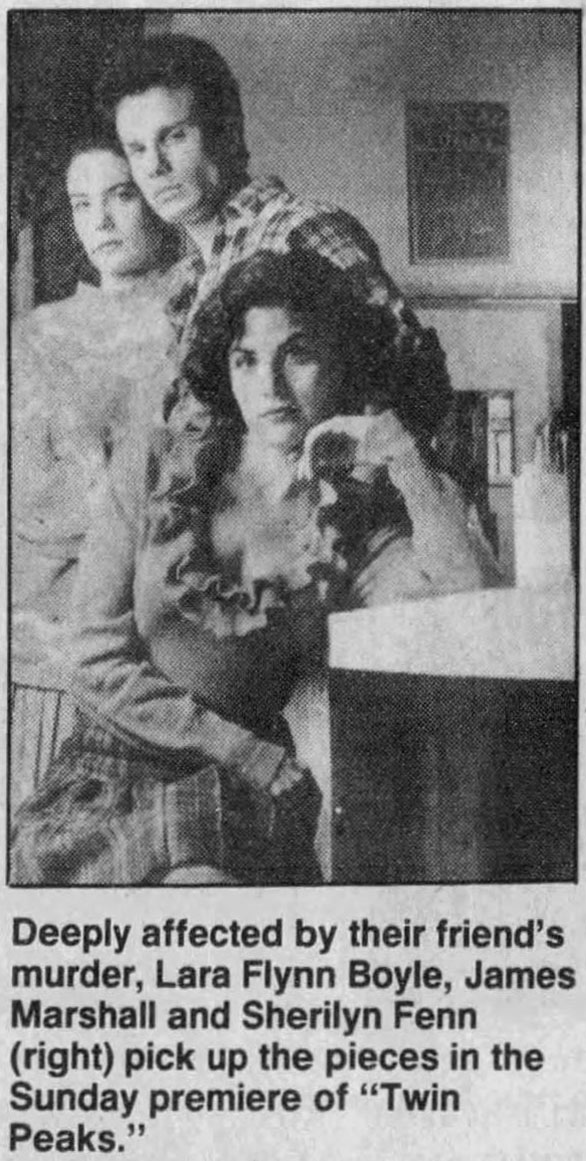
The publicity photo of Donna Hayward (Lara Flynn Boyle), James Hurley (James Marshall) and Audrey Horne (Sherilyn Fenn) was taken on the set of the Double R Diner.
Decades later, Shales passed from COVID-19 and kidney failure on Jan. 13, 2024. Yet his stories about Twin Peaks remain an important of the show’s history.
Author
Discover more from TWIN PEAKS BLOG
Subscribe to get the latest posts sent to your email.