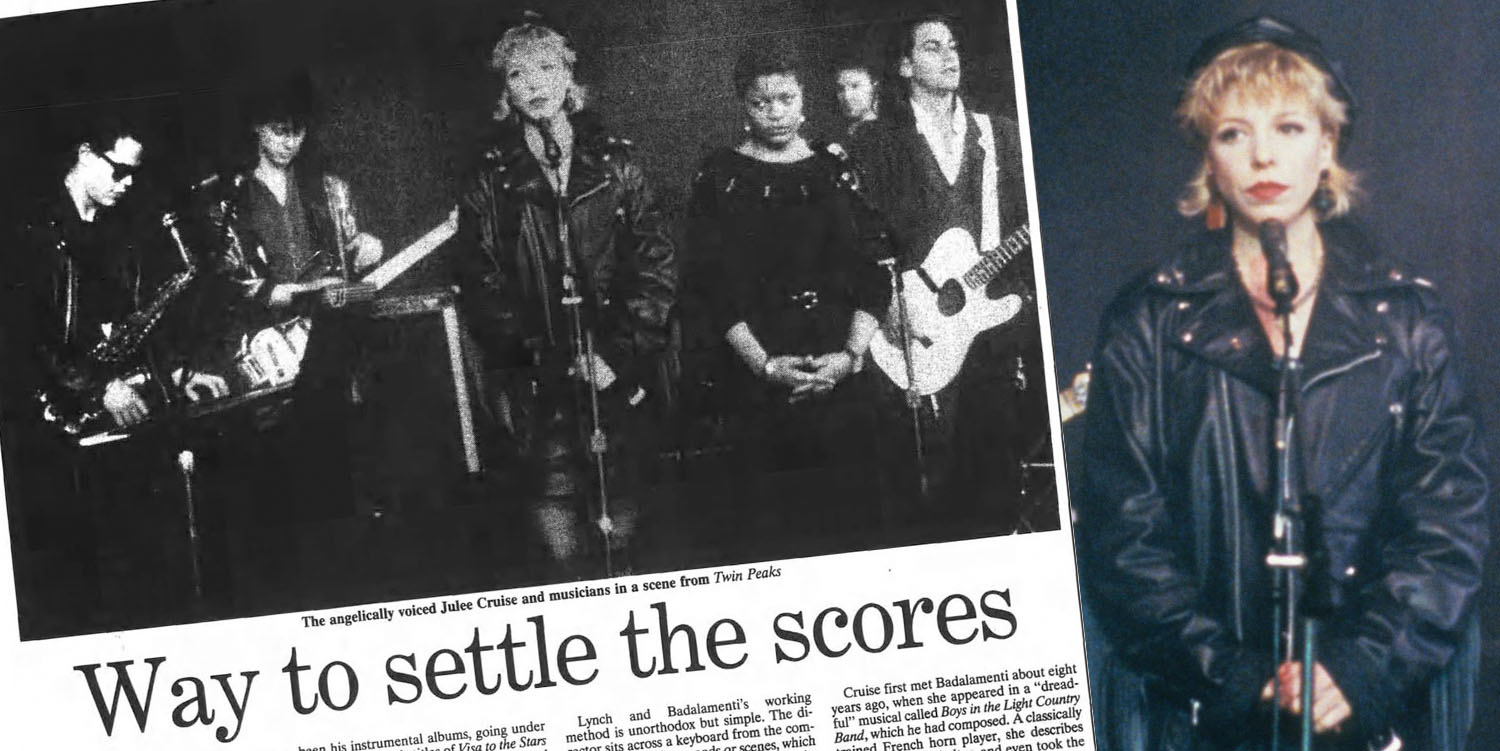
Twin Peaks mania descended on the United Kingdom when the BBC2 began airing David Lynch and Mark Frost’s wonderful and strange show on Tuesday, Oct. 23, 1990. Britain immediately fell in love with the dreamy music created by Angelo Badalamenti and Julee Cruise. “The Independent’s” long time music critic Andy Gill spoke with the musicians for an article published on Oct. 29, 1990. Like many early interviews, this story contains a few nuggets about the music we all love.
WHO IS ANDY GILL FROM “THE INDEPENDENT?”

Not to be confused with the late singer of Gang of Four with the same name, journalist Andy Gill was born on February 28, 1953 in Sheffield, England. He spend his teenage years in Nottingham before attending Sheffield University beginning in 1973. Between classes, he worked part-time at a Virgin record shop in Sheffield, so Gill had his finger on the pulse of the music scene (he speaks extensively about it in this blog article).
Four years later, he began his career as a freelance writer for New Musical Express (NME), after answering the magazine’s Hip Young Gunslingers advertisement designed to attract fresh voices. Gill was later appointed album reviews editor. He never had his photo published in the paper as he was concerned someone might take offense to a negative review and express frustrations with a punch.
In 1990, he joined The Independent as chief rock critic and remained in the position until 2018. This made him the longest-serving weekly music reviewer on a national publication. While at The Independent, Gill also contributed to Q, MOJO, The Word and Empire. Following an illness, he passed on June 9, 2019 at the age of 66.
TWIN PEAKS ARRIVES IN THE UNITED KINGDOM ON OCT. 23, 1990
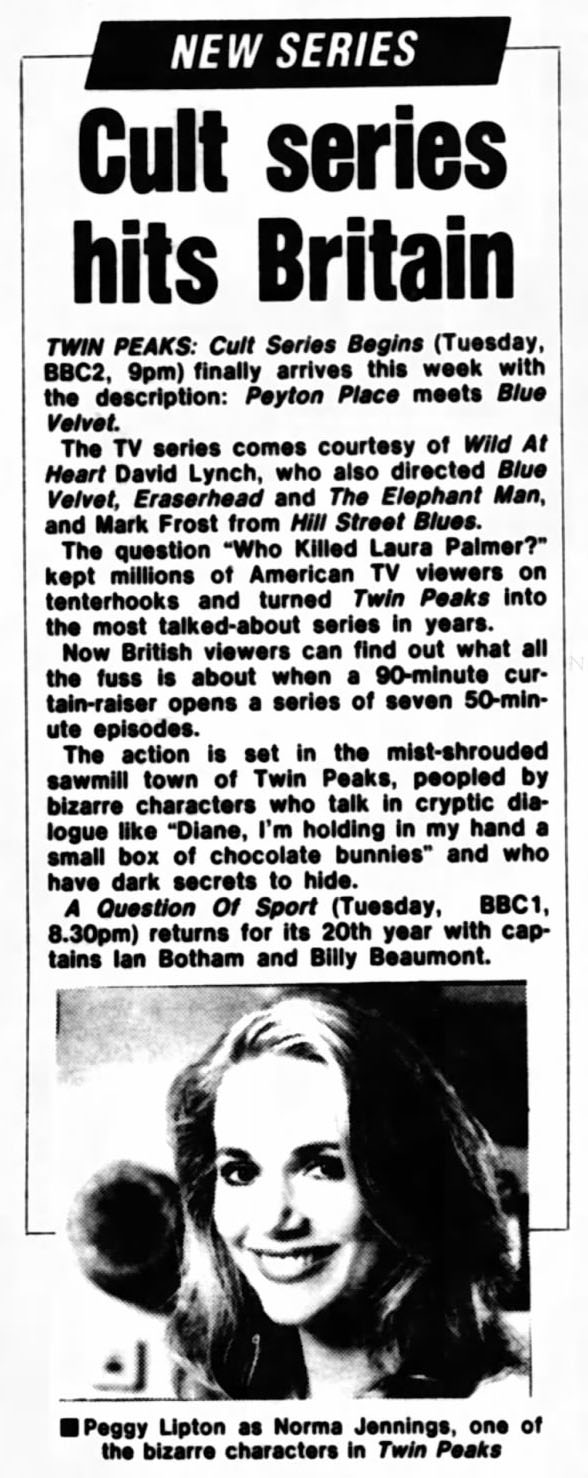
When Twin Peaks arrived on BBC2 starting Tuesday, Oct. 23, 1990, British television viewers were soon asking the question that everyone in America had been wondering since spring 1990 – “Who killed Laura Palmer?”

Interestingly, the U.K. was one of the first countries to see the pilot episode before it was aired on the ABC Television Network in April 1990. The “International Version” of the pilot was released on VHS on Dec. 8, 1989. It didn’t take long for “Peaks Mania” to take over the nation when the first season began airing.
Naturally, the music composed by Angelo Badalamenti with songs performed by Julee Cruise rocketed to the “Top of the Pops.” Cruise’s “Falling” was #11 on the charts by Nov. 22, 1990.
The Independent’s Andy Gill caught up with the maestro and the voice of love for an interview published on Oct. 29, 1990.
“WAY TO SETTLE THE SCORES” BY ANDY GILL
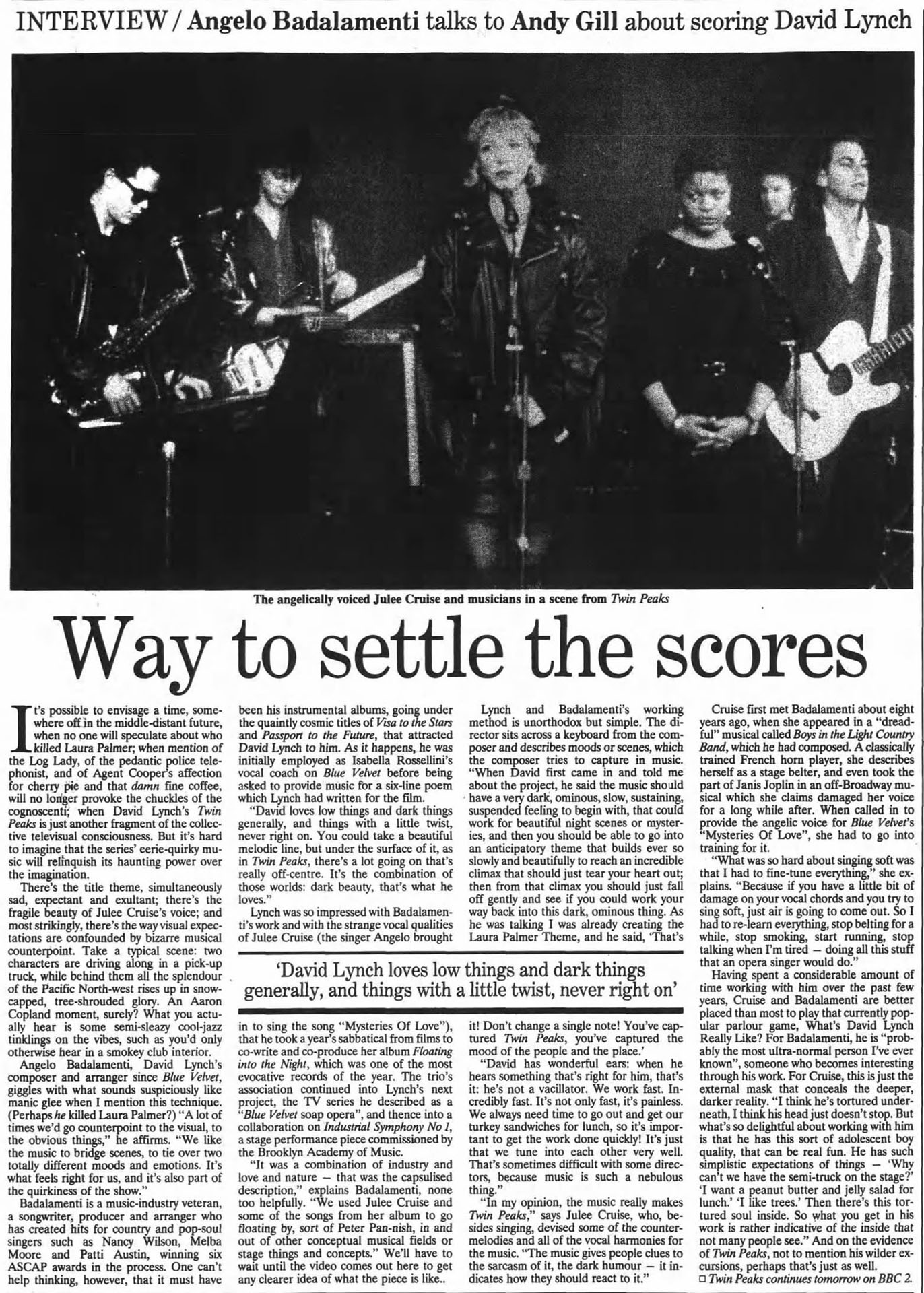
This is Gill’s original article published in the British newspaper in late October.
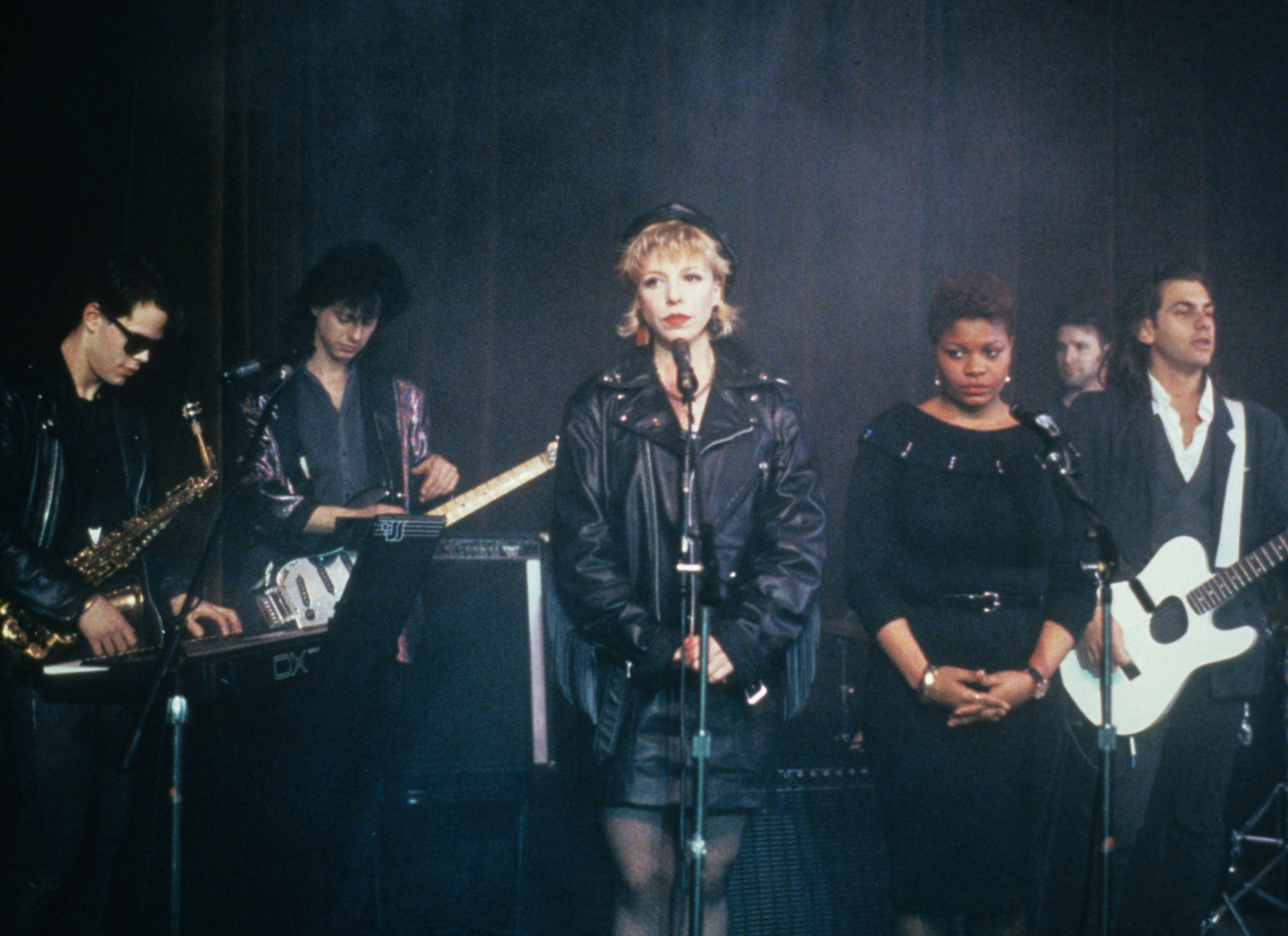
The publicity image features Cruise with a backing band at The Roadhouse, which was the then named Timberline Bar in downtown Seattle, Washington. While I’ve not identified the backup singer standing next to Julee, IMDB lists the uncredited band members:
- Band at Roadhouse: Steven Hodges [Drums]
- Band at Roadhouse: William Ungerman [Saxophone]
- Band at Roadhouse: Joseph “Simon” Szeibert [Keyboards]
- Band at Roadhouse: Gregory “Smokey” Hormel [Guitar]
- Band at Roadhouse: Joseph L. Altruda [Bass]
Yet, it’s unclear if these names were added because they appeared in the credits of Twin Peaks: Fire Walk With Me. More research is required.
Here is a transcript of Gill’s article for archival purposes along with images that didn’t appear in the story.
Way to settle the scores
Angelo Badalamenti talks to Andy Gill about scoring David Lynch
It’s possible to envisage a time, somewhere off in the middle-distant future, when no one will speculate about who killed Laura Palmer; when mention of the Log Lady, of the pedantic police telephonist, and of Agent Cooper’s affection for cherry pie and that damn fine coffee, will no longer provoke the chuckles of the cognoscenti; when David Lynch’s Twin Peaks is just another fragment of the collective televisual consciousness. But it’s hard to imagine that the series’ eerie-quirky music will relinquish its haunting power over the imagination.
There’s the title theme, simultaneously sad, expectant and exultant; there’s the fragile beauty of Julee Cruise’s voice; and most strikingly, there’s the way visual expectations are confounded by bizarre musical counterpoint. Take a typical scene: two characters are driving along in a pick-up truck, while behind them all the splendour of the Pacific Northwest rises up in snow-capped, tree-shrouded glory. An Aaron Copland moment, surely? What you actually hear is some semi-sleazy cool-jazz tinklings on the vibes, such as you’d only otherwise hear in a smokey club interior.
Angelo Badalamenti, David Lynch’s composer and arranger since Blue Velvet, giggles with what sounds suspiciously like manic glee when I mention this technique. (Perhaps he killed Laura Palmer?) “A lot of times we’d go counterpoint to the visual, to the obvious things,” he affirms. “We like the music to bridge scenes, to tie over two totally different moods and emotions. It’s what feels right for us, and it’s also part of the quirkiness of the show.”
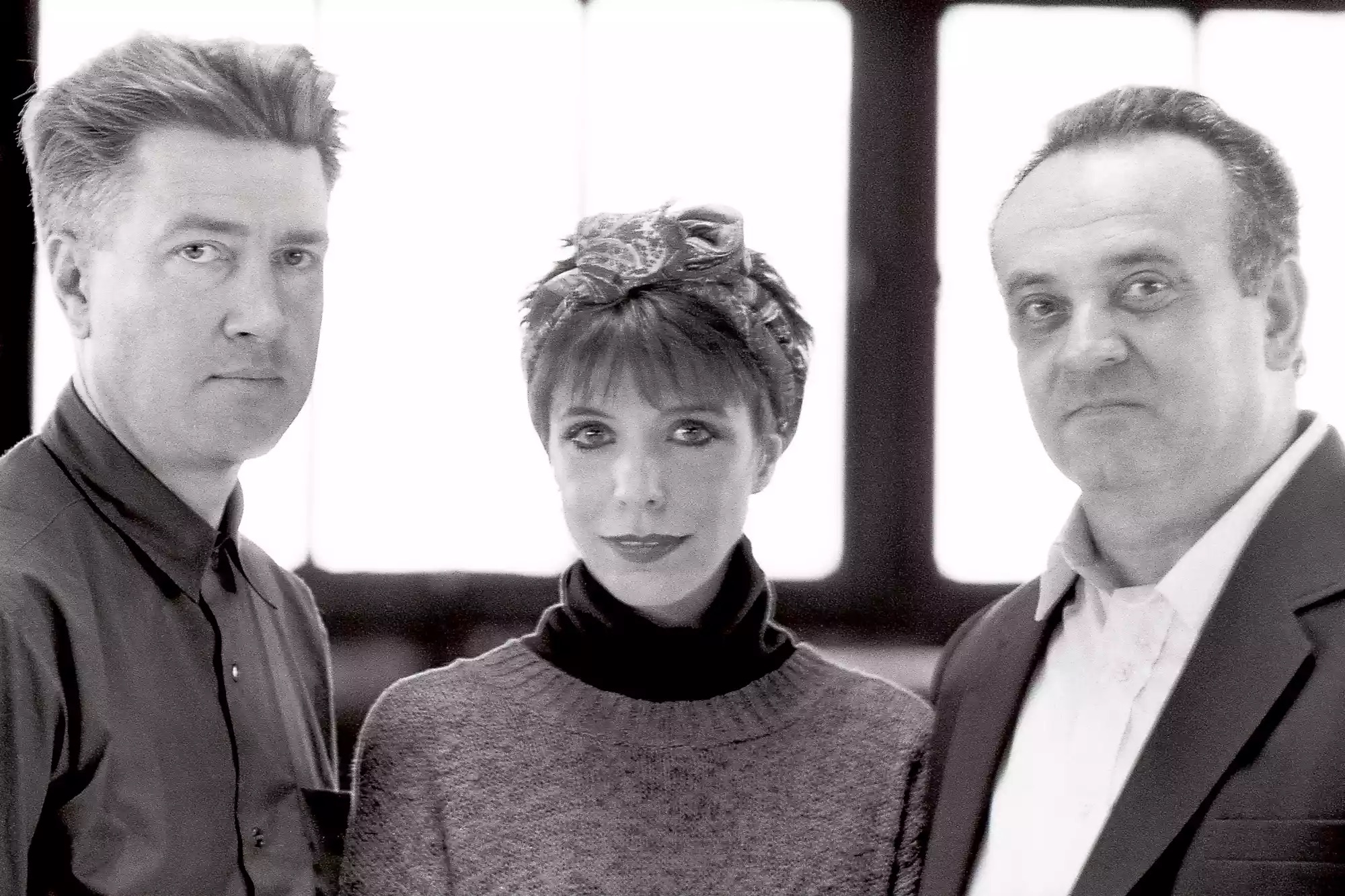
Badalamenti is a music-industry veteran, a songwriter, producer and arranger who has created hits for country and pop-soul singers such as Nancy Wilson, Melba Moore and Patti Austin, winning six ASCAP awards in the process. One can’t help thinking, however, that it must have been his instrumental albums, going under the quaintly cosmic titles of Visa to the Stars and Passport to the Future, that attracted David Lynch to him. As it happens, he was initially employed as Isabella Rossellini’s vocal coach on Blue Velvet before being asked to provide music for a six-line poem which Lynch had written for the film.
“David loves low things and dark things generally, and things with a little twist, never right on. You could take a beautiful melodic line, but under the surface of it, as in Twin Peaks, there’s a lot going on that’s really off-centre. It’s the combination of those worlds: dark beauty, that’s what he loves.”
Lynch was so impressed with Badalamenti’s work and with the strange vocal qualities of Juice Cruise (the singer Angelo brought in to sing the song “Mysteries Of Love”), that he took a year’s sabbatical from films to co-write and co-produce her album Floating into the Night, which was one of the most evocative records of the year. The trio’s association continued into Lynch’s next project, the TV series he described as a “Blue Velvet soap opera”, and thence into a collaboration on Industrial Symphony No I, a stage performance piece commissioned by the Brooklyn Academy of Music.
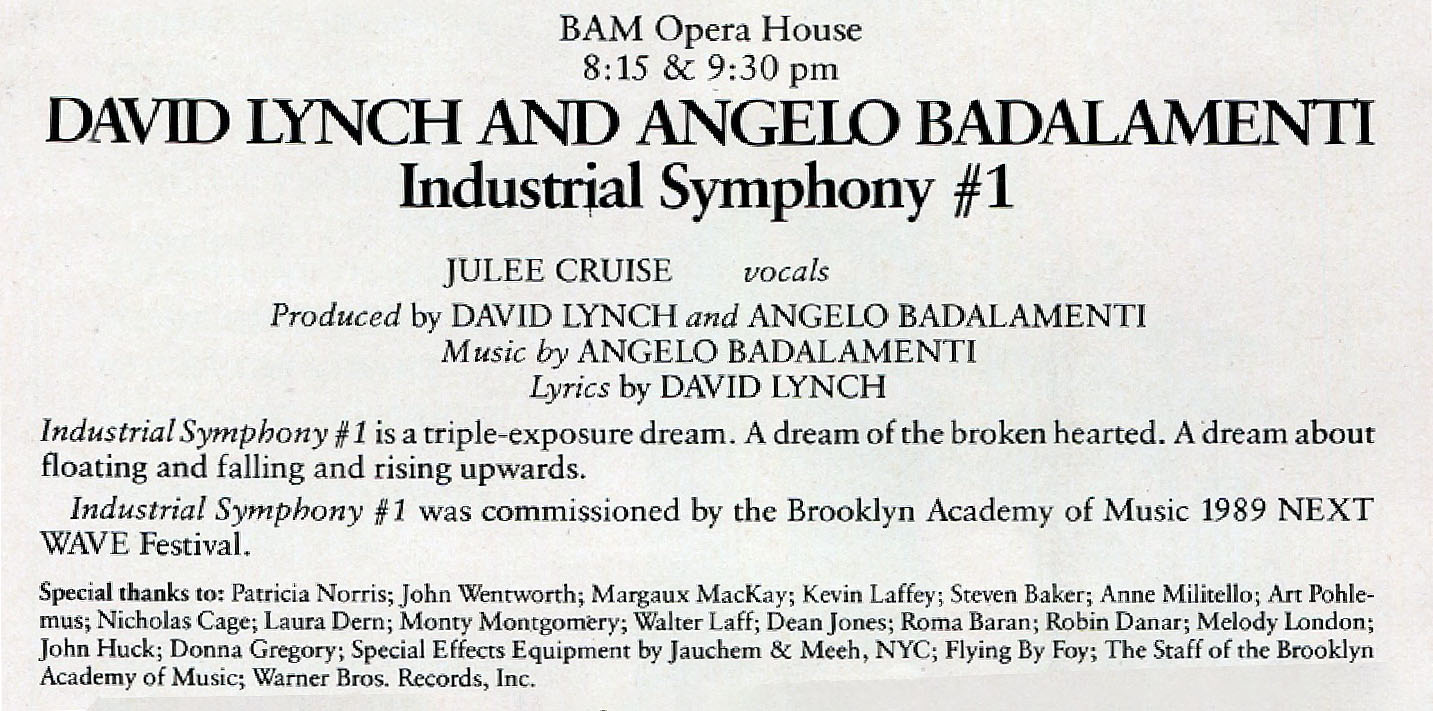
“It was a combination of industry and love and nature — that was the capsulised description,” explains Badalamenti. none too helpfully. “We used Julee Cruise and some of the songs from her album to go floating by, sort of Peter Pannish, in and out of other conceptual musical fields or stage things and concepts.” We’ll have to wait until the video comes out here to get any clearer idea of what the piece is like.
Lynch and Badalamenti’s working method is unorthodox but simple. The director sits across a keyboard from the com-poser and describes moods or scenes, which the composer tries to capture in music. “When David first came in and told me about the project, he said the music should have a very dark, ominous, slow, sustaining, suspended feeling to begin with, that could work for beautiful night scenes or mysteries, and then you should be able to go into an anticipatory theme that builds ever so slowly and beautifully to reach an incredible climax that should just tear your heart out; then from that climax you should just fall off gently and see if you could work your way back into this dark, ominous thing. As he was talking I was already creating the Laura Palmer Theme, and he said, ‘That’s it! Don’t change a single note! You’ve captured Twin Peaks, you’ve captured the mood of the people and the place.’
“David has wonderful ears: when he hears something that’s right for him, that’s it: he’s not a vacillator. We work fast. Incredibly fast. It’s not only fast, it’s painless. We always need time to go out and get our turkey sandwiches for lunch, so it’s important to get the work done quickly! It’s just that we tune into each other very well. That’s sometimes difficult with some directors, because music is such a nebulous thing.”

“In my opinion, the music really makes Twin Peaks,” says Julee Cruise, who, besides singing, devised some of the counter-melodies and all of the vocal harmonies for the music. “The music gives people clues to the sarcasm of it, the dark humour — it indicates how they should react to it.”
Cruise first met Badalamenti about eight years ago, when she appeared in a “dreadful” musical called Boys in the Light Country Band, which he had composed. A classically trained French horn player, she describes herself as a stage belter, and even took the part of Janis Joplin in an off-Broadway musical which she claims damaged her voice for a long while after. When called in to provide the angelic voice for Blue Velvet’s “Mysteries Of Love”, she had to go into training for it.
“What was so hard about singing soft was that I had to fine-tune everything,” she explains. “Because if you have a little bit of damage on your vocal chords and you try to sing soft, just air is going to come out. So I had to re-learn everything, stop belting for a while, stop smoking, start running, stop talking when I’m tired — doing all this stuff that an opera singer would do.”
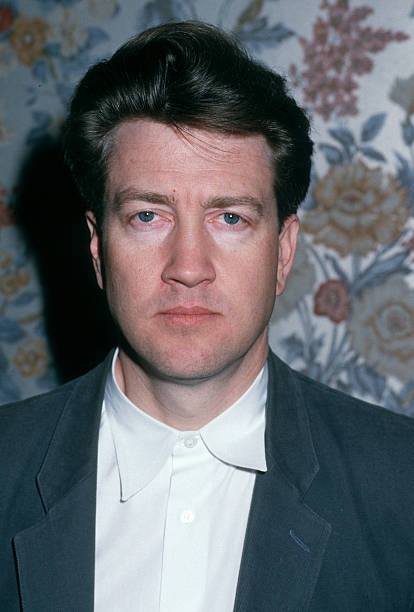
Having spent a considerable amount of time working with him over the past few years, Cruise and Badalamenti are better placed than most to play that currently popular parlour game, What’s David Lynch Really Like?
For Badalamenti, he is “probably the most ultra-normal person I’ve ever known”, someone who becomes interesting through his work.
For Cruise, this is just the external mask that conceals the deeper, darker reality.
“I think he’s tortured underneath, I think his head just doesn’t stop. But what’s so delightful about working with him is that he has this sort of adolescent boy quality, that can be real fun. He has such simplistic expectations of things — ‘Why can’t we have the semi-truck on the stage?’ ‘I want a peanut butter and jelly salad for lunch. I like trees.’ Then there’s this tortured soul inside. So what you get in his work is rather indicative of the inside that not many people see.”
And on the evidence of Twin Peaks, not to mention his wilder excursions, perhaps that’s just as well.
Twin Peaks continues tomorrow on BBC 2.
Author
Discover more from TWIN PEAKS BLOG
Subscribe to get the latest posts sent to your email.